
Most sales pages do not lose trust because they sell. They lose trust because they start performing.
You can feel it when a page stops trying to help and starts trying to corner you. The tone gets pushy. The claims get puffed up. The urgency starts wearing a fake moustache. And suddenly the whole thing feels less like a useful buying decision and more like a hostage note written by a funnel template.
If you want to know how to monetize sales pages without wrecking trust, the answer is not “sell less.” It is “sell like someone who respects the reader’s brain.”
A good sales page can absolutely make money. It should. But it needs to earn that outcome through clarity, relevance, proof, honesty, and a strong offer. Not by dragging people through manipulative copy tricks that were tired five years ago and smell even worse now.
Here’s how to build sales pages that convert without sounding desperate, slippery, or weirdly overinvested in scarcity timers.
To see how this fits into the wider strategy, open the parent guide.
Trust is not the soft part of conversion
A lot of people talk about trust like it is a nice bonus. Something fluffy. Something that matters for “brand” but not for sales.
That is backwards.
Trust is one of the main reasons someone buys from a sales page at all. Especially if you are a coach, consultant, creator, freelancer, or service-based business selling expertise, access, strategy, or transformation. Your reader is not just buying a product. They are buying your judgment, your process, your credibility, and your ability to deliver without becoming a regret they have to explain to their accountant.
When trust drops, conversion usually drops with it. Maybe not instantly. You might squeeze a few panic buys out of a hype-heavy page. But the long-term cost is ugly: lower-quality leads, more skepticism, more refund risk, more ghosting, and a reputation that starts sounding a little too “all promise, no substance.”
Monetizing well is not about adding more pressure. It is about reducing the friction that stops the right buyer from saying yes.
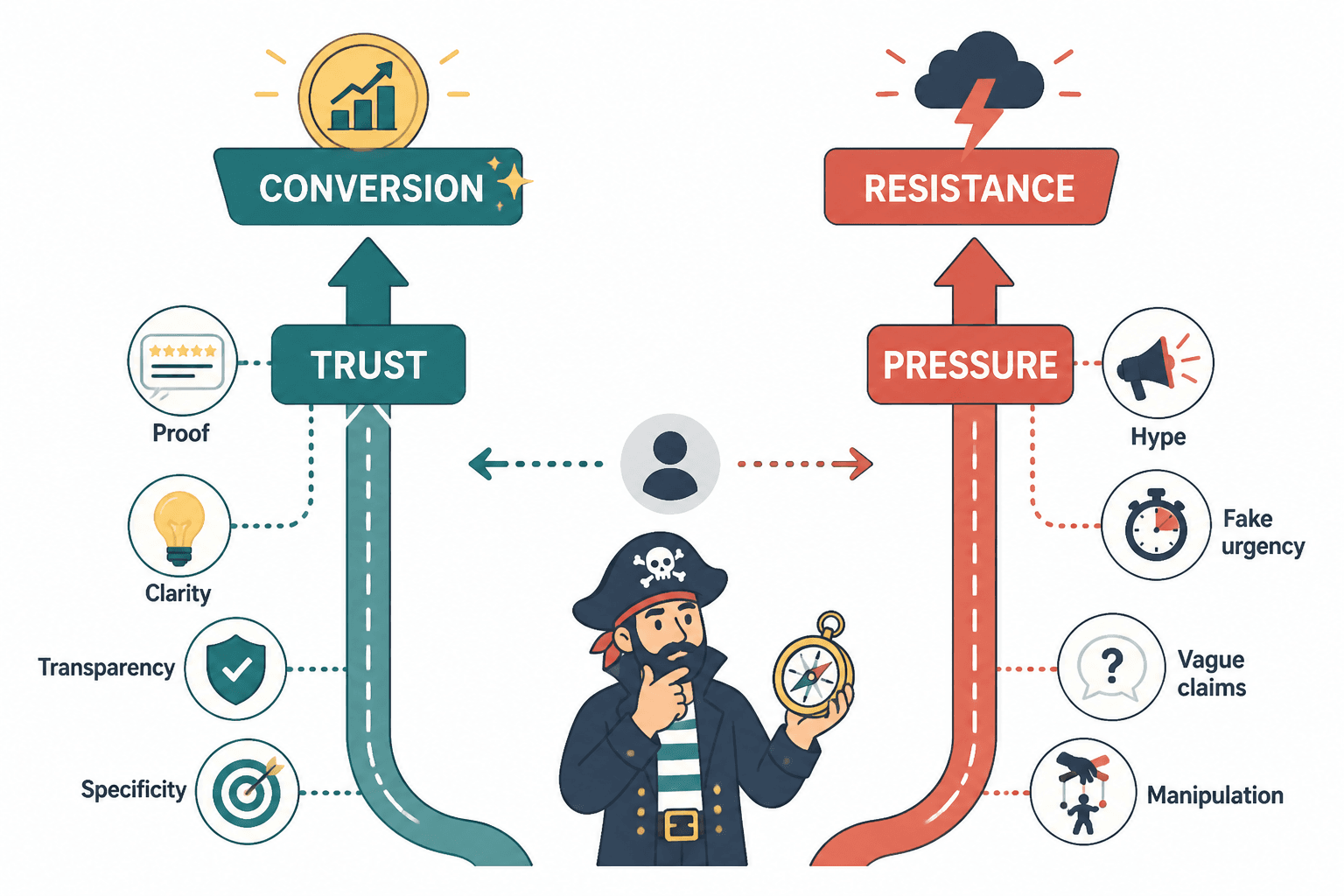
What wrecks trust on sales pages fast
Before fixing anything, it helps to be blunt about what usually breaks it.
- Claims that outrun the proof
“Double your income in 30 days” is doing a lot of reckless driving if the page has no evidence, no nuance, and no explanation. - Urgency that feels fake
If your “closing tonight” offer is still open next Tuesday, people notice. - Testimonials that say nothing
“Amazing experience!!!” is not proof. It is decoration. - Overwritten pain twisting
If every paragraph sounds like you are poking the reader’s insecurities with a stick, trust evaporates. - Vague offers
People do not trust what they cannot understand. - Too much funnel voice
That polished, dramatic, pseudo-empathic copy voice makes pages sound generated by a sales bot with boundary issues. - No downside, no nuance, no fit criteria
If your offer claims to be perfect for everyone, it sounds perfect for no one.
If your page has three or more of those issues, it is probably not under-monetized. It is under-credible.
How to monetize sales pages without wrecking trust
The job of a sales page is not to bully people into buying. It is to help the right person move from interest to decision with less uncertainty. That is a very different job, and the copy changes when you understand it.
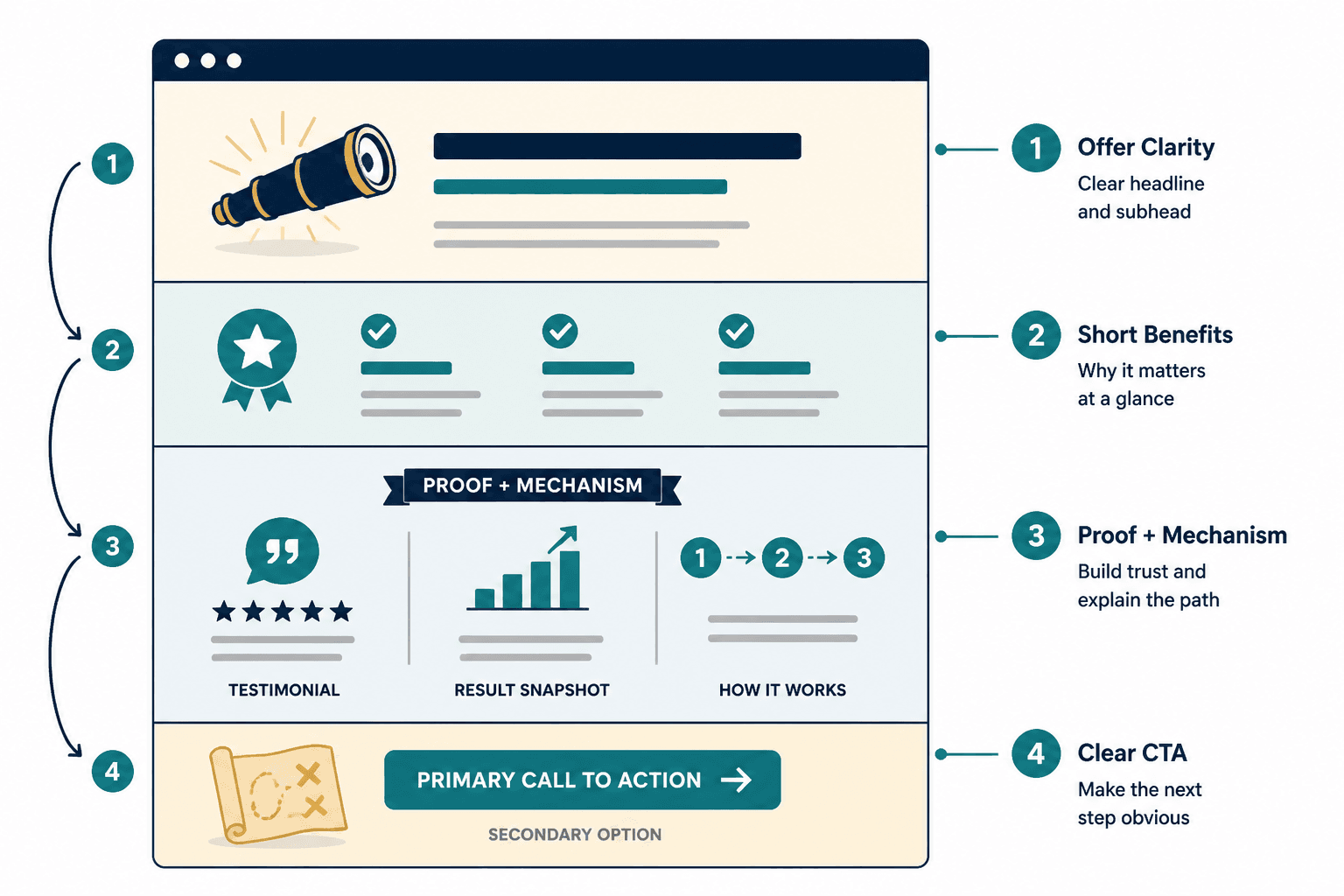
1. Make the offer painfully clear
Clarity is trust. Confusion is friction dressed as branding.
Your reader should quickly understand:
- What this is
- Who it is for
- What result it helps with
- How it works
- What is included
- How to buy or take the next step
This sounds obvious. Yet a strange number of sales pages still make people decode the offer like they are trying to enter a secret society.
Weak version: “A transformational proximity experience for visionary founders ready to align their next chapter.”
Stronger version: “A 6-week messaging and sales strategy program for solo consultants who need a clearer offer, better content, and a sales process that does not depend on random referrals.”
One sounds impressive in a mirror. The other sounds buyable.
If your offer is not clear, adding stronger CTAs will not save it. You need better positioning first. That is also where pages often benefit from stronger structure and category clarity, which is why broader resources like conversion copy and sales pages are useful to review alongside page-specific fixes.
2. Lead with the problem the buyer actually feels
Trust grows when the page sounds like it understands the buyer’s real situation. Not just the broad market problem. The felt problem.
That means moving beyond generic pain lines like:
- “Are you tired of feeling stuck?”
- “Do you want more freedom and success?”
- “Have you been struggling to grow?”
Those lines are so broad they could apply to a startup founder, a dental hygienist, or a man arguing with his Wi-Fi router.
A more trustworthy opening sounds specific:
Your sales page is getting traffic, but most visitors still leave with the same vague impression: maybe this is useful, but I’m not fully sure what I’m buying or why it matters now.
That feels more real because it is rooted in an actual buying hesitation.
If your page opens weakly, trust suffers before the offer even gets a chance. If that is the main issue, read How to Start Sales Pages Without a Weak Opening and Better Sales Pages: Sales Page Openings for Personal Brands. Openings do more trust work than people think.
3. Replace hype with proof
You do not need louder claims. You need better evidence.
Proof can include:
- Specific client results
- Short case studies
- Named outcomes with context
- Testimonials that describe what changed
- Process transparency
- Relevant experience
- Concrete examples of what the buyer gets
And the key word there is specific.
Weak testimonial: “This was amazing and helped me so much.”
Stronger testimonial: “Within three weeks, we rewrote our offer page, simplified the CTA, and started booking calls from people who were clearly better fits than the leads we were getting before.”
Specific proof tells the reader what changed, how it changed, and why it matters. That builds confidence without requiring chest-thumping copy.
Also worth saying: if your proof is thin, do not inflate the promise to compensate. Narrow the claim instead. Honest scope is more persuasive than inflated certainty.
4. Show the mechanism, not just the outcome
People trust offers more when they can see some of the logic behind the result.
A page that only promises outcomes can feel slippery, especially in crowded markets where everyone is selling confidence with a bonus PDF attached.
Instead of saying:
Get more clients with content that converts.
Say something closer to:
We fix the three places most service businesses lose buyers: the offer framing, the page opening, and the CTA path after interest. That means fewer vague visitors and more people who understand what you do and why they should act.
That kind of copy gives the buyer something solid to hold onto. It does not reveal every detail, but it demonstrates thinking. And thinking is trustworthy.
5. Use urgency carefully or not at all
Urgency is not automatically manipulative. Fake urgency is.
If there is a real reason to act now, say it plainly:
- Limited client capacity
- A live cohort start date
- A seasonal offer window
- A bonus expiring on a specific date
- A price increase with a real deadline
What does not help:
- Timers that reset
- “Only 2 spots left” with no credibility
- Constant launch-ending drama
- Pressure language that tries to shame hesitation
You do not need to act like the buyer is irresponsible for taking a beat to think. Especially on higher-ticket offers. Sometimes trust is built by making the decision easier to evaluate, not harder to escape.
Try this instead of fake pressure:
I take on a limited number of strategy clients each month because the work is hands-on. If you want this month’s availability, book before Friday. If not, join the waitlist and I’ll send the next opening.
That is calm. Credible. Human. No countdown clock needed.
6. Be candid about who this is not for
One of the fastest trust builders on a sales page is disqualification.
It signals that you are not trying to vacuum up every possible buyer with a pulse and a card. You are trying to help the right people make the right decision.
This can be as simple as a short section like:
- This is for established service businesses, not people still figuring out what they sell.
- This is not a fit if you want someone to “do your marketing for you” while giving no input.
- This works best if you already have an offer and traffic, but your page is underperforming.
That kind of filtering does two things. It protects trust, and it often improves conversions with better-fit buyers who think, “Good, this was made for someone like me.”
7. Stop writing like a sales page generator
A lot of trust gets wrecked at sentence level.
The page may have a decent offer, real proof, and strong structure, but then the copy starts doing this:
If you are truly ready to step into the next-level version of your business and finally claim the results you deserve…
No one talks like that unless they are trying to sell moon water in a webinar.
Cleaner copy usually converts better because it sounds more believable.
Try:
If your sales page is getting attention but not enough action, this offer helps you fix the messaging, structure, and CTA path so buyers stop stalling at the point of decision.
Less theatre. More signal.
If your page sounds stiff, over-polished, or weirdly robotic, How to Write Sales Pages Without Sounding Salesy or Robotic will help clean that up.
8. Make the CTA feel like a next step, not a trap door
A trustworthy CTA is clear about what happens next.
Bad CTAs create tension for the wrong reason. They feel vague, overcommitted, or suspiciously intense.
Weak CTA examples:
- Claim your transformation now
- Take the leap
- Unlock your business breakthrough
Better CTA examples:
- Book a strategy call
- Apply for the next cohort
- See pricing and what’s included
- Get the sales page review
- Start the audit
Specific CTAs lower anxiety because they tell the buyer what they are agreeing to.
And if the CTA leads to a call, application, or consultation, say what happens after the click. One short sentence can do a lot of trust work.
Example: “After you book, you’ll get a short intake form so I can review your page before the call.”
9. Make pricing less weird
Not every sales page should list full pricing. But if pricing is hidden, the page still needs to handle the tension honestly.
If you can publish pricing, great. Transparency often improves trust and qualifies buyers faster.
If you cannot publish exact pricing, you can still help by offering one of these:
- A starting price
- A price range
- A note about what affects pricing
- A clear explanation of what happens before a quote
Example: “Projects typically start at $3,000 depending on scope, page count, and whether research is included.”
That is far more trustworthy than making people schedule a call just to find out they were never in the budget zip code.
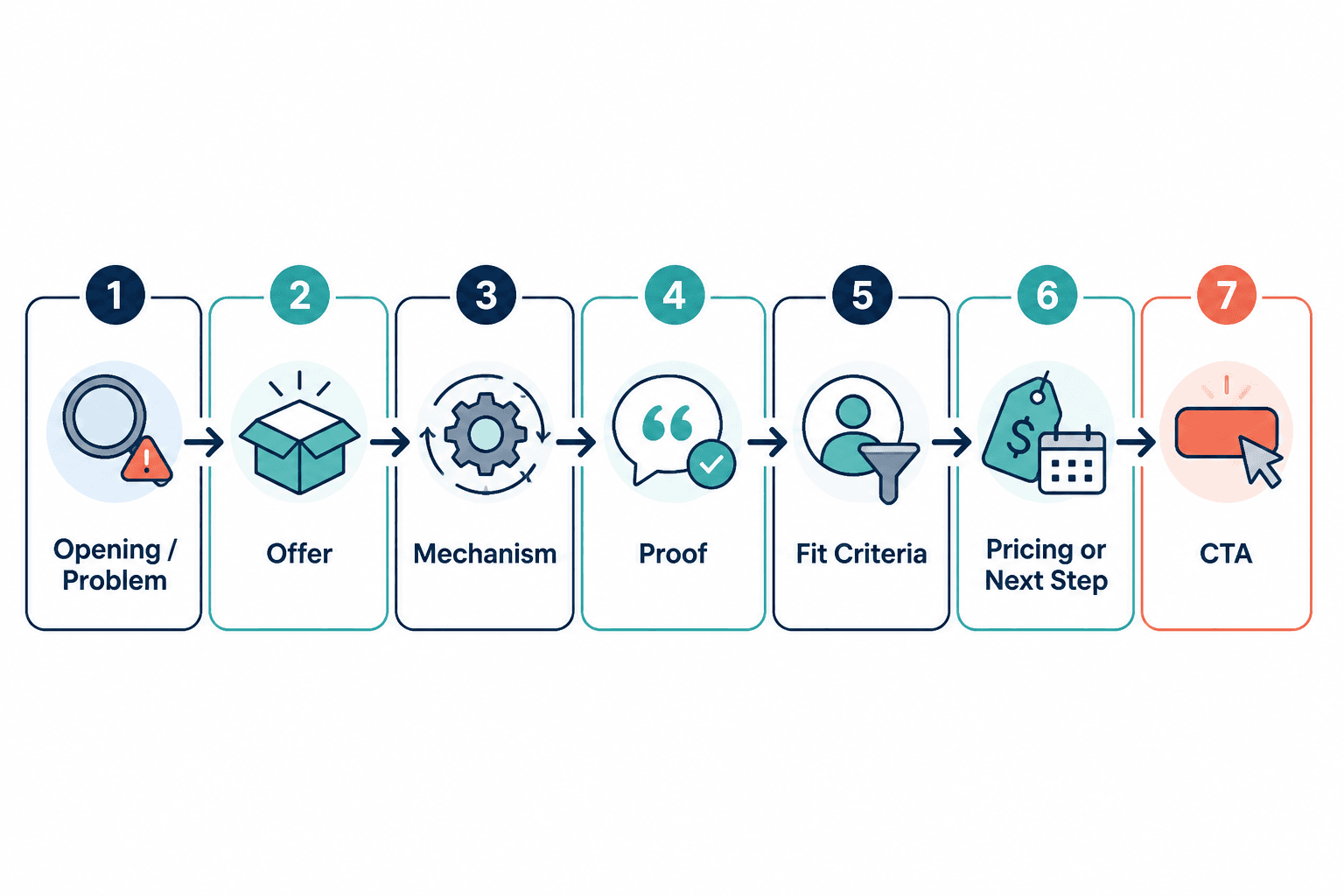
A simple trust-first sales page structure
If your page is messy, here is a cleaner structure that tends to monetize well without turning into conversion cosplay.
- Clear opening
State the problem, who it is for, and what the offer helps with. - Why this problem persists
Show the reader you understand the deeper issue, not just the symptom. - The offer
Explain what it is, how it works, and what is included. - The mechanism
Show the logic behind how this helps create the result. - Proof
Add testimonials, examples, or case-study style evidence. - Fit criteria
Clarify who this is for and not for. - Pricing or next-step clarity
Reduce uncertainty around what happens after action. - CTA
Direct, specific, low-drama.
This is also a good base if your bigger goal is not just trust, but more action. For that angle, How to Turn Sales Pages Into More Leads or Sales pairs well with this article.
Before and after: monetized without the nonsense
Here is what this looks like in practice.
Before
Ready to finally step into the business growth you deserve? This revolutionary experience helps ambitious entrepreneurs break through limitations, unlock aligned sales, and create effortless momentum in just weeks. Spots are filling fast.
After
If your service business gets interest but too few serious inquiries, this sales page strategy package helps you fix the message, structure, and CTA path that are causing buyers to hesitate. You get a full page audit, rewritten core sections, and a clearer conversion flow built around how your buyers actually decide.
The second version still sells. It just does not insult the reader’s pattern recognition.
What to check before you ask your sales page to sell harder
- Is the offer clear in the first screen or two?
- Does the page name a specific, real problem?
- Are the claims supported by proof?
- Does the buyer understand how the offer works?
- Is the tone credible, plain, and human?
- Is there real fit guidance?
- Is urgency honest?
- Does the CTA clearly explain the next step?
- Would a skeptical but qualified buyer feel respected reading this?
If the answer to several of those is no, your issue probably is not weak monetization. It is weak trust architecture.
FAQ
Should a sales page always include testimonials?
Usually, yes. If you have them. But make them specific and relevant. Generic praise is not doing much.
Can urgency still work without feeling manipulative?
Yes. Use real deadlines, real limits, and plain language. Skip fake countdown nonsense.
The bigger point is simple: clearer structure and clearer writing make the piece more useful. That is usually what makes the ending land better too.