
Most weak sales page openings do not fail because they are too short.
They fail because they say nothing that makes the right person feel seen, understood, or even mildly curious to keep reading.
You get the usual mush: “Welcome.” “If you’re looking for…” “We are passionate about helping…” “In today’s fast-paced world…” Lovely. A warm bath of absolutely no tension.
If you want to know how to start sales pages without a weak opening, the fix is not being louder or more “persuasive.” It is starting with the real problem, the real stakes, and a clear reason this page matters right now. Fast.
This is where a lot of sales pages quietly bleed conversions. The offer may be good. The proof may be solid. The CTA may even be decent. But the opening strolls in wearing fluffy brand language and asking the reader to care before earning that care.
Here’s how to open a sales page so it feels sharp, relevant, and worth reading instead of sounding like a brochure that got hit in the head by a copywriting template.
For the broader learning path, visit our parent guide.
What a sales page opening actually needs to do
The top of a sales page has one job: pull the right person into the page with enough clarity and momentum that they keep going.
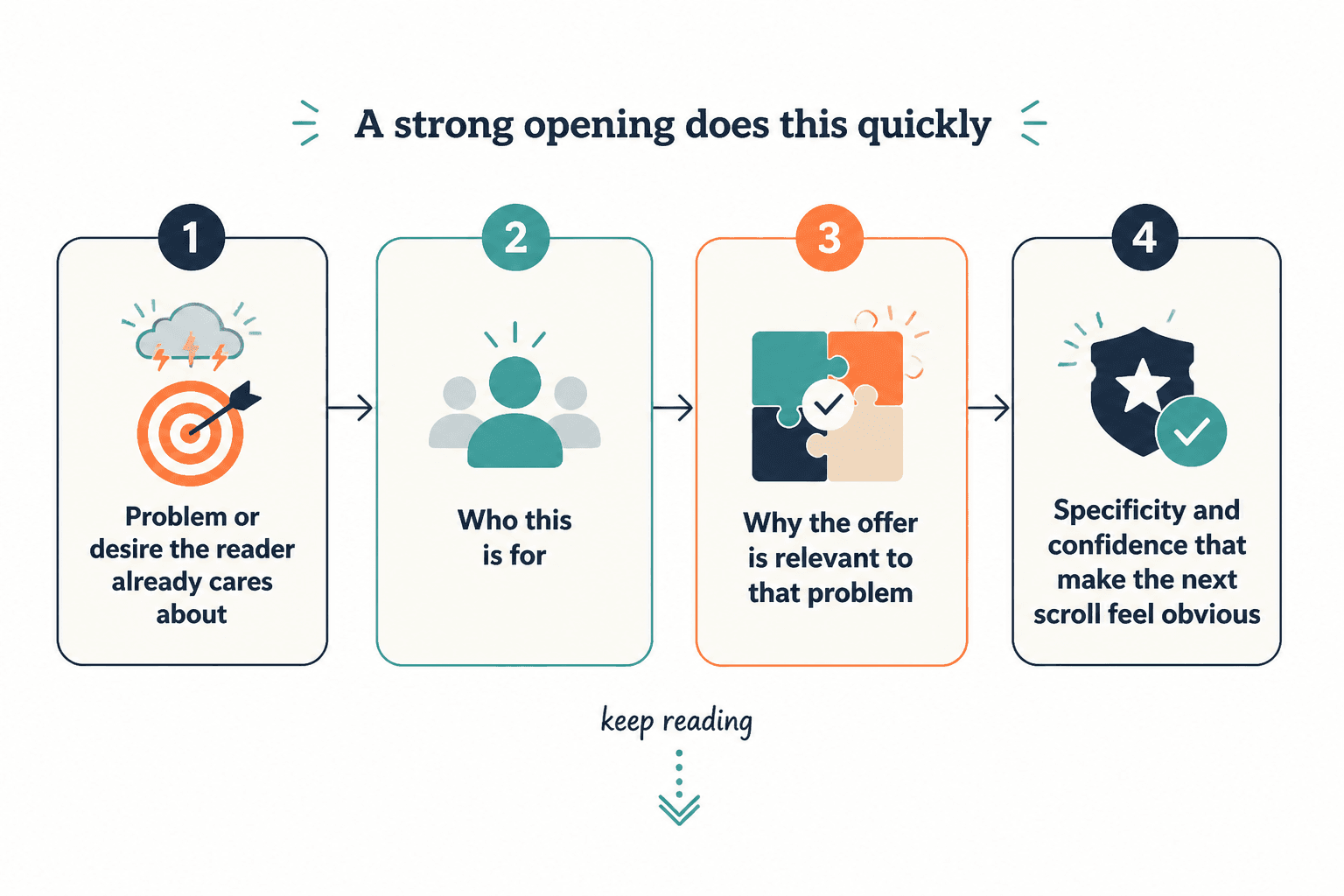
That means your opening needs to do a few things quickly:
- Name a problem, desire, friction point, or gap they already care about
- Make it clear who this is for
- Frame the offer as relevant to that problem
- Create enough specificity or tension that the page does not feel generic
- Give the reader confidence that continuing is worth their time
That’s it. Not a 400-word essay about your philosophy. Not three paragraphs of scene-setting. Not “Imagine a world where…” unless you’re selling actual science fiction.
A good opening does not need to explain everything. It needs to make the next scroll feel obvious.
Why sales page openings go weak so often
Most weak openings come from one of four bad instincts.
1. Trying to sound professional instead of useful
Professional-sounding copy is often just vagueness in a blazer.
“We help purpose-driven entrepreneurs scale with confidence” sounds polished. It also tells me almost nothing. Scale what? How? Why now? Why you?
2. Starting with the business instead of the buyer
Your reader landed on the page caring about their own problem, not your origin story. If the first thing they see is a paragraph about your values, methodology, or mission, you are making them work too hard too early.
3. Using “safe” language that avoids stakes
Weak openings avoid saying anything sharp enough to alienate the wrong person. Which sounds nice until you realize they also fail to grab the right one.
If your offer solves a costly, annoying, urgent, frustrating problem, the opening should act like it knows that.
4. Cramming everything into the first screen
Some openings are weak because they are bloated. Headline, subheadline, two badges, five bullets, a founder note, a testimonial, three CTA buttons, and a stock photo of somebody smiling at a laptop like the spreadsheet just proposed marriage.
Clarity beats crowding. Every time.
How to start sales pages without a weak opening
If you want a stronger start, build the opening in this order:
- Start with the real pain, desire, or gap
- Make the problem specific
- Connect your offer to that problem
- Add a believable promise or outcome
- Give the reader a clear next step
That sequence works because it follows the reader’s brain. First: “Is this about me?” Then: “Do they get it?” Then: “Can this actually help?”
Notice what is missing: throat-clearing. No welcome note. No generic credibility chest-beating. No dramatic manifesto. The opening is not there to prove you are special. It is there to prove the page is relevant.
Step 1: Start with the problem they already feel
The cleanest way to open a sales page is to lead with the thing your buyer is already frustrated by, tired of, confused by, or trying to get.
Not a broad category. The actual friction.
Weak:
Welcome to our copywriting service for ambitious businesses ready to grow.
Stronger:
Your sales page should not need a pity click from your nicest friend to get a sale.
That second one is not for everyone. Good. It is probably for the right person.
Here are other opening angles that work:
- A costly mistake: “If your sales page sounds polished but nobody buys, the problem usually is not traffic.”
- A frustrating pattern: “You do not need more people seeing the page. You need more of the right people wanting to stay on it.”
- A failed assumption: “Longer sales pages do not convert better just because they are longer.”
- A desired outcome: “Get a sales page that makes your offer easier to trust and easier to buy.”
Step 2: Make the problem concrete, not airy
Specificity is doing a lot of heavy lifting here. “Bad messaging” is vague. “Visitors read your headline, skim your bullets, and still have no idea why this offer is worth paying for” is better.
The more clearly you describe the stuck point, the more your reader feels understood. And when people feel understood, they keep reading. That is not a trick. It is basic attention economics.
Try asking:
- What is going wrong right now?
- What have they probably tried already?
- What part is annoying, expensive, slow, or embarrassing?
- What does this problem stop them from getting?
Then use one or two of those answers in the opening. Not all twelve. You are opening a page, not writing a witness statement.
Step 3: Tie your offer to the problem fast
Once the reader thinks, “Yep, that is my problem,” do not leave them floating there.
Show the bridge.
This is where many openings wobble. They identify the pain well enough, then wander into abstraction. You need the page to say, in plain English, what the offer helps them do.
For example:
Sales page copywriting for coaches and consultants whose offers are solid but whose pages still sound vague, flat, or weirdly hard to trust.
That line is not trying to win a literary award. It is trying to make the right buyer say, “Ah. This is for me.”
Step 4: Make a believable promise
Believable is the key word. A sales page opening is not the place for cartoon claims.
Weak promise:
Explode your conversions overnight with irresistible copy.
Better promise:
Get a clearer, sharper sales page that helps qualified readers understand your offer faster and feel more confident buying.
That works because it sounds like someone who has met reality before.
Step 5: Give them a clean next move
The opening does not need a hard pitch. But it does need direction.
Your CTA near the top can be as simple as:
- Book a consult
- See packages
- Read how it works
- Get the template
- Start your audit
Low friction. Clear language. No “begin your transformation” nonsense.
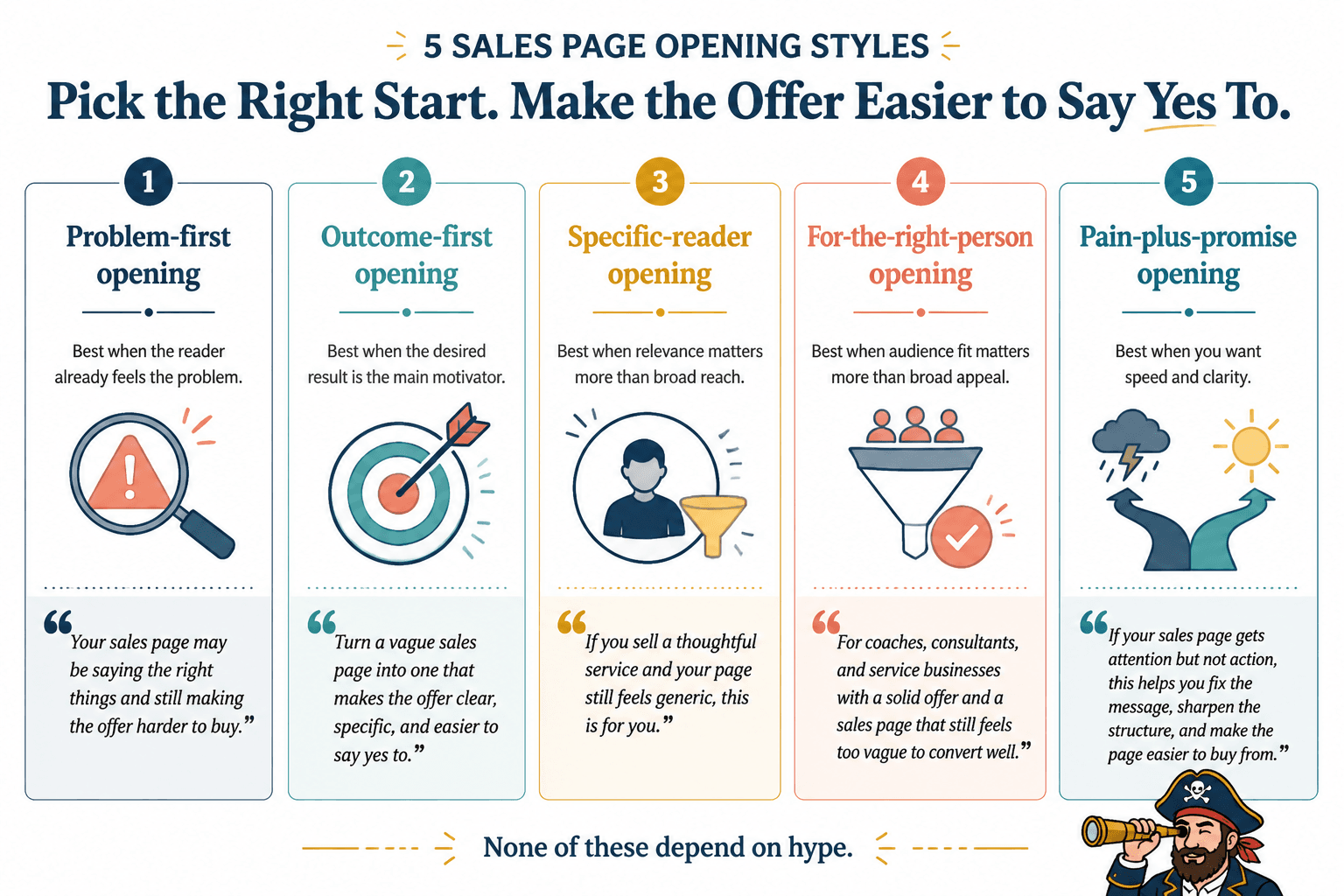
Five strong ways to open a sales page
You do not need one universal formula. You need a few reliable opening styles you can match to the offer.
1. The sharp problem opening
Best when the reader knows they have a problem and wants it fixed.
Your offer is probably not the reason people are not buying. Your sales page is making it harder than it should be.
2. The outcome-first opening
Best when the desired result is clear and attractive.
Get a sales page that makes your offer easier to understand, easier to trust, and easier to say yes to.
3. The contrast opening
Best when you want to separate your approach from common bad advice.
You do not need a louder sales page. You need one that says the right thing before your visitor gets bored and wanders off.
4. The “for the right person” opening
Best when audience fit matters more than broad appeal.
For coaches, consultants, and service businesses with a solid offer and a sales page that still feels too vague to convert well.
5. The pain-plus-promise opening
Best when you want speed and clarity.
If your sales page gets attention but not action, this helps you fix the message, sharpen the structure, and make the page easier to buy from.
None of these depend on hype. That is the point.
Before-and-after rewrites: weak sales page openings fixed
Sometimes the easiest way to understand this is to see the rewrite.
Example 1: Generic service intro
Before:
Welcome to our premium copywriting services designed to help businesses grow and thrive in a competitive marketplace.
After:
If your sales page sounds polished but still does not make the offer feel worth buying, the copy is doing less work than you think.
Why it works: It cuts the welcome mat fluff, names the issue, and implies a useful fix.
Example 2: Big promise, no substance
Before:
Unlock more revenue with high-converting copy that transforms your business.
After:
Get sales page copy that makes your offer clearer, your proof more convincing, and your CTA easier to trust.
Why it works: It replaces inflated outcomes with practical buying triggers.
Example 3: Founder-centered opening
Before:
I started this business because I believe every entrepreneur deserves messaging that reflects their passion and purpose.
After:
Your expertise should not be trapped inside a sales page that feels vague, overexplained, or weirdly hard to trust.
Why it works: It starts where the buyer already is instead of asking them to care about your motivations first.
A simple opening framework you can use
If you want a repeatable structure, use this:
- Headline: Name the problem or desired result clearly
- Subheadline: Explain who it is for and what the offer helps them do
- CTA: Give one low-friction next action
- Optional bullets: Add 2 to 4 outcomes or friction points if needed
Template:
Headline: Stop [painful problem] without [common frustration].
Subheadline: [Offer type] for [specific audience] who want to [specific result] without [specific friction].
CTA: [Clear action]
Filled example:
Headline: Stop losing sales to a page that sounds better than it converts.
Subheadline: Sales page copywriting for coaches and consultants who want clearer messaging, stronger trust, and more qualified buyers taking action.
CTA: See how it works
This is not the only structure. It is just a reliable one. Useful beats precious.
What to avoid in the first screen
If you are trying to strengthen your opening, cut these first:
The bigger point is simple: clearer structure and clearer writing make the piece more useful. That is usually what makes the ending land better too.