
For the broader learning path, visit our parent guide.
Ignoring platform fit
The bigger point is simple: clearer structure and clearer writing make the piece more useful. That is usually what makes the ending land better too.
Threads usually land better when each step builds cleanly and the ending makes the whole point feel worth the read.
Most teaching threads on X do not flop because the advice is bad. They flop because the thread is badly built.
You can know your subject cold and still write a thread that people abandon after post three. That is the annoying part. Expertise is not the same thing as thread craft. X rewards clarity, momentum, compression, and payoff. A lot of teaching threads have none of those. They open soft, wander around, repeat themselves, and then end with a sad little pitch nobody asked for.
If you want X Teaching Thread Mistakes That Hurt Performance fixed at the source, the job is not “write more.” It is “teach better in public.” That means stronger hooks, cleaner sequencing, less filler, sharper examples, and a thread structure that does not feel like it was assembled from leftover LinkedIn carousels.
Here’s how to spot the mistakes that quietly kill your thread performance, and how to fix them before you post.
The first mistake: teaching before you earn attention
A lot of teaching threads begin like this:
Here are 10 lessons I learned about content strategy over the last 5 years:
That is not a hook. That is a filing cabinet label.
People on X move fast. Your first post has one job: make the right person care enough to keep going. Not admire your professionalism. Not appreciate your effort. Keep going.
Teaching threads usually underperform when the opening is too broad, too polite, or too familiar. “Here are 7 tips” is rarely enough. The better move is to frame the value with tension, a problem, a result, or a surprise.
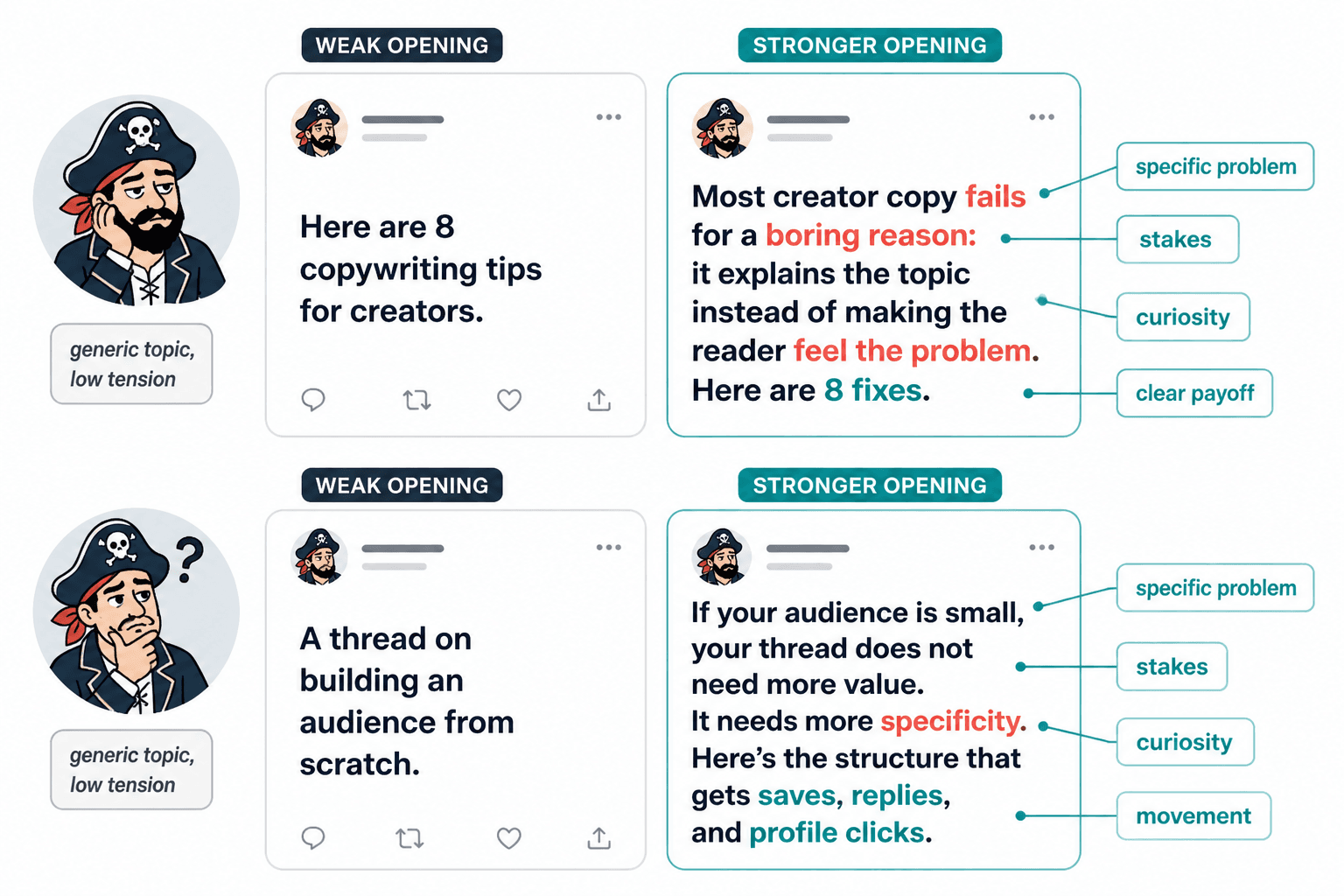
Weak opening vs stronger opening
Weak: Here are 8 copywriting tips for creators.
Stronger: Most creator copy fails for a boring reason: it explains the topic instead of making the reader feel the problem. Here are 8 fixes.
Weak: A thread on building an audience from scratch.
Stronger: If your audience is small, your thread does not need more “value.” It needs more specificity. Here’s the structure that gets saves, replies, and profile clicks.
The point is not to sound dramatic. It is to make the idea feel alive.
Too much context, not enough movement
One of the most common X teaching thread mistakes that hurt performance is throat-clearing. You know the pattern:
- Post 1: broad promise
- Post 2: more setup
- Post 3: even more setup
- Post 4: finally, the point
By then, half the readers are gone.
X is not patient with delayed value. People will absolutely read a longer thread if the momentum is there, but they will not tolerate four posts of warm-up before anything useful happens. A teaching thread should start paying rent early.
What to do instead
- Make the first post clear and loaded with tension
- Use the second post to frame the core problem or promise
- Start teaching by the third post at the latest
- Cut any sentence that exists only to sound thoughtful
If a post in your thread can be removed without hurting understanding, remove it. Threads are not improved by decorative seriousness.
Trying to teach too much in one thread
This one hurts because it usually comes from a good intention. You want the thread to be useful, so you stuff in everything. Frameworks. examples. edge cases. bonus tips. side notes. random philosophy. a CTA. maybe a downloadable thing. now the thread has become a suitcase you sat on to close.
Teaching threads work better when they have one clear promise and a disciplined path to that promise. Not three promises wearing a trench coat.
Bad scope looks like this
- How to write better hooks, structure threads, grow followers, and sell offers from X
- A thread about content strategy that turns into brand positioning halfway through
- Teaching “everything I know” in one giant blob of advice
Better scope looks like this
- 3 hook patterns that make educational threads easier to start
- 5 structure fixes for threads people drop too early
- How to turn one useful idea into a clean 7-post teaching thread
Narrower threads usually perform better because they are easier to read, easier to trust, and easier to remember. They also give you more material. One overloaded thread could often be three sharp ones.
Writing every post at the same energy level
A strong thread has rhythm. A weak one sounds flat all the way through.
Many teaching threads read like a list of evenly weighted observations. Post after post lands with the same sentence structure, the same intensity, and the same kind of point. Nothing stands out. Nothing turns the page, so to speak.
You need variation. Not chaos. Variation.
A cleaner rhythm for teaching threads
- Hook: create interest fast
- Frame: explain why this matters
- Teach: give one point at a time
- Prove: use an example, contrast, or mini case
- Shift: add a sharper insight or mistake to avoid
- Land: summarize the practical takeaway
- CTA: invite the next step without acting desperate
This is part of why strong threads feel easy to read. The writer is not just delivering information. They are managing attention.
If you want help tightening that flow, read how to improve X threads thread structure without sounding generic.
Teaching in abstractions instead of examples
Advice gets ignored when it stays vague.
Writers love saying things like “be more specific” or “focus on clarity” or “make it more engaging.” Fine. But what does that look like in an actual thread? Readers do not just need the principle. They need the translation.
Good teaching threads often include one of these:
- a before-and-after rewrite
- a sample post
- a tiny framework
- a counterexample
- a quick breakdown of why something worked
Example
Vague teaching: Make your thread hook more curiosity-driven.
Useful teaching: Instead of “5 marketing lessons I learned this year,” try “Most marketing lessons fail because they are too vague to steal. Here are 5 I actually use.” The second version gives the reader a reason to care and implies practical payoff.
Concrete examples shorten the distance between “I understand this” and “I can do this.” That is what useful threads do.
Repeating the same point in slightly different outfits
This is a sneaky thread killer.
A lot of threads look like they contain 10 ideas, but really contain 3 ideas repeated with cosmetic changes. The reader feels that drag even if they cannot name it. The thread starts to feel padded. Trust drops a little. Momentum dies a little. Then they leave.
If point four sounds like point two with a different haircut, cut it or combine it.
How to test for repetition
- Give every post a one-line purpose
- Check whether two posts teach the same lesson
- Remove “in other words” filler unless it truly adds clarity
- Merge weaker points into one stronger point with an example
Threads are not judged by how much you included. They are judged by how cleanly the reader got the value.
Bad sequencing: the points are fine, the order is a mess
Sometimes the content is solid and the thread still underperforms because the logic is sloppy. The points arrive in the wrong order. A beginner-level idea comes after an advanced one. An example shows up before the concept. The payoff appears before the setup. It feels weird because it is weird.
Teaching threads need progression. Readers should feel guided, not bounced around.
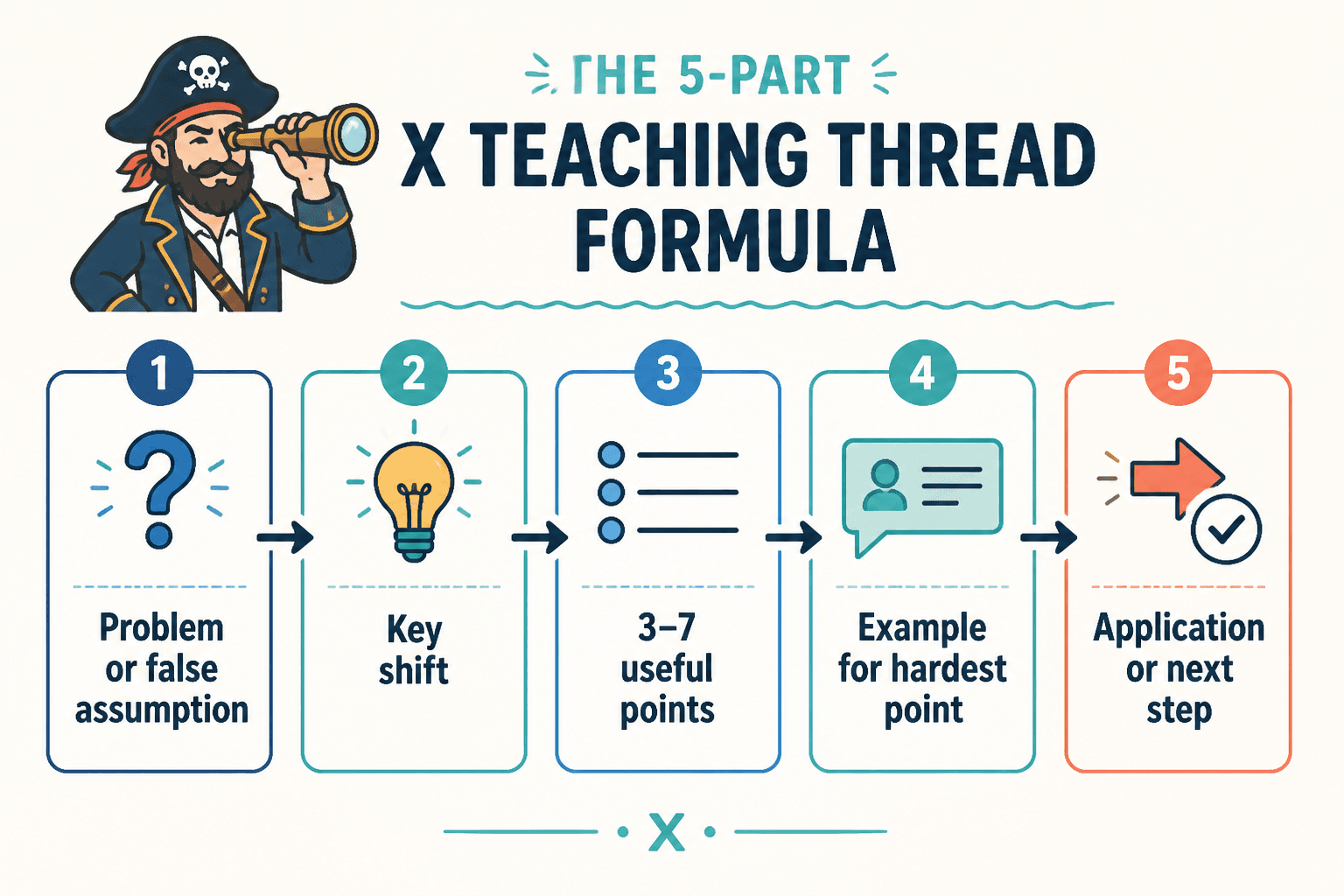
A simple sequence that usually works
- Start with the problem or false assumption
- Name the key shift
- Break the shift into 3 to 7 useful points
- Support the trickiest point with an example
- End with application or next step
This sounds basic because it is. Basic structure still beats clever mess.
For more thread-building help, the main X threads guide section is worth bookmarking.
Sounding smart instead of being clear
Some teaching threads are trying a bit too hard to sound intelligent. You can tell. The wording gets abstract. The sentences get polished to death. The point gets buried under “insightful” phrasing.
X is not the place for academic fog. If your reader has to decode the thread, you lost.
Watch for these clarity killers
- too many abstract nouns
- long intros to simple points
- fancy phrasing instead of plain language
- vague claims with no example or proof
- trying to sound profound instead of useful
A good teaching thread can be sharp, nuanced, and smart. It just should not read like it is applying for tenure.
If your draft feels dull, this is often the culprit. You may also want how to rewrite boring X threads.
No payoff at the end
You got the click. You held some attention. Then the thread ends with:
Hope this helps.
Brutal.
The end of a teaching thread matters because it shapes what the reader remembers and what they do next. A weak ending makes the whole thing feel less valuable. A good ending gives closure, application, or direction.
Better ways to end a teaching thread
- Summarize the key shift in one crisp sentence
- Give the reader one action to try today
- Invite a relevant reply
- Point them to a related resource
- Use a soft CTA that fits the thread’s promise
Example:
If your teaching threads are useful but forgettable, the problem usually is not the idea. It is the packaging. Sharpen the hook, tighten the sequence, and make every post earn its place.
That lands better than “Follow for more.” Which, to be fair, is hard to land worse than.
Turning the thread into a disguised sales pitch
There is nothing wrong with using threads to support business goals. That is sensible. But when a teaching thread exists mainly to funnel the reader into a pitch, people can smell it.
The usual pattern is this: decent advice up front, then a sudden turn into “and that’s why you need my framework/course/service/system.” It feels transactional because it is transactional.
Better approach: let the teaching stand on its own. Then make the CTA feel like a natural next step for people who want more help.
Weak CTA vs better CTA
Weak: If you want to scale your content, DM me THREAD and I’ll show you my offer.
Better: If this helped, I’ve got more on how to write better X threads and how to structure them without losing momentum.
The second one respects the reader. That tends to work better over time.
Ignoring platform fit
The bigger point is simple: clearer structure and clearer writing make the piece more useful. That is usually what makes the ending land better too.
Threads usually land better when each step builds cleanly and the ending makes the whole point feel worth the read.