
Most X thread endings are doing one of two annoying things: begging for engagement or swerving into a sales pitch that feels like it was stapled on at the last second.
That is usually not because the writer is bad at threads. It is because they treat the CTA like an afterthought. They spend 12 posts building a point, then end with “Follow for more” or “DM me if you need help,” which is the content equivalent of setting the table nicely and then serving dry toast.
If you want better X thread CTA endings for personal brands, the fix is not making them louder. It is making them fit. A strong ending should match the thread, respect the reader’s attention, and give a next step that feels natural instead of needy.
Here’s how to write thread endings that get more replies, more follows, more profile visits, and more trust without sounding like a low-budget growth hacker in a hurry.
If you want the bigger picture, start with the parent guide.
What a good X thread CTA actually does
A CTA at the end of a thread is not just there to ask for something. It closes the loop.
A good one helps the reader decide what to do with the value they just got. That might mean replying, following, clicking through to your profile, checking out a related resource, or simply remembering your name the next time they need help.
So yes, the CTA can drive action. But the real job is cleaner than that:
- It gives the thread a satisfying landing
- It keeps momentum instead of killing it
- It points the right people toward the right next step
- It strengthens your positioning
- It avoids making the whole thread feel like bait
That last one matters more than people think. If your thread feels useful and then suddenly reveals itself as a clumsy funnel tentacle, people remember the clumsy part.
Why most thread endings fall flat
The usual bad endings are not subtle.
- “Follow me for more content like this”
- “Like, comment, and repost if this helped”
- “DM me ‘THREAD’ and I’ll help you scale”
- “If you want to work with me, my DMs are open”
- “What do you think?”
None of these are illegal. They are just weak because they are generic, disconnected, and lazy. They could sit under almost any thread on almost any topic.
X is a fast platform. Compression matters. Relevance matters more. Your CTA should feel like the natural final sentence of this thread, not a recycled footer from your content template folder.
Also, a lot of personal brands ask for too much too soon. If someone just discovered you through one thread, asking them to buy, book, subscribe, follow, repost, and join your ecosystem is a bit much. They are not applying for citizenship.
Start with the thread’s real goal, not the CTA you wish would work
Before writing your ending, ask one useful question: what is this thread supposed to do?
Not in a vague “build my brand” way. In a practical way.
- Is the thread meant to earn follows?
- Is it meant to start conversations?
- Is it meant to push people to your profile?
- Is it meant to qualify potential clients?
- Is it meant to build authority around a specific topic?
- Is it meant to warm people up for an offer they already know exists?
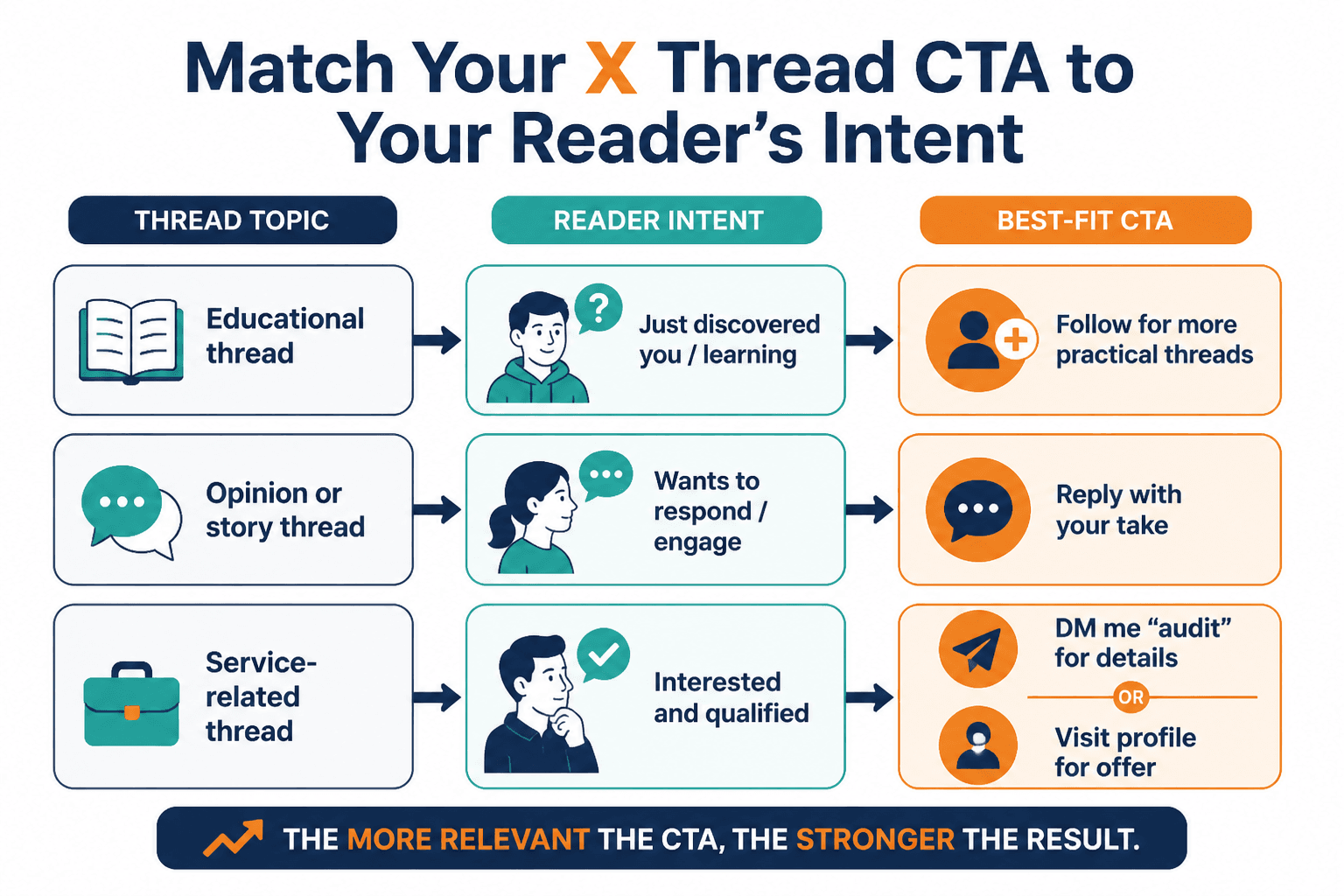
Your CTA should match that goal. If the thread is educational and top-of-funnel, ending with a direct sales pitch is often too abrupt. If the thread is a case study showing a clear business result, a softer offer CTA can make perfect sense.
This is where a lot of creators go wrong. They use the same CTA regardless of thread type. That flattens everything. A smart personal brand does not just repeat a stock line. It chooses the next step with some taste.
The 5 best types of X thread CTA endings for personal brands
You do not need 37 CTA formulas. You need a few solid categories and the judgment to use the right one.
1. The conversation CTA
Best for threads built around opinions, systems, mistakes, trends, or tradeoffs.
This works when the thread gives people something specific to react to. Not “thoughts?” Not “agree?” Something narrower and easier to answer.
Weak: What do you think?
Better: Which part of this breaks down first in your niche: the hook, the offer, or the follow-up?
Better: If you write threads for your business, which one is harder: keeping them tight or ending them without sounding salesy?
Why it works: It gives the reader an actual prompt instead of politely asking them to perform engagement.
2. The follow CTA with a reason
Best for educational threads where the reader clearly benefited and your positioning is relevant.
“Follow for more” is weak because it gives no reason and no category. Follow for more what, exactly?
Weak: Follow for more content like this.
Better: I write about sharper content systems, better hooks, and threads that sell without acting weird. Follow if that is useful to you.
Better: If you are building a personal brand on X without wanting to sound like everyone else, follow. That is mostly what I post about.
Why it works: It qualifies the audience and reinforces your positioning at the same time.
3. The profile CTA
Best when your profile already does a good job converting attention into the next step.
This can work especially well for personal brands with a clean bio, a strong pinned post, a lead magnet, or a clear offer path.
Example: If you want more examples like this, my pinned post has 20 thread structures you can steal.
Example: I break this down more in my pinned resources if you want the templates behind it.
Why it works: It moves the reader one step deeper without asking for an immediate sale.
4. The soft offer CTA
Best for case studies, process threads, credibility-building threads, and threads aimed at qualified buyers.
This is where a lot of people get twitchy and overdo it. You do not need a webinar-funnel ending. You need a sane, low-pressure invitation.
Example: If you want help turning your ideas into threads that actually lead somewhere, that is part of what I help clients do.
Example: If your brand has the expertise but your content still feels flat, that is fixable. My profile has the next step.
Why it works: It signals relevance without making the thread feel like bait-and-switch marketing sludge.
5. The continuation CTA
Best when the topic has logical adjacent parts.
This is underrated. Sometimes the best CTA is not “buy” or “reply.” It is simply directing attention to the next useful piece of content.
Example: If this was useful, I also wrote a thread on fixing weak first tweets. That one tends to save people from a lot of avoidable embarrassment.
Example: This thread covered structure. I posted another one on CTA endings, because most people ruin the last post after finally getting the rest right.
Why it works: It extends attention, builds authority, and keeps the relationship moving without forcing a conversion too early.
How to choose the right CTA ending for the thread
Use this simple matching framework.
| Thread type | Best CTA style |
|---|---|
| Educational how-to | Follow CTA, profile CTA, continuation CTA |
| Strong opinion | Conversation CTA |
| Case study | Soft offer CTA, profile CTA |
| Mistakes to avoid | Conversation CTA, follow CTA |
| Framework or template | Profile CTA, continuation CTA |
| Personal brand positioning thread | Follow CTA, soft offer CTA |
If you are unsure, default to the least pushy CTA that still makes sense. That usually ages better, and it tends to preserve trust.
Before-and-after rewrites: better X thread CTA endings for personal brands
Here is where the difference gets obvious.
Rewrite 1: generic follow ask
Before: Follow me for more tips on content creation.
After: I write about content that earns trust without sounding polished into oblivion. Follow if that is your lane.
The second one has a point of view. It also tells the reader what kind of content to expect and who it is for.
Rewrite 2: vague engagement bait
Before: What do you think? Agree or disagree?
After: Which thread mistake hurts more on X: weak first posts or endings that collapse into “follow for more”?
The second one gives people a real choice, which makes replies easier and more interesting.
Rewrite 3: awkward sales pitch
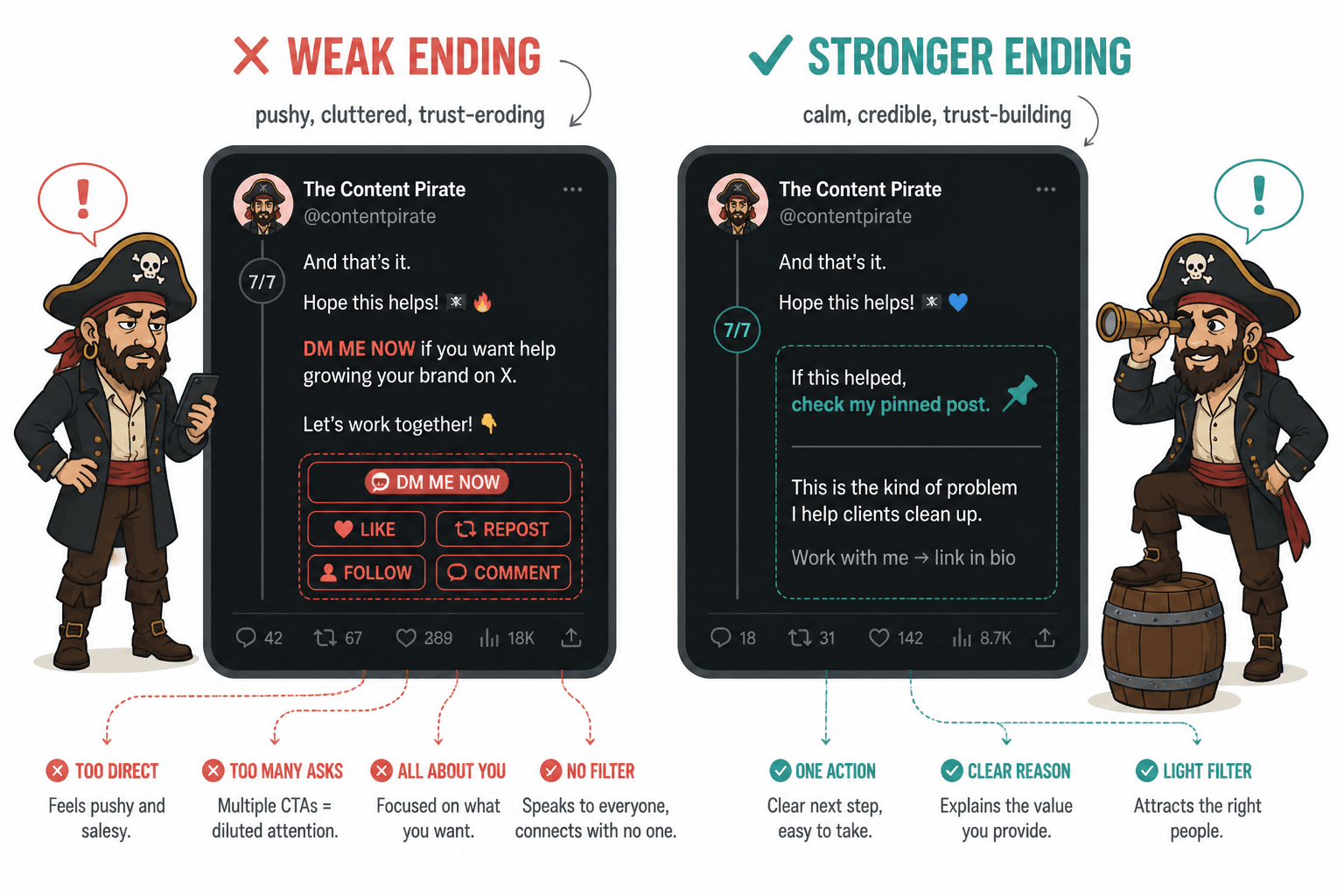
Before: If you need help growing your brand, DM me now.
After: If your threads get attention but not much business value, this is the kind of problem I help clients clean up.
Much calmer. Much more credible. Still commercial, but not clingy.
Rewrite 4: too many asks at once
Before: Like, repost, follow, and comment if this helped. Check my bio for more.
After: If this helped, check my pinned post. I keep my best thread frameworks there.
One action. Clear reason. No frantic energy.
A simple formula for writing better CTA endings
If you want a reusable structure, use this:
Relevant next step + clear reason + light audience filter
For example:
- Follow if you want more threads on content positioning and offer clarity.
- If you want the practical templates behind this, my pinned post has them.
- If you write threads for your business, which part tends to lose readers first?
- If your personal brand sounds smart but still blends in, this is exactly the kind of problem I work on.
That formula works because it forces the CTA to do more than ask. It has to justify itself.
What personal brands should not do at the end of X threads
- Do not bolt on a CTA that changes the tone of the thread. If the thread is thoughtful and useful, ending with “DM me to scale” feels cheap.
- Do not ask for every action at once. Pick one primary next step.
- Do not hide a sales pitch behind fake generosity. People can tell when a thread exists only to sneak them into your funnel.
- Do not use dead generic phrases. “Follow for more,” “thoughts?” and “agree?” are not banned, but they are tired.
- Do not treat every thread like a conversion asset. Some threads should build trust, sharpen positioning, or start conversations.
A good personal brand on X is not just trying to get action. It is trying to become memorable, credible, and easy to understand. CTA endings should support that, not undermine it.
The bigger point is simple: clearer structure and clearer writing make the piece more useful. That is usually what makes the ending land better too.