
Most people ask how long X threads should be like there is a secret number that flips the reach switch.
There is not.
The better question is this: how long does your thread need to be to make one clear point well, without losing momentum halfway through?
That is what matters in 2026. Not thread length as a weird badge of seriousness. Not stuffing 27 posts together so it looks “valuable.” Not chopping a strong idea into 14 fragments because someone said longer threads perform better. They do not, automatically. Long threads work when the idea earns the length. Shorter threads work when they land fast and clean.
So if you are wondering how long X threads should be in 2026, here is the practical answer: long enough to create momentum, short enough to keep attention, and structured tightly enough that each post earns the next one.
This article will help you choose the right thread length based on your goal, topic, and audience. We will also cover when shorter threads beat longer ones, what usually makes threads drag, and how to tell if your thread is useful or just extended for cardio.
For the full path around this topic, head to the parent guide.
How long should X threads be in 2026? The short answer
For most creators, a strong X thread in 2026 usually lands somewhere between 5 and 12 posts.
That range is long enough to build an argument, teach something useful, tell a compact story, or break down a process without exhausting the reader.
But that is a guideline, not a rule carved into the platform walls.
Here is a better way to think about it:
- 3 to 5 posts: good for quick takes, mini frameworks, strong opinions, and compact lessons
- 5 to 8 posts: great for most practical educational threads
- 8 to 12 posts: useful when you need examples, nuance, or a step-by-step breakdown
- 12 to 20 posts: only worth it when the topic is genuinely rich and every post adds something new
- 20+ posts: rarely necessary, often bloated, occasionally justified
If your thread needs 23 posts to explain one basic idea, the issue probably is not complexity. It is editing.
And if your thread is only 4 posts because you are terrified of “losing attention,” you may be under-explaining and leaving the good part on the floor.
What actually determines the right thread length
The right thread length depends less on platform folklore and more on five practical factors.
1. The complexity of the idea
Some ideas are naturally compact. Others need setup, context, proof, and a useful takeaway.
A thread called “3 mistakes making your X hooks weaker” can probably be done in 5 to 7 posts. A thread breaking down a full content workflow, a client case study, or a teardown of what changed in your strategy will usually need more room.
The mistake is forcing every topic into the same format. Good threads fit the idea. Bad threads force the idea to wear a random size.
2. The goal of the thread
Different goals need different lengths.
- Reach: shorter and sharper often works better
- Trust: moderate length with clear proof and useful detail
- Authority: longer can work if the structure is tight
- Leads: enough depth to be useful, enough restraint to avoid reading like a disguised funnel pitch
If you want the thread to spread, compression matters. If you want the reader to think, “this person actually knows what they are talking about,” some extra detail can help. Just do not confuse “more detail” with “more sentences saying the same thing in a different shirt.”
3. The strength of the hook
A longer thread can survive if the opening creates real curiosity and makes a clear promise. A weak opening kills even a short thread.
If your first post says:
I have been thinking a lot lately about content and wanted to share a few thoughts.
That thread is dead on arrival. It is not too long. It just started with nothing.
If your thread opening is a problem, fix that first. This is exactly why it helps to learn how to start X threads without a weak opening.
4. The amount of proof or specificity needed
Bold claims can be short. Persuasive claims usually need receipts.
If you are making a strong argument, teaching a method, or sharing a strategy that asks the reader to trust your judgment, you may need a few extra posts for examples, screenshots, breakdowns, or contrast.
That said, specificity makes threads stronger faster. One sharp example can often replace four vague posts full of “value.”
5. The rhythm of the writing
This part gets ignored a lot.
A 12-post thread with clean momentum can feel shorter than a 6-post thread that drags. Readers do not experience length as a number first. They experience it as energy, clarity, and pace.
If each post introduces a new beat, sharp example, or logical next step, people keep going. If three posts in a row say nearly the same thing, they are gone.
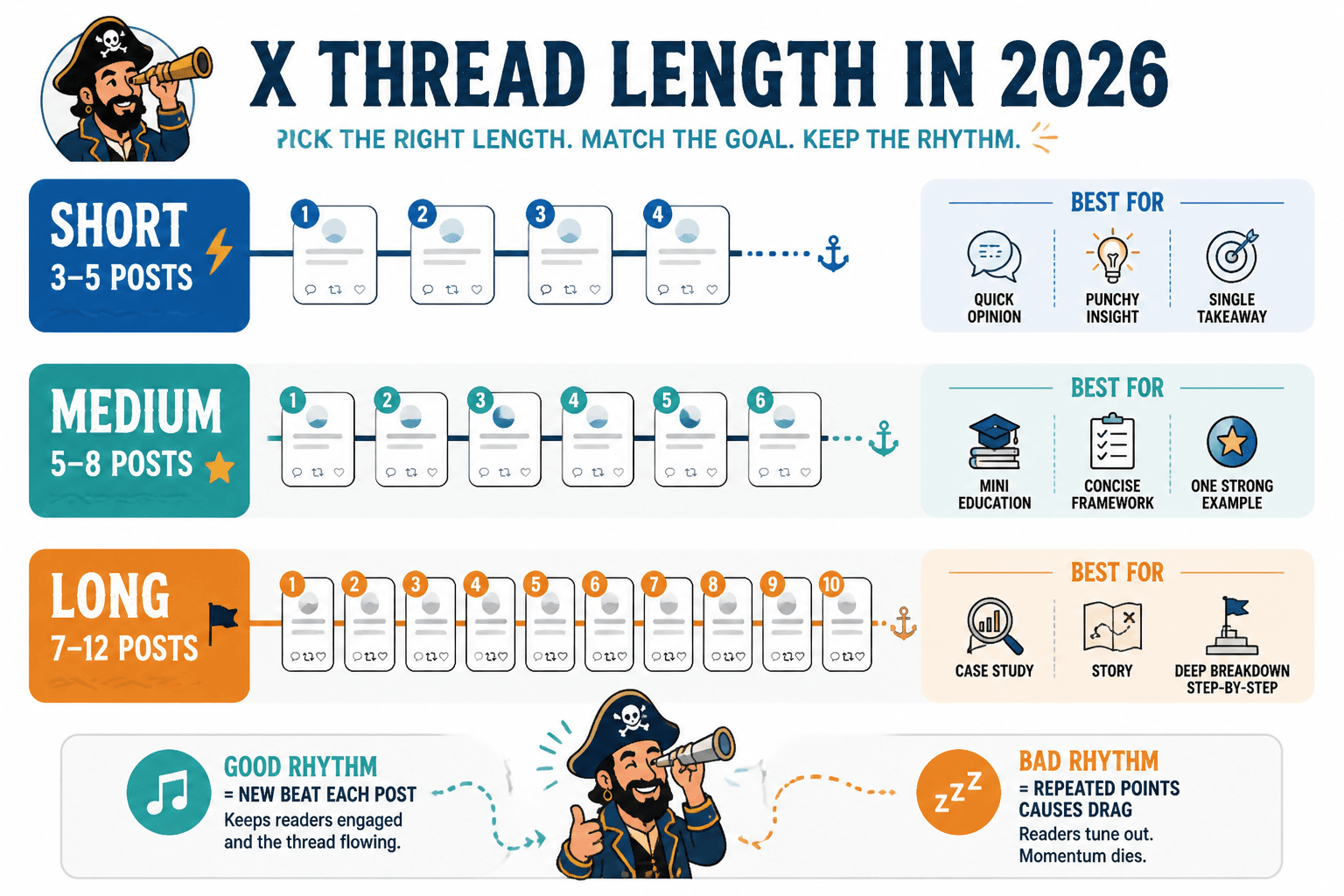
Recommended X thread lengths by content type
If you want practical ranges, here is a cleaner way to decide.
| Thread type | Suggested length | Why |
|---|---|---|
| Quick opinion thread | 3 to 5 posts | Best when tight, punchy, and quotable |
| Mini educational thread | 5 to 8 posts | Enough room for a clear lesson without drag |
| Step-by-step framework | 6 to 10 posts | Lets each step breathe |
| Case study thread | 7 to 12 posts | Needs setup, action, result, and takeaway |
| Story-based thread | 6 to 12 posts | Needs pacing and payoff, not rambling |
| Deep breakdown or teardown | 10 to 15 posts | Works if the detail is genuinely useful |
| Mega thread | 15+ posts | Only when the topic strongly deserves it |
These are not hard limits. They are sanity checks.
If you keep writing 18-post threads, ask yourself why. Maybe you cover dense topics and your audience likes depth. Fair enough. Or maybe you are posting one decent idea followed by 17 attempts to prove you are thorough. Those are not the same thing.
When short X threads beat long ones
Shorter threads often win when the idea is simple, the opinion is sharp, or the payoff is obvious.
A shorter thread can outperform a longer one because it respects the platform. X still rewards clarity, speed, compression, and ideas people can grasp quickly enough to share, reply to, or remember.
Short threads are especially good for:
- Contrarian observations
- One useful framework
- A single writing lesson
- One mistake and one fix
- A quick teardown
- A sharp personal brand opinion
Example:
- Hook: “Most X threads are too long for the idea they are trying to carry.”
- Point: “Length does not create authority. Specificity does.”
- Example: one short before/after comparison
- Takeaway: “If you can cut 4 posts and lose nothing, cut them.”
- CTA: invite the reader to review their last thread
That can work beautifully at 5 posts. Stretching it to 14 would probably weaken it.
If this is the kind of thread you write often, you will probably like when short X threads beat long ones.
When longer X threads make sense
Longer threads make sense when the reader gets a real payoff from the extra space.
That usually means one of four things:
- You are breaking down a process with multiple steps
- You are telling a story that needs setup, tension, and result
- You are teaching a nuanced concept that would be flattened if compressed too hard
- You are supporting a strong claim with useful proof
Notice the pattern: longer threads work when the extra posts add clarity, not just mass.
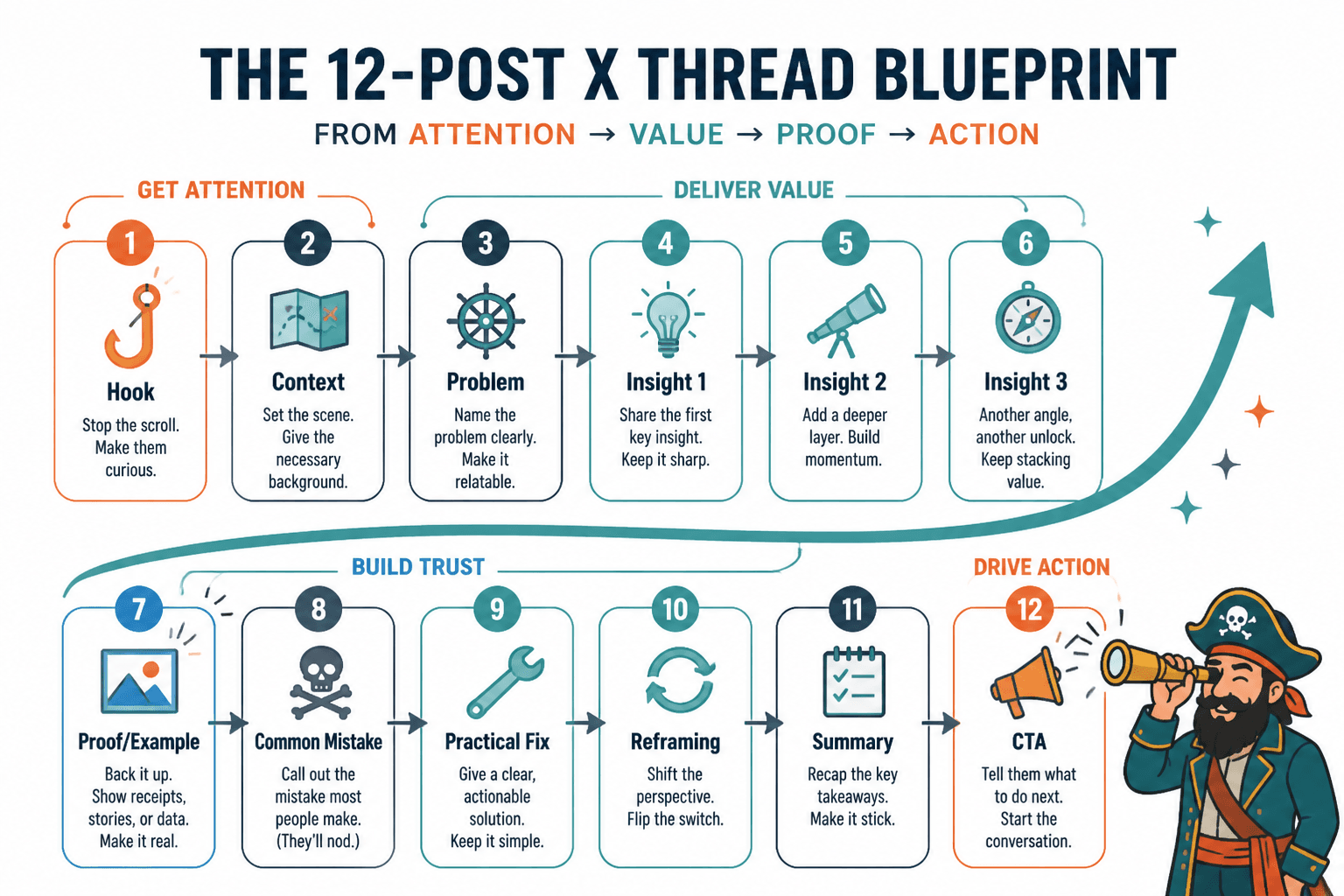
A strong 12-post thread often has a shape like this:
- Hook with a specific promise or tension
- Context: why this matters
- The core problem
- First insight
- Second insight
- Third insight
- Example or proof
- Common mistake
- Practical fix
- Useful reframing
- Summary line
- Clean CTA or next step
That is a thread with movement. Not a stack of disconnected notes pretending to be structure.
The real reason many X threads feel too long
Usually, it is not the number of posts.
It is one of these:
- The thread repeats itself
- The hook overpromises and the body underdelivers
- Each post is too vague to justify its existence
- The order is clunky
- The writer included every thought instead of the best ones
- The CTA shows up like a salesman in sunglasses
A thread feels long when the reader starts asking, “Yes, and?”
This is why editing matters more than chasing a magic number. Good thread writers are not just writing. They are sequencing. Tightening. Cutting overlap. Sharpening transitions. Removing the posts that exist only because deleting them felt emotionally difficult.
A quick bloat test
Before you publish, check your thread against these questions:
- Does each post add a new idea, example, or step?
- Could two posts be combined without losing clarity?
- Did you explain anything the audience probably already knows?
- Is there a point where the thread already feels complete?
- Is the CTA earning its place, or just lurking because you feel you should monetize everything?
If the thread starts feeling complete at post 7, and you have 11 posts, that is your edit signal.
A simple framework for choosing thread length before you write
Here is a cleaner planning method than guessing.
Step 1: Define the thread type
Ask: is this a quick take, a lesson, a framework, a story, or a breakdown?
Step 2: List the minimum beats
Write the 3 to 8 key beats the thread actually needs.
For example:
- Hook
- The mistake
- Why it happens
- The fix
- Example
- CTA
If that outline covers the idea, you probably do not need 15 posts.
Step 3: Add proof only where it improves trust
Do not add examples because examples are fashionable. Add them where they reduce friction, make the point concrete, or make the lesson easier to apply.
Step 4: Cut throat-clearing
Remove any post that says:
- “A lot of people ask me…”
- “I have been reflecting…”
- “There are many reasons for this…”
- “Here is some context…” when the context is obvious
The bigger point is simple: clearer structure and clearer writing make the piece more useful. That is usually what makes the ending land better too.