
Long X threads often get treated like proof of seriousness. More tweets, more value, more authority, more everything. That is the theory. In practice, a lot of long threads are just stretched-out ideas wearing a trench coat.
When short X threads beat long ones, it is usually for a very boring reason: they respect attention better. They get to the point faster, keep momentum, and give the reader a clean payoff before their brain wanders off to three other tabs and a fight in the replies.
If you write threads to build trust, test ideas, grow an audience, or move people toward your profile and offers, this matters. A shorter thread can be sharper, more quotable, more readable, and more likely to actually get finished. And yes, finished matters. A thread people start and abandon halfway through is not secretly winning because it looked impressive on your profile.
Here’s how to tell when a short thread is the better play, what kinds of ideas should stay short, and how to write a compact thread that still feels substantial instead of thin.
For the main guide behind this topic, visit the parent guide.
Why short X threads often work better than people want to admit
Writers love the fantasy that if they just add more context, more examples, and more nuance, people will appreciate the craft. Sometimes they do. Often, they do not.
X is still a speed-driven platform. Even thoughtful readers tend to reward clarity, compression, and pace. That does not mean every idea should be reduced to a slogan. It means the thread has to earn every extra post.
A short thread usually wins when:
- The core idea is simple enough to explain quickly
- The reader mainly needs a perspective shift, not a full framework
- The hook is strong and the payoff is clear
- The thread is designed to spark follows, replies, profile visits, or shares
- The extra tweets would mostly be examples, caveats, or repetition
Put differently: short threads win when the idea is naturally tight. Long threads lose when the writer is trying to make a medium-sized point look like a major intellectual event.
A short thread feels smart when it ends right after the reader gets the point. A long thread feels bloated when it keeps talking after the point already landed.
That is the real issue. Not length in isolation. Drag.
When short X threads beat long ones
There are a few situations where a shorter thread is not just acceptable. It is plainly better.
1. When the point has one clean argument
If your thread can be summed up in one useful sentence, you probably do not need 19 posts.
For example:
- Why most creators do not need a content calendar problem, they need a positioning problem solved
- Why weak hooks kill good advice
- Why more posting does not fix unclear offers
- Why authority often comes from specificity, not volume
Each of those can become a strong 5-to-8 post thread. Hook. Claim. Contrast. Example. Takeaway. Done. If you push them to 20 posts, you usually end up repeating the same point with slightly different shoes on.
2. When you are testing an idea
Short threads are excellent for idea testing. They help you find out if a concept has legs before you turn it into a full article, long-form thread, or email sequence.
This matters because not every idea deserves a full lecture. Some deserve a quick market test. If a 6-post thread gets strong replies, saves, quote posts, or profile clicks, you may have found something worth expanding later.
If it flops, great. You lost ten minutes, not your afternoon.
3. When pace matters more than completeness
Some thread goals are about momentum, not total coverage. You are trying to create a quick, compelling read that moves people toward a next step: follow, reply, visit profile, read a linked resource, or remember your angle.
In those cases, completeness can actually hurt performance. The thread turns into a mini-ebook when what the reader needed was a sharp guided argument.
There is a difference between useful depth and self-indulgent thoroughness. The latter usually shows up disguised as “adding value.”
4. When the audience already knows the basics
If you write for creators, consultants, marketers, or founders who already understand your general topic, they do not need every term unpacked like a classroom handout. They need signal.
A shorter thread works well here because it assumes some competence. It gives the insight, the angle, the example, and the implication. It does not spend seven tweets warming up to what the reader already knows.
This is one reason experienced audiences often respond better to compact threads. The writing feels respectful. It gets on with it.
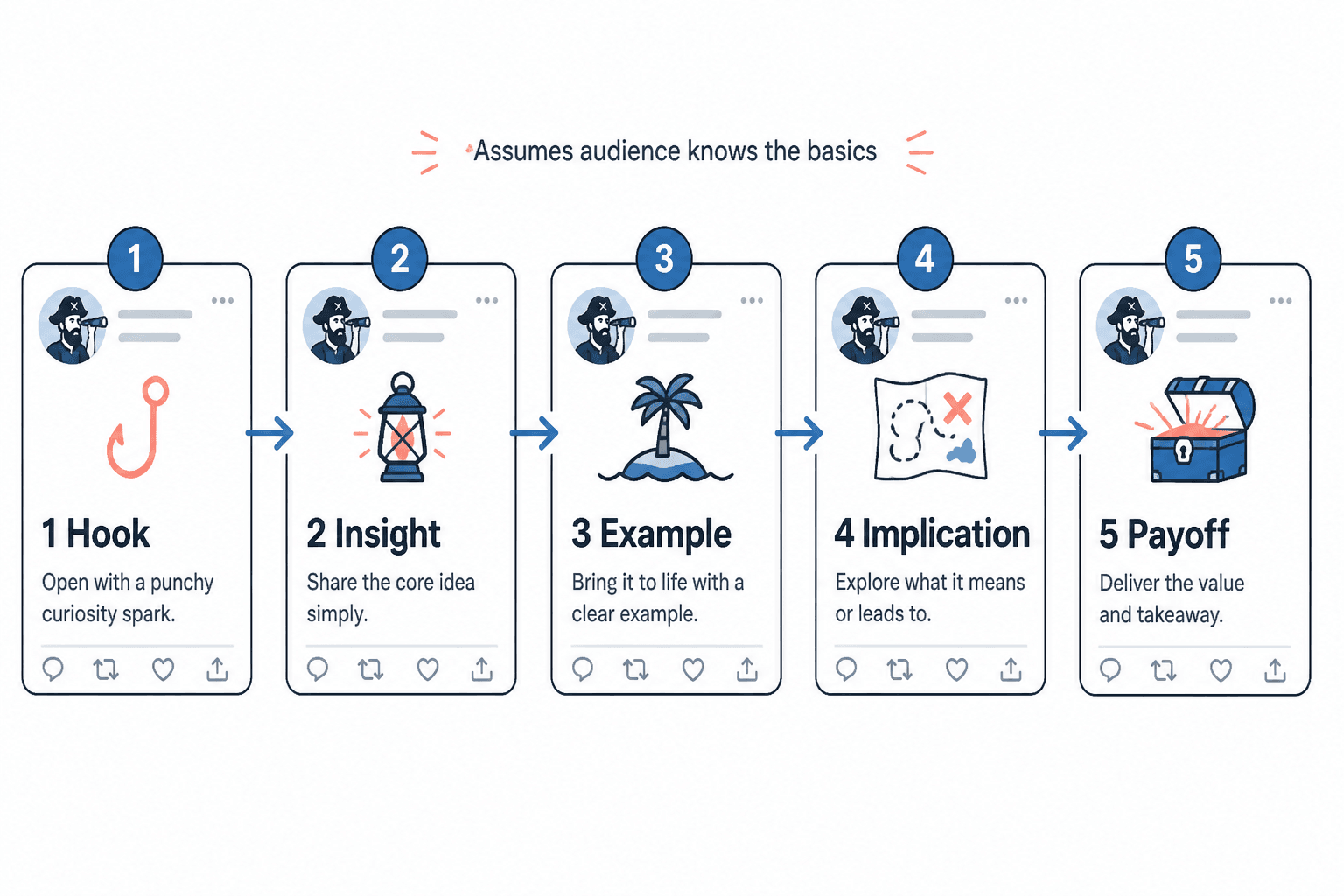
5. When the thread is built for sharing
People share what they can quickly understand and cleanly summarize. Shorter threads tend to produce tighter wording, cleaner logic, and more quotable lines.
A thread that says one sharp thing well is easier to recommend than a thread that says four decent things across 27 tweets.
This is especially true if your content lives in idea-heavy spaces like writing, branding, offers, consulting, creator business, or audience growth. Readers often want language they can borrow, reference, or react to. Compression helps.
What short threads do better than long ones
Short threads are not automatically better. Plenty of them are weak. But when they are good, they outperform long ones in some very practical ways.
They keep the hook connected to the payoff
The longer the thread, the more chances you have to wander away from the promise of the opening. A short thread forces alignment. The hook sets the expectation, and the rest of the posts have to support it quickly.
That makes the whole thing feel more coherent. It reads like one argument instead of a bundle of adjacent thoughts.
They reduce repetition
Most long threads have at least three tweets that could vanish without harming anything. Sometimes it is throat-clearing. Sometimes it is obvious filler. Sometimes it is the writer falling in love with their own paraphrasing.
Short threads make that harder. Good. Repetition is not depth. It is often just slower reading.
They are easier to finish
This one matters more than people think. Completion changes how the thread feels. If a reader reaches the end, gets the payoff, and feels smarter, they are more likely to follow, reply, or check your profile.
If they drop off in the middle because the thread started circling, you lose some of that trust. Not because the content was offensive. Just because it became work.
They make stronger repurposing material
A tight thread is easier to repurpose into a post, email, article section, carousel, or talking point. The structure is already clean. The thesis is already visible. You are not digging through a swamp of extra sentences to find the usable core.
If you want more help with thread strategy in general, the X threads section is the natural next stop. And if you are building across formats, the broader social media writing resources can help you avoid writing every platform like it has the same attention span.
How to know your thread should stay short
Use this quick test before you publish.
- Can the main idea be stated in one sentence? If yes, shorter is probably viable.
- Does each tweet add a new layer? If not, cut it.
- Would removing three tweets improve the pace? It usually does.
- Are you explaining because the reader needs it, or because you fear being misunderstood? Big difference.
- Does the thread still work if it ends earlier? If yes, end it earlier.
A lot of writers keep adding tweets because they are trying to defend the argument before anyone has even objected. That habit produces overbuilt threads. You do not need to pre-answer every possible counterpoint in public. This is X, not a doctoral defense.
A simple structure for a strong short X thread
If you want a shorter thread that still feels valuable, use this structure:
- Hook: state the tension, mistake, or useful claim
- Context: explain why it matters in one or two posts
- Core points: give 3 to 5 clear points, examples, or distinctions
- Payoff: land the lesson cleanly
- Next step: optional soft CTA, if it actually fits
That usually gives you a thread in the 5-to-9 post range. Enough space for movement. Not enough space to hide bad editing.
Example: weak long thread idea vs better short thread
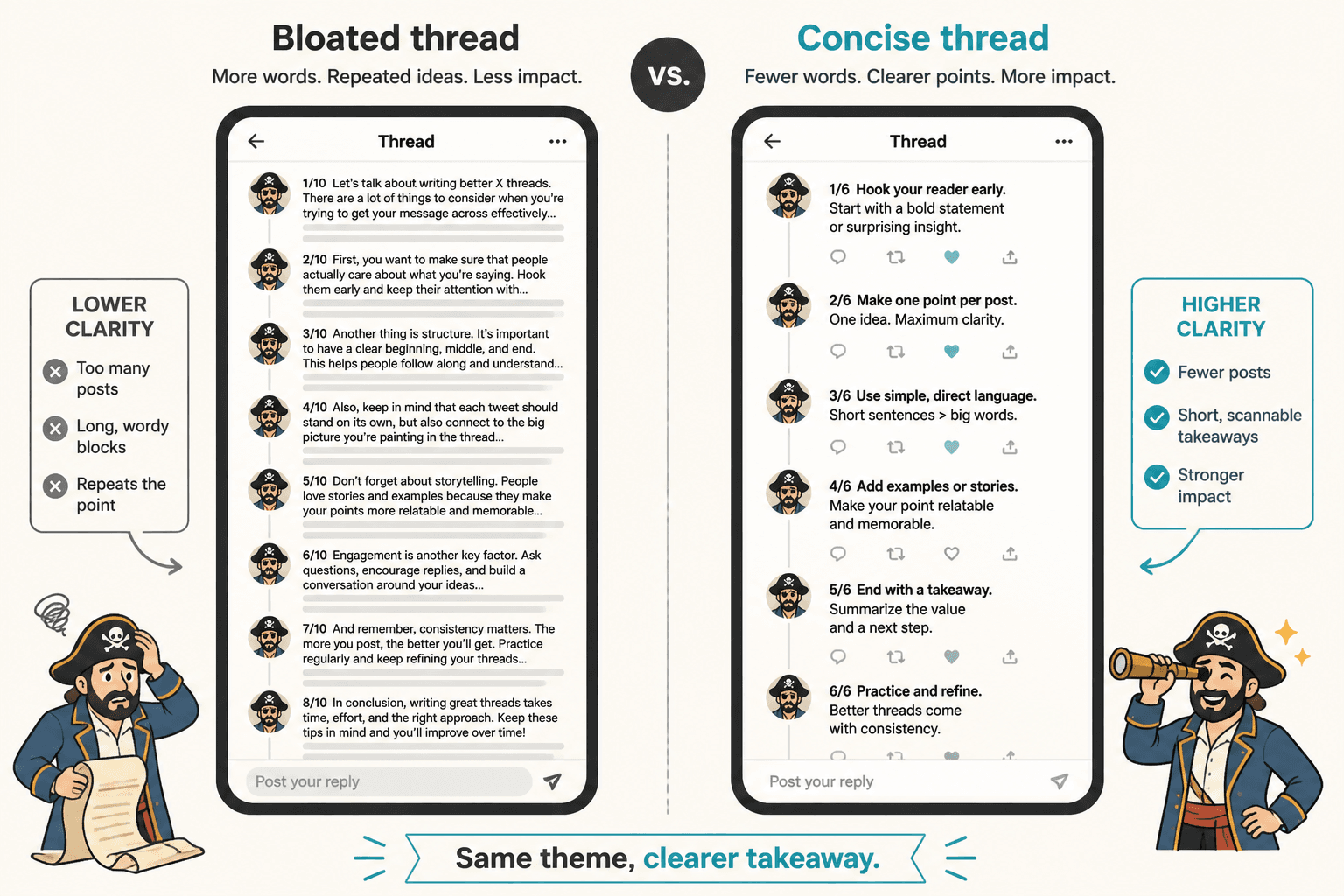
Weak version: 18 posts on why creators should focus on quality over quantity, including repeated points about burnout, audience trust, consistency, originality, and “showing up with value.”
Better short version:
- Post 1: Most creators do not have a consistency problem. They have a quality control problem.
- Post 2: Posting more does not fix weak ideas. It just distributes them faster.
- Post 3: A good post needs one clear point, not seven acceptable ones.
- Post 4: Quantity helps when you are testing. It hurts when you are publishing filler to feel productive.
- Post 5: If your content is getting polite silence, post less for a week and make each piece sharper.
- Post 6: The goal is not more posts. It is more posts worth remembering.
Same theme. Better thread. Cleaner takeaway. Less beige fog.
When a long X thread is still the right move
Short threads are not superior by default. Some ideas genuinely need room.
A longer thread usually makes sense when:
- You are teaching a multi-step process
- You need examples to make the point credible
- The topic has real nuance and compression would make it misleading
- You are breaking down a case study, framework, or teardown
- The thread is acting as a mini-guide with genuine depth
The key is that the extra length must create extra clarity or proof. Not just more words. If your longer thread is actually doing useful work, great. Keep it long. If it is adding fluff, caveats, and decorative transitions, cut it back.
If you are wrestling with exact thread length, this related guide on how long X threads should be in 2026 can help you think in ranges instead of fake rules.
Common mistakes that make short threads fail
Some writers hear “keep it short” and publish a thread so undercooked it barely qualifies as a thought. Short is not the same as lazy.
1. The hook is stronger than the thread
This happens all the time. Big dramatic opener. Tiny obvious payoff.
If the hook promises a strong insight, the thread needs to deliver an actual distinction, example, or useful angle. Otherwise it feels like bait with office lighting.
2. The thread ends before the reader gets anything usable
You can be too brief. If the thread only states a claim without showing why it matters or how to apply it, it may read like a vague opinion dressed up as expertise.
A good short thread still needs substance. Usually that means one of three things:
- A concrete example
- A useful contrast
- A specific implication or action
3. Every post sounds the same
Compression should create momentum, not monotony. If each post has the same cadence, same sentence shape, and same level of abstraction, the thread feels flat even if it is short.
Vary the rhythm. Mix claims with examples. Use one crisp line where it helps. Then move on.
The bigger point is simple: clearer structure and clearer writing make the piece more useful. That is usually what makes the ending land better too.