
Most X threads do not fail because the writer lacks expertise. They fail because the thread is bloated, vague, or clearly trying to smuggle in a pitch wearing fake value as a disguise.
That is especially common with coaches, consultants, and personal brands. You know your subject. You probably have client stories, frameworks, strong opinions, and useful lessons. But when it comes time to turn that into a thread, the result often becomes one of two things: a boring mini-blog chopped into tweets, or a dramatic hook followed by 14 posts that say almost nothing.
This guide gives you practical X Threads Examples for Coaches, Consultants, and Personal Brands that actually fit how people read on X: fast, skeptical, distracted, and always one swipe away from leaving. You will get thread structures, example formats, rewrite ideas, and ways to make your threads sharper without turning into a fake internet prophet.
If you want more platform-specific help, start with the broader guide to X threads, then pair this article with ideas on better thread topics and examples, stronger CTA endings, and templates and tools for X threads.
For the full path around this topic, head to the parent guide.
What makes an X thread worth reading
A good thread has movement. It does not just stack information. It creates momentum.
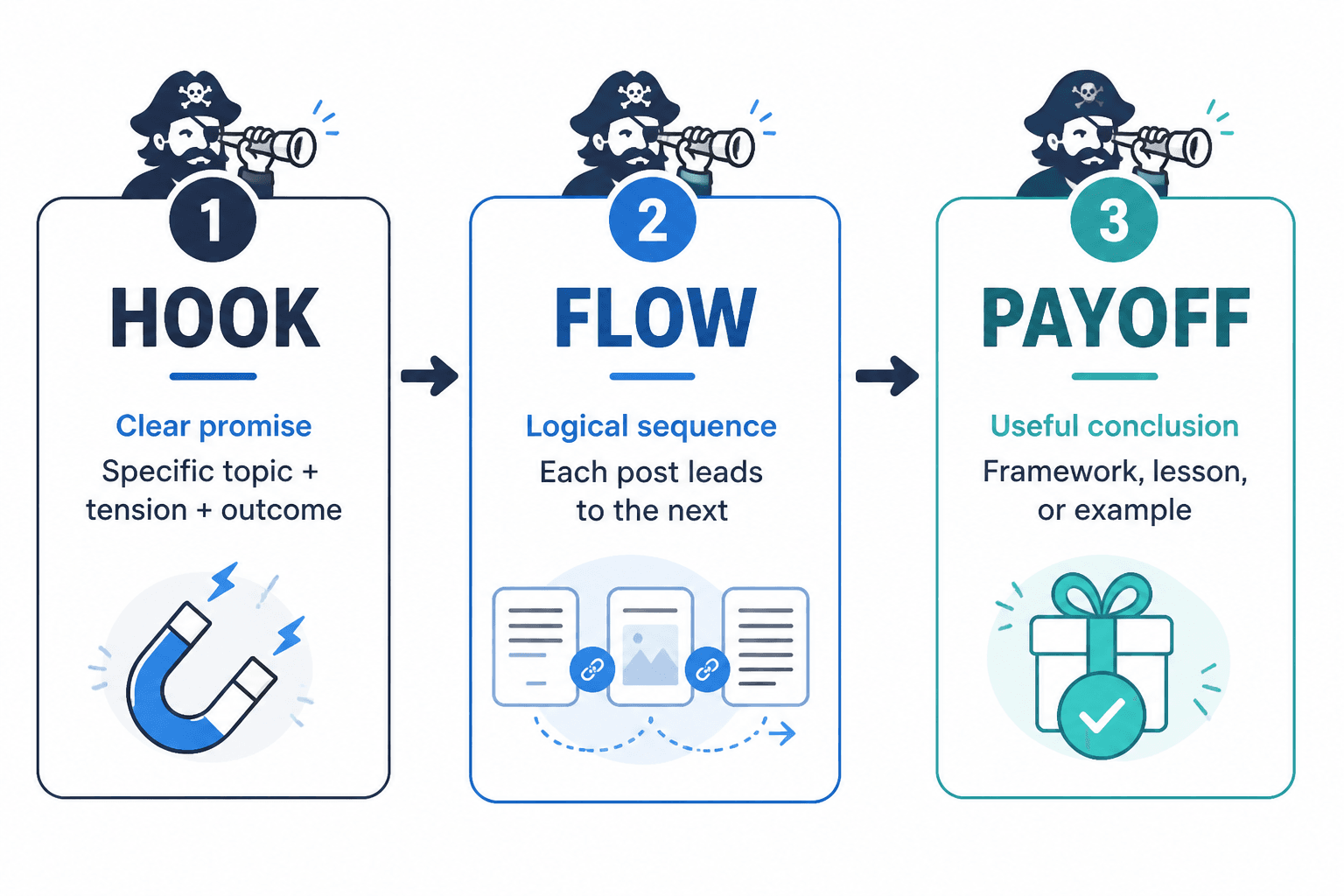
On X, that usually means the thread does at least three things well:
- Starts with a clear promise that feels specific enough to earn attention
- Builds in a logical sequence so each post pulls the reader into the next one
- Ends with a useful payoff, not a lazy “follow for more” dropped like a napkin on the floor
For coaches, consultants, and personal brands, the best threads usually do one of four jobs:
- Teach a useful framework
- Break down a mistake your audience keeps making
- Show how you think through a problem
- Use a specific story or example to prove a larger point
That last part matters. People do not just buy information. They buy judgment. A thread is one of the easiest ways to show yours.
The biggest mistakes in X threads for service-based personal brands
Before the examples, here is what keeps most threads weak.
1. The hook promises too much and says too little
Things like “10 harsh truths about business” or “Nobody talks about this” are not strong because they are dramatic. They are usually weak because they could mean anything.
A stronger hook names the actual topic, tension, and payoff.
Weak: Nobody talks about why most coaches stay stuck
Stronger: Most coaches do not have a content problem. They have an offer clarity problem. Here are 7 signs that is what is actually slowing growth.
2. The thread repeats one point 12 different ways
This is thread bloat. It happens when someone has a decent idea but not enough structure. So they stretch. Readers can feel that immediately.
If five posts in your thread could be deleted without changing the point, delete them.
3. The payoff is hidden behind filler
If the best part of the thread shows up in post 11 after eight throat-clearing posts, most people will never reach it. The thread has to earn continuation fast.
4. The CTA sounds like an exhausted growth hack
“Like, comment, repost, follow, DM me THREAD, bookmark this, and join my newsletter” is not a CTA. It is a hostage situation.
One clear next step works better.
5 high-performing thread types to steal intelligently
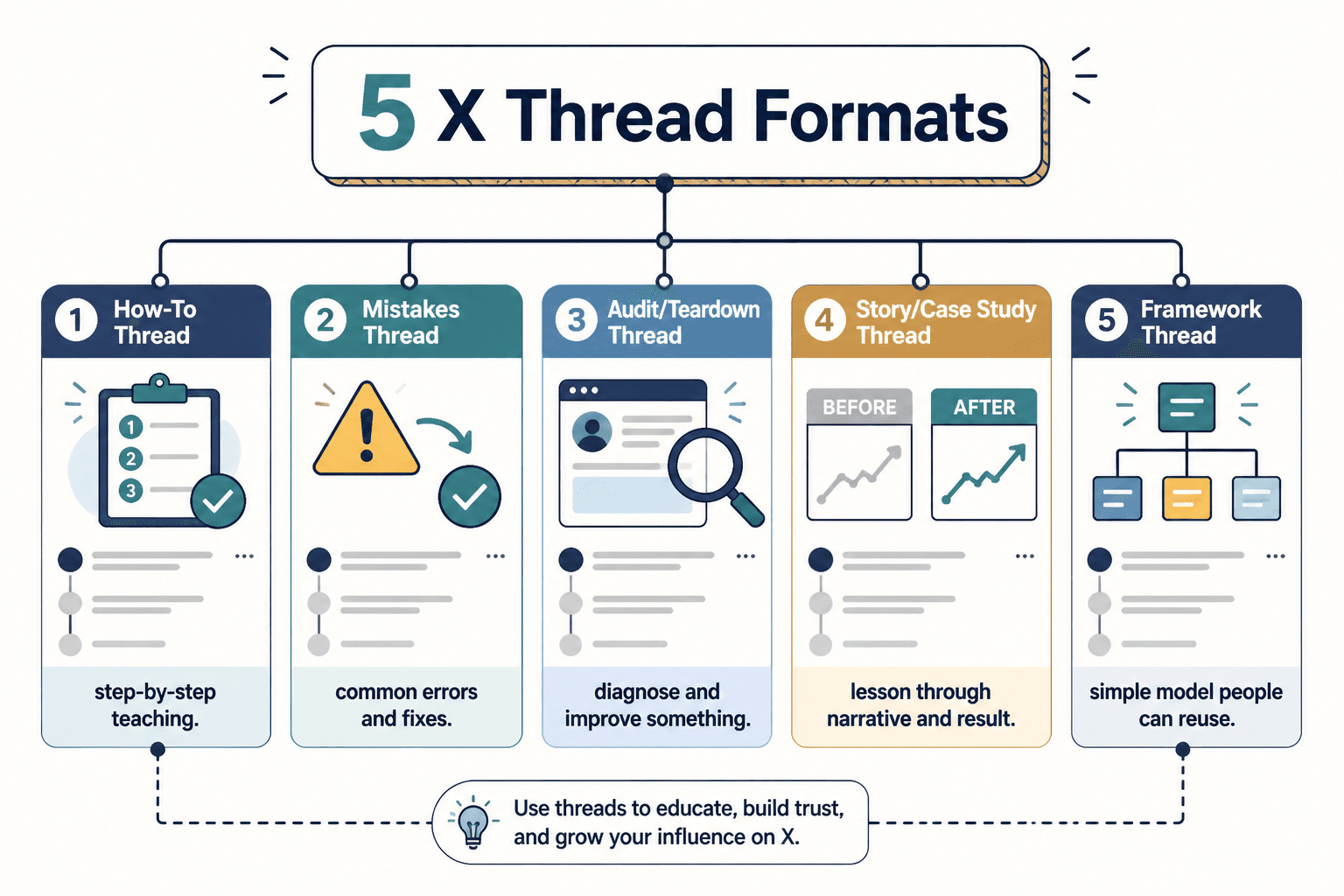
You do not need endless creativity. You need a few reliable formats that fit your expertise. Here are five thread types that work especially well for coaches, consultants, and personal brands.
1. The mistake breakdown thread
This works because it starts with tension. People want to know what they are getting wrong, especially if the mistake sounds expensive, common, or slightly embarrassing.
Best for: consultants, strategists, marketers, coaches, copywriters, brand experts
Basic structure:
- Hook: name the mistake and who it affects
- Context: explain why the mistake happens
- Breakdown: list the signs, versions, or consequences
- Fix: show what to do instead
- CTA: offer the next useful step
Example:
Most consultants are not losing leads because their service is weak.
They are losing leads because their content sounds smart but does not make the buyer feel understood.
7 signs your content has this problem:
1. You explain your method before naming the client’s actual frustration.
2. Your posts teach, but never diagnose.
3. Your examples sound polished but not real.
4. Your bio says what you do, not who it is for.
5. Your CTA asks for a call before trust exists.
6. Your content uses broad business language instead of buyer language.
7. Your offer sounds useful, but not urgent.What works better:
Start with the pain your buyer already recognizes.
Use examples that feel specific enough to be true.
Make the next step small and obvious.If your content gets polite likes but weak leads, that is usually the gap.
2. The framework thread
This is one of the cleanest ways to show expertise without sounding preachy. You are not just sharing opinions. You are giving people a usable model.
Best for: business coaches, marketing consultants, brand strategists, systems people, productivity experts
Basic structure:
- Hook: name the result and framework
- Brief context: when to use it
- Walk through each step with one sharp explanation
- Add a mini example
- End with how to apply it
Example:
If a post is not converting attention into trust, I usually check 4 things:
The C.A.R.E. framework:
1. Clarity
Can a stranger understand the point in one read?2. Authority
Does the post sound like experience, or recycled advice?3. Relevance
Does the audience care about this now?4. Ease
Is the next step obvious and low friction?Quick example:
Weak post: “Consistency matters in content marketing.”
Better post: “If your content is useful but still not bringing leads, your problem may not be consistency. It may be that every post sounds like general advice for everyone.”Same topic. More clarity. More relevance. More authority.
3. The opinion thread with receipts
This is where personal brands can stand out. Strong opinions work on X, but only if they are supported. Without proof or logic, they just read like caffeine with Wi-Fi.
Best for: founders, coaches, creators, consultants with a defined point of view
Basic structure:
- Hook with the opinion
- Explain why you believe it
- Back it with examples, client patterns, or observed mistakes
- Address the obvious objection
- Close with the practical takeaway
Example:
Hot take, but not fake dramatic hot take:
Most personal brands do not need more content pillars.
They need stronger angles.
Why:
You can post under 5 neat categories all day and still sound interchangeable.
What makes content work is not the bucket.
It is the sharpness of the point.“Mindset” is not an angle.
“Why most mindset content makes smart people feel inspired and change nothing” is an angle.“Marketing tips” is not an angle.
“Why consultants keep posting useful content that attracts peers instead of buyers” is an angle.Categories organize content.
Angles make it worth reading.
4. The story-to-lesson thread
A story thread works when it earns the lesson. Not when it uses a dramatic setup just to arrive at a bland moral like “keep going.” People have heard enough of that.
For service businesses, a small business moment, client pattern, behind-the-scenes decision, or content experiment often works better than trying to write like a memoirist trapped in a sales funnel.
Basic structure:
- Start with the moment or tension
- Show what happened
- Explain what you learned
- Translate that into a useful principle
- End with the reader application
Example:
I once rewrote a consultant’s X bio and pinned post without changing the offer.
No new lead magnet.
No new funnel.
No ad spend.Just sharper positioning.
What changed:
The bio stopped listing credentials and started naming the audience.
The pinned post stopped sounding impressive and started explaining the actual result.
The CTA became one clear next step.Result: better profile visits, better inbound messages, fewer vague calls.
The lesson:
People do not respond to “experienced professional helping businesses grow.”
They respond to clarity they can recognize instantly.
5. The mini-consulting thread
This is one of the best thread formats for consultants and coaches because it demonstrates how you think. It feels like getting a free sample of your judgment, not just your information.
Basic structure:
- Name the problem
- Break down what is likely causing it
- Show how you would approach fixing it
- Keep the advice concrete
- Offer the next step naturally
Example:
If a coach told me, “My posts get some likes but no calls booked,” here is where I would look first:
1. The posts may be educational but not buyer-relevant.
Useful does not always mean desired.2. The profile likely does not complete the sale.
If the bio is vague, the attention leaks there.3. The CTA may be too big too early.
Cold readers rarely jump straight to “book a strategy call.”4. The offer may sound broad.
People trust specialists faster.My fix would be:
Sharpen the post angles.
Tighten the profile.
Lower CTA friction.
Make the offer easier to grasp in one sentence.Traffic is only useful if the next steps make sense.
X Threads Examples for Coaches, Consultants, and Personal Brands by niche
The best examples are not just structurally solid. They also fit the business model. Here are niche-specific thread ideas you can adapt.
Business coach
- 7 reasons your content is attracting attention but not clients
- The 5 stages of a coaching offer that people actually understand
- What I would fix first in a coach’s sales process if calls are not converting
- Why general mindset content gets applause but not purchases
Brand strategist
- 5 signs your positioning is too vague to sell well
- A simple messaging framework for personal brands who sound interchangeable
- Why “authenticity” is not a brand strategy, and what to use instead
- Before-and-after examples of weak vs strong positioning lines
Copywriter or content consultant
- 8 hook mistakes that make good ideas die quietly
- How to turn one client result into 10 sharp post angles
- The difference between useful content and content that creates demand
- How I rewrite boring authority posts so they actually sound alive
Leadership or executive coach
- What smart leaders do in meetings that weak communicators avoid
- 7 phrases that quietly kill trust inside teams
- Why executive presence advice is often vague nonsense
- A framework for giving feedback without sounding soft or theatrical
Solo founder or personal brand operator
The bigger point is simple: clearer structure and clearer writing make the piece more useful. That is usually what makes the ending land better too.
Threads usually land better when each step builds cleanly and the ending makes the whole point feel worth the read.