
Most boring X threads are not boring because the writer lacks knowledge.
They are boring because the thread makes the reader work too hard to find the point. The opening is soft. The structure wanders. The posts repeat themselves. By tweet seven, the reader is trapped in a hallway of “also” and “another thing” with no reason to keep walking.
If you want to know how to rewrite boring X threads, start there. The problem usually is not that the thread needs more detail. It needs more shape, more tension, and less verbal furniture.
Here’s how to make your threads sharper, faster to read, and much more worth finishing. We’ll go through the rewrite process, what to cut, what to strengthen, and how to turn a limp thread into something people might actually read, save, and click.
If you want the broader playbook first, this pairs well with X threads writing guidance and how to write better X threads. But if your current drafts already exist and they just feel dead on arrival, rewriting is the move.
To see how this fits into the wider strategy, open the parent guide.
Why boring X threads fail so fast
X is not kind to slow starters.
People do not approach threads with patience and a tea ceremony. They scan. They decide quickly. They keep going if the thread promises one of three things: a strong opinion, a useful payoff, or a specific curiosity gap.
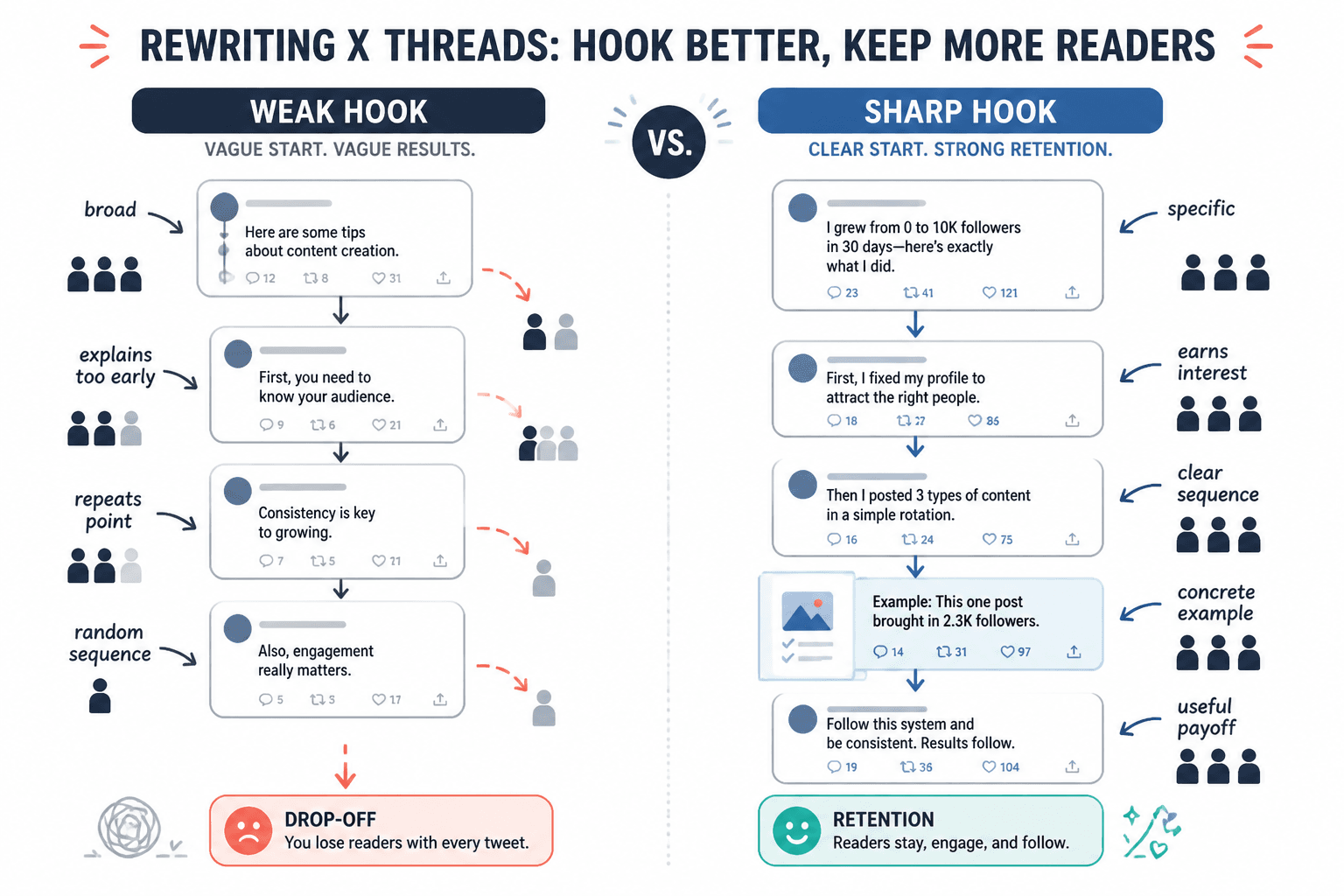
Boring threads usually fail on at least one of these fronts:
- The hook says something broad instead of specific
- The thread starts explaining before earning interest
- Multiple tweets make the same point in slightly different outfits
- The sequence feels random
- The examples are abstract or generic
- The ending arrives with no payoff or asks for a follow before delivering value
This is why rewriting matters so much on X. Small changes in compression and sequence can completely change how the thread feels. A decent idea can look weak if the packaging is sloppy. A sharp rewrite can make the exact same idea feel clearer, smarter, and more useful.
The rewrite test: find the actual point first
Before touching a single line, ask one rude but necessary question:
What is this thread actually trying to prove, teach, or argue?
If you cannot answer that in one sentence, the rewrite will stay mushy.
A lot of boring X threads are really three threads mashed together. The writer has a topic, a few observations, a couple of examples, and a CTA floating around at the end like a shopping bag in the wind. That is not a thread. That is notes pretending to be content.
Write the core point in one line before you rewrite.
- Weak: “A thread about content strategy”
- Better: “Most creators ruin threads by stuffing them with points instead of building one clean argument”
- Weak: “Things I learned about audience growth”
- Better: “Small accounts grow faster on X when their threads are narrower, sharper, and easier to quote”
The rewrite gets easier when the thread has one job.
How to rewrite boring X threads step by step
1. Rewrite the hook so it earns the second tweet
Most weak threads die in the first tweet because the opening sounds like an introduction instead of a reason to continue.
Bad hook patterns show up constantly:
- “Here are some thoughts on…”
- “A quick thread about…”
- “I’ve been thinking a lot about…”
- “10 lessons I learned from…”
- “Most people do not realize…”
These are not hooks. They are throat-clearing with punctuation.
Your first tweet should do one or more of these:
- Make a sharp claim
- Name a specific mistake
- Promise a practical payoff
- Create contrast
- Surface tension
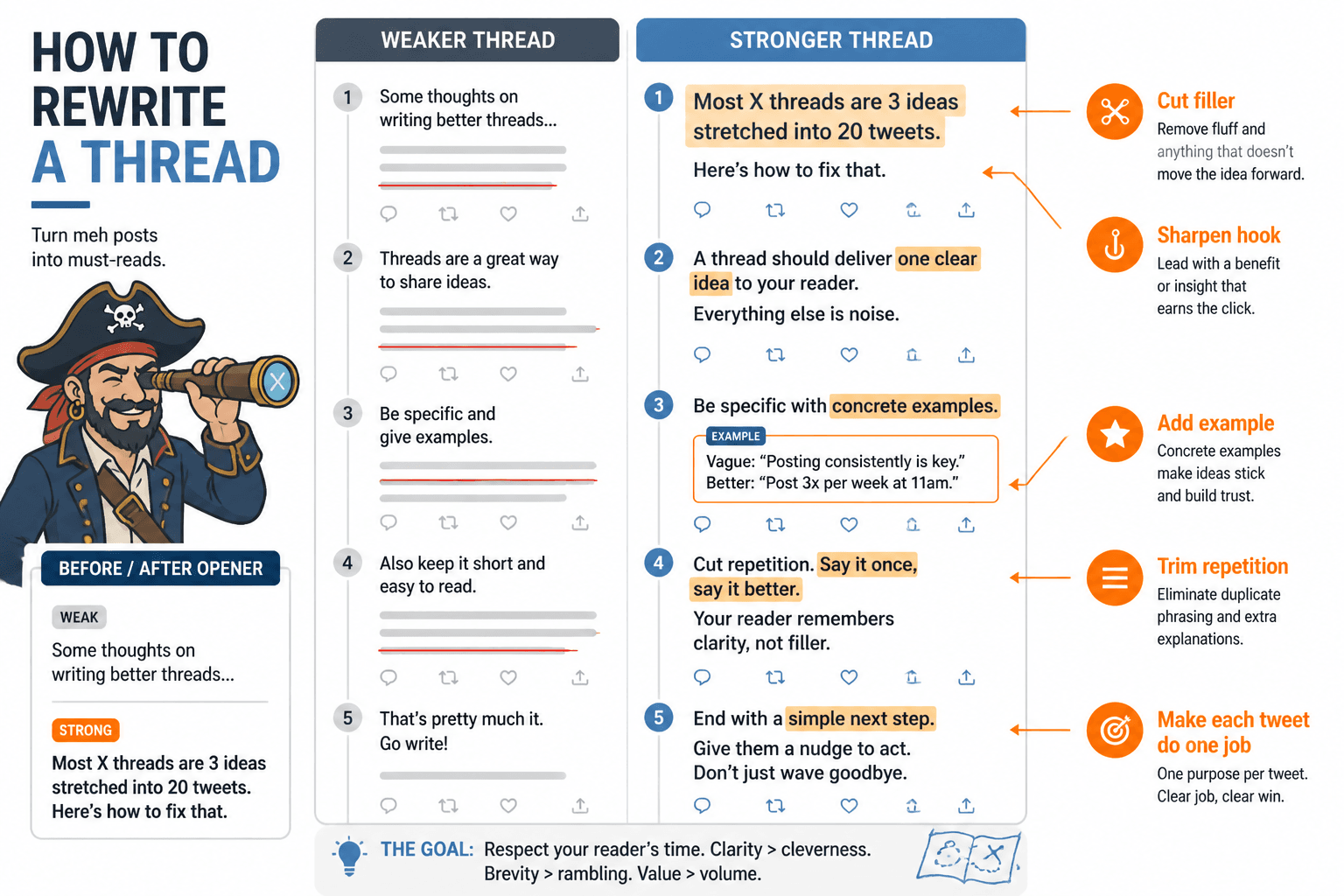
Before: “A thread on writing better content that connects with your audience”
After: “Most content does not fail because the idea is bad. It fails because the packaging makes it too easy to ignore. Here’s how to fix that in your X threads.”
Before: “10 things I learned from writing threads for 6 months”
After: “The fastest way to kill an X thread is to cram 10 decent points into one bloated mess. Strong threads usually make one point well.”
If your openings are chronically weak, read how to start X threads without a weak opening. It will save you from writing another first tweet that politely asks for permission to exist.
2. Cut any tweet that does not move the thread forward
This is where most rewrites get better fast.
Go through the draft tweet by tweet and ask:
- Does this add a new idea?
- Does this deepen the previous point?
- Does this provide proof, contrast, or clarity?
- Would the thread lose anything important if I deleted it?
If the answer to that last question is no, cut it.
Boring threads often contain filler tweets like these:
- Restating the same point more gently
- Adding an obvious sentence for “flow”
- Explaining something the reader already understands
- Trying to sound wise instead of being useful
X rewards momentum. Every tweet should either tighten the screw or open the point further in a useful way. If a tweet just sits there looking decorative, remove it.
3. Turn lists into arguments
One reason threads feel boring is that they read like random bullet points stacked vertically.
A better thread has movement. One point leads to the next. The reader can feel why tweet four follows tweet three.
That does not mean every thread needs to be dramatic. It does mean the sequence should make sense.
Weak thread structure:
- Tip 1
- Tip 2
- Tip 3
- Random opinion
- Another tip
- CTA
Stronger thread structure:
- State the core problem
- Explain why people get it wrong
- Show the better principle
- Break that principle into a few clear parts
- Give an example or rewrite
- Land the point with a clean CTA or next step
That is what makes a thread feel guided rather than dumped.
For a deeper structure breakdown, link this with how to improve X threads thread structure without sounding generic.
4. Replace vague lines with specific ones
Vagueness is one of the fastest ways to make a thread feel forgettable.
Compare these:
Vague: “You need to understand your audience better.”
Specific: “If your audience is consultants, stop writing threads like you are speaking to every creator on the internet. Consultants respond to clarity, proof, and practical outcomes, not vague inspiration.”
Vague: “Consistency is important.”
Specific: “Posting twice a week with a clear point beats posting daily threads that read like diluted notes from your shower.”
Specificity adds friction in a good way. It gives the reader something to react to, remember, or quote. It also helps you sound like a person with a point of view instead of a bot trained on recycled productivity posts.
5. Add proof, contrast, or example before asking the reader to agree
A thread becomes boring when it asks the reader to trust too many unsupported claims.
If you make a point, strengthen it with one of these:
- A mini example
- A before-and-after rewrite
- A contrast between weak and strong approaches
- A short hypothetical
- A concrete observation from platform behavior that is broad and safe
Weak: “Shorter threads often perform better.”
Better: “A 7-tweet thread with one tight argument often beats a 22-tweet thread padded with definitions, disclaimers, and repeated advice. People finish what feels purposeful.”
You do not need fake data or algorithm cosplay. You just need enough texture to make the point believable.
6. Compress every tweet until it feels deliberate
X is not allergic to nuance. It is allergic to drag.
When rewriting, tighten sentences aggressively:
- Cut setup phrases
- Remove repeated qualifiers
- Use one strong sentence instead of two soft ones
- Delete words that only make the thought sound safer
Before: “I think one thing that can sometimes be helpful when writing threads is trying to make sure each post has a clear purpose.”
After: “Each tweet needs a job. If it does not have one, cut it.”
Before: “It is also worth mentioning that adding examples can make your thread more engaging and easier for people to understand.”
After: “Examples keep threads from sounding like recycled advice.”
That does not mean every line should sound macho and over-polished. It means weak phrasing should not be taking up rent-free space.
7. Rewrite the ending so it lands instead of fading out
A lot of threads end like this:
- “Hope this helps”
- “What do you think?”
- “Follow for more”
- “Let me know if this resonated”
That is not a landing. That is the content equivalent of shrugging near a door.
A stronger ending does one of three things:
- Restates the core point in a sharper way
- Gives the reader a specific next action
- Directs them to a relevant related resource
Weak ending: “Follow for more content tips.”
Better ending: “Before you publish your next thread, delete every tweet that only repeats the last one. Your best point usually shows up sooner than you think.”
Better ending with internal next step: “If your thread idea is solid but the sequence still feels messy, read this guide on thread structure next.”
A practical before-and-after thread rewrite
Here is a condensed example of how to rewrite boring X threads in practice.
Original version:
- “A quick thread on content creation.”
- “Content creation is important for building your brand.”
- “You should know your audience.”
- “You should be consistent.”
- “You should also provide value.”
- “It helps to have a strategy.”
- “Thanks for reading. Follow for more.”
This thread is not wrong. It is just aggressively unmemorable.
Rewritten version:
The bigger point is simple: clearer structure and clearer writing make the piece more useful. That is usually what makes the ending land better too.