
Most bad X threads do not sound robotic because they used AI. They sound robotic because they were built from the same dead template as everyone else.
You have seen the type. Big promise. Numbered tips. Zero texture. A suspiciously tidy lesson in every post. Then a soft little sales pivot at the end pretending not to be a sales pivot at all.
People can feel that from miles away. Not because they are thread experts. Because humans are pretty good at spotting when a post was engineered to extract attention instead of say something worth reading.
If you want to learn How to Write X Threads Without Sounding Salesy or Robotic, the fix is not “be more authentic.” That advice has done enough damage already. The fix is to write with sharper ideas, better structure, more specificity, and a cleaner relationship to promotion.
Here is how to make your threads sound like an actual person with a point, not a content machine in a hoodie.
If you want the bigger picture, start with the parent guide.
Why X threads start sounding fake in the first place
A lot of creators think robotic writing is mainly a style problem. Too stiff. Too polished. Too many em dashes and “here are 7 lessons.” Sure. Sometimes that is part of it.
But the deeper issue is that many threads are reverse-engineered from a growth goal, not a useful idea. The writer starts with “how do I make this perform?” or “how do I slide people toward my offer?” and only then tries to find content to stuff inside that container.
That is why the thread feels hollow. The structure came first. The thinking showed up late. And the reader can tell.
On X, that problem gets exposed faster because the platform rewards compression. Weak thinking has fewer places to hide. If your thread opening is vague, your points are recycled, and your final post suddenly asks people to buy something, the whole thing feels like content cosplay.
Good threads feel like guided thinking. Bad threads feel like someone stitched together a carousel and broke it into tweets.
Start with a point, not a format
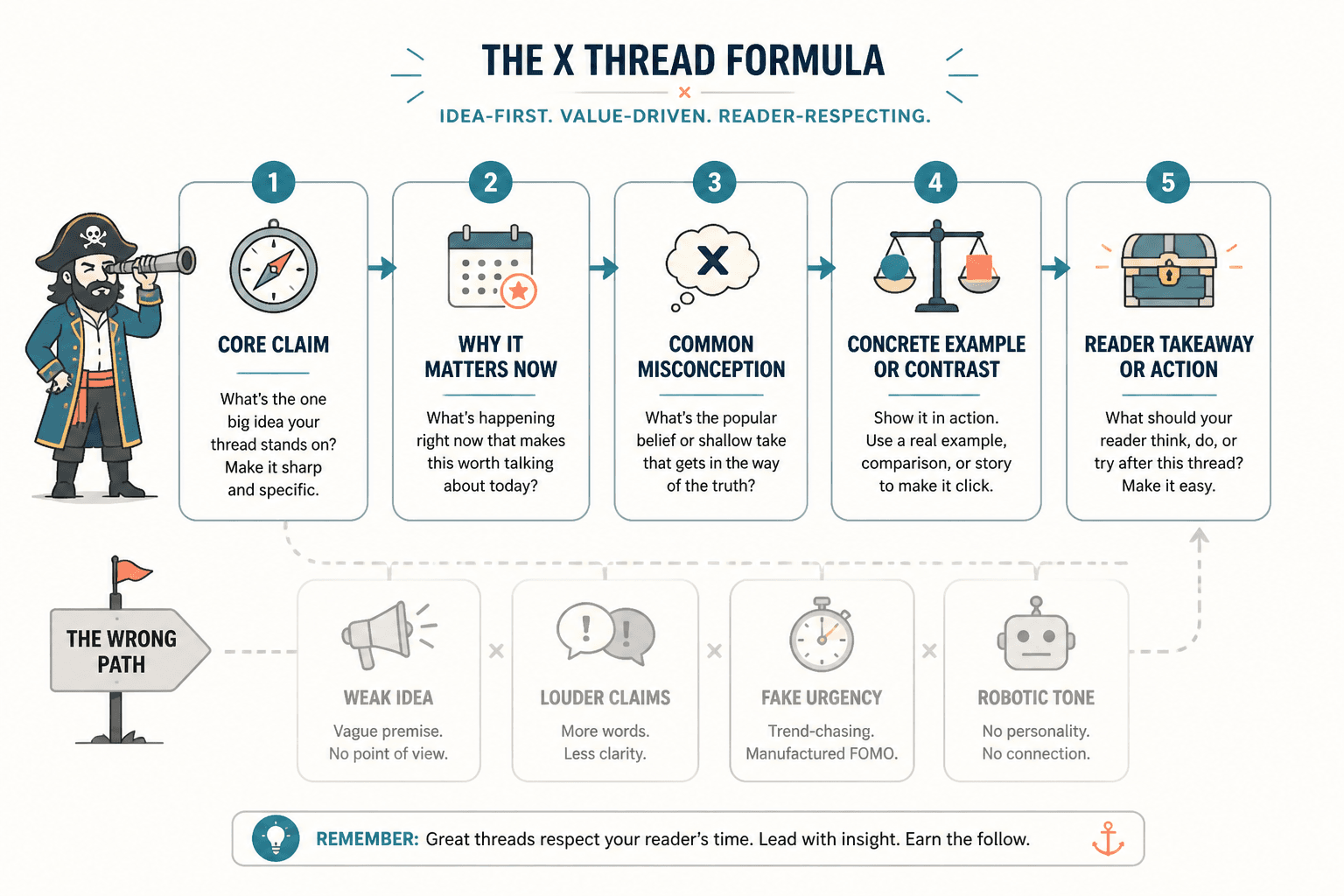
If you want your thread to sound human, start by deciding what you actually believe, know, noticed, tested, or disagree with.
Not what format you want to use. Not how many posts it should have. Not which hook formula is trending. The point comes first.
Ask these before you write
- What is the actual claim I am making?
- Why does this matter to the reader now?
- What do people usually get wrong about this?
- What specific example, observation, or contrast makes this clearer?
- What should the reader think, do, or avoid after reading it?
If you cannot answer those cleanly, you do not need a better thread template. You need a better idea.
This is also where a lot of “salesy” threads go wrong. The writer does not really have one strong insight, so they compensate with intensity. Bigger claims. Harder CTA. More urgency. More fake certainty. It is basically content contouring.
Instead, build from something solid and the writing gets more natural almost by accident.
Write the thread like a sequence, not a pile
One reason threads sound robotic is that every post is trying to sound complete on its own. So you get 12 mini-posts lined up in a trench coat pretending to be a thread.
A strong X thread has momentum. Each post earns the next one. There is movement. A thread should feel like it is taking the reader somewhere, not just dropping facts on their shoes.
If you want a deeper breakdown on sequencing, this pairs well with how to improve X thread structure without sounding generic and how to write better X threads.
A simple thread sequence that sounds more natural
- Hook: Make a clear claim, tension, or promise.
- Setup: Explain the problem, mistake, or context.
- Main points: Unpack the idea in logical steps.
- Proof or example: Show what you mean.
- Payoff: Land the lesson, takeaway, or implication.
- CTA: Suggest a next step that fits the thread.
That sequence works because it mirrors how people actually think. Claim. Reason. Evidence. Meaning. Next move.
Robotic threads often skip setup and proof. They jump straight from promise to bullet points to pitch. Efficient, yes. Convincing, not really.
Use cleaner openings and stop acting mysterious
X rewards sharper openings than most platforms. If the first post is soft, vague, or dressed up like fake intrigue, people leave.
The safest way to sound robotic is to open with a line that sounds like it was bred in a content lab.
Openings that usually feel stale
- Here’s what nobody tells you about X
- I spent 5 years learning this the hard way
- Most people do this wrong
- If you are not doing this, you are missing out
- This changed everything for me
Those are not always unusable. They are just heavily overworked and usually too vague to earn interest.
Stronger thread openings
- Most X threads do not fail because they are too short. They fail because every post sounds like it was approved by committee.
- If your thread needs 14 posts to explain one obvious point, the problem is not the algorithm.
- The fastest way to make your thread sound salesy is to hide a pitch inside “value.” People can smell that immediately.
- A thread does not need more tips. It needs a cleaner argument.
See the difference? The stronger versions have a point of view. They say something specific enough to create tension. They do not rely on fog and hand waving.
If you want to sharpen this part specifically, read how to start X threads without a weak opening.
Specificity is what makes you sound human
Generic advice sounds robotic even when a human writes it. That is the annoying part.
If your thread says things like “be consistent,” “provide value,” “build trust,” or “know your audience,” you are not writing badly. You are just saying things nobody can do much with.
Specificity gives your writing texture. It makes the reader think, “okay, this person has actually noticed something.” It also makes your thread more quotable, because clear observations travel better than vague wisdom.
Generic vs specific
| Weak | Better |
|---|---|
| Make your thread more engaging | Cut any post that repeats the previous one in slightly different words |
| Tell stories | Use one small real scenario to prove the point instead of claiming the point harder |
| Provide value first | Give the reader one framework, one example, or one decision they can use today |
| Have a good CTA | End with a next step that matches the thread instead of lunging into a product plug |
Specific writing does not need to be long. It just needs to be concrete enough to picture, test, or apply.
Stop overexplaining every point
Plenty of robotic threads are not too short. They are too padded.
This happens when the writer is trying to sound thorough, credible, or educational, so each point gets restated three different ways. That kills rhythm. It also makes the thread feel like it was optimized for perceived value instead of actual clarity.
On X, one strong line can do more than four explanatory ones. You do not need to squeeze every angle of a thought into the same thread. Leave a little air. Trust the reader to connect obvious dots.
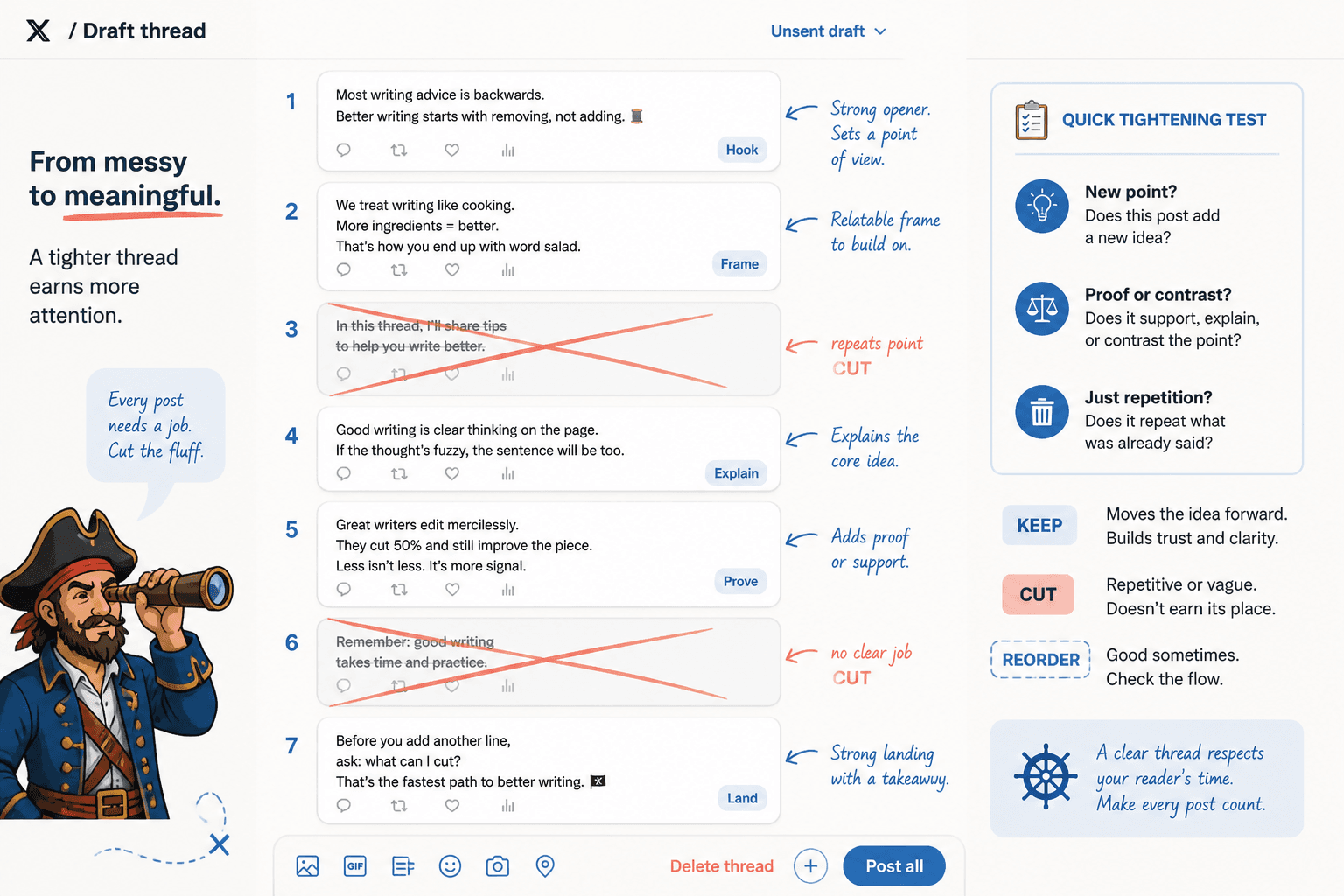
Quick tightening test
- Does this post introduce a new point?
- Does it deepen the previous point with proof or contrast?
- Or is it just repeating the same idea in cleaner shoes?
If it is the third one, cut it.
X threads work better when each post has a job. Hook. Frame. Explain. Prove. Land. If a post has no clear job, it is probably filler.
Salesy usually means the pitch showed up before trust did
Here is the blunt version: promotion is not the problem. Premature promotion is the problem.
Readers do not mind knowing you sell something. They mind feeling like the whole thread existed just to march them toward it.
That is why some threads with direct CTAs still work fine, while others feel grimy. The difference is whether the thread stands on its own. If the reader gets real value, clear thinking, or a useful shift in perspective even if they never click, the CTA feels fair.
Signs your thread is getting salesy
- The hook promises education but the thread is mostly lead-in for your offer
- You keep hinting at your product instead of making the idea useful by itself
- The final post abruptly changes tone from helpful to funnel-ish
- You are using urgency, scarcity, or drama to compensate for weak relevance
- The CTA asks for too much, too fast
What to do instead
- Teach one useful thing completely enough to stand alone
- Mention your offer only if it naturally extends the thread
- Use a CTA that fits the reader’s intent and awareness level
- Keep the tone consistent from start to finish
A thread about fixing weak hooks can reasonably end with “If you want more help with thread writing, follow for more.” It can also end with “I put together a deeper breakdown in my guide.”
What it should probably not do is spend 11 posts vaguely teaching and then hit the reader with “DM ME ‘GROWTH’ to join my premium system before prices rise tonight.” Relax.
Use CTAs that feel like a next step, not a trapdoor
A good thread CTA is aligned with the thread, the platform, and the level of trust you have earned.
It does not need to sound clever. It needs to sound proportional.
Better CTA options for X threads
- Follow if you want more threads on writing, positioning, and content that actually converts
- If this hit a problem you are dealing with, reply and tell me where your threads are getting stuck
- I wrote a deeper thread on this here if you want the structural version
- If you want help applying this to your content, my profile has the next step
Notice what these do not do. They do not fake intimacy. They do not overpromise. They do not act like reading one thread means the reader is now spiritually ready to buy your flagship offer.
That softer, cleaner transition matters. Especially on X, where people are moving fast and have low patience for funnel choreography.
A before-and-after rewrite
Before
How I built a high-converting content system in 30 days:
1. I got clear on my niche
2. I created value-packed content
3. I stayed consistent
4. I used calls to action
5. I built a personal brand
If you want to do the same, DM me “SYSTEM”
This is not just boring. It feels suspicious. The points are generic, the hook is self-focused, and the CTA is doing all the heavy lifting.
After
Most “content systems” are just messy posting with better branding.
What actually made mine easier to run was this:
1. I picked 3 repeatable post types instead of reinventing every post
2. I matched each type to a job: reach, trust, or leads
3. I kept a swipe file of hooks, examples, and CTAs so I was not drafting from zero
4. I stopped trying to sell in every post and used my profile as the bridge
That shift made the system simpler and the writing less forced.
If you want, I can post the exact structure next.
The bigger point is simple: clearer structure and clearer writing make the piece more useful. That is usually what makes the ending land better too.