
Most X threads do not flop because the writer lacked insight. They flop because the opening tweet walked in half-asleep, cleared its throat, and said something vague enough to be ignored by everyone with a pulse.
A weak thread opening kills momentum before the thread even starts. On X, people are moving fast, judging hard, and giving you about half a second to prove this will be worth their attention. If your first tweet sounds like filler, a diary entry, or a recycled “here’s what I learned” setup, the rest of the thread barely matters.
So if you want to know how to start X threads without a weak opening, the fix is not “be more clever.” It is to make the first tweet do an actual job. It needs to create tension, promise a payoff, and make the right reader think, “Yep, I need that.”
This is where a lot of thread writers get lazy. They know the body of the thread. They have useful points. Then they slap on an opening that sounds like a warm-up lap. X does not reward warm-up laps. It rewards sharp starts.
Here’s how to write thread openings that pull people in without sounding gimmicky, robotic, or like you stole them from a thread-writing bro with a ring light and a superiority complex.
If you want the bigger picture, start with the parent guide.
What a strong X thread opening actually needs to do
The first tweet in a thread is not there to introduce yourself politely. It is not there to announce that a thread is happening. And it definitely is not there to gesture vaguely at value.
A strong opening usually does three things:
- Names a specific problem, insight, or outcome
- Creates enough curiosity to earn the next click or tap
- Signals that the thread will be concrete, not fluffy
That last part matters more than people think. Readers on X have seen too many threads that promise a lot and deliver seven reheated clichés and a pitch. Your opening has to suggest substance fast.
Think of the first tweet as a compact sales page for the rest of the thread. Not salesy. Just persuasive. Its job is simple: make continuing feel like the smart choice.
Why most thread openings feel weak
Weak openings usually have one of four problems. Sometimes all four, which is honestly impressive in a bleak sort of way.
1. They start with throat-clearing
Throat-clearing is all the language that appears before the actual point.
- “I have been thinking a lot about…”
- “Wanted to share some thoughts on…”
- “A quick thread on…”
- “Here are a few things I learned…”
None of that helps. It just delays the useful part.
2. They are too vague
If your thread opener could apply to 900 other threads, it is probably too soft.
Compare these:
Here’s what content creation taught me about business.
If your content gets attention but no clients, your problem probably is not reach. It is that your posts sound useful and your offer sounds blurry.
The second one has tension. It says something. It picks a lane.
3. They promise “value” without a real payoff
People say things like:
- “10 tips for better writing”
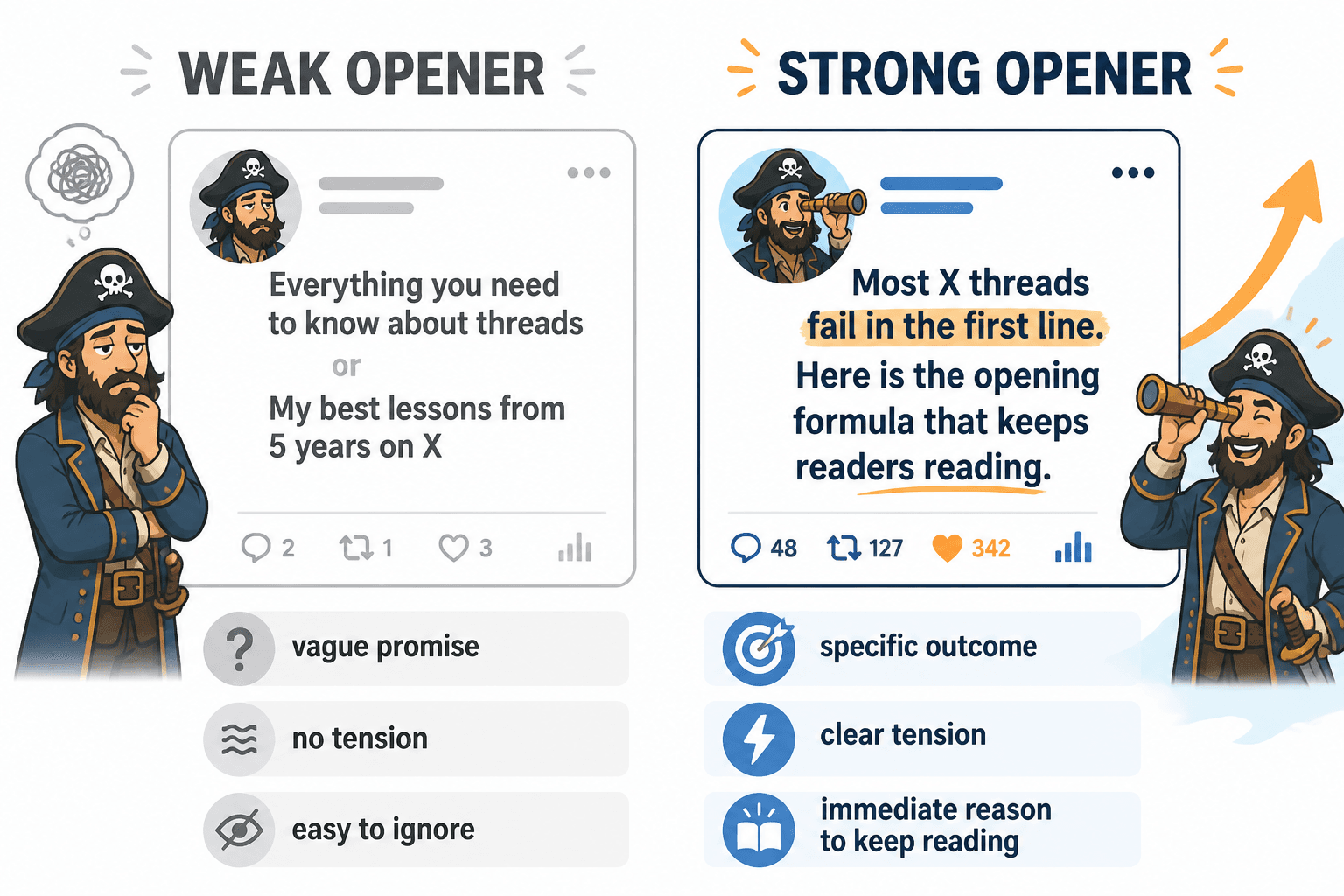
- “Everything you need to know about threads”
- “My best lessons from 5 years on X”
That is technically a promise. It is also incredibly easy to ignore. “Value” is not a hook. Specific value is.
4. They sound borrowed
X is packed with openings that sound like they came from the same stale template folder:
- “Nobody talks about this, but…”
- “I wish I knew this earlier…”
- “Most people do not realize…”
- “Here’s the thread you need…”
These are not unusable. They are just tired. If you use them, you need a genuinely strong angle right after them. Otherwise the whole thing feels mass-produced.
How to start X threads without a weak opening
If you want stronger starts, stop thinking “How do I introduce this thread?” and start thinking “What is the sharpest useful thought I can lead with?”
That shift changes everything. Your opening should not ease into the topic. It should enter the topic at the most interesting point.
Lead with the tension, not the setup
The best thread openings often begin with friction:
- A mistake people keep making
- A result they want but are missing
- A belief that sounds right but fails in practice
- A contrast between what people do and what works
For example:
Most X threads are not too short. They are too padded. People bail because the payoff could have been one post and a decent nap.
That opener has a point of view. It creates curiosity. It promises that the thread will explain what better looks like.
Make the outcome concrete
If the thread helps people do something, say what it is clearly.
Weak:
A thread on writing better online.
Stronger:
If your thread opening does not give people a reason to keep reading, the rest of your ideas are stuck behind a locked door. Here’s how to write first tweets that earn the next click.
Now the reader knows what problem is being solved and what the thread will help them do.
Use specificity that signals substance
Specificity makes a thread feel more believable and more useful. You do not need to stuff numbers into every opening, but details help.
Weak:
How to write better hooks on X.
Stronger:
Most weak thread hooks fail for one reason: they describe the topic instead of selling the payoff. Here’s a simple way to fix that in under 5 minutes.
That is more tangible. It implies there is a method coming, not just motivational wallpaper.
Sound like a person, not a thread template factory
X rewards compression, but that does not mean your first tweet should sound manufactured. You can be concise without sounding like a content machine.
This is often the difference between an opening people trust and one they scroll past. A little edge, a little clarity, and a little actual voice go a long way.
For more on making threads feel natural instead of stiff, it’s worth reading how to write X threads without sounding salesy or robotic.
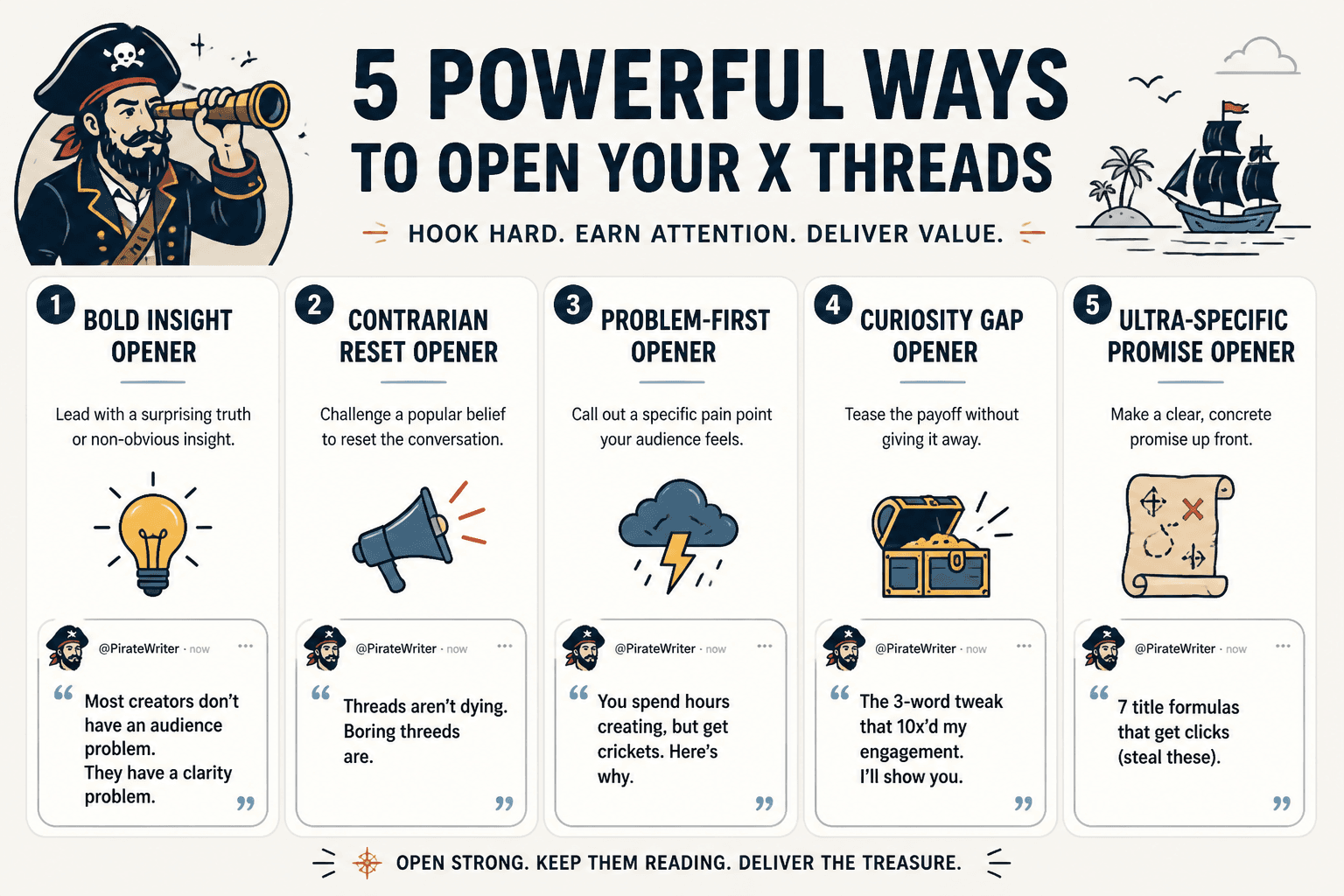
5 opening styles that work on X
You do not need one magic formula. You need a few reliable opening types you can adapt based on the idea.
1. The blunt problem opener
This starts with the pain point or failure directly.
If your threads get impressions but no replies, saves, or follows, the problem probably is not the algorithm. The opening tweet is just not giving people enough reason to care.
Why it works: it names a familiar frustration and points at a fix.
2. The sharp opinion opener
This works well when you have a point of view and can defend it in the thread.
Most thread advice makes writers worse. It trains them to sound polished, padded, and weirdly lifeless. Better threads start with clarity, not theatrics.
Why it works: strong opinions create tension fast. Just make sure the thread actually backs it up.
3. The mistake-and-fix opener
This is one of the most practical formats because it gives the reader an immediate reason to continue.
Writers keep starting threads by announcing the topic instead of selling the next tweet. Here’s how to fix that without sounding clickbaity.
Why it works: it frames the thread as corrective and useful.
4. The outcome-with-contrast opener
This opener contrasts what people usually do with what works better.
You do not need a dramatic first tweet to get people into your thread. You need a clearer one. Here’s how to write openings that create curiosity without sounding like bait.
Why it works: it cuts through a bad assumption and offers a better standard.
5. The ultra-specific promise opener
Useful when the thread teaches a process, framework, or repeatable tactic.
Here’s the 3-part test I use to tell if a thread opener is strong enough: clear problem, implied payoff, and enough tension to earn tweet two.
Why it works: it makes the thread feel organized and actionable.
Before-and-after rewrites of weak thread openings
Sometimes the easiest way to improve your opening is to see what changed.
Rewrite 1
Before:
A thread on what I learned from writing online for 2 years.
After:
Writing online for 2 years taught me one annoying truth: good ideas do not spread just because they are good. Packaging does a lot of the heavy lifting. Here are the lessons that actually changed my results.
What improved: clearer tension, stronger point of view, more credible payoff.
Rewrite 2
Before:
Here are 7 tips for writing threads that get engagement.
After:
Most “engaging” threads are just long enough to be annoying and vague enough to be forgettable. Here are 7 ways to make your threads tighter, sharper, and much harder to scroll past.
What improved: more voice, more tension, stronger implied transformation.
Rewrite 3
Before:
Nobody talks about how hard it is to write good hooks.
After:
Weak hooks usually are not missing “creativity.” They are missing direction. If the first tweet does not hint at a real payoff, people bounce. Here’s how to fix that fast.
What improved: less cliché, more substance, better setup for the thread.
A simple 4-step process for writing better first tweets
If your opening feels limp, do not just tweak adjectives and hope. Use a cleaner process.
The bigger point is simple: clearer structure and clearer writing make the piece more useful. That is usually what makes the ending land better too.