
Most people try to improve offer messaging by staring harder at a blank page.
Bad plan.
If you have already published posts, emails, articles, captions, sales pages, client replies, FAQs, or even mildly unhinged Notes app drafts, you are probably sitting on better positioning material than whatever polished nonsense you were about to force into your homepage.
How to Turn Old Content Into Better Offer Messaging & Positioning is really about this: stop inventing your message from scratch, and start extracting it from the places where your real ideas, strongest language, and audience response already exist.
Old content is useful because it shows you three things fast: what you keep saying, what people actually respond to, and what your offer probably should have been emphasizing all along. That is gold. Slightly messy gold, but still gold.
This article will show you how to mine your existing content for sharper offer messaging, clearer positioning, better proof, and stronger language you can actually use on your website, sales pages, bio, and funnel. Without sounding like you swallowed a branding workshop whole.
For the full path around this topic, head to the parent guide.
Why old content is one of the best sources for offer messaging
Your old content is not just content. It is evidence.
It shows the gap between what you thought your business was about and what people consistently paid attention to. And that gap matters, because strong positioning usually comes from observed reality, not brainstorming theater.
When you review old content, you can spot:
- Repeated themes and opinions
- Problems you explain especially well
- Phrases your audience echoes back to you
- Posts or emails that generated replies, leads, or sales
- Ideas that make your work feel distinct instead of interchangeable
- Language that sounds like you, not like a beige consultant template
That is the raw material of positioning. Not “we help purpose-driven entrepreneurs unlock aligned growth.” That sentence should probably be fined.
If your current message feels vague, flat, or weirdly detached from how you actually talk, your archive can fix that. It is often more honest than your latest attempt at sounding strategic.
What to collect before you start
Do not make this complicated. You are not building a research lab. You are gathering proof of what your audience, your content, and your work have already been telling you.
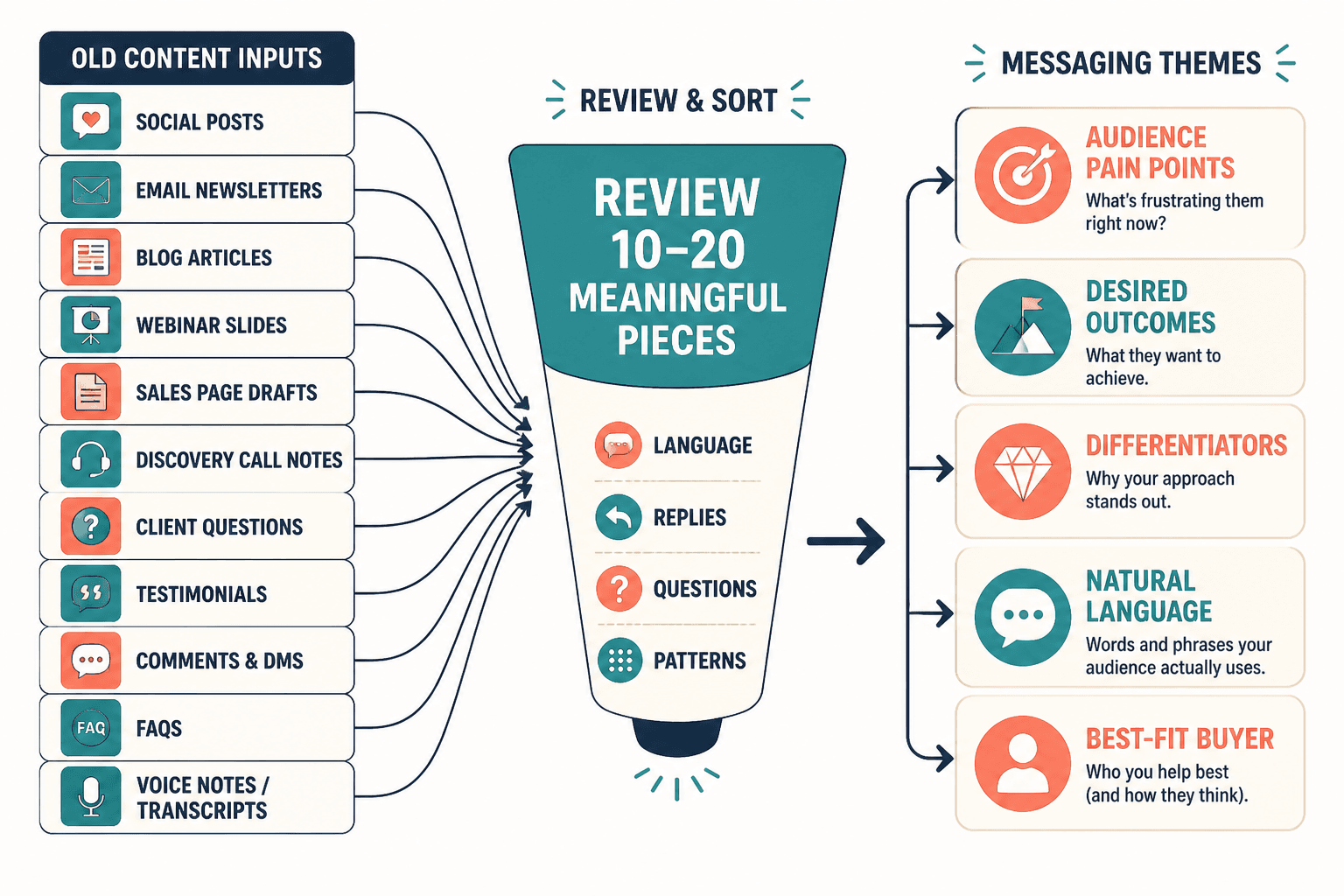
Pull together anything that contains your thinking, your language, or audience reaction:
- High-performing social posts
- Email newsletters
- Articles and blog posts
- Webinar outlines or workshop slides
- Sales page drafts
- Discovery call notes
- Client questions
- Testimonials
- Comments and DMs
- FAQ answers
- Voice notes or transcript snippets
You do not need all of it. Start with 10 to 20 pieces that feel meaningful. A mix is better than a mountain.
And no, “meaningful” does not only mean viral. A post with modest reach but excellent replies can teach you more about positioning than a broad post that got attention from people who were never going to buy anything.
What you are actually looking for
When people audit old content, they often just look for “popular stuff.” Useful, but incomplete.
You are looking for patterns that help answer five positioning questions:
- Who is this really for?
- What problem do I keep talking about most clearly?
- What outcome do I seem best at helping with?
- What makes my approach different?
- What language feels natural and gets traction?
That is the work. Everything else is support.
1. Repeated audience pain points
Look for recurring frustrations, bottlenecks, and complaints. Not generic problems. Specific ones.
For example:
- Not “people struggle with content”
- More like “people keep posting useful advice that gets ignored because the packaging is weak”
That second version is closer to messaging. It has tension, specificity, and a clearer angle.
2. Repeated outcomes
What result keeps showing up in your best material?
Not your broadest possible promise. Your most believable and useful one.
- More qualified leads
- Clearer authority
- Better conversion from profile traffic
- Simpler message
- Faster content creation
- More trust from the right audience
If your old content keeps orbiting one outcome, there is a good chance your positioning should emphasize it more directly.
3. Repeated contrasts and opinions
Your strongest positioning often hides inside your strongest disagreements.
Check for places where you regularly contrast your method with what people usually do wrong:
- Visibility vs trust
- More content vs better packaging
- Traffic vs conversion
- Templates vs thinking
- Polish vs clarity
- Audience growth vs buyer relevance
Those contrasts are useful because they make your offer feel sharper. Positioning needs edges. Not drama for the sake of drama, but enough contrast to make your approach feel like an actual choice.
4. Audience language you should steal immediately
If clients, leads, readers, or subscribers keep describing their problem in a certain way, pay attention. That language belongs in your messaging more than whatever branding phrase you made up during a coffee-fueled identity spiral.
Examples:
- “I sound smart, but not clear.”
- “My offer makes sense in conversation, not on the page.”
- “People like my content, but they do not buy.”
- “I have too many ideas and no clean message.”
Those are not just comments. They are homepage subheads, sales page bullets, and email subject line material.
A simple process for turning old content into better offer messaging and positioning
You do not need an elaborate brand strategy retreat for this. A clean working doc and some pattern recognition will do nicely.
Step 1: Pull your strongest content into one place
Create a simple document or sheet with columns like:
- Content piece
- Topic
- Main problem mentioned
- Main outcome mentioned
- Notable phrase
- Audience reaction
- Offer relevance
You are trying to reduce chaos into patterns. Nothing glamorous. Very useful.
Step 2: Highlight exact phrases worth keeping
As you review each piece, copy over the lines that feel sharp, clear, and alive.
Good lines usually do one of these things:
- Name a problem cleanly
- Express an opinion with confidence
- Explain an outcome simply
- Distinguish your approach from the usual advice
- Sound like something only you would say that way
Do not paraphrase yet. Save the exact wording first. You can refine later. If a line has traction and sounds human, keep it intact as long as possible.
Step 3: Group what keeps repeating
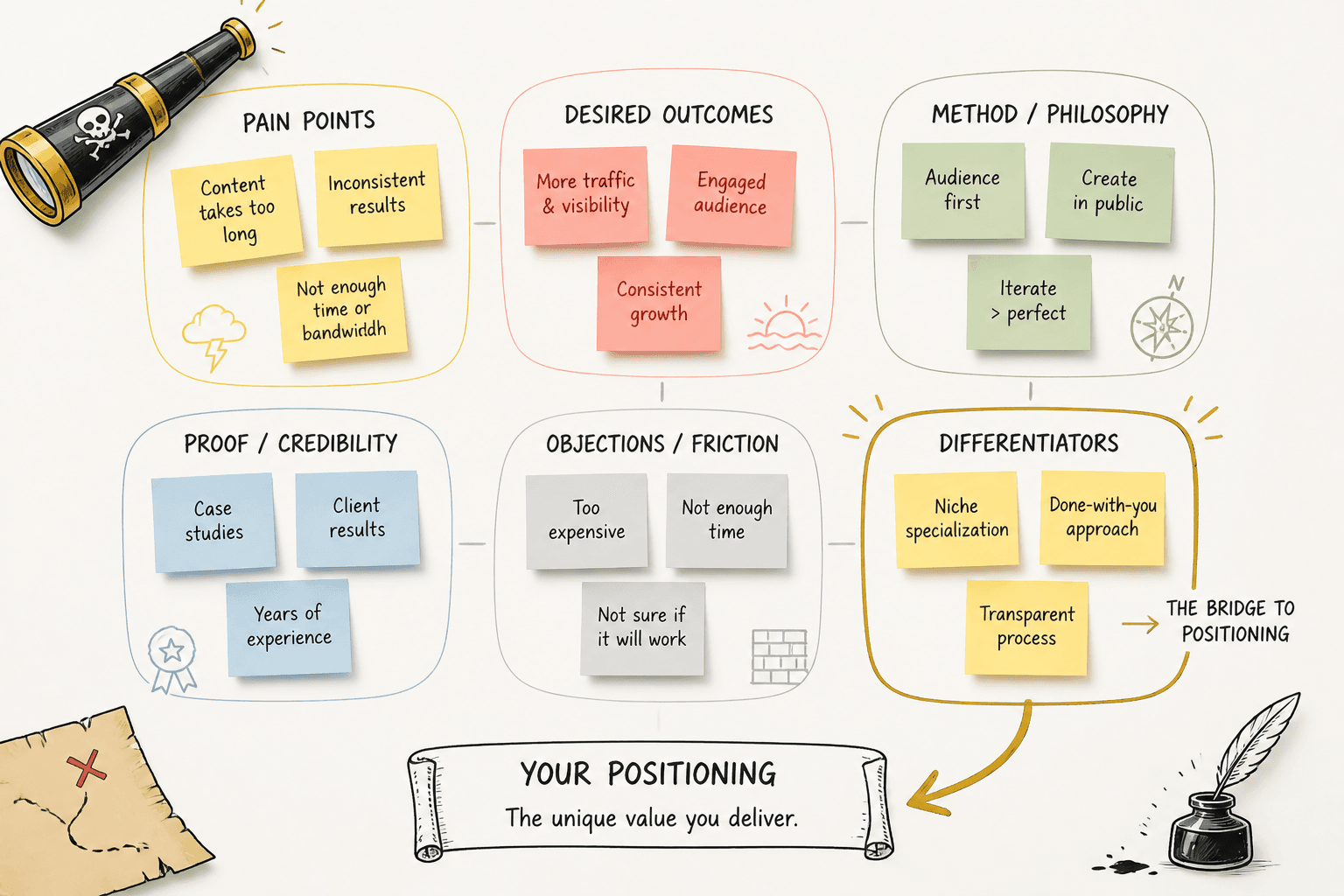
Once you have enough material, cluster it into themes.
You will usually start seeing groups like:
- Audience problem themes
- Desired outcome themes
- Method or philosophy themes
- Proof and credibility themes
- Objection or friction themes
This part matters because one good post can be a fluke. Twelve posts pointing at the same problem probably are not.
Step 4: Turn the patterns into positioning statements
Now take those clusters and write rough statements for:
- Who you help
- What they are struggling with
- What you help them achieve
- How your approach differs
- Why they should trust you
Simple example:
I help creators and service businesses whose content gets polite attention but weak conversion turn their message into clearer positioning, sharper offers, and sales copy that actually pulls its weight.
That is not perfect. It does not need to be. It just needs to be truer and more specific than “I help brands grow online.”
Step 5: Build offer messaging from what is already proven
Once the positioning is clearer, you can build or refine your offer message around it.
Pull from your archive to answer these practical website-copy questions:
- What exact problem is urgent enough to matter now?
- What have you said before that makes this feel solvable?
- What process, lens, or method keeps showing up in your best work?
- What proof can you point to?
- What objection keeps appearing?
- What next step feels natural instead of pushy?
This is where old content becomes sales asset material, not just archive clutter.
What this looks like in practice
Here is a simplified before-and-after so this does not stay trapped in theory.
Before: generic positioning
“I help personal brands grow with strategic content and authentic messaging.”
Technically fine. Practically fog.
What the old content reveals
- Your best posts are about why “valuable content” still fails to convert
- Clients often say they have expertise but cannot explain their offer clearly
- Your strongest opinions are about clarity beating volume
- Your testimonials mention sharper messaging, better leads, and easier sales conversations
- Your audience replies most when you talk about offers that sound smart but not buyable
After: sharper positioning
“I help creators, consultants, and personal brands turn scattered expertise into clear offer messaging people actually understand, trust, and buy.”
Already better. More specific audience. Clearer problem. Cleaner outcome.
After: offer messaging angle
“If your content sounds smart but your offer still feels fuzzy, I help you clarify your positioning, tighten the message, and turn that expertise into copy that pulls in better-fit leads.”
That version likely came from ideas you were already expressing, just not using in the places where buying decisions happen.
Where to use the messaging you extract
Once you have better language, do not leave it sitting in a notes doc like a forgotten gym membership.
Use it across the places that shape attention and conversion:
- Homepage headline and subhead
- Offer page opening
- About page positioning section
- Bio and profile copy
- Email opt-in page
- Lead magnet landing page
- Sales emails
- Call booking page
- Social media profile tagline
- Content CTA language
The point is consistency without stiffness. When your content, profile, and offer all use related language and reinforce the same idea, trust builds faster. Things click faster too.
What to keep, what to cut
Not every old idea deserves to survive. Some of your archive is signal. Some of it is just proof that you were trying your best on a Wednesday.
Keep:
- Specific problem language
- Distinct opinions
- Useful contrasts
- Clear outcomes
- Strong phrases that sound natural
- Proof-backed claims
- Repeated themes with audience response
Cut or rewrite:
- Broad promises you cannot support
- Trendy language you never use in real life
- Anything so vague it could fit 500 other businesses
- Overly clever lines that hide the meaning
- Hot takes with no connection to your offer
- Empty “authenticity” fluff
A good rule: if the line sounds impressive but tells the reader very little, it probably belongs in the bin.
Common mistakes when using old content for positioning
- Only choosing your most viral content. Reach is not the same as relevance.
- Copying your old words without refining them. Extraction is step one, not the final form.
- Keeping every audience segment you ever mentioned. If you try to speak to everyone you have attracted, your positioning gets blurry fast.
- Focusing only on what you like saying. Positioning also has to meet real buyer concerns.
- Ignoring proof. If your old content reveals consistent client outcomes, use them.
- Confusing content themes with offer priorities. Just because you talk about something often does not mean it should be the main promise.
Sometimes you need to zoom out and ask a slightly annoying but necessary question: what in this archive is interesting, and what in this archive is commercially useful? The overlap matters most.
The bigger point is simple: clearer structure and clearer writing make the piece more useful. That is usually what makes the ending land better too.