
Most weak landing page openings are not failing because they are too short.
They fail because they open with vague praise for the offer, generic claims about transformation, or a headline that could sit on 400 other pages without anyone noticing. “Get the results you deserve.” Great. From what? For whom? Why this? Why now?
If you want to know how to start landing pages without a weak opening, the fix is not more hype. It is more clarity, more tension, and a much better understanding of what your reader needs to believe in the first few seconds.
A strong landing page opening does four jobs fast: it tells the right person they are in the right place, makes the problem feel real, points to a believable outcome, and gives them a reason to keep reading instead of bouncing back to their tabs like a startled raccoon.
This article will help you write opening sections that feel sharp, grounded, and conversion-friendly without sounding like you borrowed your copy from a funnel template having an identity crisis. If you also need help with broader landing page strategy, section flow, or rewrites, I’ll point you to those as we go.
For the broader learning path, visit our parent guide.
What makes a landing page opening weak
Weak openings usually have one of three problems.
- They are too broad. The message tries to speak to everyone and lands on no one.
- They are too flattering to the business. Lots of “we help” language, not enough reader reality.
- They are too foggy. The promise sounds nice, but it is not concrete enough to feel trustworthy.
That is why so many landing pages open with technically polished copy that still feels dead on arrival. The words are neat. The meaning is mush.
A weak opening does not give people a reason to continue. It just announces that a page exists.
And no, adding more adjectives does not save it. “Powerful, proven, transformational support” is still fog with better hair.
How to start landing pages without a weak opening
The opening section should answer a few silent reader questions almost immediately:
- Is this for someone like me?
- Does this page understand the problem I actually care about?
- Is the outcome specific enough to matter?
- Does this sound believable?
- Should I keep reading or leave?
You do not need to answer every one of those with a giant block of copy. In fact, please don’t. You just need to build the opening around those questions instead of around your excitement about the offer.
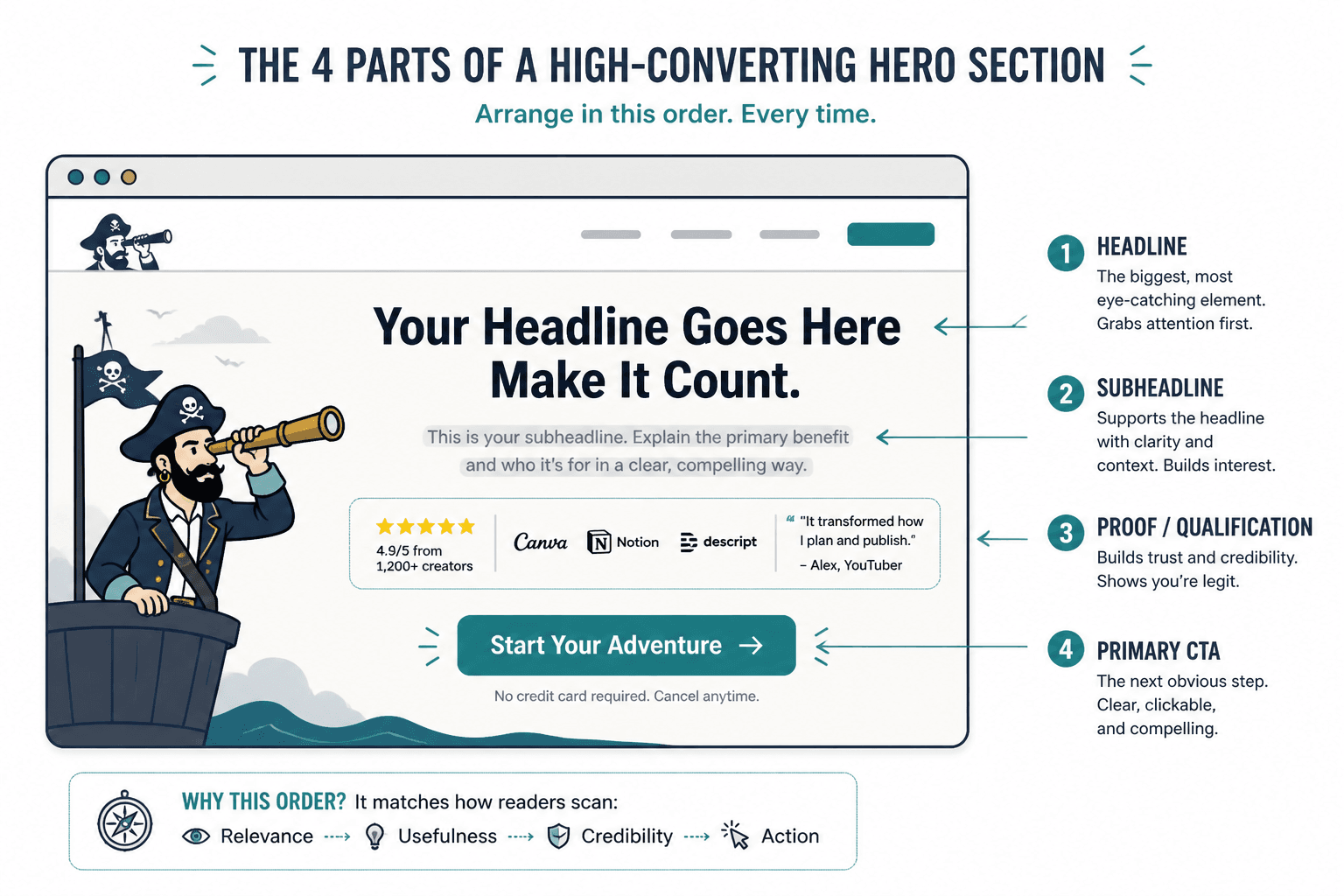
A practical opening usually includes:
- A headline with a clear promise or sharp angle
- A subheadline that adds context, specificity, or tension
- Optional proof, qualification, or positioning
- A call to action that fits the reader’s stage of awareness
That basic structure works because it respects how people actually scan pages. They do not arrive ready to trust you. They arrive ready to judge whether this page seems relevant, useful, and credible. Fair enough.
Start with the problem they already feel
One of the easiest ways to strengthen a landing page opening is to start from the reader’s current frustration instead of your service description.
That does not mean writing melodramatic pain-point copy. You do not need “Are you tired of feeling overwhelmed, stuck, unseen, and deeply misaligned?” Calm down. It means naming the actual friction in language that sounds like a competent adult wrote it.
Weak
We help businesses grow with strategic website solutions.
Stronger
Your site might be getting traffic, but if the message is vague, the structure is messy, and the opening says nothing useful, visitors leave before the page even gets a chance.
The stronger version works because it pulls the reader into a recognisable problem. It creates tension. It makes the next line easier to care about.
Good openings often begin where the reader is losing money, trust, clarity, time, or momentum. Not where you want to list your features.
Make the promise specific enough to believe
Specificity matters because weak openings usually promise an outcome in the blurriest possible language.
“Grow your brand.” “Elevate your message.” “Transform your business.” These phrases survive because they sound ambitious. They also say almost nothing. Readers cannot picture the result, so they do not trust the path.
Specific does not mean complicated. It means the reader can actually imagine what changes.
- Get more qualified discovery calls from your website
- Turn cold landing page traffic into newsletter subscribers
- Help service buyers understand your offer in under 10 seconds
- Replace vague homepage copy with a clearer path to action
Even if your offer covers a broader transformation, your opening should anchor it in something concrete. Broad outcomes can still live lower on the page. At the top, clarity wins.
Use a headline angle, not just a topic
A lot of landing page headlines are technically about the offer, but they have no angle. They just name a service category and hope the reader fills in the rest.
That is how you get headlines like:
- Website Copywriting for Coaches
- Business Messaging Services
- Conversion-Focused Landing Pages
Those are not useless. They are just incomplete. They tell me the lane. They do not give me the reason to care.
A stronger headline usually brings one of these angles:
- Outcome: Turn more visitors into booked calls with a landing page that actually explains what you do
- Problem: If your landing page sounds polished but still does not convert, the opening is probably the issue
- Contrast: Landing page copy for experts who want clarity, not funnel sludge
- Specific audience: Landing pages for coaches and consultants who need clearer messaging, not louder claims
- Time or speed: Fix the first screen of your landing page before you rewrite the whole page
The point is not to be clever. It is to give the headline a job.
If you want more examples, these landing page headline block examples will help you stop staring at a blank screen like it owes you rent.
Build the opening around one core reader thought
Strong opening sections usually work because they are built around one central idea, not five.
When people try to cram the problem, outcome, method, backstory, philosophy, niche, credentials, and CTA into the first screen, the whole thing turns into a copy traffic jam. You do not need to explain everything above the fold. You need to make the next scroll feel worth it.
A useful way to write the opening is to pick one core reader thought and build around it.
- I need this fixed
- This sounds like my situation
- This person gets the real problem
- This outcome is what I actually want
- This feels more credible than the usual fluff
Once you know which thought matters most, the opening gets easier to shape. Everything on that first screen should support that thought instead of wandering off into side quests.
A simple framework for stronger landing page openings
If you want a repeatable way to start, use this four-part framework:
- Call out the situation
Your reader needs to feel seen quickly. - Name the result
Show what changes if the problem gets solved. - Add credibility or distinction
Why this approach, offer, or person? - Give a clean next step
Do not make the CTA sound like a hostage note from an old webinar funnel.
Template
Headline: [Outcome or fix] for [specific audience or situation]
Subheadline: [Problem/tension] + [what makes your solution relevant or different]
Trust line: [proof, scope, credibility, or practical qualifier]
CTA: [clear next step]
Filled example
Headline: Landing page copy that makes your offer easier to trust and easier to buy
Subheadline: If your page sounds polished but still leaves people unsure what you do, who it is for, or why they should care, the problem usually starts in the opening.
Trust line: Strategy-led messaging and conversion copy for coaches, consultants, and service businesses selling expertise online.
CTA: See how the process works
This kind of opening does not need acrobatics. It needs relevance, clarity, and a believable promise.
Before-and-after rewrites
Here is where things usually click. Weak openings often sound “fine” until you see what a sharper version does differently.
Example 1: Generic coach landing page
Before:
Helping ambitious women step into their power and create aligned success.
After:
Business coaching for women who are good at what they do but tired of vague offers, inconsistent leads, and messaging that never quite lands.
Why it works: it swaps abstract self-belief language for concrete business friction. Much easier to trust.
Example 2: Web designer landing page
Before:
Custom websites that elevate your online presence.
After:
Custom websites for service businesses that need clearer messaging, cleaner structure, and more conversion than their current site is giving them.
Why it works: it adds audience, problem, and measurable intent without becoming stiff.
Example 3: Course sales page
Before:
Learn the exact method to grow your audience and scale your income.
After:
Learn how to turn scattered content ideas into a repeatable audience-building system you can actually maintain each week.
Why it works: “scale your income” is distant and slippery. “Repeatable system you can actually maintain” sounds human and useful.
If you need more help cleaning up stale copy, this guide on how to rewrite boring landing pages pairs nicely with this one.
What to include above the fold
You do not need every possible persuasion element in the opening. But you do need enough for the reader to orient themselves.
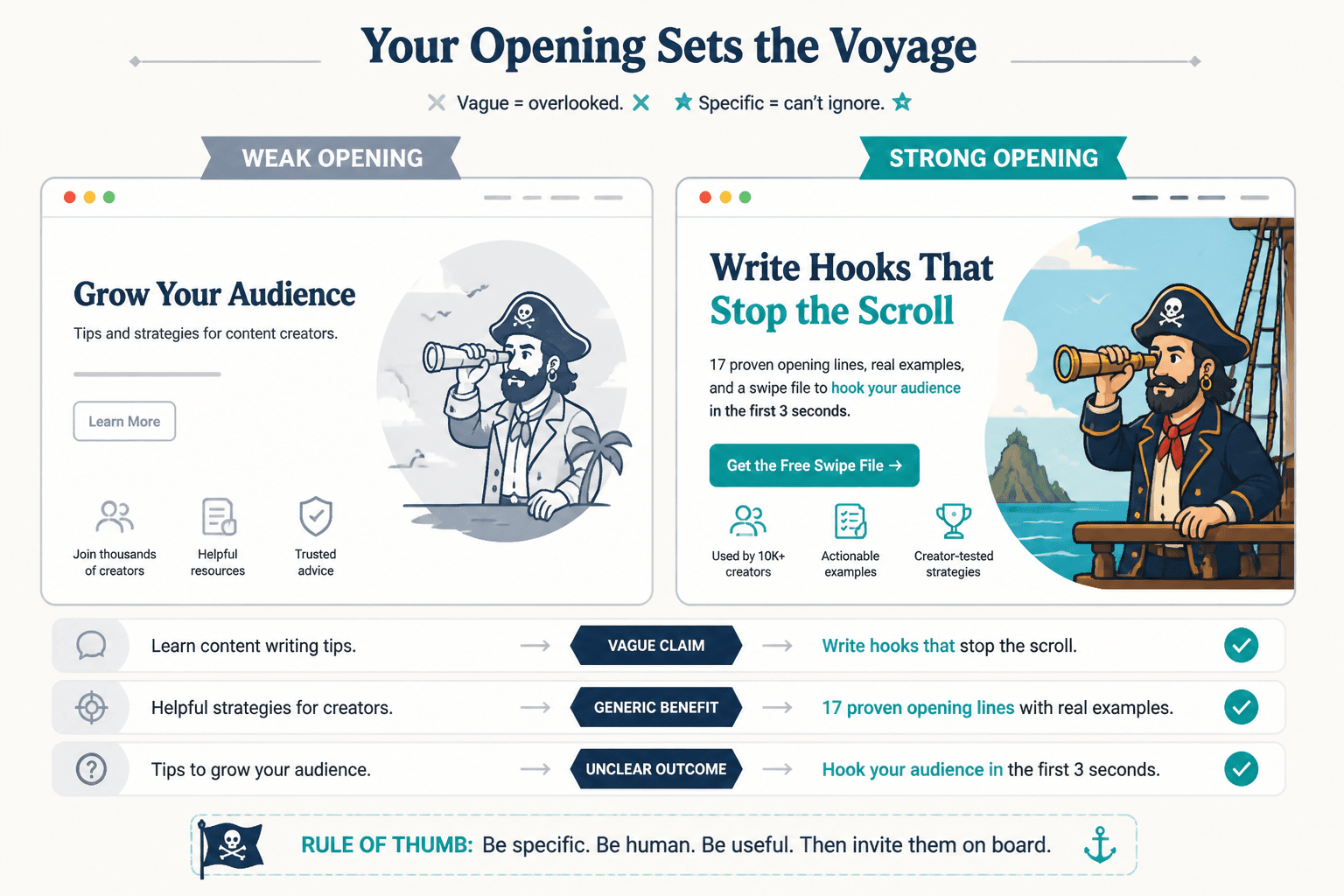
| Element | What it should do |
|---|---|
| Headline | State the promise, problem, or core angle clearly |
| Subheadline | Add context, specificity, or friction |
| CTA | Give a logical next step |
| Proof or credibility line | Reduce skepticism without bloating the section |
| Visual support | Reinforce meaning, not distract from it |
If your above-the-fold section feels flat, the issue is often not missing words. It is missing hierarchy. The reader should instantly see what matters most, what supports it, and what to do next.
And yes, section order matters after the opening too. If your page keeps losing momentum, this guide on improving landing page section order will help.
Common opening mistakes that make pages feel weak
- Starting with the business name as the headline
Unless your brand is doing serious heavy lifting already, this is usually wasted space. - Leading with mission language
People care about your values more after they understand your relevance. - Using broad emotional transformation copy
If the opening sounds like a candle store wrote it, probably fix that. - Stacking too many claims too early
More promises do not equal more persuasion. - Writing a CTA with no context
“Book now” means less when the page has not earned interest yet. - Trying to sound premium by sounding vague
This is a surprisingly popular mistake. Expensive-sounding is not the same as clear.
One more thing: do not confuse minimal with strong. A very short opening can work beautifully when the idea is sharp. It fails miserably when it is just underwritten.
How to test if your opening is actually working
Before you publish, run the opening through this quick test.
- Can a stranger tell who this is for in under five seconds?
- Does the opening name a real problem or desired outcome?
- Would this still make sense if the brand name was removed?
- Could three competitors use the same wording without changing much?
- Is the promise specific enough to picture?
- Does the CTA make sense at this stage?
The bigger point is simple: clearer structure and clearer writing make the piece more useful. That is usually what makes the ending land better too.