Most product and service descriptions do not fail because the offer is bad. They fail because the copy explains what the thing is, then forgets to explain why anyone should care.
That is where benefit bullets earn their keep. A good benefit bullet takes a feature, outcome, process, deliverable, or promise and translates it into something the buyer can feel, picture, or want. A bad one just stands there in loafers, saying things like “high quality support” and “tailored solutions.”
If you want better product and service descriptions, sharper benefit bullets are one of the fastest upgrades you can make. They help readers scan, understand value faster, and stop asking the silent question sitting underneath every sales page: cool, but what do I get from this?
This guide will show you how to write benefit bullets that sound specific, useful, and credible, plus a pile of examples you can adapt for your own offers. If you sell services, digital products, coaching, consulting, templates, retainers, audits, or done-for-you work, this is the part of your page worth fixing.
If you want the broader structure around these bullets, start with the product and service descriptions hub, then come back and sharpen the value line by line.
For the broader learning path, visit our parent guide.
What benefit bullets actually do
Benefit bullets are not there to decorate your page. They have a job.
- They make value easy to scan
- They reduce mental effort
- They turn vague promises into clearer outcomes
- They help readers self-qualify quickly
- They support trust when your main copy is doing the heavier persuasion work
Think of them as bridges between what you offer and what your buyer wants. Not every reader will study your full description. Plenty will skim the headline, glance at the bullets, and decide whether to keep going. So the bullets cannot be filler. They are often the first proof of whether you understand the customer at all.
And no, “save time and money” does not count as specific just because everyone says it.
The difference between features and benefits
You probably know the distinction already, but it is worth making practical.
| Type | What it says | Example |
|---|---|---|
| Feature | What the offer includes | 5 email templates |
| Benefit | What that inclusion helps the buyer do | Reply faster without staring at a blank screen for 20 minutes |
| Outcome | What changes after using it | More consistent outreach with less daily friction |
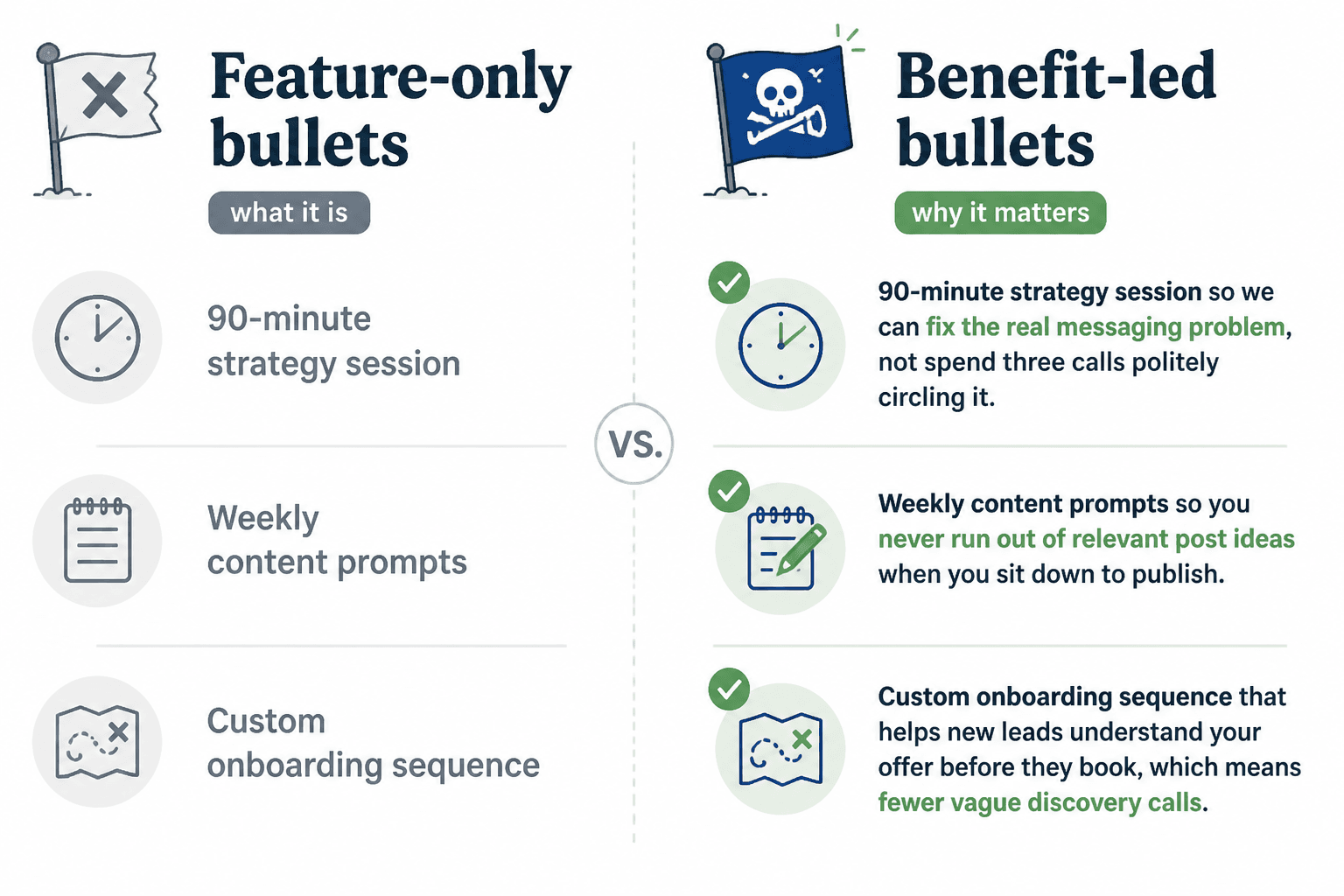
You do still need features. Buyers want to know what they are paying for. But features alone are thin. “90-minute strategy session” tells me the format. It does not tell me why I should want that format.
A stronger bullet might be:
90-minute strategy session so we can fix the real messaging problem, not spend three calls politely circling it.
That has texture. It implies speed, focus, and a point of view. Much better.
For more broad examples of how these pieces fit into a full description, see best product and service descriptions ideas and examples for creators.
A simple formula for writing better benefit bullets
If you tend to freeze when writing bullets, use this formula:
What it is + what it helps the buyer do + why that matters
For example:
- Weekly content prompts so you never run out of relevant post ideas when you actually sit down to publish
- Custom onboarding sequence that helps new leads understand your offer before they book, which means fewer vague discovery calls
- Review and rewrite of your homepage so visitors can figure out what you do in seconds instead of bouncing because the copy sounds impressive but says nothing
You do not always need all three parts, but if a bullet feels flat, one of them is usually missing.
What strong benefit bullets usually include
The best ones are usually doing at least one of these things:
- Reducing friction: easier, faster, simpler, clearer
- Increasing confidence: less guessing, less second-guessing, more clarity
- Improving results: more leads, better conversion, stronger content, sharper positioning
- Protecting time or energy: fewer revisions, less back-and-forth, less decision fatigue
- Adding control: reusable systems, templates, structure, process
- Making the intangible tangible: confidence becomes “know what to say on your homepage,” clarity becomes “stop rewriting the same offer explanation 14 times”
That last one matters more than people think. A lot of service businesses sell things that sound abstract: strategy, positioning, confidence, alignment, voice, support. Fine. But your buyer still needs to picture what those things look like in real life. Otherwise your bullet points read like scented air.
Benefit bullet examples for product and service descriptions
Here is the useful part: examples you can actually steal the shape of.
Benefit bullets for coaching offers
- Get outside perspective when you are too close to your own business to spot the obvious fixes
- Leave each session with clear next steps, not a notebook full of noble intentions
- Untangle messy messaging so your audience understands your value faster
- Build a plan you can actually follow without needing a 47-tab dashboard
- Get honest feedback that is useful, not vague encouragement in a nice blazer
- Turn ideas into offers, content, or decisions while they still have momentum
Benefit bullets for consulting services
- Spot conversion leaks across your site, funnel, or offer before they keep quietly eating leads
- Get a sharper strategy built around your business model, not recycled advice from someone else’s launch thread
- Make better marketing decisions with clearer priorities and fewer random tactics
- Shorten the path from attention to action by removing confusing messaging
- Get recommendations you can use immediately instead of a polished PDF that dies in your downloads folder
- Focus your budget and effort on the fixes most likely to move results
Benefit bullets for done-for-you services
- Free up your time without sacrificing quality or voice
- Stop piecing together drafts, edits, and last-minute fixes at the worst possible moment
- Get polished deliverables that are ready to use, publish, or hand off
- Reduce back-and-forth with a process that keeps projects moving
- Hand over the work to someone who knows what good looks like
- Keep showing up consistently without doing every part yourself
Benefit bullets for digital products
- Start faster with templates that remove the blank-page problem
- Get a repeatable structure you can reuse instead of reinventing from scratch every time
- Save hours on setup, drafting, planning, or formatting
- Skip the guesswork and go straight to a proven starting point
- Make your work look more polished without needing a full custom build
- Use examples you can adapt quickly to your niche, offer, or voice
Benefit bullets for memberships or retainers
- Get ongoing support without having to start from zero each time a new problem pops up
- Keep momentum with regular feedback, direction, and accountability
- Make faster decisions because someone already understands your business context
- Avoid expensive stops and starts caused by inconsistent marketing effort
- Get a steady stream of strategic input instead of one big burst followed by silence
- Build progress through repetition, refinement, and real-world adjustments
If your offers are aimed at experts, service businesses, or personal brands, you may also want product and service descriptions examples for coaches, consultants, and personal brands.
Before-and-after benefit bullet rewrites
Sometimes the easiest way to improve your bullets is to see what weak ones look like next to stronger versions.
| Weak | Stronger |
|---|---|
| Personalized support | Get feedback tailored to your business, so you are not trying to force generic advice onto a very specific problem |
| Comprehensive strategy | Walk away with a focused plan you can actually execute, instead of 19 ideas competing for your attention |
| High-quality templates | Use ready-made templates that help you write faster without sounding copied and dead behind the eyes |
| Fast delivery | Get what you need quickly, while the project still has momentum and the opportunity still matters |
| Expert guidance | Make decisions with experienced input instead of guessing your way into preventable mistakes |
| Improved messaging | Say what you do more clearly, so better-fit clients understand your value before you have to explain it in a DM |
Notice what changed. The stronger bullets are not just longer. They are more concrete. They refer to an actual frustration, an actual outcome, or an actual moment in the buyer’s life.
That is the standard. Not “more words.” More relevance.
Fast-fill templates you can adapt
If you need to write a lot of bullets quickly, use these templates as a starting point. Do not copy them lazily. Adjust them until they sound like your offer and your audience, not like a decent first draft that got abandoned halfway through.
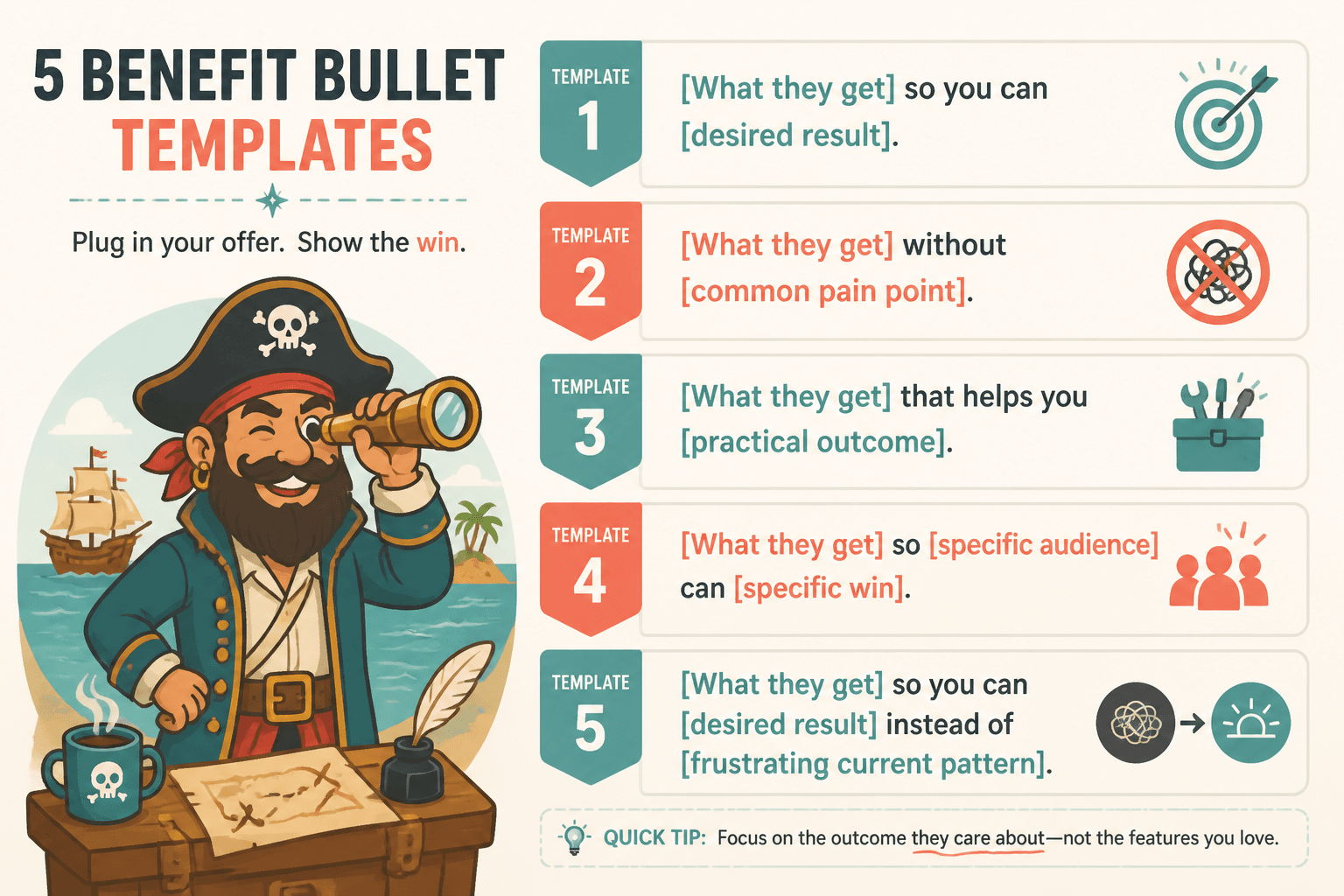
Template 1: Reduce friction
[Feature or deliverable] so you can [do the thing faster, easier, or with less stress].
Example: Custom proposal templates so you can send polished offers faster without rewriting the same sales copy every week.
Template 2: Clarify the outcome
[Deliverable] that helps you [specific result] without [common pain point].
Example: Homepage copy that helps you convert more qualified visitors without sounding like every other consultant online.
Template 3: Connect the process to the payoff
[Process element] so we can [practical improvement] before it turns into [larger problem].
Example: Early messaging review so we can fix confusing positioning before you build an entire launch around it.
Template 4: Make the invisible visible
[Abstract promise], which means [real-world effect the buyer can picture].
Example: More confidence in your content, which means you stop rewriting every caption three times before posting.
Template 5: Add contrast
[What they get] so you can [desired result] instead of [frustrating current pattern].
Example: A reusable client onboarding flow so you can look organized from day one instead of patching the process together in email every time.
If you need help pairing bullets with the rest of the page, simple product and service descriptions feature sections templates for busy creators is a useful next read.
How many benefit bullets should you use?
Enough to make the value clear. Not so many that the page starts wheezing.
For most product and service descriptions, 4 to 8 strong bullets is plenty. If you need 17 bullets to explain why the offer matters, the problem may not be the bullet count. It may be that the offer is muddy, the audience is too broad, or the copy is saying the same thing six different ways with increasingly expensive adjectives.
You can also split bullets into sections if that makes the value easier to scan. For example:
- What’s included
- What this helps you do
- Why clients usually want this now
That structure works especially well for more complex services.
Common mistakes that make benefit bullets weak
1. They are too vague
“Better results.” “Enhanced visibility.” “Powerful transformation.” These say almost nothing. They sound polished right up until a real human tries to understand them.
2. They only describe the deliverable
“Three coaching calls.” “Workbook included.” “Slack support.” Fine, but incomplete. Why does the buyer want those things?
3. They all sound the same
If every bullet starts with “Get” and ends with “success,” you have a rhythm problem and probably a clarity problem too. Vary the structure. Add detail. Show range.
4. They overpromise
Do not write bullets that guarantee a life upgrade you cannot reasonably support. Buyers are not idiots. “Explode your business” is not a benefit. It is a red flag wearing sunglasses.
5. They are all internal logic, no customer logic
The bigger point is simple: clearer structure and clearer writing make the piece more useful. That is usually what makes the ending land better too.
The bigger point is simple: clearer structure and clearer writing make the piece more useful. That is usually what makes the ending land better too.