
Most product and service descriptions are trying very hard to sound credible and accidentally becoming unreadable.
You have probably seen the type. Lots of “transformative support,” “customized solutions,” and “helping you align with your highest goals.” Which sounds impressive right up until a real buyer asks the obvious question: what exactly am I getting, and why should I care?
That is the real job of a description. Not to sound polished. Not to sound premium. To help the right person quickly understand what the offer is, who it is for, what it helps them do, and why this version is worth buying.
If you need better product and service descriptions for your coaching offer, consulting package, done-for-you service, or personal brand offer stack, this will help. You will get practical product and service description examples for coaches, consultants, and personal brands, plus a simple structure you can steal without making your website sound like it was assembled by a nervous committee.
A good description does two things at once: it clarifies the offer and increases buyer confidence. A bad one hides the offer behind vague benefits and hopes adjectives will do the heavy lifting. They won’t.
Want the broader roadmap? Start with the parent guide.
What strong product and service descriptions actually need to do
Before we get into examples, it helps to get clear on what makes a description work.
For coaches, consultants, and personal brands, the buyer usually is not comparing you only on features. They are comparing you on clarity, relevance, trust, and ease. If your offer description feels fuzzy, overhyped, or suspiciously abstract, people hesitate. And hesitation kills more conversions than imperfect wording ever will.
- What it is: the format, scope, or type of offer
- Who it is for: the kind of person or business it fits best
- What problem it solves: the friction, gap, or desired outcome
- What happens inside: the process, deliverables, or structure
- What makes it valuable: speed, expertise, customization, access, proof, or outcome
- What to do next: book, apply, buy, inquire, or read more
That does not mean every description needs to be long. It means it needs to answer the buyer’s real questions fast. Short is fine. Vague is not.
For a deeper breakdown of what makes these pages convert, you can also read this guide to better product and service descriptions.
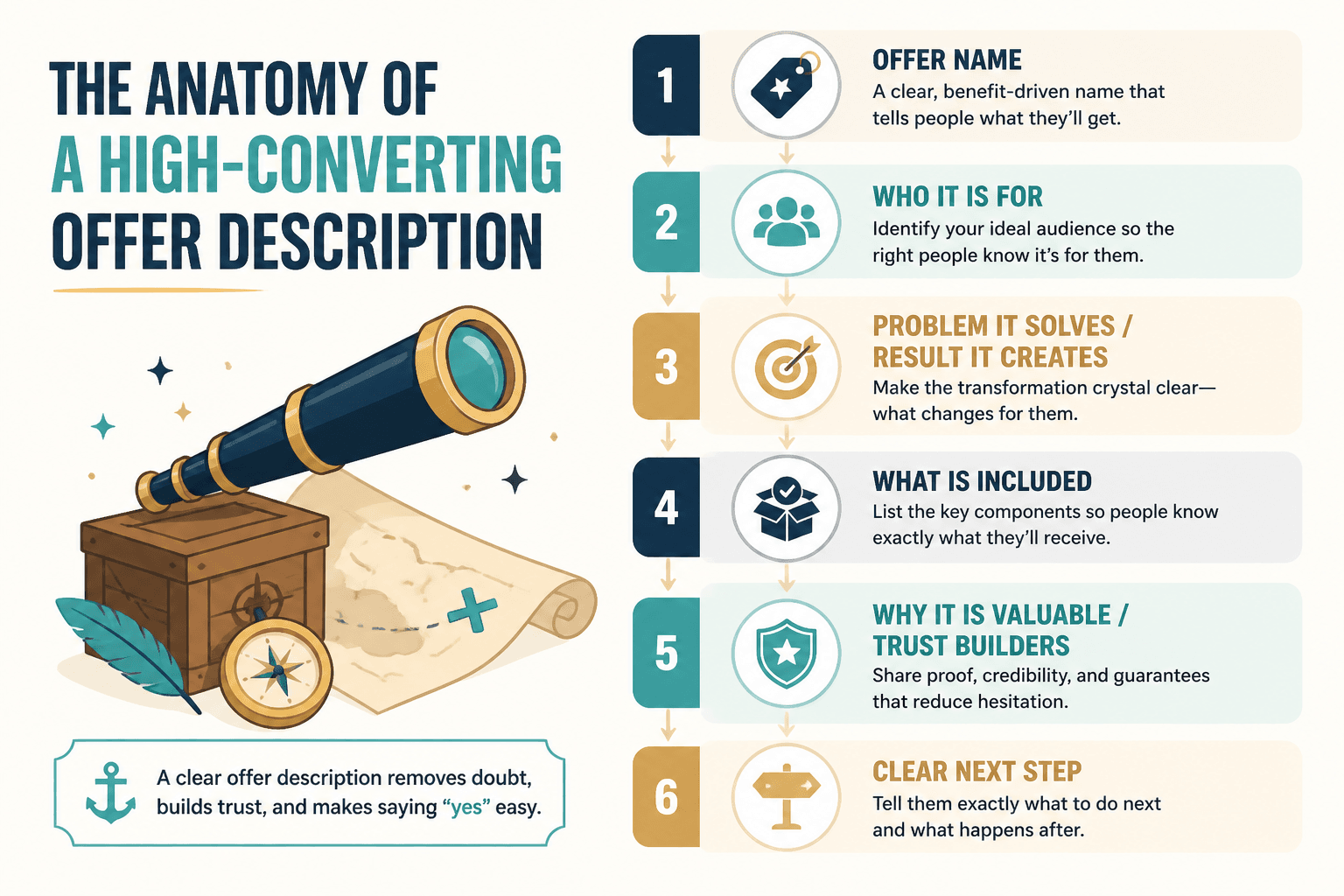
A simple structure you can use for nearly any offer
Here is the easiest useful structure for writing a product or service description without turning into a brochure goblin.
- Name the offer plainly
- Say who it is for
- Explain the result or improvement it helps create
- Show what is included
- Add one or two points that reduce uncertainty
- End with a clear next step
That structure works because buyers are not looking for literary beauty. They are looking for orientation. They want to know, “Is this for me, and is this worth my time or money?”
If your description skips straight to lofty promises and emotional fog, people have to do the work of decoding it. Most won’t. They’ll leave and go buy from someone whose copy had the decency to make sense.
Product and service description examples for coaches
Coaching descriptions often get buried under transformation language. Yes, buyers care about outcomes. But they also want to know what kind of coaching this is, what support looks like, and what makes your approach useful in the real world.
Example 1: Business coaching package
Strategic Growth Coaching
This 12-week coaching package is for service-based founders who have steady demand but messy growth. We work on positioning, offer clarity, messaging, and client acquisition so your business becomes easier to sell and easier to run.
You will get weekly private coaching calls, tailored action plans, messaging feedback between sessions, and support tightening the parts of your business that keep slowing conversion down.
Best for founders who are past the “just start posting” stage and need sharper strategy, cleaner offers, and better decision-making.
Why this works:
- It names the audience clearly
- It identifies the real problem, not just a dream outcome
- It explains what happens inside the offer
- It sounds specific, not mystical
Example 2: Life or mindset coaching offer
Confidence Coaching for Career Pivots
This coaching offer helps professionals who are changing direction stop second-guessing every move. If you are stuck between “I need a change” and “I have no idea what I am doing,” this is built for that messy middle.
Together, we work through decision clarity, self-trust, communication, and the practical next steps needed to move forward without spiraling every week.
Includes six private sessions, reflection exercises, and voice-note support between calls.
This one works because it does not rely on generic transformation fluff. It names the emotional tension, but keeps one foot in practical reality.
Weak version vs stronger version
| Weak | Stronger |
|---|---|
| I help ambitious women step into their power and create aligned success. | Private coaching for women founders who are capable, overextended, and tired of running a business that looks better from the outside than it feels on the inside. |
| This container supports deep transformation and elevated identity shifts. | Over 8 weeks, we work on decision-making, boundaries, offer clarity, and the habits that keep your business growth from eating your life. |
The weak version is not wrong exactly. It is just foggy. The stronger version gives the buyer something solid to grab onto.
Product and service description examples for consultants
Consultants usually have the opposite problem. They know what they do, but they write descriptions like internal project documentation. Accurate, maybe. Persuasive, not so much.
A good consulting description should connect expertise to business value. Not by making fake promises. By showing the buyer what problem you help solve, how your process works, and what kind of outcome they can reasonably expect.
Example 1: Messaging consultant
Messaging Strategy Intensive
A focused consulting session for founders and small teams who know their offer is solid but cannot explain it clearly enough to sell it consistently.
In one intensive, we refine your positioning, tighten your core message, identify the language your buyers actually respond to, and build sharper messaging you can use across your site, sales pages, and content.
You leave with a clearer value proposition, stronger buyer-facing language, and a practical roadmap for fixing messaging gaps that are hurting conversions.
Example 2: Operations consultant
Workflow and Delivery Audit
This consulting service is for solo operators and small service businesses that are growing faster than their backend can handle. If delivery feels chaotic, communication is scattered, and too much still lives in your head, this audit helps clean it up.
I review your current workflow, client journey, tools, and operational bottlenecks, then deliver a practical plan to streamline how work gets sold, delivered, and managed.
Ideal for businesses that want more capacity without immediately hiring a full team.
Notice what both descriptions do well:
- They define the scope of the service
- They reflect the buyer’s current frustration
- They describe the output clearly
- They make the value feel tangible
If you want to sharpen the language inside these descriptions even further, buyer-intent phrasing makes a big difference. Tiny wording changes can make an offer feel either vague and expensive or useful and worth it.
Product and service description examples for personal brands
Personal brands often sell a mix of offers: templates, audits, strategy sessions, retainers, digital products, workshops, subscriptions. That variety is useful, but it can also make your website feel like a yard sale with nice fonts.
Your descriptions need to create order. They should help people quickly understand the difference between your offers, who each one is for, and when to choose which.
Example 1: Digital product
Content Planning Template Pack
A plug-in planning system for creators and personal brands who are tired of reinventing their content every week.
This template pack helps you organize ideas, map content around your offers, and turn random inspiration into a repeatable publishing workflow. Includes planning sheets, post-angle prompts, and a simple weekly system for keeping your content moving.
Best for creators who have ideas but need a cleaner way to shape and ship them.
Example 2: Audit service
Website Copy Audit
A focused review for coaches, consultants, and creator-led brands whose website sounds decent but is not pulling its weight.
I audit your homepage, core offer page, and calls to action to find the messaging gaps, clarity problems, and missed conversion opportunities that make people browse without taking action.
You get annotated feedback, rewrite recommendations, and priority fixes so you know what to change first.
Example 3: Membership or subscription offer
Monthly Content Strategy Lab
An ongoing membership for business owners and personal brands who want better content systems without paying for full done-for-you support.
Members get monthly planning sessions, content reviews, fresh prompts, and practical strategy guidance to help them publish more consistently and turn attention into trust, leads, and cleaner sales conversations.
Good fit if you want expert feedback and structure, but still plan to write and publish your own content.
The useful thing here is separation. Each description makes the offer feel distinct. That matters. If every offer sounds like “support to help you grow with clarity,” people have no clue what to buy.
For more angles and swipeable ideas, see these additional product and service description ideas and examples.
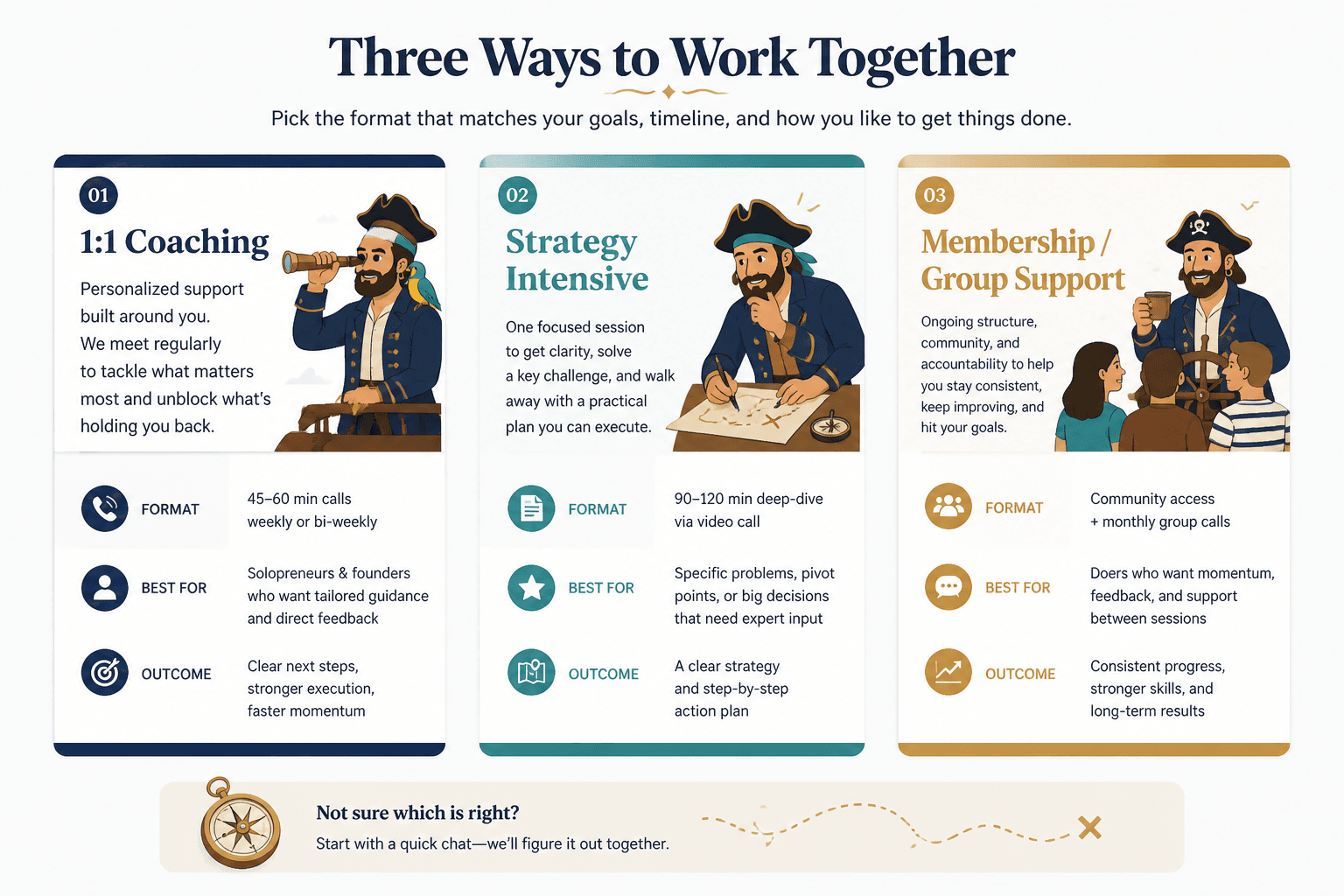
How to write descriptions that sound clear, not canned
The fastest way to improve your copy is to stop writing from your own internal language and start writing from buyer understanding.
That means fewer abstract claims and more real-world phrasing. Instead of describing your method as “high-touch strategic support,” explain what that support actually looks like. Instead of saying your service creates “powerful breakthroughs,” explain what changes after someone works with you.
Swap vague phrases for buyer-facing clarity
| Vague phrase | Better phrasing |
|---|---|
| Personalized support | Private feedback, tailored recommendations, and direct guidance based on your offer and goals |
| Transformational framework | A structured process to help you clarify your offer, strengthen your message, and make the next steps obvious |
| Aligned growth | Growth that does not depend on chaotic marketing, constant content panic, or saying yes to the wrong work |
| Done-with-you strategy | We build the plan together, then refine the messaging, structure, and execution around your business |
This is where many descriptions improve fast. Not because they become longer, but because they become interpretable. Buyers should not need a decoder ring to understand your offer.
A fill-in structure you can adapt
If you want a reusable template, use this:
[Offer name]
This [product/service type] is for [specific audience] who want to [goal] without [common frustration].
Inside, you will get [key features or deliverables] to help you [practical result].
Best fit for [who it is for]. [Optional trust builder, timeline, or process note].
Filled-in example:
LinkedIn Profile Rewrite
This done-for-you service is for consultants and experts who want a clearer profile that attracts better-fit leads without sounding stiff, salesy, or painfully self-important.
Inside, you will get a rewritten headline, about section, featured section strategy, and CTA recommendations to help your profile explain what you do and give visitors a better next step.
Best fit for people with a proven offer who need sharper positioning, not generic personal branding fluff.
That last line matters more than people think. A small note about fit can improve conversions by filtering out the wrong buyer before they waste your time.
Mistakes that make descriptions weaker than they need to be
- Leading with features only: Buyers care about what is included, but not in a vacuum
- Leading with outcomes only: Big promises with no mechanics feel thin fast
- Using industry cliches: “Holistic,” “empowering,” “aligned,” and “impactful” have all been worked to death
- Trying to sound premium by sounding vague: Expensive is not the same thing as unclear
- Describing every offer the same way: If your audit, course, and retainer all sound identical, your offer ladder is doing a poor impression of a fog machine
- No next step: If the reader has to guess what to click, you are adding friction for no reason
One more thing: stop overstuffing your descriptions with every possible detail just because you are afraid someone will ask questions. A strong description should create confidence, not perform legal disclosure cosplay. Give enough detail to make the offer feel real, then direct the reader to the next step.
How to make your descriptions more convincing without getting salesy
You do not need pushy language. You need useful specificity.
One of the best ways to strengthen a description is to add light proof or friction-reducing details. Not giant claims. Just smart signals that help people trust what they are reading.
- Clarify who the offer is best for
- Mention the format or timeline
- Name the main deliverables
- Reference the problem it solves in plain language
- Add a line that distinguishes it from cheaper, shallower, or more generic alternatives
If you are writing benefit bullets beneath the description, make them concrete. This related piece on benefit bullet examples creators can adapt fast will help with that.
And if you are building out a full set of offer pages, it may help to browse the broader category for website conversion copy resources as well.
Quick rewrite examples
Before
I help purpose-driven entrepreneurs elevate their brand presence through customized strategic solutions.
After
I help coaches and consultants fix unclear messaging so their website, content, and offers are easier to understand and easier to buy.
Before
This premium experience supports transformation, visibility, and impact.
The bigger point is simple: clearer structure and clearer writing make the piece more useful. That is usually what makes the ending land better too.
The bigger point is simple: clearer structure and clearer writing make the piece more useful. That is usually what makes the ending land better too.