
Most people do not need more Substack ideas. They need a better way to turn decent ideas into publishable posts without reinventing the wheel every single week.
That is usually where Substack starts to wobble. Not because the writer lacks expertise. Not because the audience is wrong. Because the workflow is chaos, the structure changes every issue, and every new series gets treated like a dramatic act of creative birth instead of what it often should be: a repeatable format with a brain.
If you are looking for the best templates and tools for Substack posts and series, the goal is not to make your writing feel templated. The goal is to make it easier to publish stronger posts, build recognizable series, and stop wasting energy on avoidable decisions.
Here is how to do that without turning your newsletter into beige productivity soup.
For the full path around this topic, head to the parent guide.
What actually makes a Substack template useful
A good Substack template does not just save time. It improves the post.
That means it should help you do at least one of these things:
- Get to the point faster
- Create a clearer reading experience
- Build consistency across issues
- Make a series easier to sustain
- Guide the reader toward a next step
- Reduce blank-page paralysis without making everything sound the same
Bad templates, on the other hand, tend to produce stiff writing. They force every idea into the same shape. They over-organize simple points. Or they become so elaborate that filling them out feels like applying for funding.
Substack rewards recognizable voice and clear thinking. Your template should support that, not smother it.
The best templates for Substack posts
You do not need 47 newsletter frameworks. You need a small set of reliable post formats that fit your style, audience, and publishing rhythm.
1. The sharp insight post
Best for creators, consultants, coaches, and solo founders with one strong idea and enough experience to say something useful about it.
- Opening: State the opinion, mistake, or tension fast
- Context: Explain why people get this wrong
- Main insight: Break down what actually matters
- Example: Show what this looks like in practice
- Close: Give the reader one action or question to carry forward
Simple template:
- Most people think ___.
- The real problem is ___.
- What matters more is ___.
- For example, ___.
- If you are doing this now, start by ___.
This works especially well when your audience does not need a huge essay. They need a well-framed correction.
2. The teach-through-example post
This is one of the strongest Substack post formats because it combines usefulness with proof. Instead of making abstract claims, you show the thing.
- Opening: Name the problem
- Before: Show the weak version
- After: Show the improved version
- Breakdown: Explain what changed and why
- Close: Invite the reader to apply the same lens
This is ideal for writers, marketers, brand strategists, messaging consultants, and anyone whose work improves through editing, framing, or positioning.
If your expertise lives in “making things clearer,” examples will usually outperform theory.
3. The recurring column template
Series are where Substack can really shine. A recurring column gives readers a reason to come back because they understand the shape of what they are getting.
A strong recurring column usually includes:
- A consistent theme or promise
- A stable format
- A clear title pattern
- Enough flexibility that you do not get bored by issue four
Example recurring series structure:
- Series promise: “Every Tuesday, one sharp teardown of a creator growth tactic people misuse”
- Issue layout: bad advice → what is wrong with it → better approach → practical fix
- Title pattern: “Why ___ fails” or “Stop doing ___ on Substack”
This kind of structure lowers your planning burden and increases your odds of building reader habit. It also makes it easier to map content in advance, which matters more than people admit.
For help building a sustainable publishing rhythm around that structure, it is worth pairing this with simple Substack posts and series issue cadence templates for busy creators.
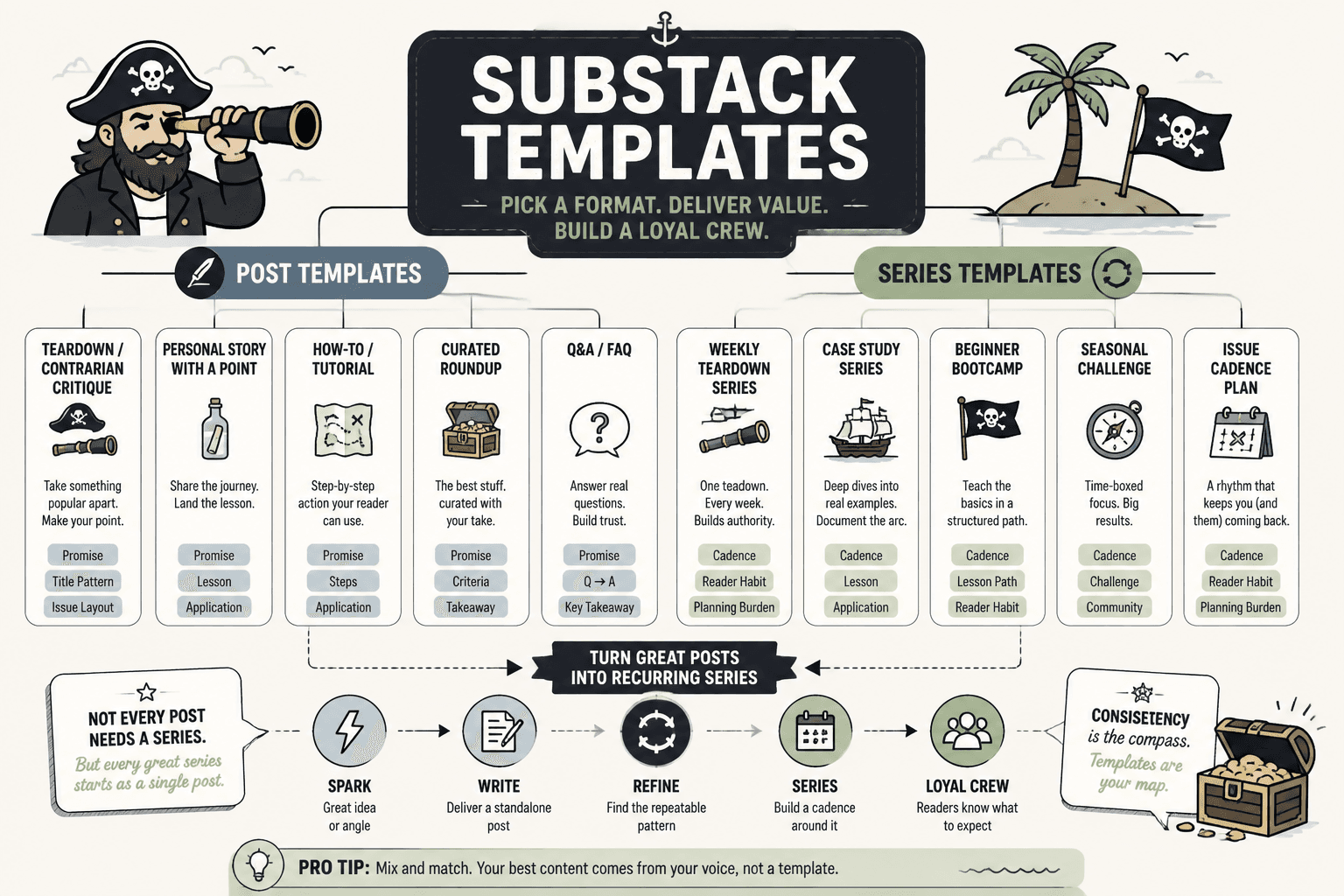
4. The personal story with a point
This one gets abused constantly, mostly because too many newsletter writers think “I had a thought in a coffee shop” counts as substance.
A good personal-story post is not a diary entry with a moral taped on at the end. It has structure.
- Scene: Start with the moment or problem
- Tension: What was difficult, surprising, or revealing?
- Shift: What changed?
- Lesson: What does this mean for the reader?
- Application: How should they think or act differently?
If the lesson could be removed and the story still works exactly the same, it is probably not a useful newsletter post. It is just journaling in public with nicer formatting.
5. The curated resource issue
This format works well when your audience values curation, filtering, and context more than long-form original essays every single time.
- Opening: What this collection is about
- Selections: 3 to 7 links, examples, tools, or ideas
- Commentary: Why each one matters
- Close: Tell readers what to explore next
The key is the commentary. Without that, you are just sending a list. A decent curator adds judgment, not just volume.
The best templates for Substack series
A post template helps you publish. A series template helps you build momentum.
Series are useful because they solve three annoying problems at once:
- They reduce topic sprawl
- They make planning easier
- They train readers to expect a certain kind of value from you
Series template 1: The 4-part authority series
Great for proving expertise around one business problem or topic cluster.
- Issue 1: The big mistake
- Issue 2: The better framework
- Issue 3: Real examples or case-style breakdowns
- Issue 4: Implementation steps and next move
This works well for consultants, service providers, niche operators, and educators. It gives enough depth to build trust without wandering into ebook territory.
Series template 2: The ongoing editorial series
This is for writers and operators who want a stable repeated lens rather than a fixed beginning and end.
- Theme: One angle you keep returning to
- Structure: Similar framing every issue
- Cadence: Weekly, biweekly, or monthly
- Archive value: Each issue should still stand alone later
Think less “course delivered by email” and more “recognizable column people choose to read because your perspective is useful.”
Series template 3: The reader journey series
This format is underrated. Instead of organizing around your knowledge, you organize around the reader’s progress.
- Issue 1: Diagnose the problem
- Issue 2: Clarify what to stop doing
- Issue 3: Show the replacement approach
- Issue 4: Give a repeatable process
- Issue 5: Share examples, edge cases, or advanced notes
This is especially useful for audience education and warm lead nurturing because it mirrors the actual decision path readers go through.
The best tools for Substack posts and series
Tools are helpful. They are not magic. They will not rescue a weak point of view, a fuzzy audience, or a newsletter with no editorial spine.
What they can do is make the work cleaner, faster, and easier to repeat.
1. Drafting and idea development tools
Use these to get rough material into shape, collect fragments, and reduce the friction between idea and draft.
- Notes apps: Good for capturing lines, themes, issue ideas, and future series angles
- Outlining tools: Useful when your posts tend to ramble or bloat
- AI drafting tools: Helpful for generating rough structures, alternate headlines, summaries, and rewrite options
The warning here is simple: do not let the tool flatten your voice. AI can be useful for scaffolding, but if you let it finish every sentence, your newsletter starts sounding like a very polite intern who read three content strategy threads and developed confidence.
If you want a more focused breakdown of that side of the workflow, see best AI tools for Substack posts and series.
2. Template storage and workflow tools
This category matters more than people think. Once you have 3 to 6 strong newsletter templates, you need a clean place to keep them.
Useful template storage systems usually include:
- A swipe file for strong openings and issue titles
- A folder or database of post structures
- A content calendar for upcoming issues and series arcs
- A checklist for pre-publish review
You can build that in almost any decent workspace tool. The exact brand matters less than the structure. If your system makes it hard to find your own templates, it is not a system. It is digital clutter with confidence.
3. Editorial planning tools
Series fall apart when there is no planning layer between “that could be interesting” and “send.”
A basic editorial planning setup should let you track:
- Series name
- Core promise
- Target reader
- Issue count or cadence
- Status of each draft
- Related offers or CTAs
- Repurposing opportunities
This matters because a good Substack series is not just a pile of adjacent thoughts. It should have direction. A bit of structure makes the writing easier and the reading experience better.
4. Monetization and creator business tools
If your newsletter supports a business, your tools should not stop at writing.
You may also need tools for:
- Paid subscriptions
- Offer delivery
- Lead capture
- Simple funnels
- Audience segmentation
- Client or customer tracking
That side of the stack deserves its own discussion, especially if you are trying to turn attention into revenue without turning every issue into a clumsy sales memo. For that, read best Substack tools and creator monetization tools for Substack posts and series.
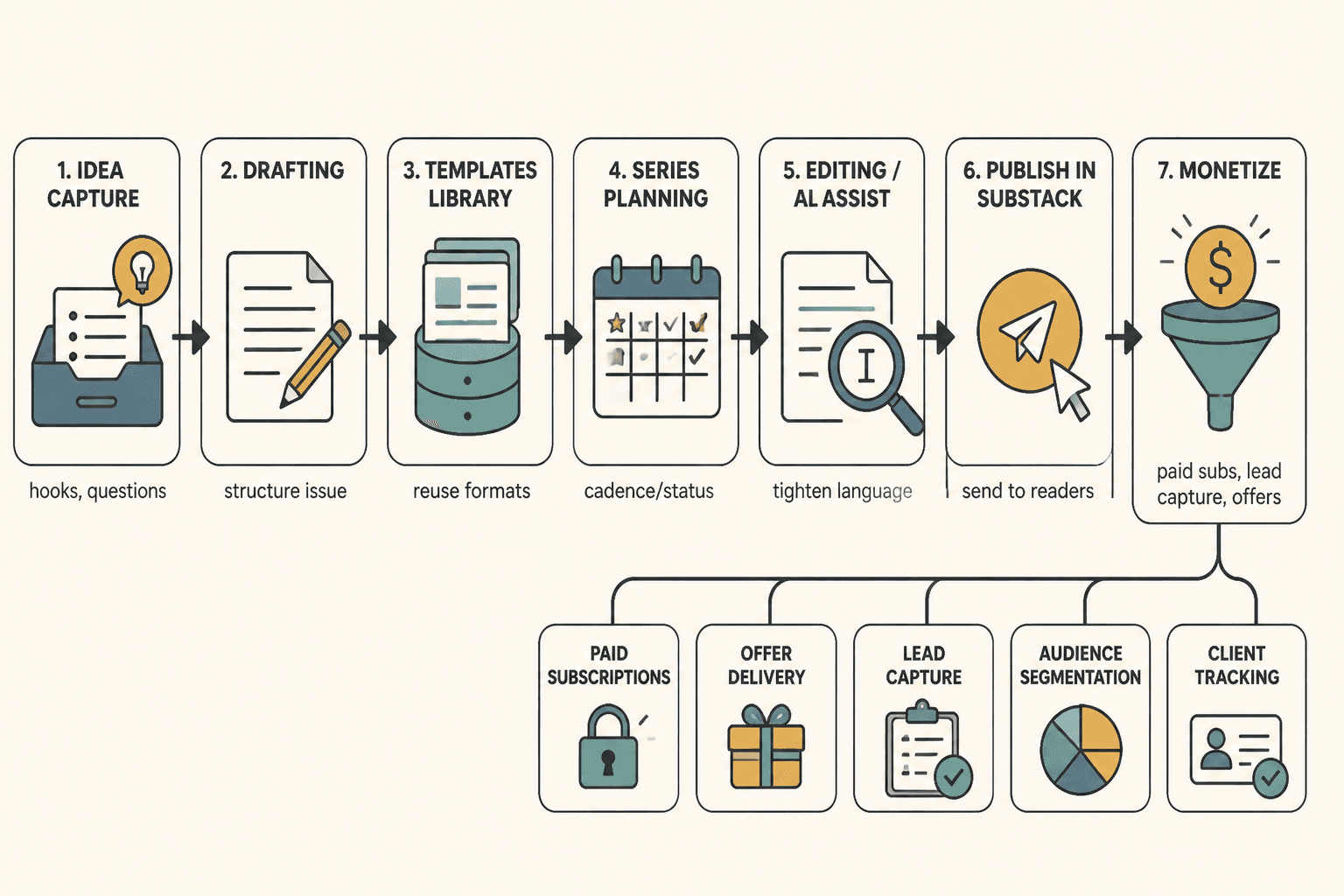
A simple tool stack that is enough for most creators
You probably do not need a massive creator operating system. You need a sane setup.
| Need | What to use | What it is for |
|---|---|---|
| Capture ideas | Notes app or inbox doc | Save post angles, lines, hooks, and reader questions |
| Build drafts | Writing or outlining tool | Turn rough thoughts into clean issue structures |
| Store templates | Database or workspace tool | Keep repeatable formats easy to reuse |
| Plan series | Editorial calendar | Track issue flow, cadence, and publishing status |
| Refine language | Editing support or AI assist | Tighten intros, improve titles, test rewrites |
| Support business goals | Monetization and CRM tools | Connect content to offers, leads, or subscriptions |
That is enough to run a sharp newsletter operation without becoming the kind of person who spends six hours color-coding a content dashboard instead of publishing.
How to choose the right template for your Substack
Do not pick templates based on what looks impressive. Pick them based on what helps you publish useful work consistently.
Ask these questions:
- Does this format fit how I naturally explain things?
- Can I sustain it for at least 6 to 10 issues?
- Will my audience understand the value quickly?
- Does it help me connect ideas across time?
- Can I reuse it without sounding repetitive?
- Does it support my business model or reader goal?
If the format is clever but exhausting, it is a bad fit. If it is easy to repeat but produces thin content, also a bad fit. The sweet spot is structure with enough flexibility to stay alive.
A practical starter system for Substack posts and series
If you want a cleaner setup fast, use this:
- Choose 3 post templates you can use repeatedly.
- Choose 1 recurring series format tied to your main topic or offer.
- Create a simple template library with title patterns, openers, and issue structures.
- Keep one running list of future issue ideas sorted by theme.
- Use one planning board for draft status and publishing cadence.
- Add a lightweight pre-send checklist so each issue gets basic quality control.
That alone will put you ahead of a surprising number of newsletter writers who are still treating each send like an isolated event.
If you need fresh angles to fill those templates, best Substack posts and series ideas and examples for creators should help.
Common mistakes when using templates and tools on Substack
Templates and tools help. They also create new ways to be lazy.
- Using one template for every idea: Not every point needs a full essay or a 5-part breakdown.
- Letting AI smooth away your edge: Clear is good. Generic is not.
- Building a series with no reader promise: A repeated label is not a series.
- Making templates too rigid: Readers like familiarity, not formula fatigue.
- Collecting tools instead of fixing process: More software will not save bad editorial habits.
- Ignoring archive value: Substack posts should still make sense when discovered later.
The most useful setup is usually boring in the best possible way. It helps you think clearly, publish regularly, and build trust over time. No drama. No excessive dashboard worship. Just a system that does its job.
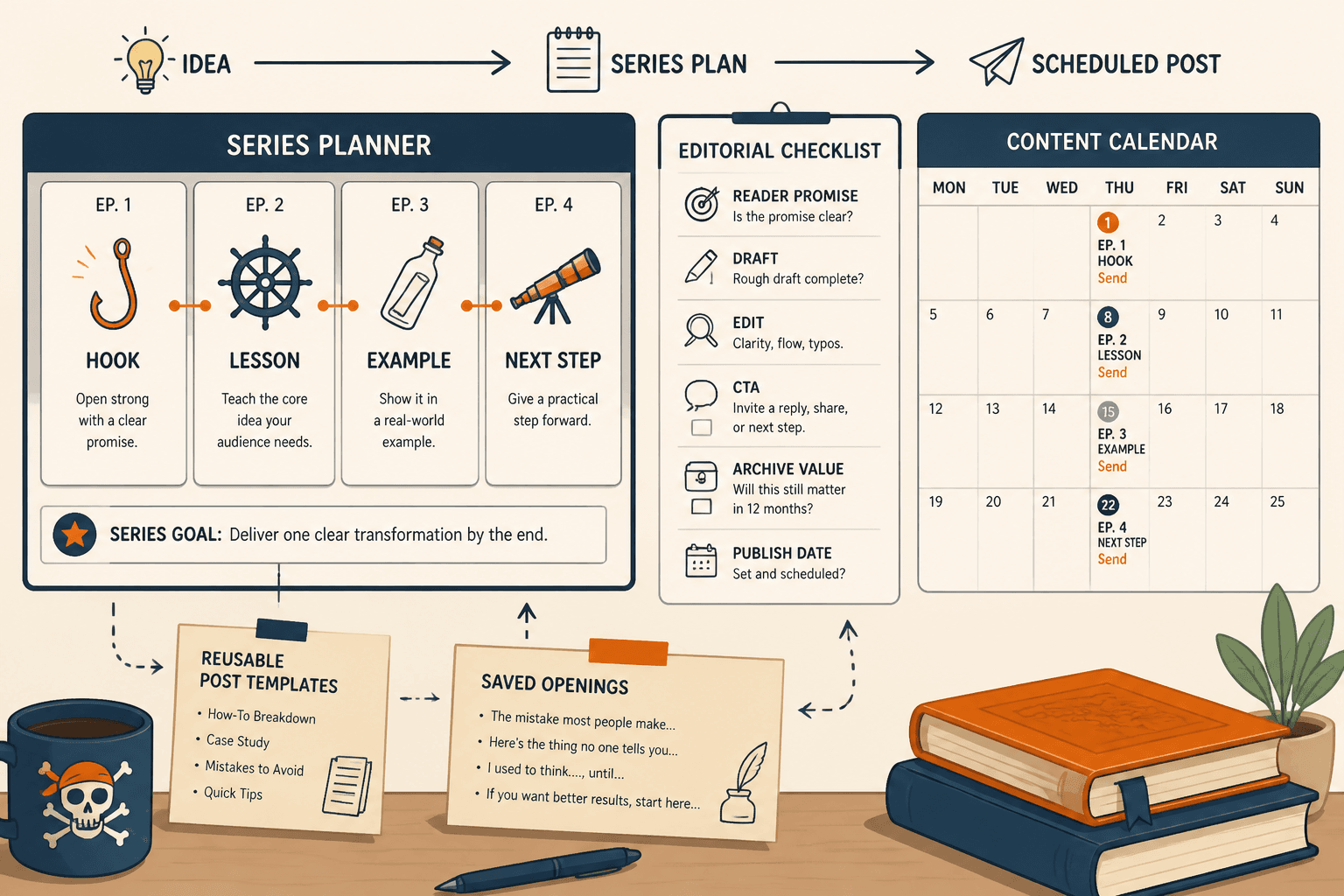
Build a system, not a pile of drafts
The best templates and tools for Substack posts and series are the ones that make your writing easier to publish and easier to read.
That usually means fewer formats, better structure, and a tool stack that supports the work instead of becoming the work.
Start small. Pick a couple of post templates. Build one series people can recognize. Store your best openings and structures somewhere sane. Then keep going long enough for the pattern to become an asset.
Because the real win is not having a “system.” It is having a newsletter process that does not collapse every time a blank page looks back at you.
If you want broader context around planning and writing newsletters, you can also explore email newsletter writing, newsletter writing, and Substack posts and series.
FAQ
How many templates should a Substack writer have?
Usually 3 to 5 is enough. More than that and you often create clutter instead of flexibility.
Should every Substack newsletter become a series?
No. Series are useful when you have a repeatable angle or topic path. Some newsletters work better as standalone issues with occasional themed runs.
Are AI tools good for Substack writing?
They can be good for outlines, rewrites, title options, and cleanup. They are not good at replacing your judgment, positioning, or voice.
The bigger point is simple: clearer structure and clearer writing make the piece more useful. That is usually what makes the ending land better too.