
Most personal brand retargeting is bad for one simple reason: it shows up too late, says too little, and asks for too much.
Someone reads a few posts, maybe grabs a freebie, maybe visits your offer page, and then gets chased around by the digital equivalent of a sweaty networking guy saying, “Just circling back.” Not ideal.
If you want better audience-to-offer journeys, retargeting should not feel like a second-rate ad tactic bolted onto your content after the fact. It should feel like the natural next conversation. Same problem. Same promise. More context. Less friction.
This is where most creators, coaches, consultants, and solo founders get it wrong. They build content. They build an offer. They maybe build a lead magnet. Then retargeting gets treated like a magical conversion patch. It is not. It works best when it helps warm people move one clean step closer to a decision.
Here’s how to build Better Audience-to-Offer Journey Retargeting Ideas for Personal Brands that feel smarter, more human, and much more likely to lead to clicks, replies, bookings, and sales.
Want the broader roadmap? Start with the parent guide.
What retargeting is actually supposed to do
Retargeting is not there to bully cold people into buying.
It is there to reconnect with people who already showed some level of interest and help them take the next logical step. That might be reading a deeper piece, joining your email list, watching a short training, booking a call, or finally buying the thing they already half-wanted.
For personal brands, that matters even more because trust is usually the real conversion mechanism. People do not buy because your ad platform found them. They buy because the right message reached them at the right stage with enough proof and relevance to make the decision feel safe.
Good retargeting does three things:
- Reminds the right people that you exist
- Reduces uncertainty about your offer
- Moves them into a lower-friction next action
That is it. Not mystical. Not sexy. Very useful.
The real mistake: sending everyone to the same pitch
Audience-to-offer journeys break when every warm person gets the same message.
The person who watched 10 seconds of a video should not get the same retargeting as the person who visited your sales page twice and opened three emails. One is vaguely aware of you. The other is stalling. Different job. Different message.
If your retargeting does not account for intent, you end up with weak results and weird messaging. You either pitch too early or over-explain too late. Both are expensive ways to look confused.
A cleaner approach is to map retargeting to journey stages. If you need help building the bigger structure first, this audience-to-offer journey framework is a useful starting point, along with this practical guide for better results.
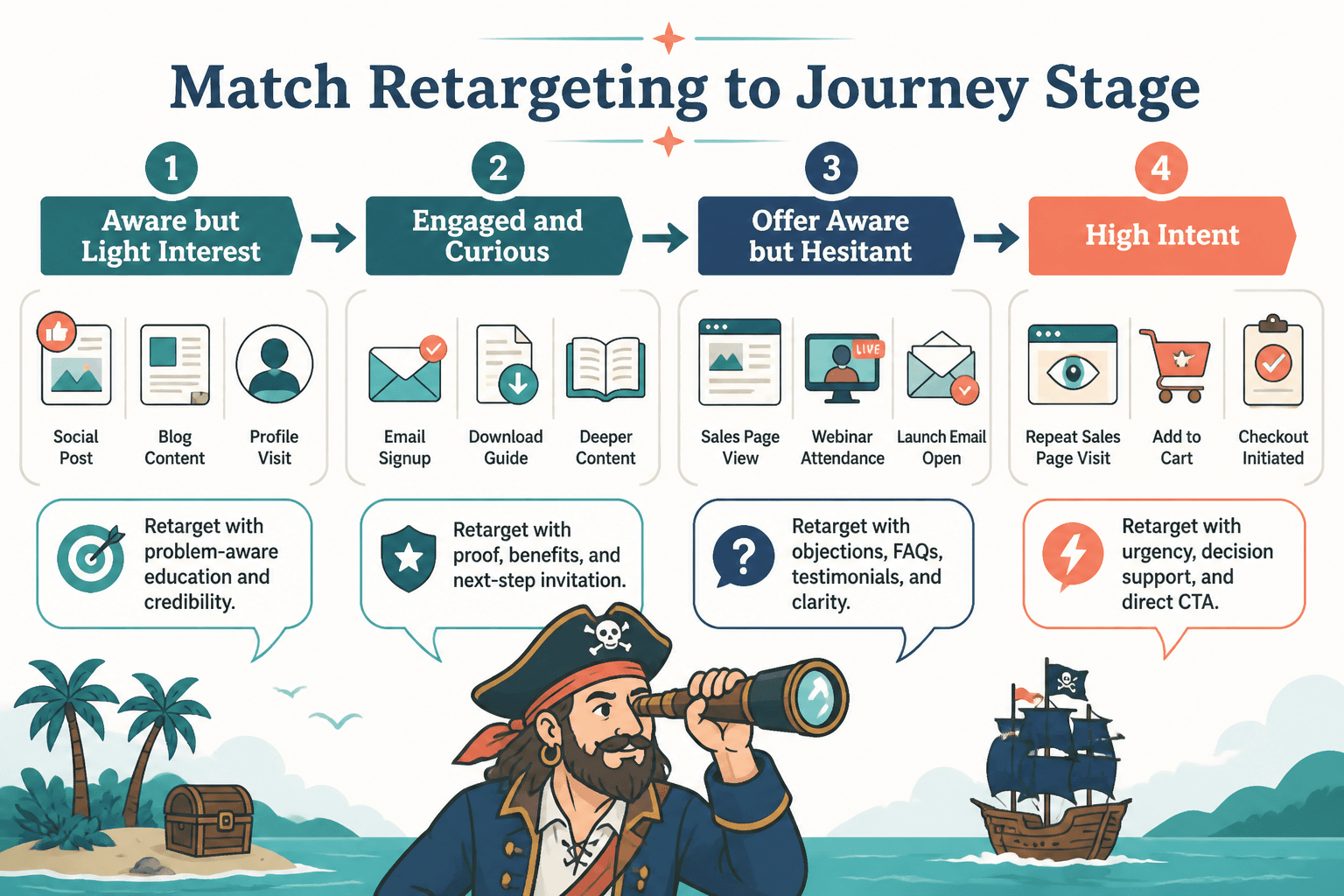
Build retargeting around stages, not platforms
People love asking which platform is best for retargeting. Usually the better question is: what does this person already know, and what do they still need before saying yes?
Start with journey stages like these:
- Stage 1: Aware but light interest — consumed some content, maybe visited your profile or website
- Stage 2: Engaged and curious — clicked, subscribed, downloaded, or spent meaningful time with your material
- Stage 3: Offer aware but hesitant — viewed offer page, opened launch emails, watched sales content, did not convert
- Stage 4: High intent — returned to the sales page, started checkout, clicked booking links, replied with buying questions
Each stage needs a different kind of retargeting. Not because you need 47 campaigns. Because message fit matters.
Stage 1 retargeting: move from attention to trust
At this stage, the goal is not “buy now.” The goal is “see me as relevant.”
Useful retargeting ideas here:
- Promote a strong authority article that solves one sharp problem
- Retarget profile visitors with a lead magnet that matches the content they engaged with
- Show a short proof-based video explaining your method or point of view
- Promote a case-study style post rather than a hard offer
What works here is educational specificity. You are not trying to close. You are trying to become the obvious next source.
For example:
- Weak retargeting: “Ready to scale your business? Book a call now.”
- Better retargeting: “If your content gets attention but not leads, here are the 3 gaps usually causing it.”
Stage 2 retargeting: move from trust to consideration
Now they know who you are. Good. Do not waste that by continuing to post vague awareness fluff.
This is the stage for stronger proof, sharper framing, and low-pressure pathways into your ecosystem.
Good options:
- Retarget lead magnet subscribers with a “what to do next” resource
- Show testimonials tied to one specific result or problem
- Invite them to a workshop, mini training, or short email series
- Promote a comparison piece that helps them understand why your process is different
This is also a strong place for a useful article that deepens authority. If your audience journey content is already in place, connect retargeting to assets like these audience-to-offer journey examples so warm readers can see what the path looks like in practice.
Stage 3 retargeting: handle hesitation, not just visibility
This is where a lot of money gets wasted.
Somebody visited your offer page and did not buy. That does not automatically mean they need more reminders. They may need more clarity, more proof, better timing, or less risk.
So the message should address likely friction points:
- “What exactly happens if I buy?”
- “Is this for someone like me?”
- “Why this instead of another option?”
- “Will this be worth the money?”
- “Do I need this now or later?”
Retargeting ideas for this stage:
- A short walkthrough of the offer and how it works
- A client case study with concrete before-and-after detail
- A FAQ-style ad handling objections cleanly
- A “who this is and is not for” message
- A deadline or timing reminder, but only if the deadline is real and not invented by a marketing goblin
If your offer timing is off, no amount of retargeting polish will save it. Read how to improve offer timing without sounding generic if people keep reaching the offer page but not moving.
Stage 4 retargeting: remove friction and make the next step easy
These people do not need your whole philosophy again. They need a nudge, a detail, or a clean reason to finish what they started.
Useful retargeting here might include:
- A direct reminder to complete booking or checkout
- A short message about onboarding, support, or what happens after purchase
- A social proof asset featuring someone similar to them
- A simple “still deciding?” CTA that leads to FAQs or a lower-friction consult
The tone matters. You are not trying to act urgent because the dashboard told you they are warm. You are trying to help them make a decision without adding noise.
Retargeting ideas that work especially well for personal brands
Personal brands have an advantage here. People often buy the offer because they trust the person behind it. That means your retargeting can lean on voice, credibility, and thought process in ways generic brand ads cannot.
Here are a few retargeting angles that tend to work well.
1. The “you’ve seen the ideas, here’s the system” retarget
This works well when people know your content but have not connected it to your paid work.
Message angle:
You’ve probably seen me talk about fixing content clarity, positioning, and conversion gaps. This is the system I use when clients want all of that working together, not as random advice scattered across posts.
This bridges free content to paid offer without sounding like you suddenly remembered commerce exists.
2. The objection-specific proof retarget
Do not throw generic testimonials at everyone. Match proof to the hesitation.
If someone worries about time, show proof from a busy client. If they worry about complexity, show how simple the process is. If they worry your offer is too advanced, show a beginner-friendly result.
Proof works best when it answers a doubt, not when it just exists decoratively.
3. The “here’s what happens next” retarget
People often stall because they cannot picture the process after clicking buy or booking the call.
A simple retargeting message like this can help:
If you book, here’s what happens: first we audit your current funnel, then we fix the message gaps, then we build the next-step path so your content stops doing all the work alone.
Clarity lowers resistance. Fancy copy usually raises it.
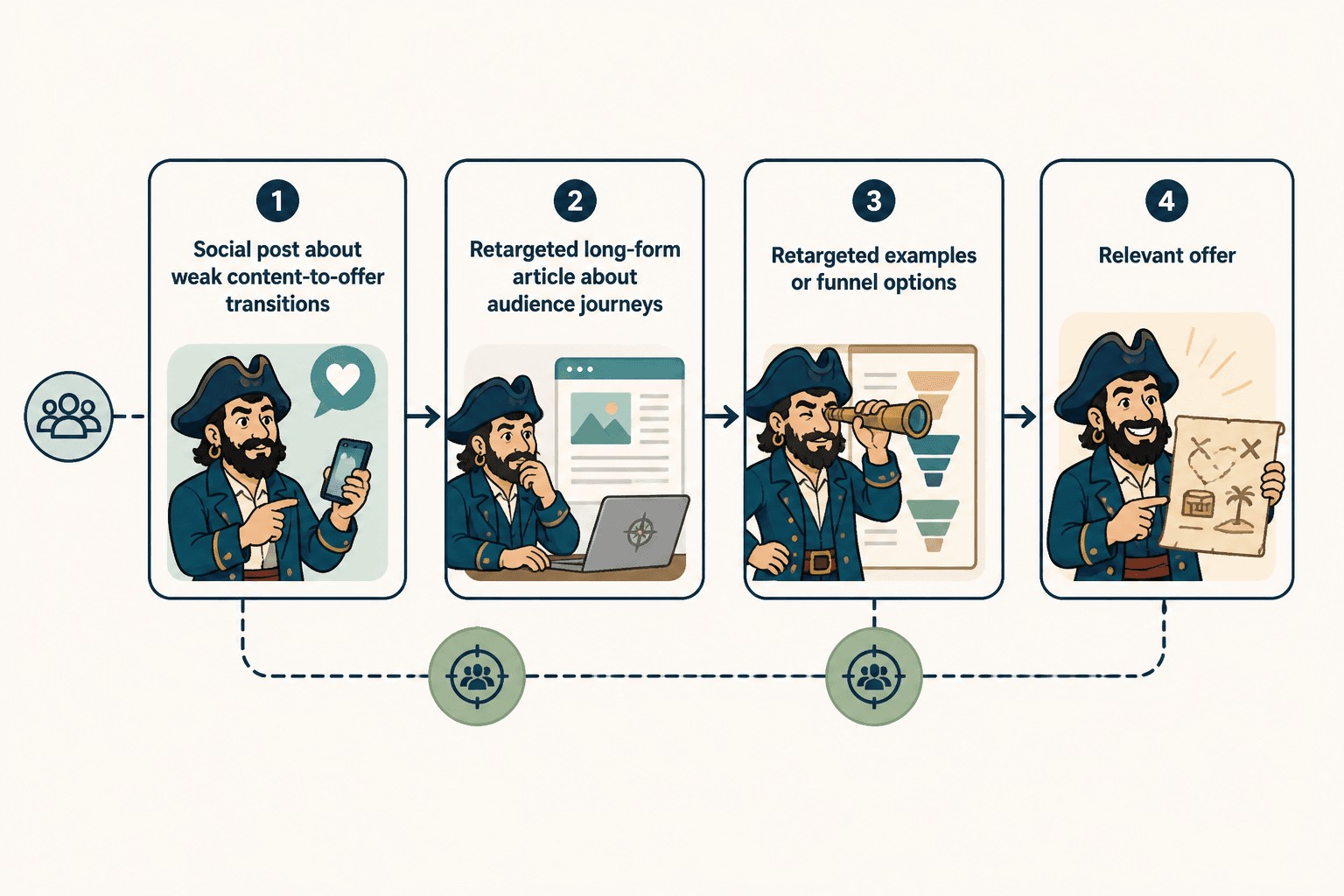
4. The content sequel retarget
This one is underrated. If someone engaged with a post or article on one problem, retarget them with the next logical piece.
Example journey:
- Post about weak content-to-offer transitions
- Retarget with article on audience journeys
- Retarget article readers with examples or funnel options
- Retarget those readers with a relevant offer
That feels coherent because it is coherent.
Useful next reads here include best funnel ideas to pair with audience-to-offer journeys and broader resources under monetization funnels and funnel systems.
A simple retargeting framework for better audience-to-offer journeys
If you want this to stay manageable, use a four-part framework:
- Entry point: what did they engage with first?
- Intent signal: what action shows stronger interest?
- Friction point: what might stop them from moving?
- Next step: what is the easiest useful action from here?
That gives you smarter retargeting without turning your marketing into a giant dashboard hobby.
| Audience behavior | Likely stage | Best retargeting move |
|---|---|---|
| Read a few posts or visited profile | Light interest | Send to useful article, lead magnet, or proof-based content |
| Downloaded freebie or read article | Curious | Show method, case study, or next-step resource |
| Visited offer page | Hesitant | Address objections, clarify fit, explain process |
| Clicked checkout or booking | High intent | Reduce friction, answer final questions, remind simply |
What to retarget people with at each stage
If you are stuck on asset ideas, here is a practical menu.
For awareness-stage audiences
- Short authority article
- Problem-specific lead magnet
- Best-performing educational post
- Short video with one contrarian insight
For engaged audiences
- Mini training
- Case study
- Method explainer
- Email series opt-in
- Comparison content showing your difference
For offer-aware audiences
- Offer walkthrough
- Client proof by use case
- FAQ content
- “Who this is for” asset
- Pricing context or ROI framing where appropriate
For high-intent audiences
- Booking reminder
- Cart completion reminder
- Short objection handling message
- “Still deciding?” consult CTA
- Deadline reminder if real
Three retargeting mistakes personal brands make constantly
They retarget clicks instead of meaning
Not every click means the same thing. Somebody who clicked a spicy opinion post is not necessarily ready for your premium offer. Behavior matters, but context matters more.
They jump from content to hard pitch too fast
If the first retargeting message after a useful post is “book a strategy call,” do not be shocked when people ignore it. The warmer the audience, the more this can work, but most brands overestimate warmth because analytics are flattering liars.
They use the same message for everyone who did not buy
That giant bucket includes people who were curious, people who were busy, people who were unconvinced, and people who were never a fit in the first place. Different reasons require different messages. Obvious, but often ignored.
The bigger point is simple: clearer structure and clearer writing make the piece more useful. That is usually what makes the ending land better too.