
Most blog rewrites do not fail because the writer lacks skill. They fail because the writer treats the refresh like a cleanup job, then quietly turns it into a pitch deck with better punctuation.
That is how you end up with updated posts that sound weirdly stiff, stuffed with keywords, and just salesy enough to make the whole thing feel less trustworthy. The facts may be fresher. The article may technically be “better optimized.” But the voice? Gone. The usefulness? Buried under brand-safe mush.
If you want to know how to write blog rewrites and refreshes without sounding salesy or robotic, the fix is not to sprinkle in a few contractions and call it human. You need a better process. One that keeps the article sharp, useful, readable, and convincingly written by a person with standards.
This piece will help you do exactly that: update old content without flattening its personality, pushing too hard, or replacing clear ideas with SEO oatmeal. If your blog refreshes keep sounding like they were approved by three nervous stakeholders and a timid AI prompt, good. We can fix that.
To see how this fits into the wider strategy, open the parent guide.
Why blog refreshes so often sound robotic
A rewrite usually starts with a sensible goal. Improve rankings. Update examples. Tighten the structure. Add a CTA. Make the piece more current. All fair.
The problem starts when “refresh” gets interpreted as “sand off everything distinctive.” Suddenly the article is packed with generic transitions, padded subheads, lifeless definitions, and lines that sound like they were generated to avoid offending anyone with a calendar link.
There are a few usual suspects.
- Overcorrecting for SEO and stuffing in phrases that do not belong
- Adding sales language where trust-building content should stay useful
- Replacing specific opinions with broad, empty claims
- Flattening the voice to sound “more professional”
- Using AI outputs as final copy instead of rough material
- Expanding sections that did not need expansion just to make the post feel updated
Professional does not have to mean bloodless. And updated does not have to mean beige.
A good refresh should make a post more accurate, more useful, and easier to trust. Not more polished in the dead-eyed corporate sense.
What a good blog rewrite is actually supposed to do
A strong rewrite improves the article’s performance and the reading experience. It does not just update timestamps and slide in a product mention every fourth paragraph.
At minimum, a useful refresh should do four things:
- Fix outdated information
- Clarify the main point faster
- Improve structure and readability
- Strengthen trust by making the article more concrete and relevant
That trust point matters. A lot of bad rewrites become salesy because they stop trying to help and start trying to convert too early. You can feel the shift as a reader. The tone gets pushy. The examples become suspiciously convenient. The article starts sounding less like guidance and more like a polite ambush.
Useful blog content can absolutely support business goals. It should. But there is a difference between an article that earns interest and one that keeps elbowing the reader toward an offer before proving it deserves attention.
If you want a stronger baseline process, this is a good place to continue after this article: how to write better blog rewrites and refreshes.
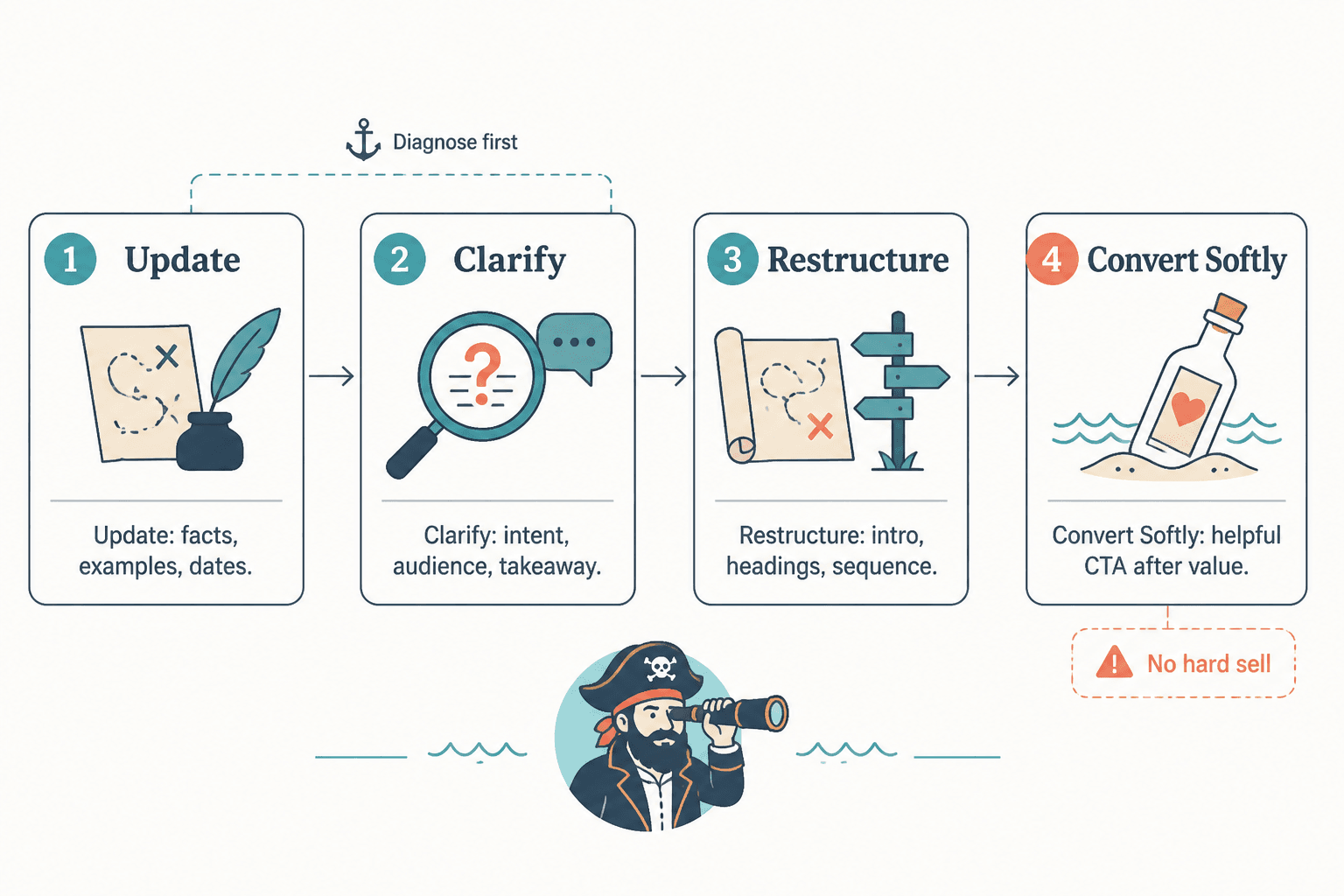
Start with diagnosis, not rewriting
Before you touch the draft, figure out what is actually wrong with it. This sounds obvious. It is also skipped constantly.
Writers often open the article and begin replacing sentences on instinct. That usually creates a strange half-old, half-new draft where the voice is inconsistent and the real problems remain untouched.
Instead, audit the piece first.
Ask these questions before rewriting
- Is the core angle still relevant?
- What parts are outdated, vague, repetitive, or weak?
- Where does the intro drag?
- Which sections feel written for search engines instead of humans?
- Where does the article start pushing too hard?
- What proof, examples, or specifics are missing?
- Does the CTA fit the reader’s stage of awareness, or is it awkwardly early?
This gives you a real rewrite brief instead of a vague “make it better” task. Which, frankly, is how a lot of robotic copy gets born in the first place.
If your openings are part of the problem, read how to start blog rewrites and refreshes without a weak opening. Many stale articles do not need more content. They need a better first 150 words.
Keep the original point. Upgrade the delivery.
One of the fastest ways to make a rewrite sound robotic is to lose the article’s actual point while trying to “elevate” the language. You do not need elevated language. You need clearer thought.
Good rewrites usually preserve the original intent while improving how the idea lands. That means you should identify the central claim of the article in one sentence before rewriting anything.
For example:
- Weak original point: “Blog updates are important for SEO and user experience.”
- Better working point: “A blog refresh should make old content more useful and more credible, not just more optimized.”
See the difference? The second one gives you a standard for every edit that follows. It also sounds like someone actually means it.
Cut the fake-professional language
A lot of salesy or robotic writing is really just fake-professional writing in a blazer. It uses formal phrasing to sound credible, but it drains the piece of clarity and tone.
Here is the kind of language that usually needs to go:
- “It is essential to note that…”
- “In order to maximize results…”
- “Businesses looking to optimize their content strategy…”
- “Leverage this opportunity to…”
- “High-quality content plays a pivotal role…”
None of that helps. It just makes the article sound like it was written from inside a webinar landing page.
Try this instead
| Robotic version | Human version |
|---|---|
| It is essential to update content regularly. | Old content goes stale faster than most teams admit. |
| Businesses should leverage refreshed articles to improve performance. | A refreshed article can pull more traffic and trust if the update is actually useful. |
| In order to maximize reader engagement, add compelling calls to action. | If you add a CTA, make it fit the article instead of barging in like a sales rep at lunch. |
The human version is not casual for the sake of casual. It is clearer, more direct, and less padded. That is usually what people mean when they say they want writing to sound natural.
How to update a post without making it salesy
Salesy rewrites usually come from fear. Someone wants the refreshed post to “do more” for the business, so they start forcing product mentions, lead-ins, and CTAs into every available gap.
That approach is clumsy. It also tends to reduce trust, which is the thing that makes content useful for business in the first place.
Use this rule: help first, sell second, and sell lightly
A blog refresh should strengthen commercial intent by improving clarity and relevance, not by cramming in promotional copy. In practice, that means:
- Add examples that show expertise
- Include proof or practical insight that makes your perspective more credible
- Use a CTA that matches the article’s promise
- Keep product or service mentions relevant and brief
- Do not interrupt useful sections with random pitch language
Here is a simple before-and-after.
Before: awkwardly salesy
Refreshing blog content is one of the best ways to improve SEO and user engagement. If your team wants better results from content marketing, our expert services can help you rewrite and optimize every article for success.
After: useful first, commercial second
Refreshing blog content works best when you update the substance, not just the publish date. Tighten the angle, replace weak examples, cut padded sections, and make the article easier to trust. If you offer rewrite services, that is where your value actually lives.
The second version still supports a service-based business. It just does it like a grown-up.
If your issue is not stiffness but generic rewrites that all blur together, read how to improve blog rewrites and refreshes stale post fixes without sounding generic.
Rewrite for specificity, not just freshness
A common refresh mistake is updating surface details while leaving the article vague. So the year changes, the examples become newer, maybe a tool gets replaced, but the writing still says almost nothing concrete.
Specificity is what keeps a rewrite from sounding robotic. Robots, metaphorically speaking, love broad claims. Humans trust details.
What to make more specific in a refresh
- Claims: replace “this helps performance” with what kind of performance and how
- Advice: replace “improve readability” with the actual edit choices involved
- Examples: swap generic examples for realistic ones
- Outcomes: show what gets better when the advice is applied
- Warnings: name the exact mistake, not a fuzzy category of “bad content”
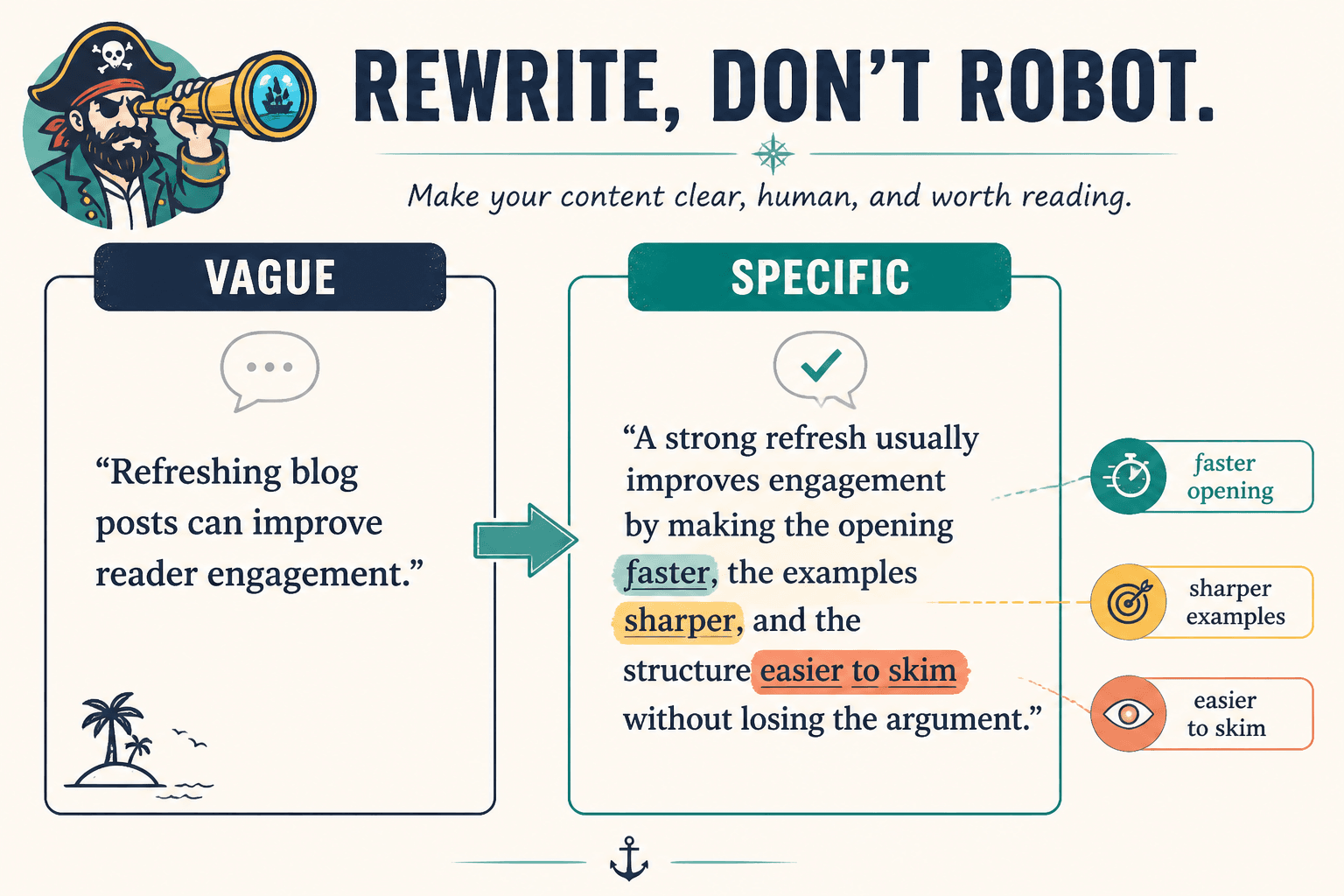
For example, instead of saying:
“Refreshing blog posts can improve reader engagement.”
Say:
“A strong refresh usually improves engagement by making the opening faster, the examples sharper, and the structure easier to skim without losing the argument.”
That second line tells the reader what the work actually looks like. Which is generally the point of writing advice.
Use AI carefully, or it will flatten the whole article
AI can help with blog refreshes. It can summarize weak sections, suggest alternate structures, spot repetition, generate headline options, and help you compare versions faster.
What it cannot reliably do on its own is preserve judgment, voice, and strategic restraint. That is where things go sideways.
If you feed an old article into a tool and ask it to “rewrite this for SEO,” you will often get exactly what you asked for: a tidier, flatter, more generic version of the piece. Cleaner grammar. Worse writing.
A better way to use AI in blog rewrites
- Use it to identify weak or repetitive sections
- Ask for multiple angle options, not one final draft
- Use it to generate examples you can refine, not publish untouched
- Have it extract the core claims from the original piece
- Use it for comparison, compression, and cleanup
- Keep final voice, structure, and CTA decisions human
If a sentence sounds technically fine but weirdly lifeless, trust that instinct. “Fine” is not the bar. The bar is useful, clear, and believable.
Keep the voice by rewriting in layers
One reason rewrites go robotic is that people try to solve everything at once. They update facts, adjust SEO, rewrite transitions, add CTA language, and clean grammar in a single pass. That is a great way to lose control of tone.
Layered rewriting works better.
A practical 5-pass rewrite process
- Structural pass: fix the order, headings, missing sections, and logic
- Substance pass: update facts, examples, proof, and recommendations
- Clarity pass: tighten rambling sentences, remove throat-clearing, sharpen claims
- Voice pass: make the piece sound like a person, not an internal memo
- Conversion pass: add or refine the CTA so it fits naturally
Notice that conversion comes last. Not first. Not in the middle. Last. Because if the article still is not good, no CTA polish is going to save it.
How to make CTAs feel natural in a refreshed blog post
A CTA becomes salesy when it feels detached from what the article just did. If the piece offered practical help and then suddenly lurches into “book a call today to transform your content strategy,” yes, readers will notice. And not in a flattering way.
The cleanest CTA usually extends the reader’s next logical step.
Examples of better CTA logic
| If the article helps with… | A natural CTA is… |
|---|---|
| Diagnosing weak blog posts | Read a related article on fixing stale posts |
| Improving intros | Read a deeper piece on stronger openings |
| Rewriting tone | See examples of boring copy rewritten more sharply |
| A service problem the reader may want help with | Offer a light consultation or next-step resource |
For example, a natural internal path here might point readers to how to rewrite boring blog rewrites and refreshes if they want more before-and-after examples.
You can also link broader topic clusters where relevant, like blog rewrites and refreshes or the wider blog SEO writing section. That helps the reader and supports your content structure without getting clingy about it.
Before-and-after rewrites that sound more human
Sometimes the fastest way to fix robotic writing is to see what changed.
Example 1: padded and bland
Before: Blog refreshes are an essential part of maintaining a successful content strategy. By updating older blog content, businesses can ensure that their websites remain relevant and continue to meet the needs of their audience.
After: Old blog posts do not stay useful by accident. If the advice is dated, the examples are thin, or the structure drags, readers feel it fast. A real refresh fixes that instead of pretending a new publish date counts as maintenance.
Example 2: too sales-forward
Before: If you want to maximize the impact of your existing content, our team can help you create compelling blog updates that drive measurable business results.
After: A good update does more than “repurpose” an old post. It makes the article clearer, more credible, and easier to act on. If you offer rewrite support, show that through the quality of the refresh before asking anyone to hire you.
Example 3: AI-polished but empty
Before: In today’s competitive digital environment, refreshed blog content can be leveraged to improve visibility, enhance user engagement, and support broader marketing objectives.
After: A refreshed post can win more search traffic, hold attention longer, and do a better job leading readers to the next step. But only if the update improves the thinking, not just the phrasing.
The pattern is simple: less fluff, more point.
A quick checklist for blog rewrites that still sound like you
- Does the intro get to the real problem quickly?
- Did you keep the article’s original point clear?
- Did you remove fake-professional filler?
- Did you add specific examples, not generic claims?
- Did you update facts without overexplaining obvious basics?
- Did you make the structure easier to scan?
- Did you use AI as support instead of letting it flatten the piece?
- Does the CTA feel earned?
- Would a real reader describe the article as useful, not just polished?
If too many of those answers are “sort of,” the rewrite probably needs another pass.
For a broader category view, you can also explore the blog article systems section on rewrites and refreshes. It is useful if you are building a repeatable process instead of winging each update from scratch.
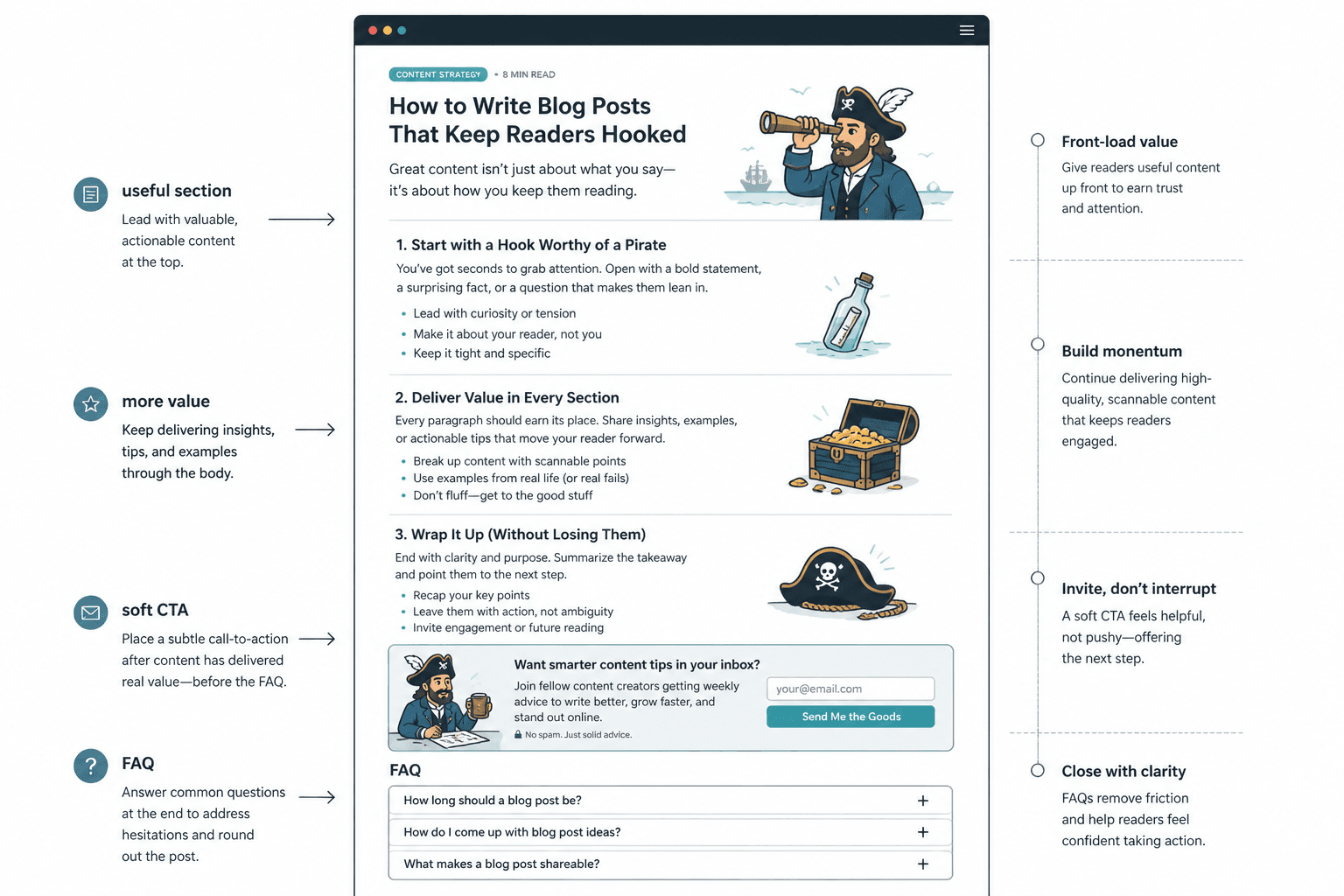
FAQ
How much should I change in a blog refresh?
Enough to improve the article in a meaningful way. If only the date and a few keywords changed, that is maintenance cosplay.
Can a refreshed blog post include a CTA?
Yes. Just make it relevant, brief, and placed after real value has been delivered.
How do I know if a rewrite sounds robotic?
If the article is technically clean but says familiar things in generic language, sounds too formal, or could belong to any brand, it probably does.
Should I use AI to rewrite old blog posts?
Use it to assist, not decide. It can speed up analysis and drafting, but it should not be trusted with your final voice.
The bigger point is simple: clearer structure and clearer writing make the piece more useful. That is usually what makes the ending land better too.