
Some audience-to-offer journeys are too long for the amount of trust, urgency, and clarity involved. That is the whole problem.
People love to talk about nurturing. Building funnels. Warming leads. Creating elegant customer journeys with twelve touchpoints, three automations, a lead magnet, a webinar, a case study, and a soft CTA pretending not to be a CTA. Very sophisticated. Very impressive. Also frequently unnecessary.
When Short Audience-to-Offer Journeys Beat Long Ones comes down to one simple truth: if the offer is clear, the problem is active, and the buyer already has enough trust, adding extra steps often hurts more than it helps.
A shorter journey can mean faster decisions, less drop-off, less confusion, and more revenue from the attention you already earned. Not always. But often enough that creators, consultants, coaches, and solo founders should stop assuming longer equals smarter.
Here’s how to tell when a short path works better, when a long one still makes sense, and how to avoid building a funnel that feels like admin work in costume.
For the main guide behind this topic, visit the parent guide.
Why people make audience-to-offer journeys too long
Most long journeys are not built because the buyer needs them.
They are built because the seller is nervous.
Nervous about asking too directly. Nervous about being seen as pushy. Nervous that if someone does not buy, the problem must be “more nurture” instead of weak messaging, weak positioning, weak proof, or an offer nobody wants badly enough.
So the path gets longer. Another freebie. Another email sequence. Another “value” post. Another delay between attention and action.
Sometimes that extra runway is useful. A lot of times, it is just friction wearing a strategy hat.
What a short audience-to-offer journey actually means
A short journey does not mean reckless selling or shouting “buy now” at strangers on the internet like a maniac in a trench coat.
It means reducing unnecessary distance between:
- attention and relevance
- interest and next step
- problem awareness and offer fit
- trust signal and buying opportunity
In practice, that might look like:
- a post leading directly to a booking page
- a thread leading straight to a paid product
- a case study linking to a consultation offer
- a profile CTA that sends people to one clear service page
- a newsletter issue that sells a workshop without making readers survive six weeks of “warming up” first
Short does not mean shallow. It means the path matches the buying reality.
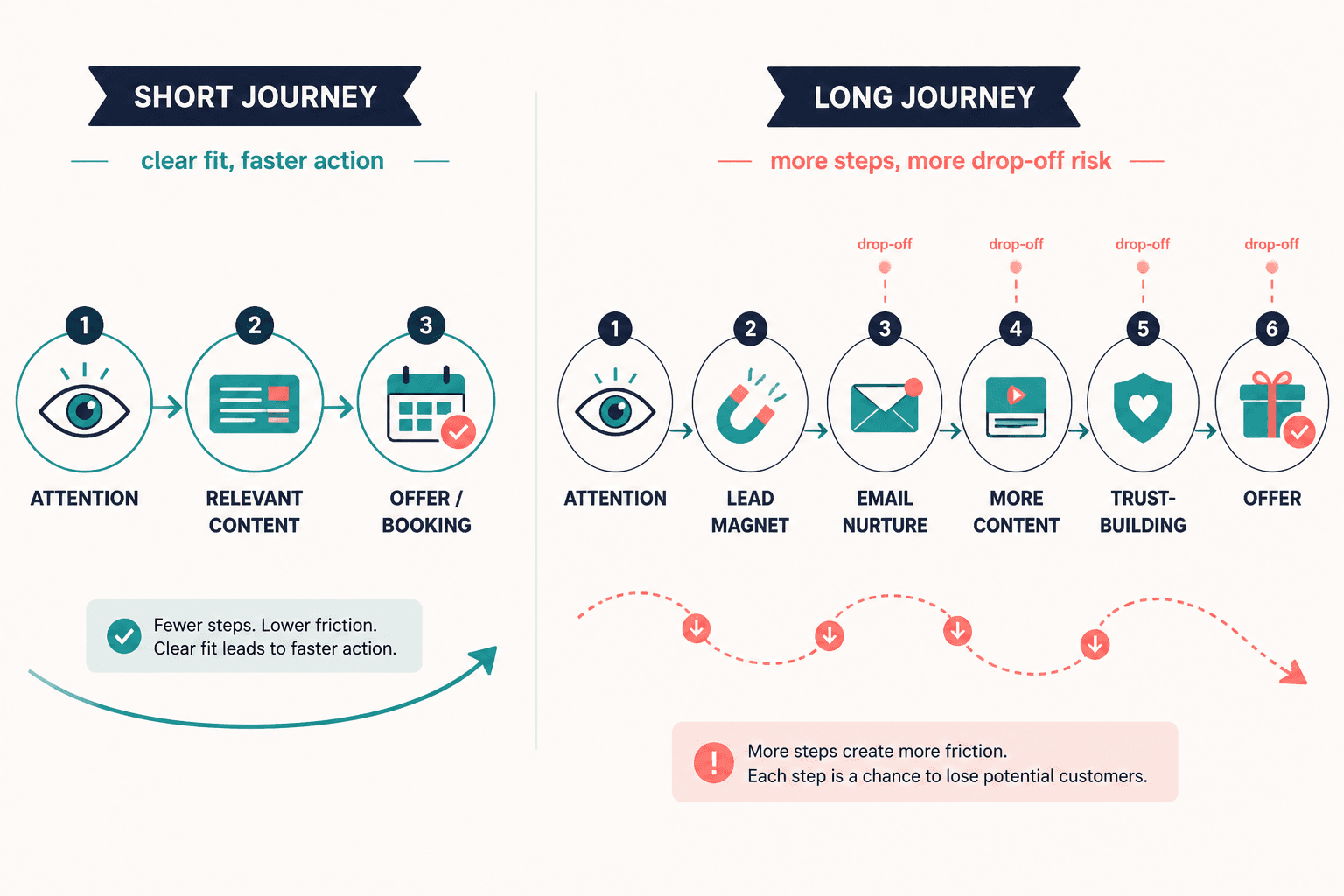
When short audience-to-offer journeys beat long ones
Short journeys tend to win when the buyer does not need a theatrical amount of persuasion. Here are the main situations where cutting steps usually improves results.
1. The problem is urgent and obvious
If your audience knows the problem is real and wants it solved soon, a long nurture sequence can feel absurd.
Examples:
- a consultant helping founders fix poor conversion on a live offer
- a copywriter rewriting a sales page before launch
- a designer improving a messy pitch deck before investor meetings
- a coach helping a client prepare for a major interview or speaking event
In these cases, people are not asking for a philosophical journey. They are asking, “Can you help, do you seem credible, and what do I do next?”
If the answer is yes, dragging them through a long sequence can lower conversion. Urgency decays. Attention wanders. The need is still there, but now they are solving it with someone else.
2. The offer is easy to understand
Some offers need explanation because they are new, high-ticket, technical, or oddly positioned. Others are immediately legible.
“I rewrite LinkedIn profiles for consultants.” Clear.
“I build a simple email welcome funnel for coaches.” Clear.
“I help experts turn scattered ideas into a clean authority content system.” Slightly fuzzier, but still workable if supported well.
The easier your offer is to grasp, the fewer educational steps you usually need. Long journeys are often a patch for unclear offers. Better positioning can remove half the funnel.
3. Trust already exists
Not every buyer starts cold.
Some people have been reading your posts for months. Some found you through referrals. Some came from your podcast guest appearance, newsletter, client mention, or comment section. Some already know exactly what you do and were just waiting until the timing made sense.
These people do not need ten more emails about your philosophy. They need a clean path to act.
This is one of the most common mistakes in monetization funnels: treating warm buyers like they are icy strangers. You make them prove their devotion by clicking through a maze. They leave.
4. The audience is small but relevant
Creators with small audiences often think they need more complexity to compensate for lower volume. Usually the opposite is true.
If your audience is small but well-matched, shorter journeys often work better because every extra step creates avoidable leakage. You do not have thousands of casual viewers to waste. You need the right people to move smoothly from interest to action.
This matters especially for consultants, service providers, and niche experts. A few high-fit buyers matter more than broad reach. A shorter path helps them say yes while the relevance is fresh.
If that sounds familiar, this pairs well with audience-to-offer journeys for creators with small audiences.
5. The content already does the nurturing
A lot of people separate content and funnel as if they live on different planets.
But if your posts, articles, emails, case studies, and profile already build trust, answer objections, show proof, and position the offer, you may not need a long formal journey on top of that.
The nurture already happened in public.
This is where many creators overbuild. They publish useful content for months, develop credibility, attract the right people, and then force those same people into a clunky funnel that repeats what they already know. That is not strategy. That is duplication.
6. The buying decision is low-friction
Shorter journeys tend to work better when the purchase:
- is relatively low cost
- has clear deliverables
- does not require team approval
- has low perceived risk
- solves one concrete problem
Think audits, templates, workshops, strategy sessions, mini-offers, profile rewrites, small retainers, or focused service packages.
You do not need a cathedral-sized funnel to sell a useful, understandable offer with modest risk. You need clarity, proof, and a decent CTA.
Signs your long journey is costing you conversions
If you are unsure whether the path is too long, look for these signals.
- People engage with content but do not reach the offer.
- You get interest in DMs, but people vanish when sent through the official process.
- Your free resource gets downloads, but few qualified conversations follow.
- You keep adding nurture steps because the previous nurture steps did not convert.
- People ask basic questions the funnel should have already answered.
- Warm referrals still have to jump through unnecessary hoops.
- Your sales process feels more complex than the offer itself.
One of the easiest ways to spot the issue is to ask: “If a ready buyer found me today, how many clicks, forms, pages, and delays stand between them and the obvious next step?”
If the answer sounds mildly annoying even to you, imagine how it feels to someone who has children, deadlines, notifications, and the attention span of modern internet life working against them.
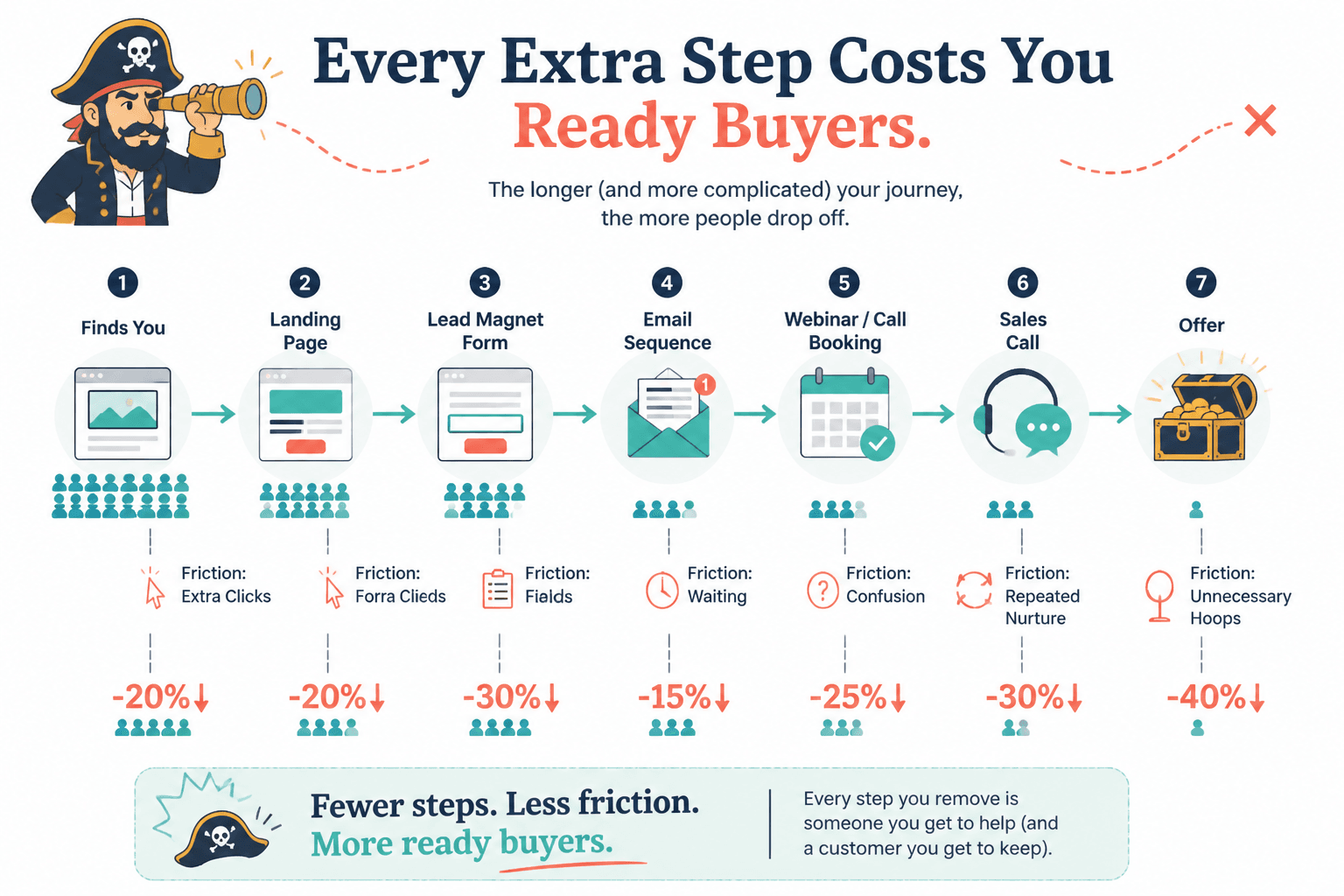
When longer journeys still make sense
Shorter is not always better. Sometimes a longer path is the sane choice.
Use more runway when the offer is expensive, complex, unfamiliar, or tied to a bigger identity shift. If someone is considering a major investment, a group program with a nuanced method, a retainer with lots of moving parts, or something that requires stakeholder buy-in, extra trust-building and clarification may be necessary.
Longer journeys can also help when the audience is problem-unaware. If they do not yet understand the cost of inaction, you may need more content and sequencing before the offer becomes relevant.
The point is not “always shorten.” The point is “stop making people travel farther than needed.”
For a broader look at journey design, see audience-to-offer journeys guide for creators who want better results and the parent page on audience-to-offer journeys.
How to decide if your audience-to-offer journey should be shorter
Here is a practical way to evaluate it.
Check the five friction questions
- Does the buyer already understand the problem?
If yes, you need less education. - Does the buyer already understand the offer?
If yes, you need less explanation. - Do they already trust you enough to consider action?
If yes, you need fewer warming steps. - Is there a clear, low-friction next move?
If no, that is usually the real bottleneck. - Is every step earning its place?
If a step does not increase clarity, trust, qualification, or conversion, it is probably clutter.
If you answer yes to the first three and no to the idea that every step is essential, your journey probably needs shortening.
Map the current path
Write out the actual route, not the one you imagine in your head.
- Post
- Profile
- Link in bio
- Lead magnet page
- Email confirmation
- Welcome email
- Nurture email 1
- Nurture email 2
- Invitation to book
- Application form
- Call
- Proposal
Then ask a rude but useful question: what would happen if you removed three of these steps?
Quite often, not much would break. In fact, things might improve.
Short journey models that work well
You do not need a giant system to monetize attention well. Here are a few short audience-to-offer journey models that make sense for many creators and service businesses.
Post to booking page
Best for service offers with high intent and clear outcomes.
- Post identifies a specific problem
- Post shows authority or proof
- CTA invites readers to book
- Booking page qualifies and converts
This works especially well when the audience already knows you or the problem is painful enough to act on now.
Article to related offer
Best for deeper authority content.
- Article solves part of the problem
- Examples show your thinking
- CTA points to a service, audit, workshop, or paid resource
If the article itself demonstrates expertise, you may not need an extra nurturing detour.
Profile to offer page
Best for creators whose content already builds trust consistently.
- Content creates interest
- Profile explains who you help and how
- CTA sends people to one simple next step
This is cleaner than making people choose between seven links and a mild identity crisis.
Free resource to paid mini-offer
Best when the free resource naturally leads into a fast next purchase.
Not every lead magnet needs a five-email philosophical saga. Sometimes the right move is:
- free checklist
- quick win
- paid template, workshop, or audit offer
That keeps momentum intact.
How to shorten the journey without becoming pushy
This is where people get twitchy. They hear “shorter path” and assume it means harder sell.
It doesn’t. A shorter journey is not more aggressive by default. It is often more respectful because it does not waste the buyer’s time.
Here’s how to do it well.
Make the offer clearer
Confusing offers need more explanation. Clear offers can move faster.
Tighten:
- who it is for
- what problem it solves
- what happens inside
- what outcome is realistic
- what the next step is
Add proof earlier
If people hesitate because trust is weak, do not automatically add more steps. Add better proof sooner.
That can include:
- specific results
- examples of work
- strong testimonials
- case-study snippets
- clear process breakdowns
Proof reduces the need for endless pre-selling.
Use direct but low-pressure CTAs
You do not need fake urgency or manipulative scarcity. You need a sane invitation.
Examples:
- “If you want help fixing this in your own funnel, you can book a strategy session here.”
- “If your profile is doing none of this, my rewrite package is probably the faster fix.”
- “If you want the template instead of building this from scratch, that’s here.”
Simple. Clear. Not weird.
Remove duplicate nurture
If your content already teaches the idea, your lead magnet does not need to re-teach it. If your sales page already explains the offer, your booking form does not need to interrogate people like customs at an international airport.
Every repeated step adds drag. Cut repetition first.
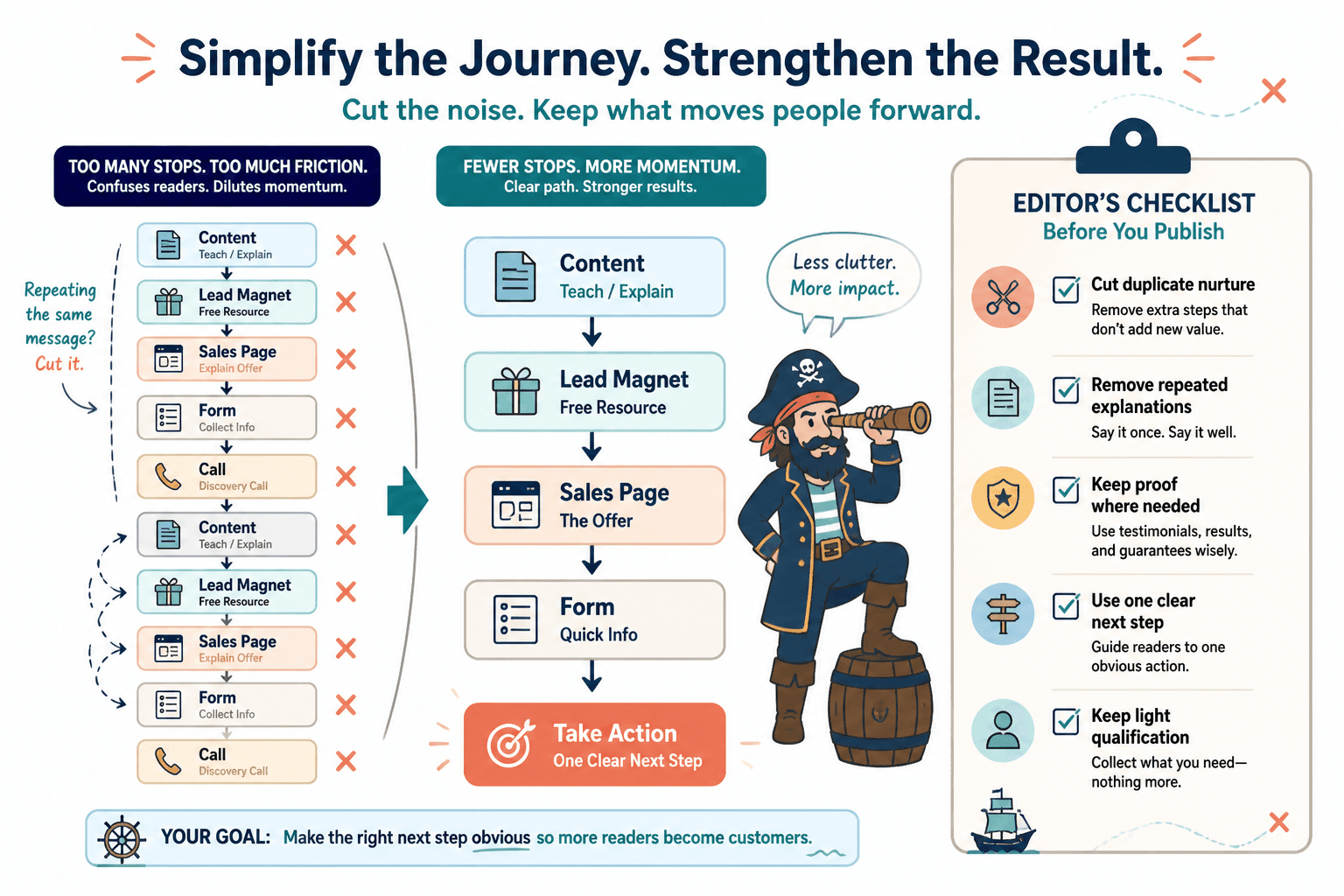
Common mistakes when trying to shorten the path
There is a difference between streamlining and stripping out all persuasive structure. A shorter journey can still fail if you remove the wrong things.
- Cutting trust instead of cutting clutter. If buyers truly need reassurance, skipping proof will hurt.
- Sending cold traffic straight to a vague offer. Short only works if relevance and clarity are strong.
- Using weak CTAs. “Reach out if this resonates” is not a serious next step.
- Ignoring qualification. Fewer steps should not mean more bad-fit leads.
- Keeping the same messy messaging. A shorter path will not rescue a bland offer.
If your conversions are weak, read audience-to-offer journeys conversion steps mistakes that hurt performance. A lot of “funnel problems” are really step-quality problems.
A quick before-and-after example
Too long
The bigger point is simple: clearer structure and clearer writing make the piece more useful. That is usually what makes the ending land better too.
Audience-to-offer journeys work better when the next step feels like a natural continuation of the problem. Better alignment usually beats more pressure.