
Most people do not have a content problem. They have a journey problem.
They post. People pay attention. A few even engage. Then… nothing useful happens. No clear next step. No bridge from interest to inquiry. No path from “this person seems smart” to “I’d actually pay them.”
That is where audience-to-offer journeys come in. And no, this does not mean building some overengineered funnel monster with seventeen emails, three countdown timers, and a soul-slightly-damaged webinar script.
A good journey is simpler than that. It moves the right person from attention to trust to action without making the whole thing feel like a trap.
This guide gives you practical Audience-to-Offer Journeys Examples for Coaches, Consultants, and Personal Brands so you can see what that actually looks like in the real world. Not theory. Not vague funnel diagrams. Actual journey patterns you can adapt based on your audience, your platform, and your offer.
If your content gets attention but not many leads, or if your offers feel disconnected from what you post, this is the fix. Or at least a large chunk of it.
For the full path around this topic, head to the parent guide.
What an audience-to-offer journey actually is
An audience-to-offer journey is the path someone takes from discovering you to buying from you.
That path might start with a LinkedIn post, an article, an X thread, a Facebook post, a podcast clip, a profile visit, a lead magnet, a newsletter, a case study, a DM conversation, or a booking page. The point is not the format. The point is the sequence.
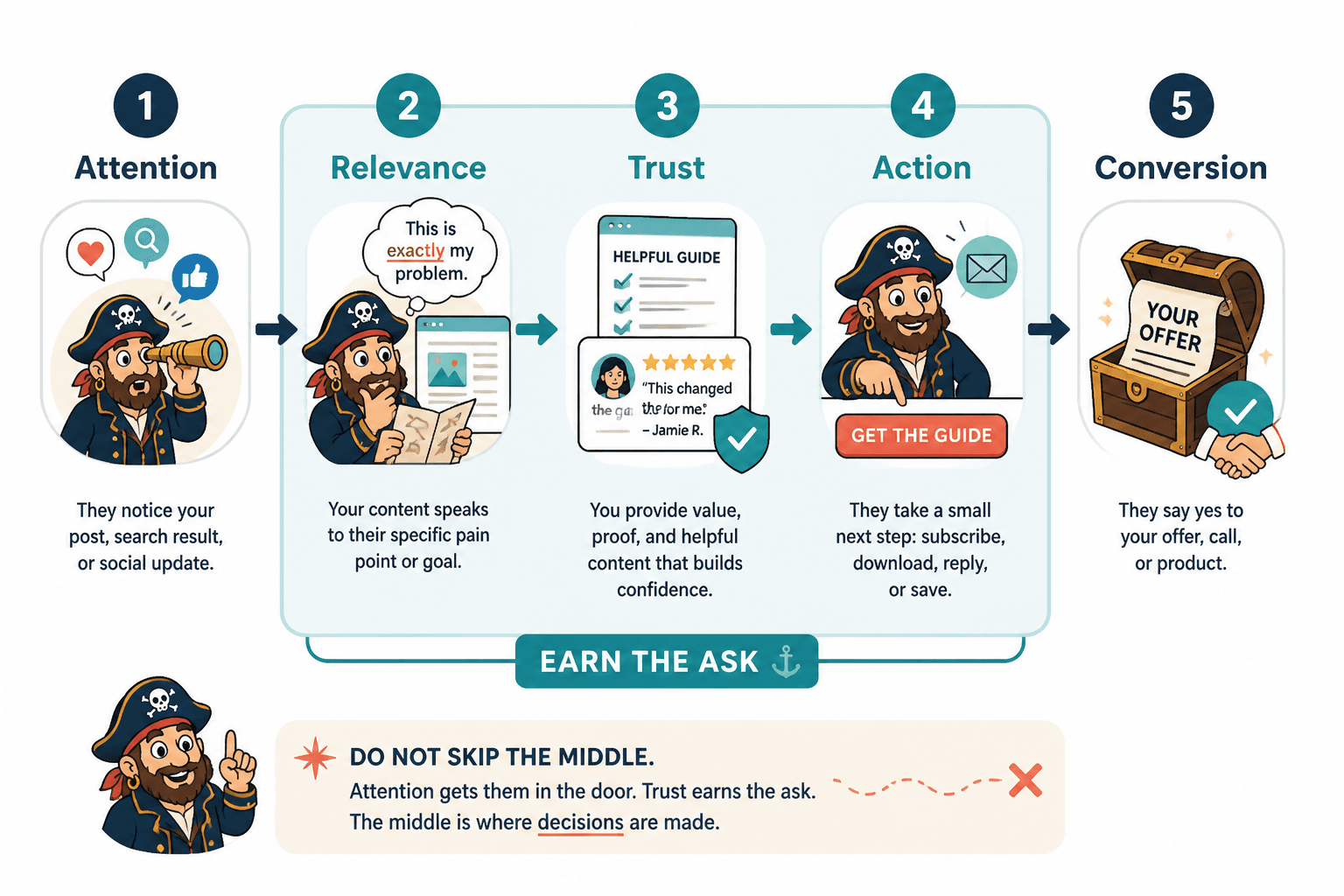
A strong sequence usually has five parts:
- Attention: They find you.
- Relevance: They realize you talk about problems they actually have.
- Trust: They see enough proof, usefulness, or clarity to take you seriously.
- Action: They take a small next step.
- Conversion: That step leads naturally to your offer.
Simple. Not always easy, but simple.
The mistake a lot of coaches, consultants, and personal brands make is skipping the middle. They go from “here is a thought” straight to “book a call.” Which can work if you already have a warm audience, strong authority, or lucky timing. For everyone else, it usually feels abrupt and vaguely desperate.
Good journeys earn the ask.
What makes a journey work
Before the examples, it helps to know what separates a journey that converts from one that just looks tidy in a Notion board.
1. The content and the offer match
If your content is about productivity habits and your offer is executive messaging strategy, do not be surprised when the wrong people raise their hands. Attention is not enough. It has to be the right attention.
2. The next step feels proportionate
A stranger reading one post usually is not ready for a sales call. But they might download a short resource, read a useful article, join your newsletter, or reply to a very specific question.
3. Trust is built before pressure appears
Trust can come from clarity, proof, consistency, examples, case studies, useful insights, strong positioning, or simply sounding like a competent adult instead of a hype machine.
4. The journey removes friction
If people have to guess what you do, who it is for, where to click, what happens next, or whether the offer is relevant, you have friction. And friction kills more conversions than “the algorithm” ever will.
5. The offer is introduced naturally
The best journeys make the offer feel like the logical next step, not a sales ambush hidden behind a “free value” bush.
7 audience-to-offer journey examples you can actually use
These are not the only models, but they cover a lot of what works for coaches, consultants, and personal brands with service offers, advisory offers, digital products, or small-ticket entry points.
1. The insight post to lead magnet to consult call journey
This is a classic for consultants and strategic coaches who solve clear business problems.
- Step 1: Post a sharp insight about a painful, expensive problem.
- Step 2: Offer a relevant lead magnet that helps diagnose or understand that problem.
- Step 3: Follow up with nurturing emails, examples, or case studies.
- Step 4: Invite qualified people to book a call.
Example: A messaging consultant posts about why B2B founders keep sounding interchangeable in sales content. The CTA offers a messaging teardown checklist. The follow-up emails include before-and-after examples and one short case study. The final CTA invites founders to book a messaging strategy session.
Why it works: The lead magnet acts like a bridge. It turns casual attention into owned attention, then gives you room to build trust without trying to sell too early.
Best for: Consultants, B2B coaches, positioning strategists, conversion copywriters, leadership advisors.
Common mistake: Making the lead magnet too broad. “The Ultimate Guide to Success” is not a bridge. It is a PDF-shaped shrug.
2. The educational article to profile to booking page journey
This works well when your audience needs more depth before they trust you.
- Step 1: Publish a search-friendly or shareable article solving a specific problem.
- Step 2: Use that article to establish authority and clarity.
- Step 3: Make sure your profile reinforces who you help and what you offer.
- Step 4: Send readers to a clean booking or inquiry page.
Example: A leadership coach writes an article on why high-performing managers struggle to give direct feedback without sounding robotic. Readers land on the article through search, shares, or internal links. The bio and profile clearly position the coach for leadership teams and 1:1 coaching. The next step is a consultation call.
Why it works: Some offers need depth, not just feed-level visibility. Articles can do more of the heavy lifting when the buyer needs to believe you actually know your craft.
This is one reason solid evergreen articles still matter. Not every offer should rely on social posts alone. Social gets you seen. Long-form often gets you believed.
If you want broader strategy around this, the main audience-to-offer journeys guide is worth reading alongside this one.
3. The short-form content to newsletter to low-ticket offer journey
This is great for personal brands who want to monetize before trying to sell premium services to everyone with a pulse.
- Step 1: Share frequent short-form content around a narrow problem or skill.
- Step 2: Invite people to join a newsletter for deeper advice.
- Step 3: Build trust with consistent, useful emails.
- Step 4: Sell a workshop, mini-course, toolkit, or template pack.
Example: A creator helping service businesses write better authority content posts daily writing breakdowns on LinkedIn and X. The CTA points people to a weekly newsletter with practical examples. After a few issues, subscribers are offered a paid content planning workshop.
Why it works: It gives people a lower-risk way to buy from you first. Once someone has had a useful paid experience, premium offers often become much easier to sell.
Best for: Writers, educators, creators, experts with teachable systems, people building digital products alongside services.
4. The case study post to DM conversation to service offer journey
This one works well when your audience is small but relevant.
- Step 1: Share a specific case study with a clear result, process, or lesson.
- Step 2: Invite conversation from people dealing with the same issue.
- Step 3: Continue the discussion in comments or DMs.
- Step 4: If there is fit, move to a service offer or discovery call.
Example: A sales consultant posts a short case study showing how a client improved call conversion by fixing one weak onboarding step. The CTA is not “book now.” It is “If your pipeline is full but close rates are weirdly soft, message me ‘pipeline’ and I’ll send the diagnostic questions we used.” Some of those conversations turn into consulting leads.
Why it works: It starts with proof, not pitch. That matters. People trust demonstrated thinking far more than generic claims about “helping clients scale.”
Common mistake: Turning every DM into an immediate sales script. If the conversation was invited as a helpful next step, act like a human and earn the right to steer it further.
For more on what happens after first contact, see better audience-to-offer journeys retargeting ideas for personal brands.
5. The webinar or live session to diagnostic offer journey
Live formats can speed up trust when the offer is more expensive or nuanced.
- Step 1: Promote a focused live training, workshop, or webinar.
- Step 2: Teach one meaningful idea well.
- Step 3: Show what gets in the way of implementation.
- Step 4: Offer a paid or application-based diagnostic, audit, or strategy session.
Example: A brand strategist hosts a session on why founders with good offers still struggle to sound distinct. At the end, attendees can apply for a paid brand message audit. That audit then leads naturally to a larger strategic engagement.
Why it works: The live session creates depth and momentum. The diagnostic offer feels like a practical next step because the audience already understands the problem and sees why outside perspective helps.
This model is especially useful when your full offer is hard to explain quickly. A live session gives context. The diagnostic creates a smaller decision. Much better than trying to leap straight from “here is one tip” to “hire me for five figures.”
6. The problem-aware post to self-audit tool to group program journey
This is a strong option for coaches and educators selling a cohort, membership, or group program.
- Step 1: Post about a frustrating pattern your audience recognizes.
- Step 2: Offer a self-audit, scorecard, or short assessment.
- Step 3: Use the results to segment people by need or readiness.
- Step 4: Invite qualified people into the group program.
Example: A business coach writes posts about why independent consultants stay stuck at referral-only growth. The CTA links to a “consultant growth bottleneck audit.” Based on the result, people are directed to a relevant training and then invited to a group coaching program focused on outbound content and lead flow.
Why it works: Self-assessment increases relevance. It helps people see themselves in the problem before you ask them to invest in the solution.
Common mistake: Making the audit feel gimmicky or overcomplicated. This does not need to look like a personality quiz made by a caffeinated raccoon. It just needs to help someone identify what is actually blocking results.
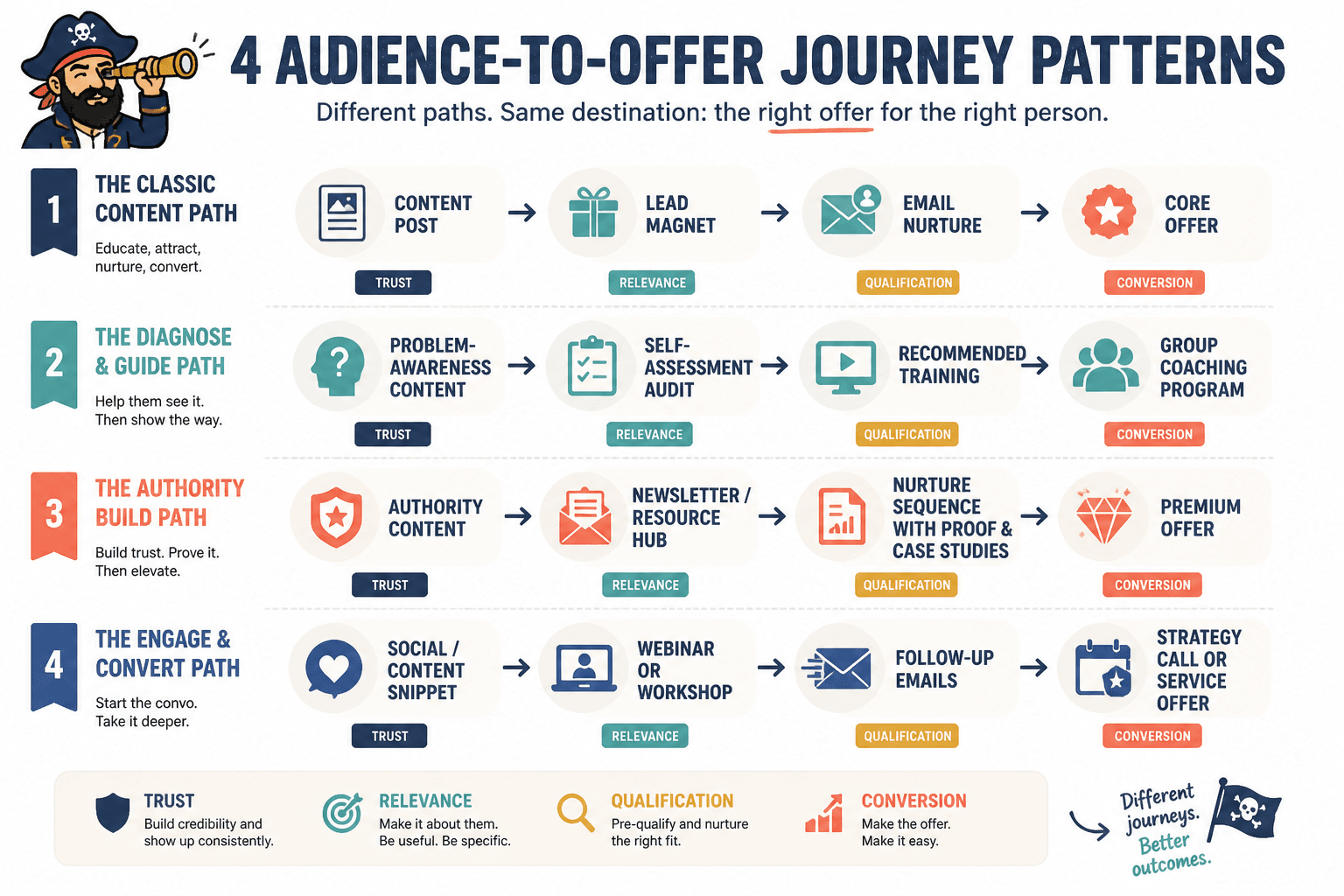
7. The authority content to nurture sequence to premium offer journey
This is often the best fit for high-trust, higher-ticket offers.
- Step 1: Publish authority content regularly: articles, strong opinion posts, frameworks, case studies.
- Step 2: Capture interest through a newsletter, resource hub, or application form.
- Step 3: Nurture with proof, perspective, and relevance over time.
- Step 4: Present the premium offer once the audience understands both the stakes and your method.
Example: An executive advisor shares nuanced content on visibility, leadership communication, and reputation. Interested readers join a newsletter. Over a few weeks, they receive deeper guidance, examples, and client patterns. The CTA then invites qualified readers to apply for private advisory work.
Why it works: Premium buyers rarely convert because of one clever post. They convert because repeated exposure reduces uncertainty and increases trust.
How to choose the right audience-to-offer journey
You do not need seven journeys. You need one or two that fit your business.
Pick based on three things: your offer, your audience temperature, and your buying friction.
| If your offer is… | Best journey style |
|---|---|
| High-ticket and customized | Article or authority post → proof → consult call |
| Mid-ticket strategic service | Insight content → lead magnet → nurture → call |
| Low-ticket digital product | Short-form content → newsletter → offer |
| Group coaching program | Problem content → self-audit or webinar → invite |
| Advisory or consulting retainer | Case study or authority content → conversation → application |
Another useful rule: the colder the audience and the more expensive the offer, the more trust your journey needs to build before asking for action.
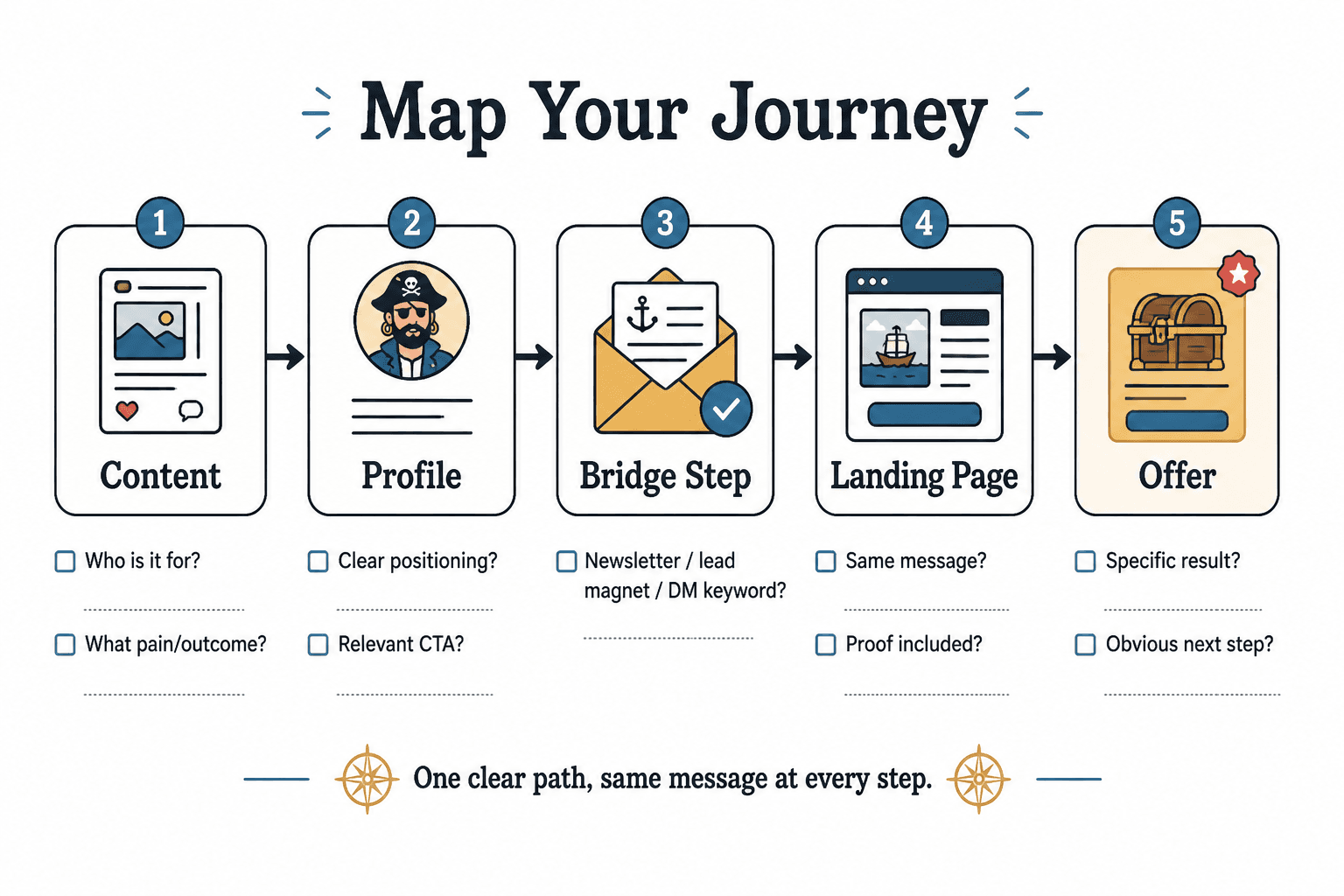
How to map your own journey in 5 steps
If you want to build this without overcomplicating it, start here.
1. Start with the offer
What exactly are you trying to sell? A 1:1 service, a group program, a workshop, a retainer, a strategy intensive?
If the offer is fuzzy, the journey will be fuzzy too.
2. Define the buyer’s first meaningful problem
Not the full transformation. The first problem that makes them pay attention.
For example:
- “My content is visible but not converting.”
- “People like my work but do not inquire.”
- “My positioning feels broad and forgettable.”
- “I get leads, but they are low fit.”
3. Create the bridge step
This is the in-between action that moves someone from casual interest to stronger intent.
Examples:
- Lead magnet
- Newsletter signup
- Self-audit
- Case study
- DM prompt
- Workshop registration
- Diagnostic session
4. Add trust assets
What will help a skeptical but interested person believe you are worth their time and money?
- Examples
- Client outcomes
- Process breakdowns
- Before-and-after rewrites
- Frameworks
- Email nurture
- Clear positioning on your profile
5. Make the next step obvious
This sounds boring. It is also where a lot of journeys quietly break.
If someone is interested, do they know where to go? Is the CTA clear? Is your profile aligned? Does the landing page continue the same message? Or does the whole thing collapse into vague “work with me” language the second money enters the chat?
That last one happens a lot.
Common audience-to-offer journey mistakes
- Posting disconnected content: If your content attracts one audience and your offer serves another, the journey breaks before it starts.
- Pitching too early: Attention is not consent to be sold to immediately.
- No bridge step: Going straight from post to paid call is often too abrupt.
- Weak profile copy: If people visit your profile and still do not know what you do, you are leaking trust.
- No proof: Good intentions are nice. Evidence converts better.
- Too many paths: One post points to a newsletter, another to a webinar, another to a free call, another to a template, another to a mystery link. Calm down. Pick a path.
- Bad offer fit: No journey can save an offer people do not want or understand.
If you want more strategic examples, see best audience-to-offer journeys ideas and examples for creators and audience-to-offer journeys guide for creators who want better results.
A simple way to think about this without turning into a funnel goblin
Here is the clean version.
The bigger point is simple: clearer structure and clearer writing make the piece more useful. That is usually what makes the ending land better too.