
Most welcome emails are weirdly undercooked.
Someone just gave you attention, permission, and a spot in their inbox, and what do many creators send back? A bland “thanks for subscribing,” a messy wall of links, or a mini autobiography nobody asked for.
That is a waste of a very good moment.
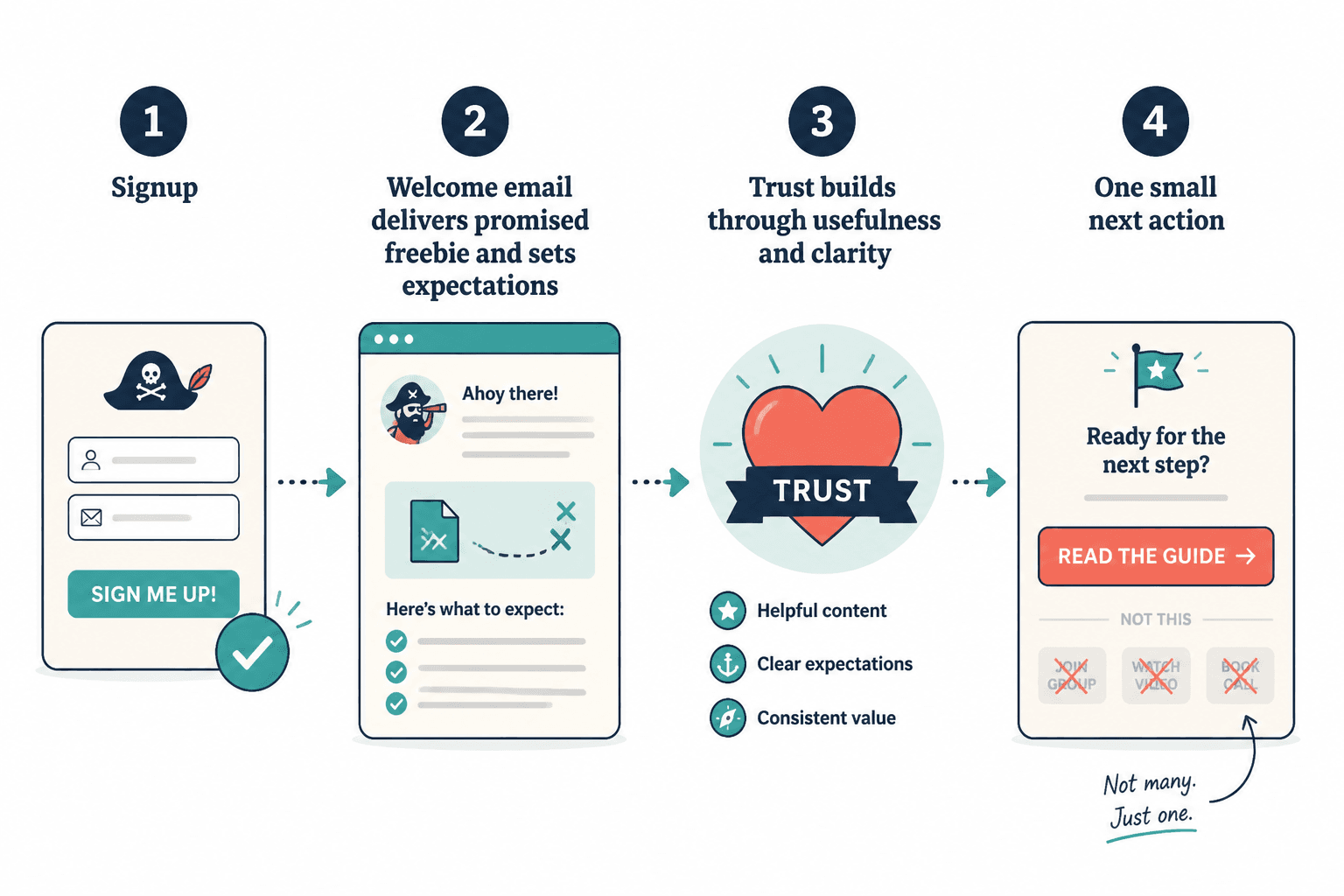
A strong welcome email does not need to be clever, long, or dressed up like a product launch. It needs to do a few simple things well: confirm the signup was worth it, set expectations, build trust fast, and point the reader toward a useful next step.
This Welcome Emails Guide for Creators will show you how to do that without sounding robotic, needy, or like you copied a funnel bro’s template from 2019. If you write newsletters, sell services, coach clients, create content, or build a personal brand, your welcome email is not admin. It is positioning.
And yes, small creators should care about this too. Especially small creators. When you do not have massive reach, each new subscriber matters more.
For the full path around this topic, head to the parent guide.
What a welcome email is actually supposed to do
A welcome email is not just a receipt for joining your list.
It is the first real impression of your newsletter, brand, or offer after someone raises their hand. That means its job is less “say hello” and more “make the relationship make sense.”
At minimum, a good creator welcome email should:
- Confirm who you are and why the subscriber signed up
- Deliver the thing they expected, if there was a lead magnet or freebie
- Set expectations for what kind of emails they will get
- Give them a reason to keep opening future emails
- Move them toward one small next action
That next action matters more than people think. Do not cram in six of them. Pick one. Read a useful post. Reply with a quick answer. Whitelist your address. Check out your best resource. Follow your work more closely. Simple wins.
If you want the broader context around creator email systems, this section of the site is a good place to keep reading: email newsletter writing and welcome emails for creators.
Why so many creator welcome emails get ignored
Usually, the problem is not the email platform. It is not some mysterious inbox curse either. It is that the email does not feel written with any real intent.
Here is what tends to go wrong:
- It says hello but says nothing useful
- It talks too much about the creator and not enough about the reader
- It links to everything, which means the reader clicks nothing
- It sounds polished in the dead-eyed AI way
- It makes promises about “value” instead of showing actual value
- It asks for a sale before trust exists
There is also a common creator mistake here: trying to prove too much too early. You do not need to unload your life story, all your credentials, your full framework, three testimonials, and four offers in email one. Calm down. This is an introduction, not a hostage situation.
The core structure of a welcome email that gets better results
If you want a simple structure that works across newsletters, creator businesses, coaching offers, and personal brands, use this:
- Subject line that feels clear, not overmarketed
- Warm opening that acknowledges the signup
- Quick value that reinforces why they joined
- Expectation setting so future emails feel coherent
- One next action that is easy and relevant
- Human sign-off that sounds like a person
That is the skeleton. The rest depends on your business model, your voice, and what the subscriber signed up for.
1. Subject line: clear beats cute
You do not need to write a subject line like you are trying to win a copywriting cage match.
Good welcome email subject lines for creators often sound like this:
- Welcome — here is what to expect
- You are in. Start here.
- Glad you joined
- Your guide is inside
- Welcome to the newsletter
- A quick note before we begin
These work because they are obvious. Obvious is underrated. Especially in email.
Weak versions tend to sound like this:
- The secret nobody tells you 👀
- You will not believe what happens next
- My gift to the world
- This changes everything
No. You are not launching a magic trick. You are sending a welcome email.
2. Opening: make the signup feel smart
Your first few lines should reassure the reader that joining your list was a sensible decision, not another inbox mistake.
Simple example:
Thanks for joining. You signed up because you want better content that sounds sharper, works harder, and does not read like it was assembled by a very polite machine. That is exactly what I send here.
That works because it is specific. It reflects back the reason for subscribing. It does not waste 80 words saying “I’m so excited to have you here.”
3. Quick value: give them something useful immediately
If the subscriber joined for a resource, deliver it fast. If they joined for your ideas, give them one useful insight immediately. If they joined because of your content, point them toward your best starting point.
This can be as simple as:
- A short lesson
- A helpful link
- A practical checklist
- A “start here” list of your best pieces
- One mistake to avoid
The key is speed. Do not bury the value under throat-clearing.
4. Set expectations before confusion sets in
People stay subscribed when they understand what they signed up for.
Tell them things like:
- How often you email
- What kinds of topics you cover
- What your emails tend to be like
- Whether you also share offers sometimes
Example:
I usually send one email a week with practical ideas on content, positioning, and audience growth. Occasionally I will share templates, tools, or offers if they are actually useful. No daily spam. No “just checking in” nonsense.
That line does more trust-building than a generic “you’ll get valuable content from time to time” ever will.
5. One next action is enough
Do not ask them to read five articles, follow four social accounts, book a call, buy your product, and reply with their biggest challenge. Pick one action.
Strong welcome email CTAs for creators include:
- Reply and tell me what you are working on
- Start with this article
- Download the resource here
- Read these three best posts first
- Add this email to your primary inbox
If you want examples of stronger structures and angles, you can pair this guide with best welcome email ideas and examples for creators and how to write better welcome emails.
A practical welcome email formula for creators
Here is a dead simple formula you can adapt.
Subject: Welcome — here is what to expect
Hey [First Name],
Thanks for joining.
You signed up because you want [specific outcome]. Around here, I help [specific audience] do that through [specific kind of content or help].
To get you started, here is [resource / best article / quick win].
You can expect [frequency] emails about [topics]. They are usually [tone or format].
If you want, hit reply and tell me [simple question]. I read those.
Glad you are here,
[Name]
That formula is intentionally plain. Plain is fine. Better than fine, actually. A welcome email is doing relationship work. It does not need to perform circus tricks.
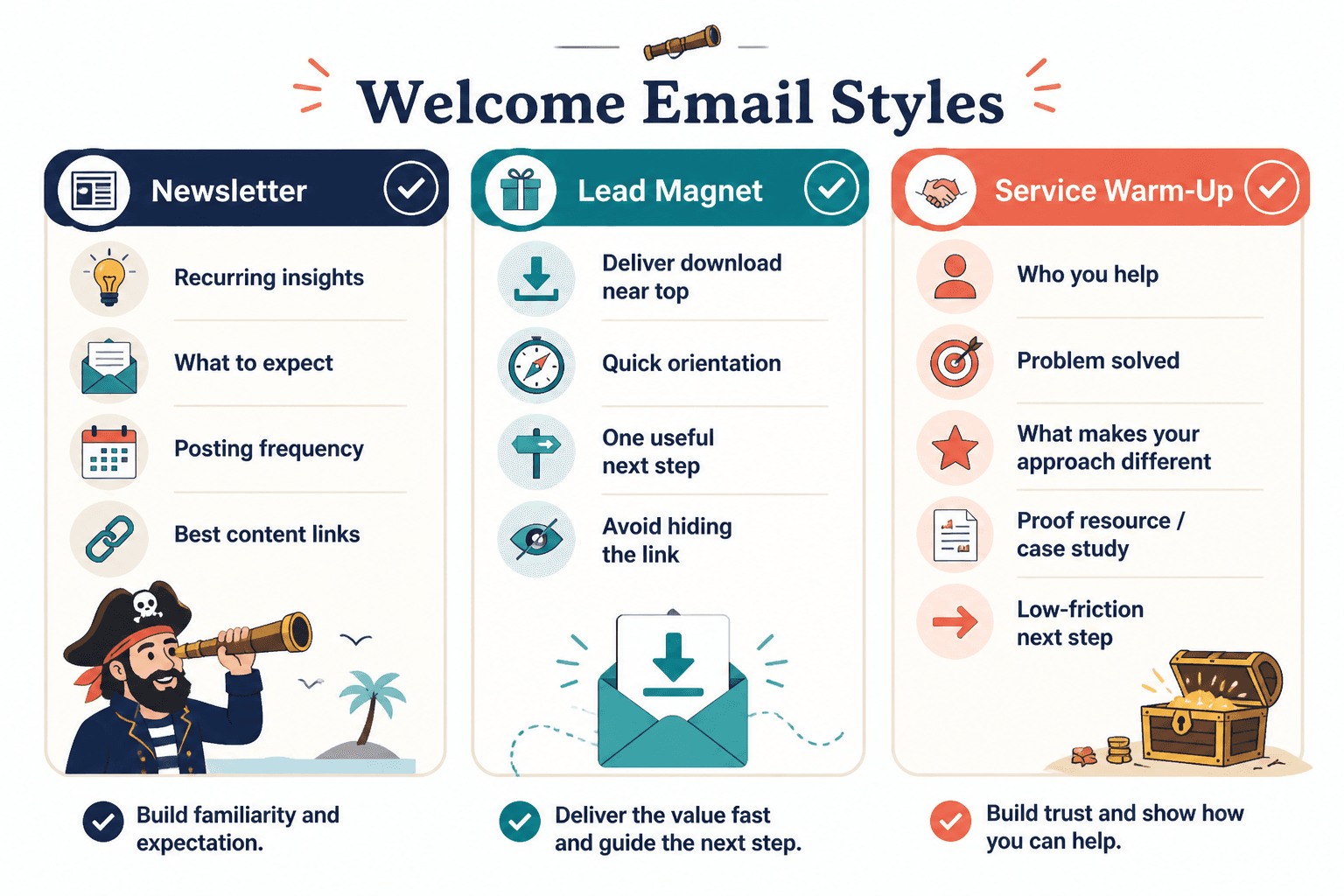
Three welcome email styles creators can use
You do not need one universal style. Different creators need different versions depending on how they attract subscribers and what happens next.
The newsletter-first welcome email
Best for writers, creators, thought leaders, and personal brands whose main goal is trust and readership.
Focus on:
- Your angle
- What kind of thinking you share
- Why your emails are worth opening
- One or two best pieces to start with
This version should feel like a smart introduction, not a funnel ambush.
The lead magnet welcome email
Best for creators using a checklist, guide, template, swipe file, or mini resource to grow their list.
Focus on:
- Fast delivery of the promised resource
- A short explanation of how to use it
- One natural next step after using it
- Expectation setting for future emails
Do not make people hunt for the download link like it is hidden treasure. Put it near the top.
The service or offer warm-up welcome email
Best for coaches, consultants, freelancers, and solo founders who use content to attract qualified leads.
Focus on:
- Who you help
- What problem you solve
- What makes your approach different
- A proof-bearing resource or case-study-style article
- A low-friction next step
This is where many people get too eager and pitch too hard. Resist that. The first email can mention your work, sure, but it should not feel like a waiter dropping the bill before the food arrives.
What to include in a creator welcome email sequence
One welcome email is often enough to start well. But if you want better results, a short welcome sequence usually does more heavy lifting.
A good sequence gives you room to build familiarity without stuffing everything into one email. That matters because trust tends to grow across a few interactions, not one heroic send.
A simple 3-email sequence might look like this:
- Email 1: Welcome, delivery, expectations, one next action
- Email 2: Best ideas or most useful resources
- Email 3: Your approach, perspective, or offer explained clearly
If you have a warmer audience or a more involved offer, you might stretch that to five emails. But you do not need some 12-part saga to make this work.
Here is the point: the sequence should reduce uncertainty. Who are you? What do you help with? Why should they care? What should they read, do, or consider next? Every email should answer one of those questions cleanly.
Before-and-after welcome email rewrites
Sometimes the easiest way to improve your writing is to see what the bad version is doing wrong.
Example 1: vague and generic
Before
Hello and welcome to my newsletter. I am so excited to have you here. I will be sharing valuable insights, tips, and updates to help you on your journey. Stay tuned for more.
After
Thanks for joining.
I write for creators and service businesses who want sharper content, better positioning, and emails people actually read.
You can expect one email a week with practical examples, useful breakdowns, and the occasional template. To start, here is one of my best resources on writing stronger welcome emails.
Why it works better:
- Clear audience
- Clear value
- Clear frequency
- Clear next step
Example 2: too much too soon
Before
Welcome! Here are my podcast, YouTube channel, Instagram, free ebook, consultation page, blog, case studies, templates, and membership. I’ve helped hundreds of people transform their businesses and I’d love to help you too. Book a call now.
After
Glad you are here.
If you joined because you want better email and content systems, start with this: [best starting resource]. It will give you the quickest picture of how I think and what tends to work.
I’ll send more practical ideas each week. If you ever want help applying this to your business, you will hear about that too. No rush.
The rewrite lowers friction. It gives one path, not a maze.
Example 3: overdone personality, underdone clarity
Before
Welcome to my strange little corner of the internet, where caffeine, chaos, and creativity collide. Buckle up, because we’re about to go on a wild journey together.
After
Welcome.
This newsletter is where I share practical ideas on writing, audience growth, and creator business systems without the usual fluff. If you like useful over inspirational, you’ll probably enjoy it here.
A little personality is great. But clarity still has to show up to work.
How to tailor welcome emails based on your creator business
Not every creator needs the same kind of welcome email. The more closely it fits your actual model, the better it tends to perform.
| Creator type | Best welcome email focus | Strong next action |
|---|---|---|
| Newsletter writer | Voice, topic, best reads | Read one standout piece |
| Coach or consultant | Problem, approach, trust | Reply or read a case-style article |
| Freelancer | Expertise, positioning, proof | View sample work or process page |
| Course creator | Outcome, framework, student fit | Start with a beginner resource |
| Personal brand | Perspective, niche, consistency | Follow the email series or best content |
If your audience is still small, do not assume this means your welcome emails can be sloppy. Smaller lists often have more concentrated opportunity because the subscribers are closer to the source. They found you for a reason. Treat that reason seriously.
If that is your situation, read welcome emails for creators with small audiences. Small lists do not need less strategy. They need less fluff.
Mistakes creators keep making with welcome emails
Some of these are subtle. Some are deeply obvious and still happen all the time.
- Writing like a brand handbook. Sound like a person, not a mission statement with punctuation.
- Burying the promised resource. If they signed up for something, give it to them quickly.
- Using five CTAs. Too many options kills action.
- Making it all about you. Your story matters only if it helps the reader understand the value.
- Being vague about future emails. Unclear expectations lead to unsubscribes or indifference.
- Pitching immediately. You can mention an offer. You should not shove it into their face on line three.
- Sounding suspiciously polished. If it reads like AI oatmeal, people feel it.
That last one matters more now. A lot of inbox copy sounds technically clean but emotionally empty. The fix is not “add emojis” or “be more authentic” in some vague way. The fix is specificity. Specific audience. Specific promise. Specific next step. Specific point of view.
Tools and templates can help, but they will not save a weak message
Email tools are useful for automation, segmentation, testing, and not forgetting to send things. Templates are useful for speed and consistency. Both are good.
But neither can rescue a welcome email that has no point.
Use tools to:
- Automate the send after signup
- Segment people by interest or lead source
- Test subject lines or timing
- Build simple sequences
- Track clicks and replies
Do not expect tools to:
- Create trust from nothing
- Figure out your positioning for you
- Turn generic ideas into memorable ones
- Know what your audience actually cares about without your input
If you want the practical stack side of this, see best templates and tools for welcome emails.
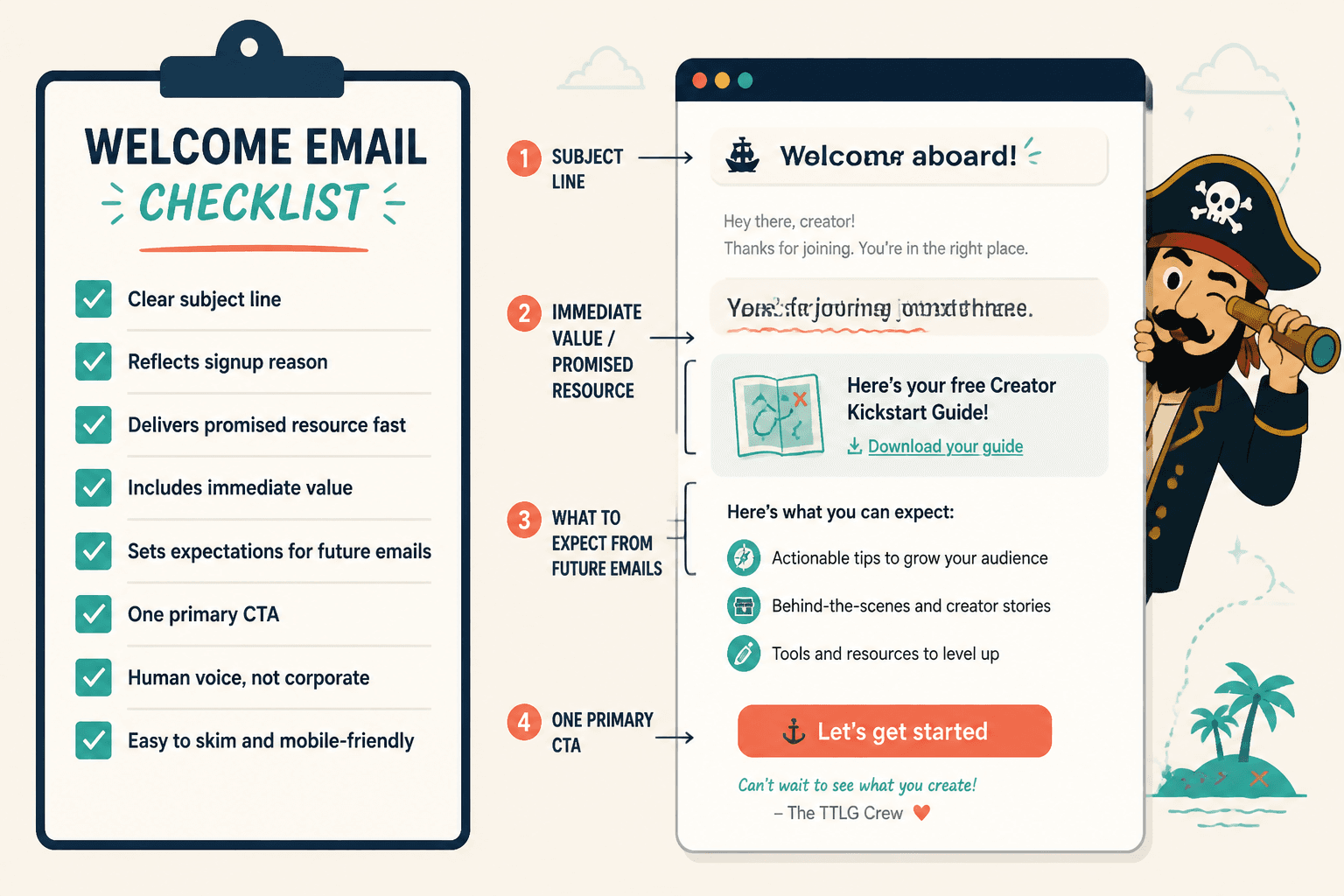
A simple welcome email checklist before you hit publish
Before you turn on your automation, check this:
- Is the subject line clear?
- Does the opening reflect why they subscribed?
- Did you deliver the promised resource fast?
- Is there immediate value in the email itself?
- Did you explain what future emails will be like?
- Is there only one primary CTA?
- Does it sound like a human with a point of view?
- Could someone skim it in under a minute and still get the point?
If the answer to three or four of these is “sort of,” the email probably needs another pass.
How to know if your welcome email is doing its job
The bigger point is simple: clearer structure and clearer writing make the piece more useful. That is usually what makes the ending land better too.
Welcome emails work best when they set expectations clearly and move the relationship forward without overperforming. Clarity and trust do more than extra cleverness.