
Most old content does not have a traffic problem. It has a journey problem.
You published the post, thread, article, guide, carousel, or email. Maybe it got decent attention. Maybe it still gets some. But it does not lead anywhere useful. People read it, nod politely, and vanish back into the internet swamp.
That is usually not because the content is bad. It is because the content was built to inform, not to move people. There is a difference. Helpful content can earn attention. Better audience-to-offer journeys turn that attention into trust, intent, and action.
If you want to know How to Turn Old Content Into Better Audience-to-Offer Journeys, the job is not to slap a CTA at the bottom and hope for the best. The job is to figure out what each piece already does well, where the friction is, and what next step actually fits the reader who just consumed it.
Here’s how to audit older content, rebuild the path around it, and make more of your existing library pull people toward leads or sales without making everything sound like a needy pitch in a blazer.
For the full path around this topic, head to the parent guide.
Why old content is usually underperforming
Creators often assume old content stops working because it is outdated, buried, or not optimized enough. Sometimes that is true. More often, it still has value but no clear role in the bigger system.
A lot of old content was created with one of these goals:
- share an idea
- prove expertise
- join a trend
- get reach
- teach something useful
All fine. None of those automatically creates movement toward an offer.
Audience-to-offer journeys work when the next step feels like the natural continuation of the thing the reader already cares about. Bad journeys break that logic. They go from “helpful post about fixing your messaging” to “book a high-ticket strategy call” with the grace of a shopping cart rolling down stairs.
Before you repurpose anything, get brutally clear on this: the point is not to squeeze revenue out of every old asset. The point is to use old content to guide the right people toward the right next action.
That might be an email signup. It might be a related article. It might be a low-friction lead magnet. It might be a booking page. It might be a sales page. But the step has to fit the moment.
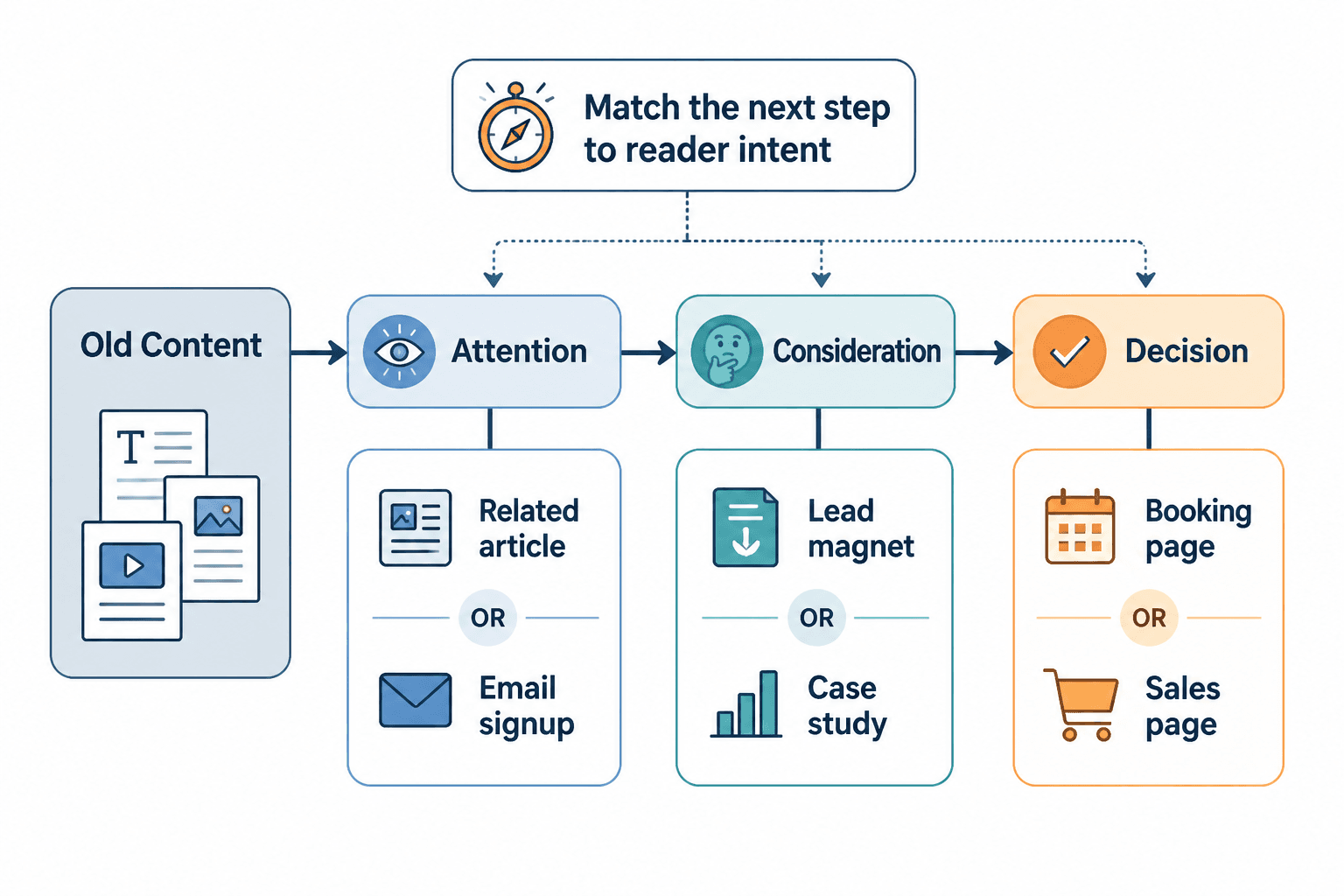
Start by sorting old content by journey stage
If you treat all old content the same, you will make messy decisions. A top-of-funnel opinion post does not need the same next step as a bottom-of-funnel case study. Start by tagging each piece based on where it belongs in the journey.
1. Attention content
This content gets people interested. It names a problem, challenges a bad assumption, or gives a sharp insight.
- short posts
- contrarian takes
- hook-driven threads
- problem-aware articles
Its job is not to close. Its job is to pull the right person into your world.
2. Trust-building content
This content helps the reader believe you know what you are talking about and understand their situation well enough to help.
- how-to articles
- breakdowns
- framework posts
- examples and rewrites
- myth-busting content
This is where many creators should spend more time. Reach gets attention. Trust gets action.
3. Intent-shaping content
This content helps the reader see the cost of doing nothing, the value of solving the problem properly, and the kind of solution that actually fits.
- buyer-guidance articles
- mistake breakdowns
- comparison posts
- process explanations
- offer timing content
This is where a lot of monetization quietly happens. Not because you are pitching harder, but because you are making the decision easier.
4. Conversion content
This content helps someone take the step.
- case studies
- offer pages
- FAQ pages
- consultation pages
- sales emails
Once your old content is sorted into stages, you can fix the path between them instead of randomly editing pieces in isolation.
How to audit old content for better audience-to-offer journeys
You do not need a giant spreadsheet empire for this, though if spreadsheets are your thing, I will not stand in your way. A simple audit works fine if you focus on the right questions.
For each old piece, check these five things:
What problem is this piece really about?
Not the broad topic. The actual problem. “Content strategy” is a topic. “Your posts get attention but no qualified leads” is a problem. Journey design gets much easier when the content addresses a specific struggle.
Who is this piece best for?
If the answer is “everyone who wants to grow online,” the answer is useless. Narrow it down. Solo consultants? Coaches with weak funnels? Founders with strong expertise but weak content conversion? Specificity makes next-step recommendations feel relevant instead of generic.
What level of awareness does the reader probably have?
Someone reading a broad educational post is in a different place than someone reading a case study comparing two ways to structure an offer path. Do not send both readers to the same CTA and act surprised when one of them ignores it.
What action does this piece currently invite?
Be honest. A lot of old content has one of these:
- no CTA at all
- a weak “follow for more” CTA
- a pitch that arrives too early
- a link to something only loosely related
- a next step that asks for too much commitment
What should the next step actually be?
This is the real fix. The best next step is not the offer you most want to push. It is the next action the reader is most likely to take after consuming that piece.
| Content type | Likely reader state | Better next step |
|---|---|---|
| Problem-aware post | Interested but early | Related guide or email signup |
| How-to article | Actively trying to solve | Template, checklist, or deeper article |
| Mistake breakdown | Comparing approaches | Case study or process page |
| Case study | High intent | Consultation, offer page, or sales conversation |
If you want a broader strategic foundation for this kind of path design, it helps to review the core audience-to-offer journeys framework and the more complete guide for creators who want better results.
Fix the next step before you rewrite the content
Many people start by updating headlines, polishing wording, or adding a new section. Fine, but secondary. First decide what role the piece should play now.
Old content usually becomes more useful when you assign it one of these jobs:
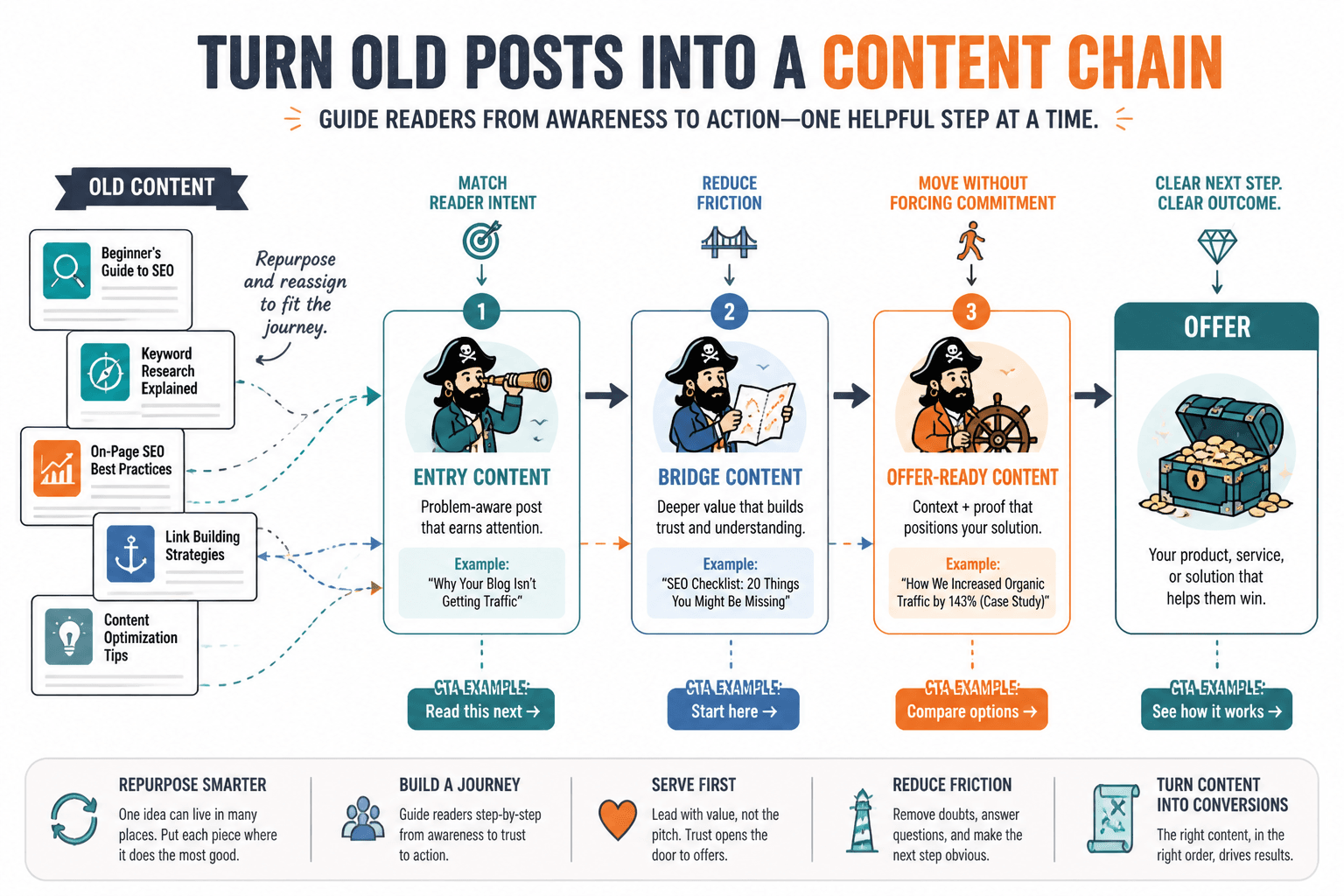
- entry point: attracts the right reader into your ecosystem
- bridge asset: moves someone from awareness into trust or intent
- conversion support: helps remove objections before an offer
- proof asset: reinforces credibility near the decision point
This matters because the rewrite should serve the job. If a post is now an entry point, sharpen the hook and add a low-friction next step. If it is a bridge asset, expand the explanation and direct readers to a deeper resource. If it is conversion support, add proof and a stronger CTA.
Without that decision, people “optimize” content in random ways. They add more words, nicer graphics, and a sad little call to action that still does not fit. That is not journey design. That is decorating confusion.
Three smart ways to repurpose old content into a better journey
1. Turn standalone content into content chains
One old piece should not be forced to do everything. It should lead naturally to the next piece.
Example:
- Old post: “Why your content gets attention but not clients”
- Next step: article on fixing audience-to-offer gaps
- Next step: checklist or guide on journey structure
- Next step: consultation or offer page
That sequence works because each piece answers the next logical question.
Good journeys feel like relief. The reader thinks, “Yes, that is exactly what I needed next.” Bad ones feel like a trap door.
2. Split broad content into stage-specific assets
A lot of old content is too broad. It tries to educate, persuade, and convert in one go. That usually makes it muddy.
Instead of keeping one bloated piece, split it into smaller assets with clearer jobs:
- a short post that names the pain
- a deeper article that teaches the fix
- a buyer-guidance piece that explains what good solutions look like
- a conversion page that invites the next step
This is often the cleanest way to turn old educational content into a proper funnel path without stuffing everything into one overworked article.
3. Add transitional CTAs, not just final CTAs
Not every CTA should ask for the sale. Transitional CTAs are underrated, mostly because they are less dramatic and therefore less sexy to marketers who enjoy yelling about conversions.
But transitional CTAs are often what make journeys work.
Examples:
- “If this is your problem, read this next.”
- “If your offer timing is off, this guide will help.”
- “If you already have content but it is not leading anywhere, start here.”
- “If you are choosing between more traffic and a better path, read this before creating more posts.”
Those CTAs create movement without forcing commitment too early. That is exactly what many old assets are missing.
For more on writing the path itself, see how to write better audience-to-offer journeys. If your main issue is moving people closer to action, this guide on turning journeys into more leads or sales is the next useful step.
What to actually change inside the old content
Once the journey role is clear, then edit the piece itself. You usually do not need a total rewrite. You need targeted changes.
Rewrite the opening so the right reader recognizes themselves
Older content often starts too broadly. Tighten the opening so it names the problem, the audience, or the tension fast.
Weak: “Content marketing can be a powerful way to grow your business.”
Better: “If your old content gets some attention but never seems to move people any closer to your offer, the issue is probably not volume. It is the missing path.”
Cut sections that do not help the next step
If a section is interesting but does not support the piece’s current job, cut it or move it elsewhere. Not every decent thought belongs in the same asset. Your content is not a junk drawer.
Add proof, examples, or contrast where trust is weak
If the content is supposed to move someone toward intent, give them something stronger than nice-sounding advice. Add a short example, a before-and-after, a mini case, or a specific scenario that shows the idea in motion.
This matters a lot for monetization content because readers are not just evaluating the idea. They are evaluating whether you seem precise enough to help them. Vague content builds vague trust.
Upgrade the CTA so it matches the reader’s temperature
Cold readers need softer CTAs. Warm readers can handle stronger ones. If an old educational piece is still fairly top-of-funnel, do not end it with the content equivalent of “marry me.”
Better CTA matches look like this:
- Cold: read the next guide, join the list, grab the resource
- Warm: review the process, compare options, see how this works in practice
- Hot: book the call, apply, buy, reply, inquire
If offer timing is where your old content keeps falling apart, read how to improve audience-to-offer journeys offer timing without sounding generic. It will save you from pitching too early and wondering why people disappear.
A simple audience-to-offer journey upgrade framework
If you want a repeatable process, use this on every older piece worth keeping.
- Identify the piece’s strongest angle. What does it already do well: attract, teach, persuade, or convert?
- Choose one journey role. Entry point, bridge asset, conversion support, or proof asset.
- Match one next step. Pick the most logical action for the reader after this piece.
- Edit the opening. Make the problem and reader fit clearer, faster.
- Trim anything off-path. Remove sections that distract from the role.
- Add one trust booster. Example, proof, contrast, or mini-case.
- Replace the CTA. Use a next step that fits the reader’s level of intent.
- Link it into a chain. Connect it to one or two related assets, not ten random things.
This is also where your internal linking should get smarter. Not just for SEO, though that helps. Internal links are part of the journey. They should guide the reader toward the next useful layer, not dump a pile of “related posts” on them and call it strategy.
If you are building the bigger system, the broader monetization funnels and funnel systems hub gives useful context for where these journey upgrades fit.
Common mistakes people make when repurposing old content
- Adding a harder pitch instead of a better path. More aggressive CTAs do not fix weak journey design.
- Treating every old piece as a sales asset. Some content should warm people up, not close them.
- Ignoring reader intent. The next step should feel earned and relevant.
- Linking everywhere. Too many options can kill momentum.
- Keeping broad, vague intros. If the opening is soft, fewer right-fit readers will continue.
- Using generic lead magnets. “Download my free guide” is not a strategy. It is a button with hopes.
- Not tracking which pieces already attract good-fit people. Some low-traffic content may be far more valuable than the flashy stuff.
One point deserves a little more attention: not all old content should be saved.
Some pieces are too off-positioning, too generic, too trend-tied, or too disconnected from what you actually sell now. You do not need to build a journey around every content fossil in your archive. Keep the pieces that still attract relevant attention, explain a useful problem, or support trust. Let the rest die with dignity.

Quick examples of old content turned into better journeys
Example 1: old educational article
Before: A broad article on “how to create better content” with a generic newsletter CTA.
After: Reposition it around one problem, like content that gets attention but not action. Add a section on journey gaps, link to a more specific guide, and end with a CTA to a relevant resource or consultation page.
Example 2: old LinkedIn post with decent engagement
Before: A post about common funnel mistakes ending with “follow for more.”
The bigger point is simple: clearer structure and clearer writing make the piece more useful. That is usually what makes the ending land better too.