
Most audience-to-offer journeys do not fail because the offer is bad. They fail because the offer shows up at the wrong moment, in the wrong tone, with all the grace of a popup yelling “BUY NOW” before anyone’s even figured out who you are.
That is usually a timing problem dressed up as a conversion problem.
If you want to know How to Improve Audience-to-Offer Journey Offer Timing Without Sounding Generic, the fix is not “nurture more” or “provide value” or any other advice that sounds useful until you try to apply it and realize it means absolutely nothing. The real job is to make your offer feel like the next sensible step, not a sudden personality shift.
This article will help you do exactly that. We’ll cover how to spot bad timing, how to structure the journey so the offer lands naturally, what signals suggest people are ready, and how to invite action without sounding like a copy-and-paste funnel template from 2019.
If you have been publishing content, building some trust, maybe even getting attention, but the jump from audience to offer still feels awkward, this is the part to fix.
Want the broader roadmap? Start with the parent guide.
Why offer timing gets weird so fast
A lot of creators and consultants treat offer timing like a calendar problem.
“I posted three tips, so now I can pitch.”
“I sent five emails, so now the sales message goes out.”
“I gave enough free value, so people should be ready.”
That logic sounds tidy. It is also how you end up with audience journeys that feel mechanical. People are not moving because you hit the scheduled pitch slot. They move when the timing matches their awareness, interest, trust, and context.
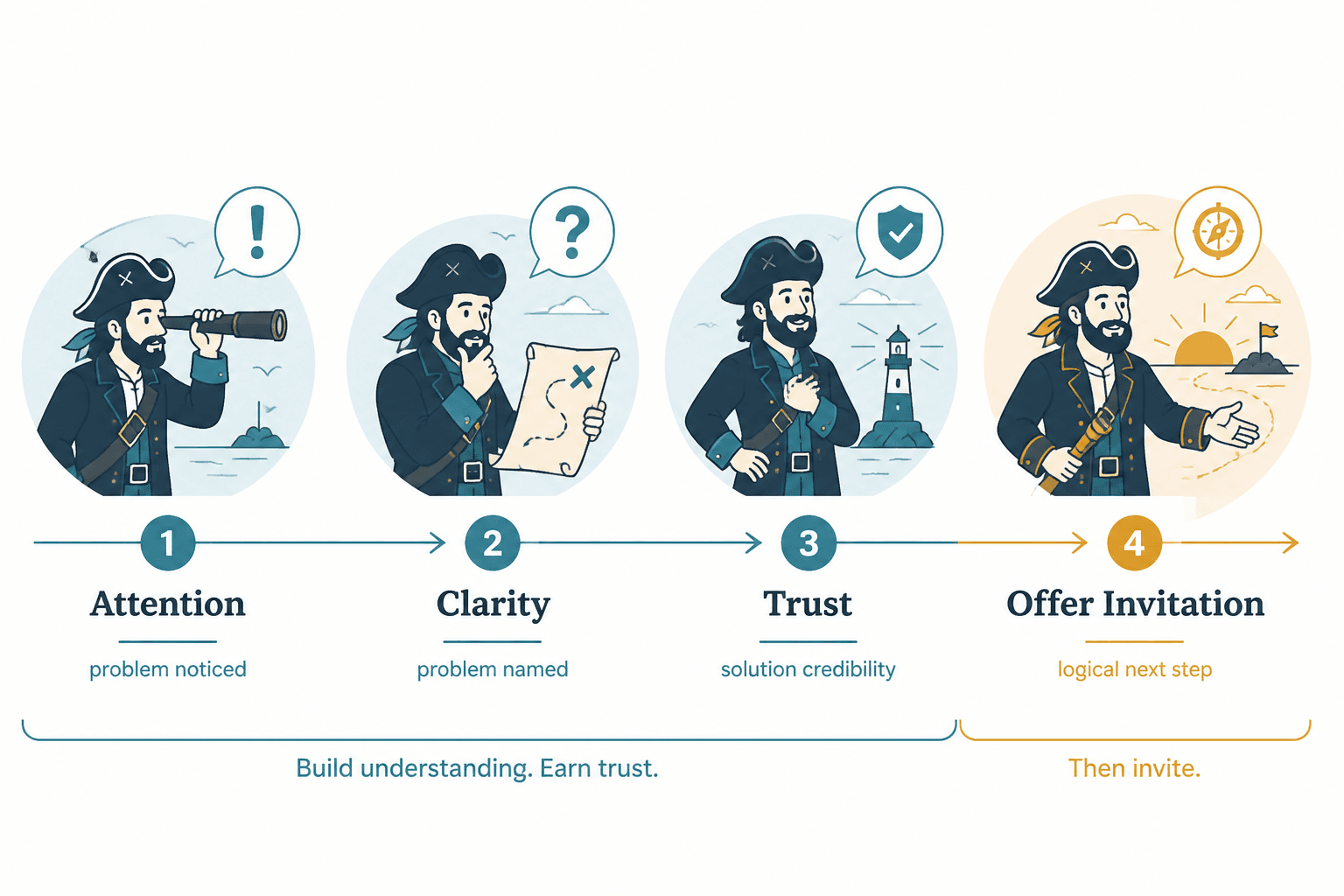
Good offer timing is less about counting touches and more about reducing friction between these stages:
- They notice you
- They understand what you actually do
- They believe you know your stuff
- They see themselves in the problem
- They trust your way of solving it
- They feel ready for a next step
If your offer appears before those pieces line up, it feels premature. If it appears long after they line up, you lose momentum. Both hurt conversions. One feels pushy. The other feels oddly passive.
That middle zone is what you are trying to hit.
What good audience-to-offer timing actually feels like
The best-timed offers usually share one trait: they feel earned.
Not manipulative. Not vague. Not overly dramatic. Earned.
That means the audience has already seen enough to understand three things:
- What problem you help solve
- Why your approach is credible
- Why taking the next step now makes sense
Notice what is missing there: pressure tactics. You do not need to turn every content path into a countdown timer with emotional wallpaper.
A well-timed offer often feels like this:
“I was already thinking about this problem. Your content helped me name it more clearly. Now your offer looks like the logical next move.”
That is the standard. Not “I guess I got worn down by enough reminders.”
If you need help shaping the full path before fixing timing, this related guide on audience-to-offer journeys is the right foundation.
How to Improve Audience-to-Offer Journey Offer Timing Without Sounding Generic
The simplest way to improve offer timing is to stop asking, “When should I pitch?” and start asking, “What does the audience need to believe before this offer feels obvious?”
That shift matters because generic selling language usually appears when the strategy is weak. If you have not built the right bridge, you compensate with fluff. You start saying things like “if this resonated” and “for those ready to step into the next level.” Which is a lovely way to say nothing at all.
Instead, build the journey around belief progression.
Stage 1: Attention before invitation
At the start, your audience is not ready for your offer. They are trying to decide if you are relevant.
This is where content should do things like:
- Name specific problems clearly
- Challenge common mistakes
- Offer useful perspective
- Make your niche and angle easy to understand
Do not sell hard here. Your job is clarity. If people cannot quickly tell who you help and what kind of outcomes you work on, your eventual offer will feel random no matter how polished the copy is.
Stage 2: Trust before ask
Once people know what you are about, they need reasons to trust your thinking.
This is where many journeys get lazy. People keep posting broad advice, motivational fluff, or reworded common sense, then wonder why nobody buys. Trust is not built by being visible. It is built by being convincingly useful.
Good trust-building content might include:
- Breakdowns of what people get wrong
- Clear frameworks with real application
- Mini case-study style examples
- Before-and-after messaging rewrites
- Specific observations that prove experience
This stage matters because strong offer timing depends on trust density. If trust is thin, the offer feels early. If trust is solid, the same offer can feel perfectly natural.
Stage 3: Relevance before conversion
Before asking people to act, show them why the offer matters now.
That does not require fake urgency. It requires situational relevance.
For example:
- If they are getting attention but not leads, talk about the gap between content reach and conversion
- If they are attracting the wrong audience, talk about positioning drift
- If they are posting consistently but hearing crickets, talk about weak audience-to-offer connections
Now your offer is not interrupting the conversation. It is continuing it.
5 signs your offer is appearing too early
- Your audience engages with educational content but ignores offer posts.
They like the ideas, but they do not yet see you as the person to hire or buy from. - You keep explaining what the offer is instead of why it matters.
When timing is right, less explanation is needed because the setup already did its job. - Your CTA sounds extra gentle, vague, or apologetic.
That is often a sign you know the pitch has not been properly earned. - You are relying on urgency language to force momentum.
Not always wrong, but often a patch for weak journey design. - People say “interesting” but do not take the next step.
That usually means the content built curiosity, not buying intent.
If these sound familiar, the fix is not always “pitch harder.” Sometimes it is “build a better bridge.”
You may also want to review conversion-step mistakes that hurt performance, because bad timing is often tied to structural gaps earlier in the journey.
5 signs your offer is appearing too late
- People keep asking how to work with you, but your content rarely tells them.
- Your posts educate well but never transition toward action.
- You assume more nurturing is always better.
It is not. At some point, extra nurturing becomes delay wearing a helpful hat. - You have warm audience signals, but no direct path forward.
- You are afraid a clear offer will “ruin trust.”
If the offer fits the journey, clarity builds trust. Vagueness does not.
This side of the problem gets less attention, but it matters. Plenty of smart creators are not too salesy. They are too indirect. They build credibility, create demand, and then leave people standing in the lobby with no sign for where to go next.
Use audience signals, not arbitrary posting schedules
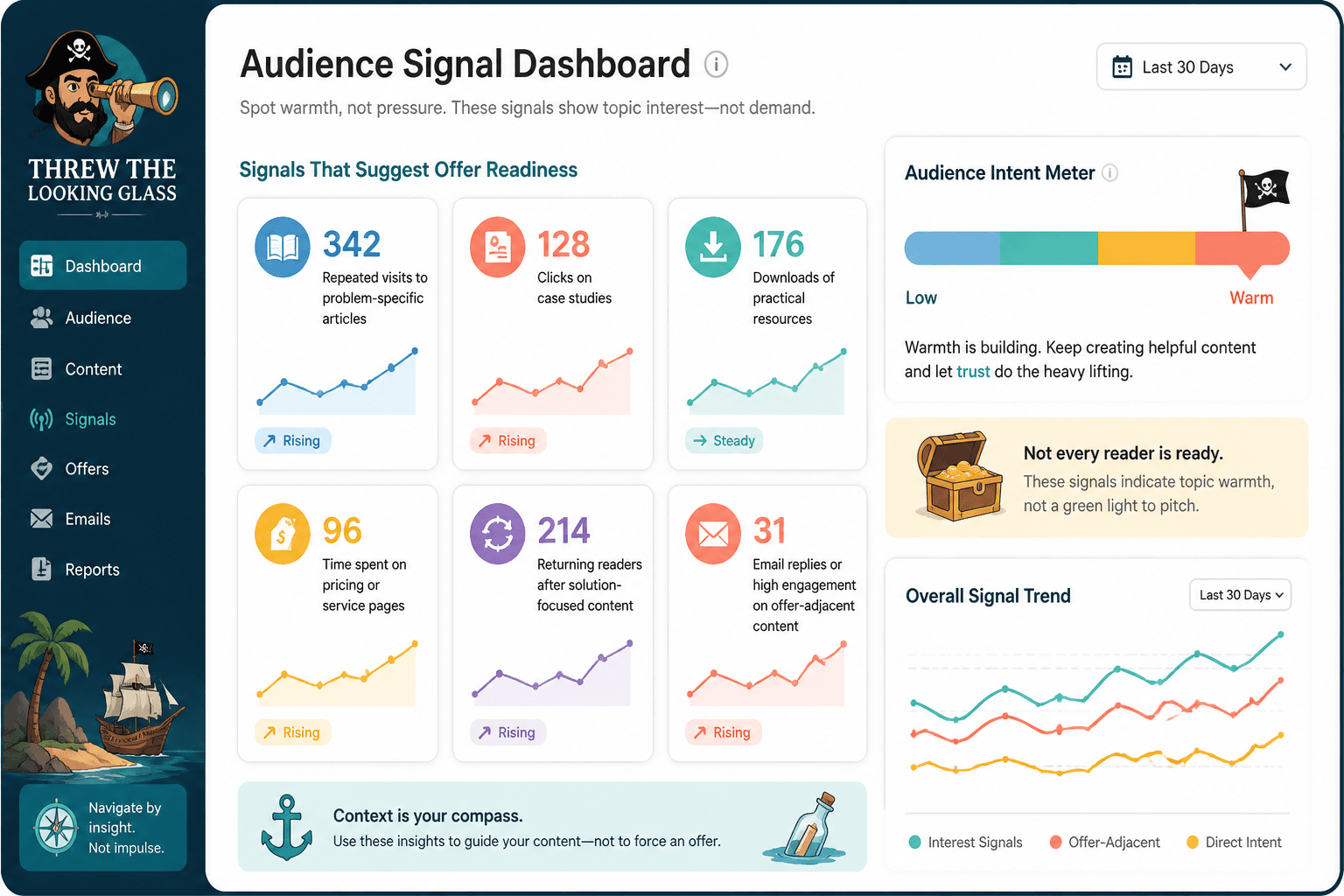
A better way to time offers is to watch for readiness signals. Not in a creepy “behavioral trigger funnel mastermind” way. Just in a sane, practical sense.
Look for signs like:
- People asking specific follow-up questions
- Comments that reveal problem awareness
- DMs about your process, pricing, or fit
- Repeated engagement on content about the same pain point
- Newsletter clicks toward service or offer pages
- Profile visits after content tied to a clear problem
These signals do not mean every person is ready. They do mean the topic is warm enough to support a stronger invitation.
That is the key distinction. You are not trying to force every reader into the offer. You are creating a path for the ready people without making the rest feel cornered.
For broader strategy context, it can help to review the main monetization and funnel systems hub and see how timing fits into the larger conversion path.
How to make the transition into your offer feel natural
This is where generic language usually sneaks in. The content is decent, the audience is interested, then the transition gets weird:
“If you are ready to transform your business, I have limited spots available for a powerful container…”
No. Absolutely not.
A natural offer transition usually does one of these three things:
- Extends the idea into a practical next step
- Offers help for people already dealing with the exact problem discussed
- Frames the offer as a useful continuation, not a dramatic pivot
Weak transition
“If this resonated and you want support, reach out.”
Better transition
“If your content is getting attention but not turning into qualified leads, that is exactly what I help fix. My offer focuses on tightening the path from post to profile to inquiry.”
The second one works better because it is specific. It connects the content problem to the offer outcome. It does not ask the reader to do all the interpretive labor themselves.
If your openings are weak, your offer timing will feel worse than it is because people were never properly guided into the topic in the first place. This is where starting audience-to-offer journeys without a weak opening becomes useful.
A simple framework for better offer timing
Use this four-part sequence when building or reviewing your journey.
| Stage | What the audience needs | What your content should do | What to avoid |
|---|---|---|---|
| Notice | Relevance | Name sharp problems and perspectives | Immediate pitching |
| Understand | Clarity | Explain your niche, method, and angle | Vague expertise claims |
| Trust | Proof and usefulness | Show specific thinking, examples, and results | Generic value posts |
| Act | Low-friction next step | Present a clear offer tied to the problem | Soft, confusing, or abrupt CTAs |
That sequence is simple on purpose. Most audience-to-offer journeys do not need more complexity. They need more coherence.
Content types that support better offer timing
If your content mix is all top-of-funnel thoughts and no mid-journey trust builders, your offer timing will always feel off. A healthy journey usually includes a mix like this:
- Problem-aware posts: help readers recognize the issue clearly
- Myth-busting posts: challenge bad assumptions and create contrast
- Process posts: explain how you think or work
- Proof posts: show examples, outcomes, or real changes
- Offer-adjacent posts: connect the problem to a practical solution path
- Direct invitation posts: clearly explain the offer and who it is for
Notice that “direct invitation” is only one category. If it is the only one you are missing, fine. If it is the only one you are using, that is why everything feels like a pitch.
And if your message gets clunky around the selling parts, read how to write audience-to-offer journeys without sounding salesy or robotic. Bad timing and bad wording love to travel as a pair.
Before-and-after examples of better-timed offer language
Example 1: Too early
Before: “Struggling to grow? DM me and I’ll help you scale.”
After: “If you are posting consistently but still not attracting qualified leads, that usually is not a consistency issue. It is a journey issue. I help businesses fix the path between audience attention and actual offers.”
The rewrite works because it targets a more specific stage of awareness. It does not ask cold readers to leap straight from mild interest into “scale” talk. Which, to be honest, has become one of the internet’s laziest verbs.
Example 2: Too vague
Before: “If this spoke to you, I have a few ways to support you.”
After: “If your audience engages with your content but rarely moves toward your offer, my strategy work is built for that exact gap. We tighten messaging, sequencing, and offer positioning so the next step feels obvious.”
The second version respects the reader’s intelligence. It says what the problem is, what the offer helps with, and why the fit makes sense.
Example 3: Too late
Before: “More tips coming soon.”
After: “If you do not want to keep patching this manually, I also offer hands-on help building the full audience-to-offer system. Details are in my profile.”
This version does not oversell. It simply stops hiding the next step.
The bigger point is simple: clearer structure and clearer writing make the piece more useful. That is usually what makes the ending land better too.