
Most old blog content does not need a funeral. It needs an editor.
People love to treat underperforming articles like they are broken beyond repair. So they either leave them to rot on page 6 of search results or rewrite them from scratch for no good reason. Both moves are usually wasteful. If the topic is still relevant, the real problem is often simpler: the article is outdated, too vague, poorly structured, badly aimed, or written in a voice that sounds like it was assembled by a committee in a beige conference room.
How to Turn Old Content Into Better Blog Rewrites and Refreshes is really a question of judgment. You are not just updating words. You are deciding what deserves to stay, what needs sharper thinking, and what should be cut before it wastes another second of the reader’s time.
This article will help you do that properly. We’ll cover how to spot which posts are worth refreshing, what to fix first, how to rewrite without sanding off the original value, and how to turn stale content into something stronger for search, readers, and actual business results.
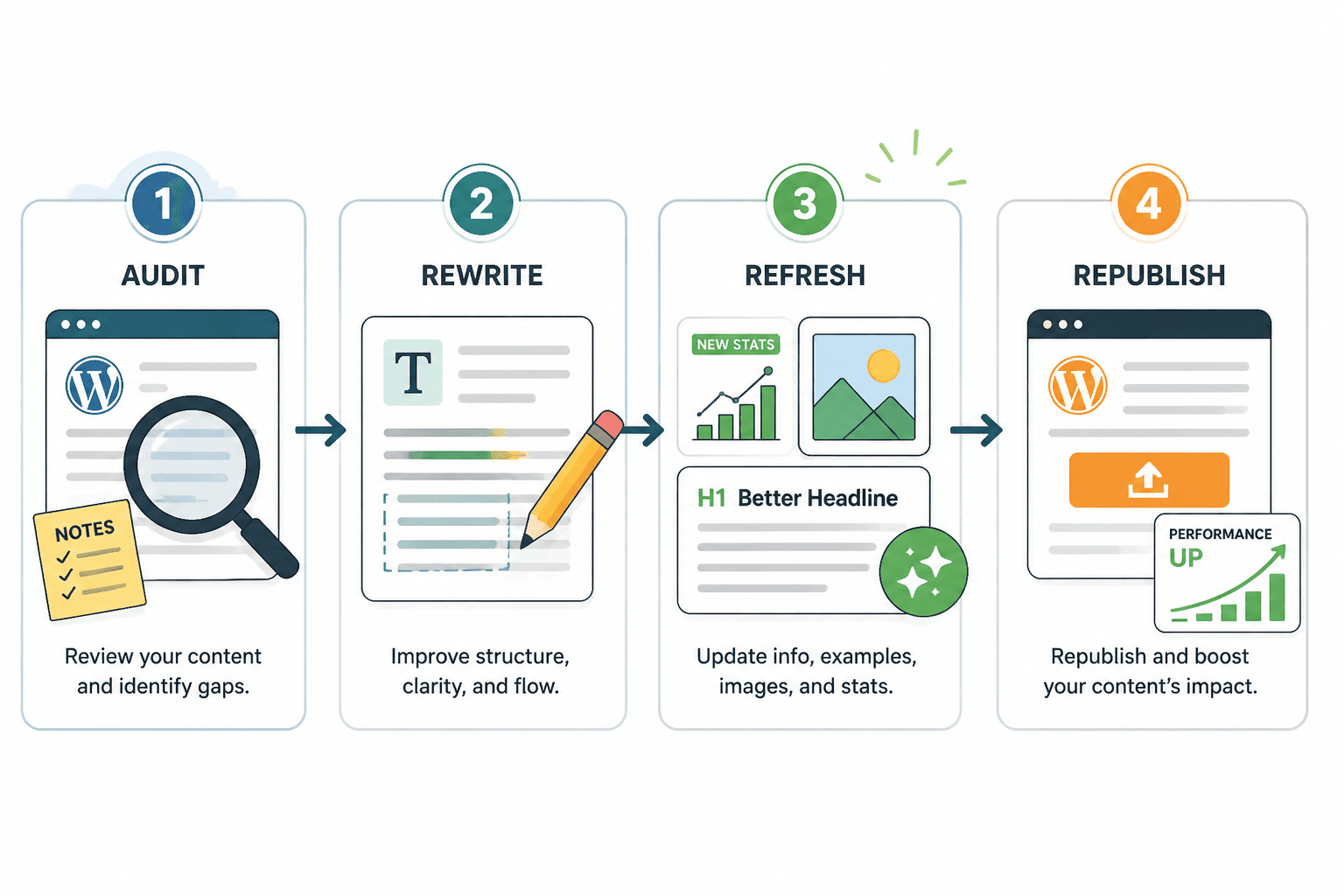
For the main guide behind this topic, visit the parent guide.
Why most old blog posts underperform
Old content usually does not fail because it is old. It fails because it no longer fits what readers want, how they search, or what your business is trying to do.
Sometimes the advice is outdated. Sometimes the examples are weak. Sometimes the article is technically about the right topic, but it takes 700 words to say something that should have been clear in 120. And sometimes the post is fine, but the title, introduction, or structure quietly murders its chances.
A lot of creators make the same mistake here: they focus on freshness like it is a magic trick. Add a new year. Change a few lines. Swap one screenshot. Call it updated. That is not a refresh. That is content taxidermy.
A proper rewrite or refresh improves the article’s usefulness, clarity, positioning, and ability to earn attention. If you want a broader framework for that process, this guide on better blog rewrites and refreshes is a strong next read after this one.
First, decide: rewrite, refresh, merge, or delete
Before you touch the draft, figure out what kind of problem you are dealing with. Not every old post needs the same treatment.
| Content condition | Best move | What it means |
|---|---|---|
| Solid topic, outdated details | Refresh | Update facts, examples, links, screenshots, and structure |
| Good idea, weak writing or bad positioning | Rewrite | Keep the core topic but substantially improve the article |
| Several overlapping weak posts | Merge | Combine into one stronger article and avoid cannibalizing yourself |
| Irrelevant, thin, or off-brand content | Delete or redirect | Remove it if it no longer serves readers or your site |
If you skip this step, you end up polishing content that should have been consolidated or keeping posts alive that add nothing except clutter.
This matters even more if your site has grown messy over time. If you have too many overlapping posts, your better move may be to strengthen one pillar article and fold the weaker pieces into it. The broader blog rewrites and refreshes hub can help you think about that at a systems level.
How to choose which old content is worth updating
Do not refresh randomly. Start with content that has a real upside.
Look for posts with one or more of these signs
- They already get some traffic, but not much
- They rank for relevant terms but sit outside the top results
- They cover topics still tied to your offer, services, or audience
- They have useful bones but weak execution
- They used to perform better and slipped
- They attract attention but do not convert
- They are strategically important to your authority or internal linking
A post with some traction is often easier to improve than a post nobody ever wanted in the first place. There is a difference between under-optimized and fundamentally uninteresting.
When you are choosing candidates, ask:
- Is this topic still relevant to my audience?
- Does this post support a current business goal?
- Can I make it materially more useful than it is now?
- Would I be comfortable sending someone to this article today?
If the answer to the last question is no, good. That usually means there is something worth fixing.
Audit the post before you rewrite a single sentence
A rewrite goes badly when you start editing line by line without diagnosing the actual problem. You do not want to tidy the wording on an article whose real issue is bad intent match, muddy structure, or a title that promises one thing and delivers another.
Run a quick content audit on the article
- Title: Is it specific, clear, and worth clicking?
- Intro: Does it get to the point fast, or does it wander?
- Search intent: Does the piece answer what the reader likely came for?
- Structure: Are the sections logically ordered and easy to scan?
- Depth: Is it too thin, or padded with repetition?
- Examples: Are they current, useful, and concrete?
- Tone: Does it sound like a person with judgment, or a brochure?
- Internal links: Does it connect readers to related next steps?
- CTA: Is there a clear next action, or does it just stop?
This kind of audit is annoyingly unglamorous, which is probably why people skip it. But it is where better rewrites start. If you want the article to pull more than traffic, and actually support leads or offers, read how to turn blog rewrites and refreshes into more leads or sales after this.
What to fix first in a blog refresh
Not every problem deserves equal attention. Some changes move the article a lot. Others are cosmetic. Start with the parts that affect usefulness and clarity first.
1. Fix the angle
Plenty of blog posts are technically on-topic but badly framed. They are too broad, too timid, or trying to please everyone. If the angle is weak, the whole article feels mushy.
For example, “Tips for Better Blog Content” is not really an angle. It is a bucket. “How to Refresh Blog Posts That Already Rank But Do Not Convert” is an angle. Now the reader knows who it is for and what problem it solves.
2. Fix the introduction
Most weak intros do one of two things: they stall, or they generalize. They open with throat-clearing about how important content is, which helps nobody, or they spend too long setting up a point that should have arrived immediately.
Your introduction should do three jobs fast:
- Name the real problem
- Show the reader they are in the right place
- Make a clean promise about what the article will help them do
3. Fix the structure
If readers have to hunt for the useful bits, the article is working against itself. Better structure makes content easier to read, easier to trust, and easier to repurpose.
Strong rewrites usually do at least one of these:
- Break one bloated section into clearer subtopics
- Move the most useful advice higher
- Cut repeated points
- Add examples where the article previously stayed abstract
- Turn rambling paragraphs into tighter chunks
4. Fix stale examples and weak proof
Outdated examples make the whole article feel less trustworthy, even when the underlying advice is still sound. Swap in better examples, fresher screenshots, more relevant use cases, or clearer before-and-after rewrites.
This is especially important if your audience is creators, consultants, coaches, or personal brands. They do not just want principles. They want to see what those principles look like in practice.

5. Fix the CTA
A lot of old blog posts end like the writer simply got tired. No next step. No link to the next relevant article. No invitation. Just vibes and a period.
You do not need a hard sell at the end of every article. But you do need direction. If someone found the piece useful, what should they do next?
- Read a deeper related article
- Check out a service page
- Join a newsletter
- Download a resource
- Explore a topic hub
How to rewrite old content without making it bland
This is where people get weirdly cautious. They know the old post needs work, but they are so worried about “preserving SEO” that they keep half the bad writing like it is a sacred artifact.
You are allowed to make the article better. In fact, that is the point.
A strong rewrite keeps the useful core and improves the delivery. It does not strip out personality, flatten opinions, or turn clear writing into sanitized mush. Readers do not want a content refresh that sounds like legal approved it.
A practical rewrite process
- Identify the real point. What is the article actually trying to help the reader do?
- Cut throat-clearing. Remove filler intros, padded transitions, and generic statements.
- Tighten the argument. Make each section earn its place.
- Add specifics. Use examples, templates, clearer language, and sharper subheads.
- Update for current relevance. Replace dated references, stats, screenshots, and tool mentions.
- Improve the CTA and internal links. Give the piece somewhere useful to send the reader next.
If you want a more detailed walkthrough, this article on how to write better blog rewrites and refreshes is worth bookmarking.
Before and after: what a better refresh actually looks like
Here is a simple example of how a refresh can improve an article without changing its core topic.
Weak version
Content updating is important for SEO and user experience. If you have old blog posts on your website, it can be helpful to revisit them from time to time and make changes that improve their quality and relevance.
Stronger version
Old blog posts usually do not need light housekeeping. They need a sharper angle, fresher proof, and less fluff. If a post is still relevant but underperforming, a real refresh can do more than a brand-new article written in a hurry.
Same topic. Better framing. Clearer tension. More confidence. Less corporate wallpaper.
Here is another one.
Weak section heading
Things to Consider When Updating Content
Stronger section heading
What to fix first so your blog refresh actually matters
The stronger version sounds like it knows why the reader is here. That matters.
Do not just update the article. Improve the search fit.
If you are learning how to turn old content into better blog rewrites and refreshes, search fit is a big part of the job. Not in a robotic keyword-stuffing way. In a “does this piece still deserve to rank for what people want?” way.
That means checking whether the article still matches current search intent and topic expectations.
Questions to ask
- Does the title reflect what readers are actually trying to solve?
- Are the subheads aligned with the questions they probably have?
- Is the article too broad for the query?
- Does it need a better format, like steps, examples, or a comparison table?
- Does the piece answer the obvious follow-up questions?
Sometimes the best refresh is not more content. It is better alignment. A tighter title. Stronger headings. A more direct intro. Cleaner examples. Less wandering.
If search visibility is part of the goal, this article on search refreshes for personal brands is a useful companion.
Internal links are part of the refresh, not an afterthought
A refreshed article should not sit there like an isolated island pretending the rest of your site does not exist. Internal links help readers continue, help search engines understand your topic relationships, and help you build authority around a cluster instead of one lonely post doing all the work.
At minimum, look for chances to link your refreshed article to:
- A broader topic hub
- A deeper tactical article
- A related conversion-focused article
- A pillar page on the same subject
For this topic, that might mean linking into your broader blog SEO and writing category, a systems-level resource like blog article systems, or the parent resource on blog rewrites and refreshes.
That kind of linking is not glamorous, but it makes the article more useful and more connected. Which is generally what a website is supposed to be doing.
What to keep when refreshing old content
Not everything old is bad. Some articles have solid ideas, strong phrasing, or useful sections that still work perfectly well. Do not rewrite just to feel productive.
Keep what still does the job:
- Clear original insights
- Useful frameworks
- Good examples that still apply
- Memorable lines with personality
- Sections that already answer the reader’s question well
The goal is not to erase the old article. It is to make it more effective.
Common mistakes that make refreshes weaker
This is where good intentions often go to die.
- Changing words without improving meaning. A synonym swap is not a strategy.
- Keeping bloated sections because they already exist. Old paragraphs do not deserve tenure.
- Adding fluff to make it longer. Longer is only better if it is more useful.
- Ignoring the CTA. Traffic without direction is not nearly as helpful as people pretend.
- Refreshing posts with no business value. Some content is not worth saving.
- Failing to align with your current positioning. If your audience or offer changed, the content should catch up.
- Updating details but not improving readability. Fresh facts cannot save a miserable reading experience.
A blog refresh should leave the article stronger in at least one meaningful way: clearer, more useful, better structured, more relevant, easier to act on, or better connected to the rest of your site. Ideally several of those.
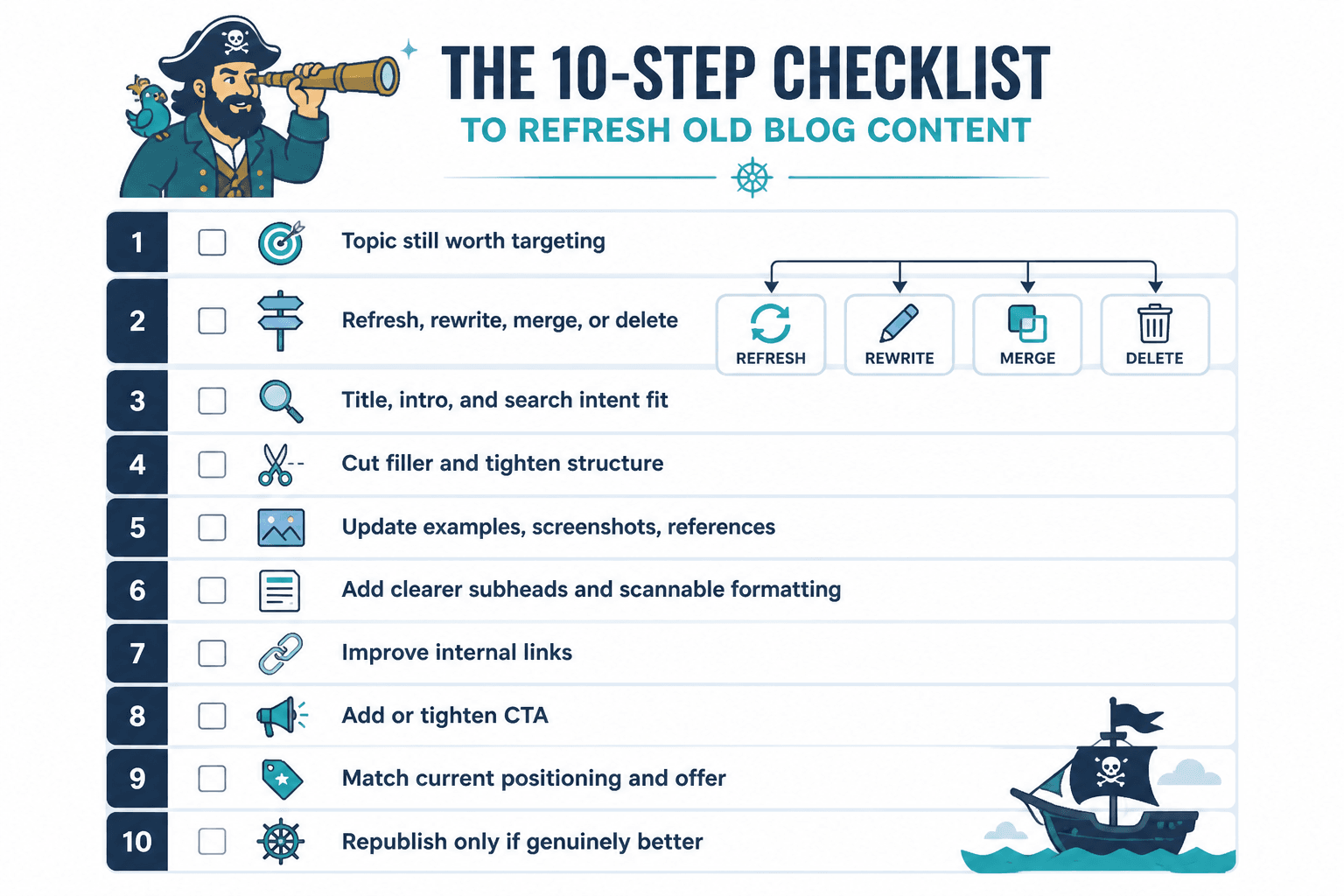
A simple refresh checklist you can use every time
- Confirm the topic is still worth targeting
- Decide whether the piece needs a refresh, rewrite, merge, or deletion
- Review the title, intro, and search intent fit
- Cut filler and tighten structure
- Update examples, screenshots, and references
- Add clearer subheads and scannable formatting
- Improve internal links
- Add or tighten the CTA
- Make sure the article reflects your current positioning and offer
- Republish only when it is genuinely better, not just technically newer
FAQ
How often should I refresh old blog posts?
Refresh them when they are slipping, outdated, strategically important, or almost good enough to be more useful than they currently are. Not every post needs a schedule.
Is it better to rewrite or publish a new article?
If the old post already covers a relevant topic and has some value or visibility, rewriting is often smarter. Publish a new one when the angle is different enough to deserve its own page.
Should I change the URL when refreshing a blog post?
Usually no. Keep the URL unless there is a very strong reason to change it. Unnecessary URL changes create extra cleanup and can dilute existing value.
How much should I change in a real refresh?
Enough to materially improve the article. That might mean a new intro and a few updates, or a full structural rewrite. The point is impact, not a percentage.
Can old content rewrites help with leads too?
Yes, if you improve the article’s relevance, clarity, internal links, and CTA. Better content is nice. Better content with a logical next step is better business.
Make the article more useful, not just more recent
That is the real standard.
The bigger point is simple: clearer structure and clearer writing make the piece more useful. That is usually what makes the ending land better too.
Better rewrites and refreshes make the article clearer, more current, and easier to act on. A sharper update usually beats a bigger but messier rewrite.