
A lot of Substack writers act like longer automatically means smarter, deeper, and more worth paying for.
It does not.
Sometimes the long version is better. Sometimes it is just a 2-minute idea dragged across 1,800 words because the writer wanted it to feel substantial. That is not substance. That is formatting cosplay.
When Short Substack Posts & Series Beat Long Ones comes down to one thing: does the reader need depth, or do they need momentum? If the real value is speed, clarity, frequency, or a tighter reading experience, short wins. And in plenty of cases, a short series beats one giant essay because readers actually finish it, remember it, and come back for the next part.
Here’s how to tell when shorter is the smarter move, how to use series without making them annoying, and what too many Substack writers keep getting wrong when they confuse “more words” with “more value.”
If you want the bigger picture, start with the parent guide.
Long is not premium by default
There is a weird creator habit where people assume readers are sitting around hoping to receive mini ebooks in their inbox.
They are not. They are busy. They are distracted. They are reading between meetings, while half-watching something, or while pretending to take a break and actually checking five tabs at once. If your post needs to be long, fine. If it is long because you could not trim it, that is your problem, not the reader’s.
Short posts and short series often perform better because they respect attention. They make one point clearly. They create rhythm. They build a habit. They lower the commitment needed to read, share, and reply.
That matters on Substack more than some writers admit. Yes, readers on Substack will tolerate more depth than readers on most social platforms. But “more tolerance” is not the same thing as “unlimited patience.”
A shorter post is not weak if the idea lands cleanly. A longer post is not strong if it wanders around looking for a point.
When short Substack posts beat long ones
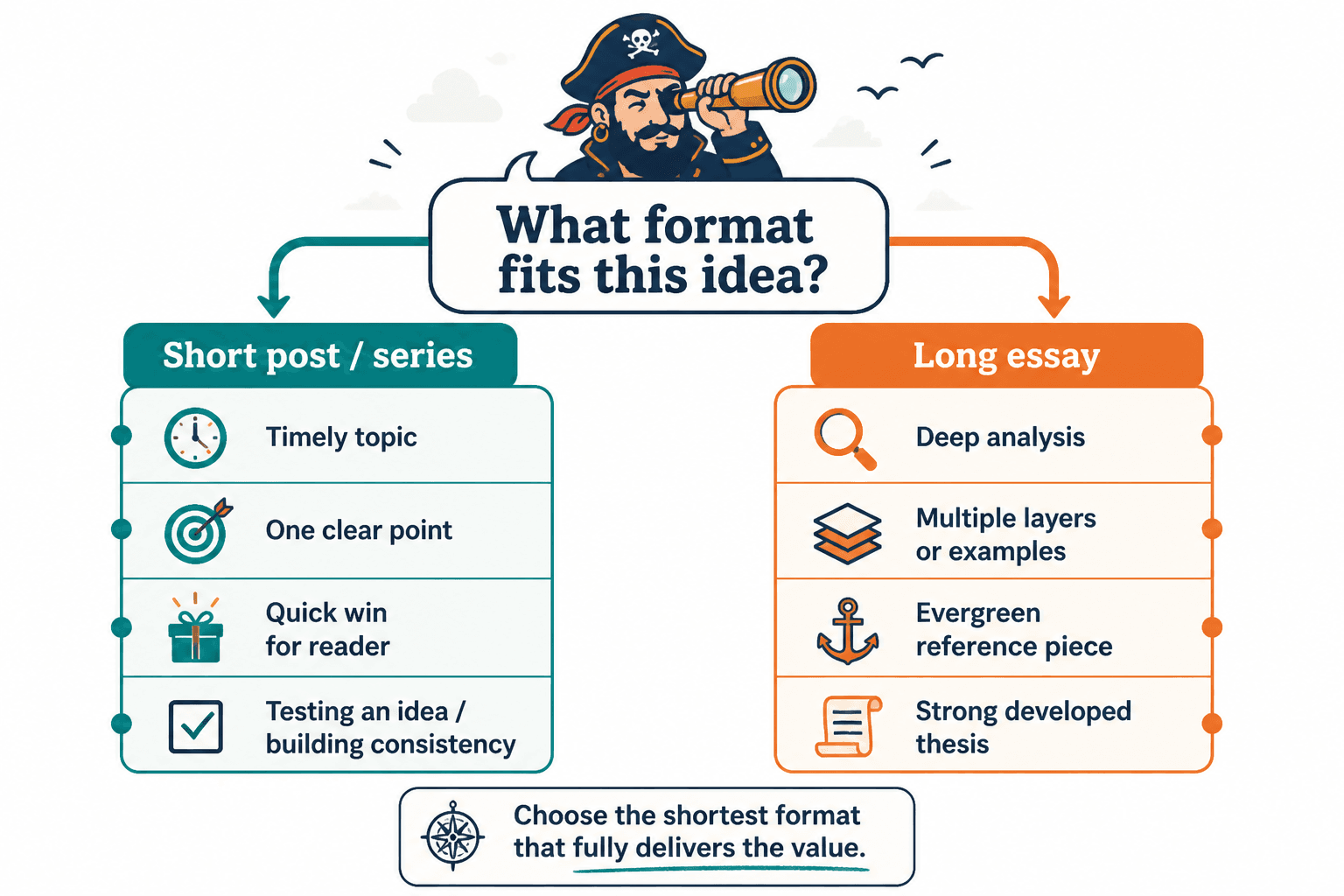
Short posts work best when the value is in immediacy, sharpness, or repeatability. If the reader can get the full benefit quickly, stretching it usually makes it worse.
1. When you have one strong point, not five decent ones
If the post has one useful insight, one opinion, one lesson, one observation, or one punchy framework, keep it tight. Most posts do not need a long setup, a dramatic middle, and a life-lesson ending. They need a point.
Good short-post material includes:
- a contrarian but useful opinion
- a quick lesson from client work
- a sharp breakdown of one mistake
- a small workflow that saves time
- a short story with a clear takeaway
- one example that reveals a bigger truth
If you are repeating yourself to make the post feel “complete,” it probably wants to be shorter.
2. When consistency matters more than depth
One underrated reason short Substack posts win: they are easier to publish consistently without melting your brain.
That does not mean you should send undercooked thoughts every day like a maniac. It means a tighter format can help you maintain quality and frequency at the same time. Readers get used to hearing from you. You get more reps. Your voice gets clearer. Your archive grows faster. And your ideas get tested in the open instead of waiting three weeks for one polished masterpiece that may or may not land.
For many creators, especially those building authority, trust, or paid subscriptions, consistency beats occasional brilliance with long gaps in between.
That is especially true if you are still developing your angle. A short format gives you room to learn what readers actually respond to before you commit to heavyweight essays every time.
3. When the topic is timely
If your value comes from reacting quickly to a shift, trend, platform change, creator behavior, market mood, or common mistake, speed matters.
A shorter post lets you publish while the idea still feels fresh. A long essay that arrives two weeks later may be beautifully written and basically mistimed.
This is one place where creators overestimate polish and underestimate relevance. If your audience wants your read on something now, a crisp 500 to 900 words can do more work than a sprawling 2,500-word treatment later.
4. When the reader needs a quick win
Short posts are excellent when the goal is immediate action.
If you are teaching someone how to improve a headline, fix a CTA, sharpen a profile sentence, choose a content angle, or avoid one common writing mistake, shorter often converts better because the reader can use it right away. There is less friction between reading and doing.
That is part of why concise educational newsletters can feel so strong. They make the reader think, “I can use this today,” not “I should set aside time for this later,” which usually means never.
5. When you want replies and interaction
Long posts can absolutely earn thoughtful replies. But shorter ones often invite more of them.
Why? Because they leave a little space. A short post with a clear opinion or useful prompt feels conversational. A long post can feel finished, polished, and slightly harder to enter. Readers are more likely to answer a compact idea they can react to than a fully developed essay that seems to have covered every angle already.
If part of your Substack strategy is building community, not just broadcasting, shorter can help.
When a short series beats one long Substack post
This is where things get especially useful.
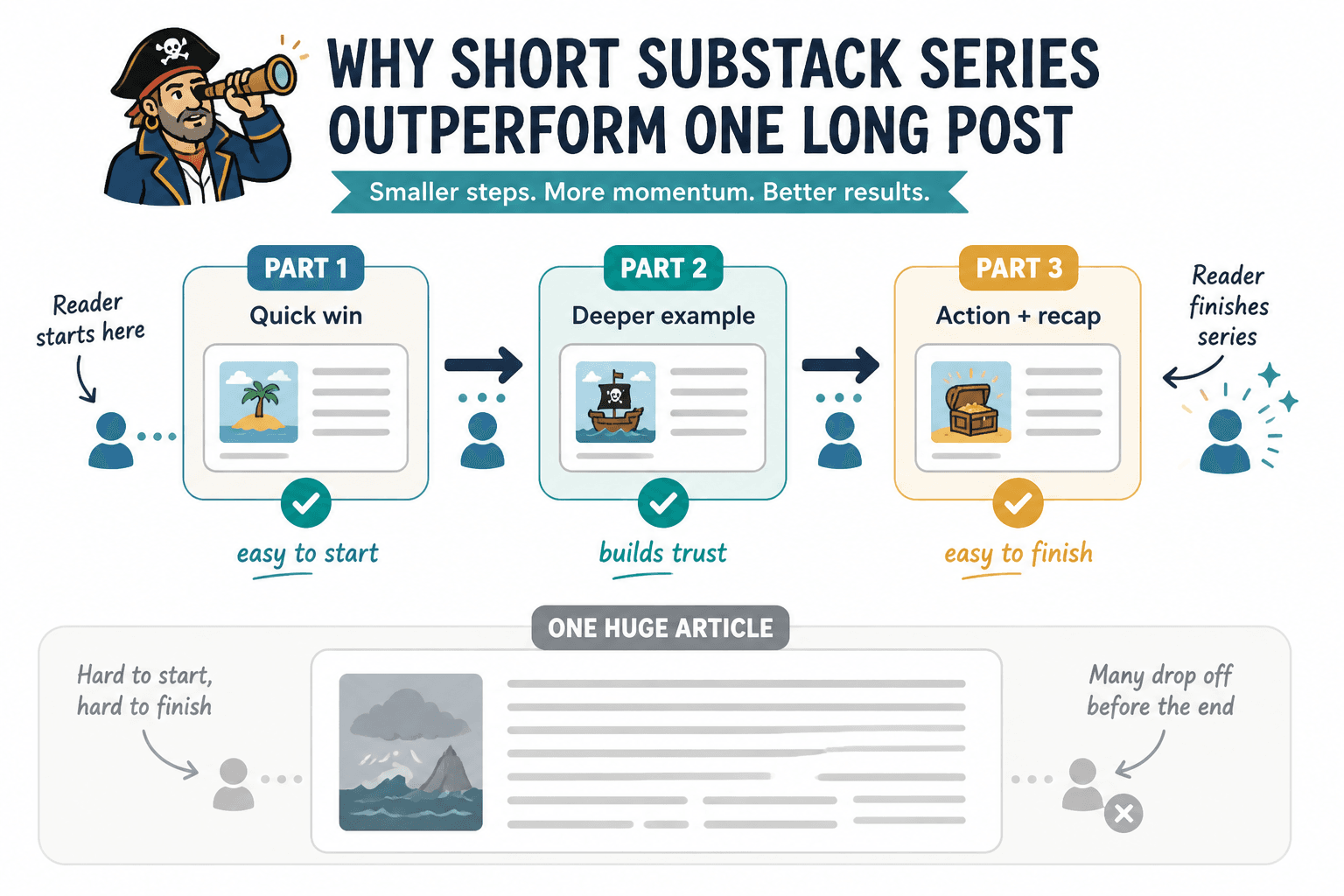
A series can give you depth without forcing readers to consume everything in one sitting. Instead of dropping one giant post that tries to cover the full topic, you break it into parts with a clear arc. Done well, that creates momentum, anticipation, and better retention.
Done badly, of course, it feels like content rationing. Nobody enjoys being drip-fed one normal article in six tiny pieces because the writer wanted to manufacture suspense around a list of formatting tips.
So when does a series actually beat a long standalone piece?
When the topic has natural stages
Series work well when the subject already has built-in parts.
- part 1: strategy
- part 2: structure
- part 3: examples
- part 4: mistakes
Or:
- part 1: what works
- part 2: what fails
- part 3: how to fix it
If each part can stand on its own while also contributing to the bigger picture, that is a real series. Much better than one bloated article trying to carry every idea at once.
When each part solves a distinct problem
A good series does not just split a topic by word count. It splits by reader need.
For example, if you are writing about Substack growth, one post could cover getting discovered, another could cover keeping readers engaged, and another could cover converting free readers to paid. Each piece helps a different part of the journey. That is useful. That gives people reasons to read all of it.
If instead your series is just one long article chopped into arbitrary slices, readers can tell. They are not fools.
When anticipation helps the format
Some ideas get better when readers know another part is coming.
This works especially well for:
- case study breakdowns
- step-by-step systems
- multi-part frameworks
- creator experiments
- behind-the-scenes process series
- paid newsletter teaching sequences
The next part creates return behavior. It gives your publication a stronger rhythm. It also gives you more chances to guide readers to related posts, paid offers, or deeper resources without cramming all of that into one monster post.
If you are building a larger Substack strategy, it helps to think in connected pieces rather than isolated essays. The broader approach in this guide to Substack posts and series for better results pairs well with that mindset.
When readability matters more than completeness
Readers like completion. They like feeling caught up. A shorter series can deliver that better than one huge article that they save for later and never finish.
That matters more than many writers admit. Completion builds trust. If readers regularly finish your work, they are more likely to remember your ideas, recommend your newsletter, and eventually pay for more.
A half-read epic does less for your business than a well-read series.
Signs your “long post” should really be short
Not every long draft deserves to stay long. Here are some clues that it wants a trim, or a split.
- You make the main point in the first third, then keep circling it.
- The examples say the same thing in slightly different outfits.
- The intro takes forever to arrive anywhere useful.
- One section is clearly stronger than the rest.
- The post includes multiple subtopics that could each stand alone.
- You are adding filler to make it feel “worth sending.”
- The CTA gets buried because the post has too much furniture in it.
That last one matters. Long posts can weaken action if readers are exhausted by the time you ask them to do something. A shorter post often gives your CTA more punch because the reader is still with you.
How to decide: short post, long post, or series?
You do not need a mystical content instinct here. A simple decision filter works fine.
| Choose this | Best when | Watch out for |
|---|---|---|
| Short post | One strong point, fast value, timely angle, clear takeaway | Being too thin or obvious |
| Long post | The topic needs nuance, proof, detail, and a full argument | Padding, repetition, weak pacing |
| Series | The topic has clear parts, each part adds value, momentum helps | Artificial splitting, weak continuity, no payoff |
If you want a more length-specific breakdown, this article on how long Substack posts and series should be is the next useful stop.
How to make short Substack posts feel valuable
Short only works when it is deliberate. Otherwise it just feels unfinished.
To make a short post land, tighten the thinking, not just the word count.
Lead with the point fast
Do not spend four paragraphs warming up. Readers should know quickly why this post matters.
Weak opening:
I have been thinking a lot lately about the nature of newsletter writing and what makes a post effective in a crowded digital environment.
Better opening:
Most Substack posts are too long for the value they deliver. The writer had one solid idea and turned it into a small hostage situation.
Make one useful claim
A short post needs a spine. Pick one claim, support it, and stop before the post starts sagging.
Use one strong example
You do not need five examples if one does the job properly. One sharp example often carries more authority than a parade of half-explained ones.
End cleanly
Short posts suffer when the ending rambles. Land the point, offer the next step, and get out.
The bigger point is simple: clearer structure and clearer writing make the piece more useful. That is usually what makes the ending land better too.