
Most product and service descriptions do not fail because the offer is bad. They fail because the copy makes people work too hard to understand what is being sold, who it is for, and why they should care.
That sounds obvious, but apparently not obvious enough, because the internet is still full of descriptions stuffed with vague benefits, polite fluff, and clever wording that says almost nothing. You read three paragraphs and still cannot answer a basic question: what do I actually get here?
If you want better conversion copy, clarity has to do more than “be present.” It has to carry the whole description. This article will show you the most common product and service description mistakes that hurt clarity, why they tank performance, and how to fix them without making your copy sound stiff, robotic, or painfully generic.
If you want the broader framework behind strong description writing, start with the product and service descriptions hub or the more complete guide for creators who want better results. For now, we are dealing with the mistakes that quietly wreck good offers.
To see how this fits into the wider strategy, open the parent guide.
Why clarity matters more than cleverness
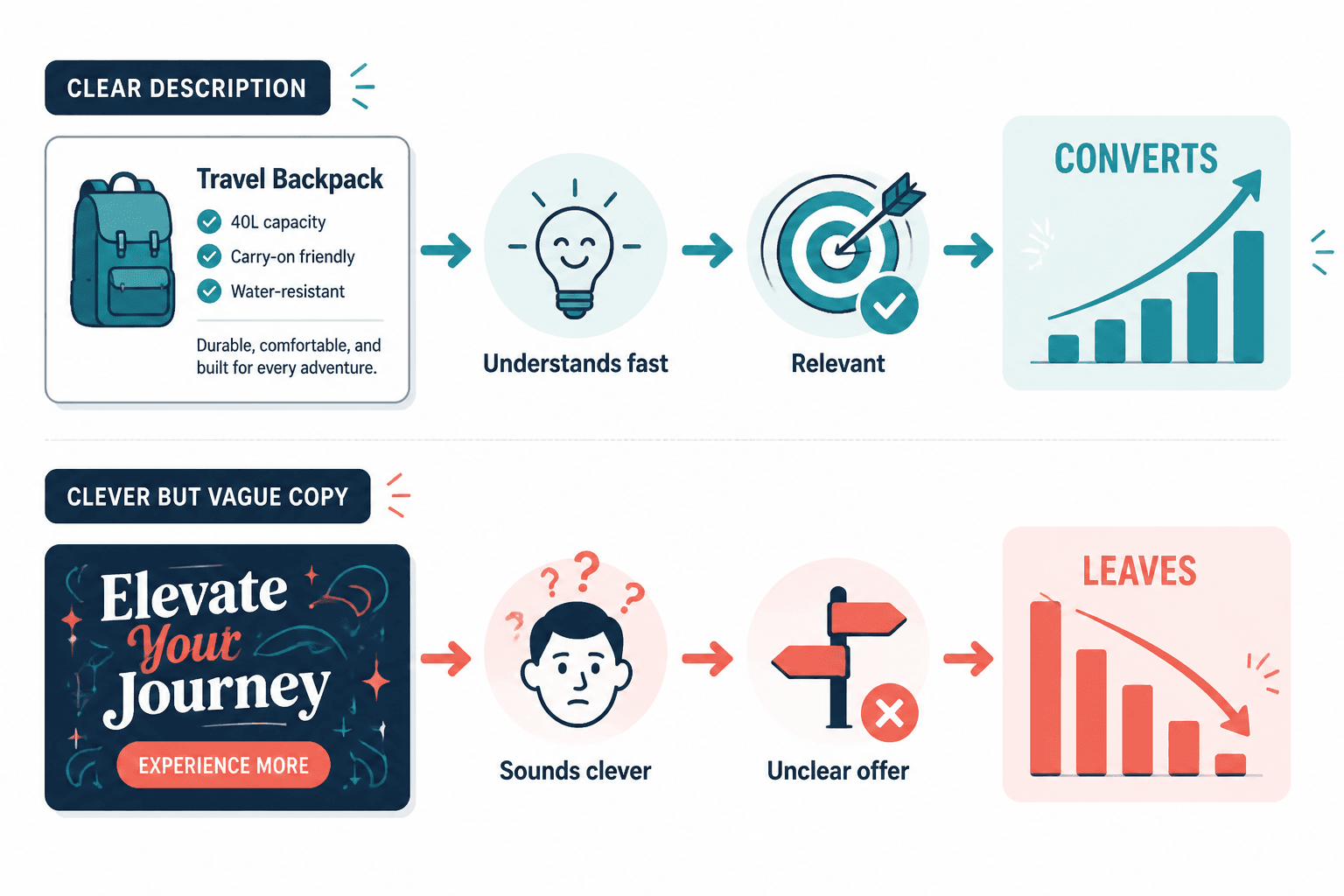
People do not buy when they are mildly impressed by your wording. They buy when they understand the offer fast enough to decide it is relevant.
That is the real job of a description. Not to perform intelligence. Not to sound premium by using abstract nouns. Not to create a misty little aura around the offer. Just to make the value legible.
And yes, style matters. Voice matters. Brand matters. But if your description sounds good and explains badly, it is decoration pretending to be strategy.
Product and service description mistakes that hurt clarity
Here are the mistakes that show up constantly across websites, landing pages, service pages, offer decks, and sales pages. Some are obvious once you notice them. Some hide behind “brand voice” and get a little too comfortable there.
1. Leading with vague benefits instead of the actual offer
A lot of descriptions start with something like:
Helping you scale with confidence and create sustainable growth.
Fine. Maybe. But what are you selling?
Benefits matter, but not before the reader knows what the thing is. If you lead with airy outcomes and skip the concrete offer, people have to reverse-engineer the basics. Most will not bother.
Better approach: name the offer first, then connect it to the result.
I write conversion-focused website copy for coaches and consultants who need clearer messaging, stronger service pages, and more qualified inquiries.
Now we know what it is, who it is for, and what it helps with. Nice. Civilized. Useful.
2. Using broad words that could mean almost anything
Words like support, solutions, transformation, elevated, strategic, and customized are not always wrong. They are just wildly overtrusted.
On their own, they do not clarify much. They blur. They sound respectable while quietly removing information.
For example:
- “Strategic content support”
- “Customized brand solutions”
- “Transformational messaging experience”
These phrases feel polished, but they are fog wearing nice shoes.
Fix it by replacing broad terms with specifics:
- What exactly are you delivering?
- What problem does it solve?
- What format is it in?
- Who is it for?
- What changes after they buy?
Instead of “customized messaging support,” say “a 90-minute messaging strategy session with a revised homepage headline, positioning statement, and CTA recommendations.”
3. Describing your process before the buyer understands the value
Business owners love talking about process. It feels concrete. It proves you have one. It makes the offer seem serious.
But if your description opens with a six-step methodology before the reader even knows what problem you solve, you are making them sit through onboarding before they have decided to care.
Process should support clarity, not replace it.
Bad order: method first, value second.
Better order: what it is, who it is for, what it helps them do, then how it works.
This is especially important for services. If someone lands on your page and gets “phase one: immersion and alignment” before they understand the outcome, it feels self-important fast.
4. Writing for yourself instead of the buyer
This one shows up in descriptions obsessed with credentials, philosophy, or internal language.
There is nothing wrong with expertise. You should absolutely show why someone should trust you. But if the copy is mostly about your framework, your values, your unique lens, and your lovely process language, the buyer still has a problem: they are trying to figure out if this helps them.
Strong descriptions translate expertise into buyer relevance.
That means focusing on questions like:
- What problem is this solving for me?
- How will I use it?
- What makes this different from the other options?
- What result should I expect?
- What happens next if I buy?
If your copy answers your own branding goals better than customer questions, clarity drops hard.
5. Hiding the audience
Some descriptions try so hard not to exclude anyone that they become weak for everyone.
“For businesses ready to grow” is not clear. It is barely a category. A freelancer, SaaS founder, local agency, online coach, and skincare brand could all read that and learn almost nothing.
Specific audience language improves clarity because it tells the right person, quickly, “yes, this is probably for you.”
Compare these:
- “Website copy for growing businesses”
- “Website copy for coaches, consultants, and service providers who need clearer offers and better inquiry conversion”
The second one is stronger because it narrows the fit and sharpens the use case.
If you are struggling with this balance, the article on service framing without sounding generic will help.
6. Trying to sound premium by becoming abstract
This is a sneaky one. A lot of brands think simple language sounds basic, and abstract language sounds expensive.
So the description shifts from clear to fancy-looking:
An elevated container for visionary founders seeking aligned expansion.
That may impress exactly three people, all of whom are probably other copywriters.
Premium does not come from abstraction. It comes from confidence, precision, and relevance. Clear language is not cheap. Weak language is cheap.
If your offer is genuinely high value, it can survive being described plainly. In fact, it usually performs better that way.
7. Listing features without explaining why they matter
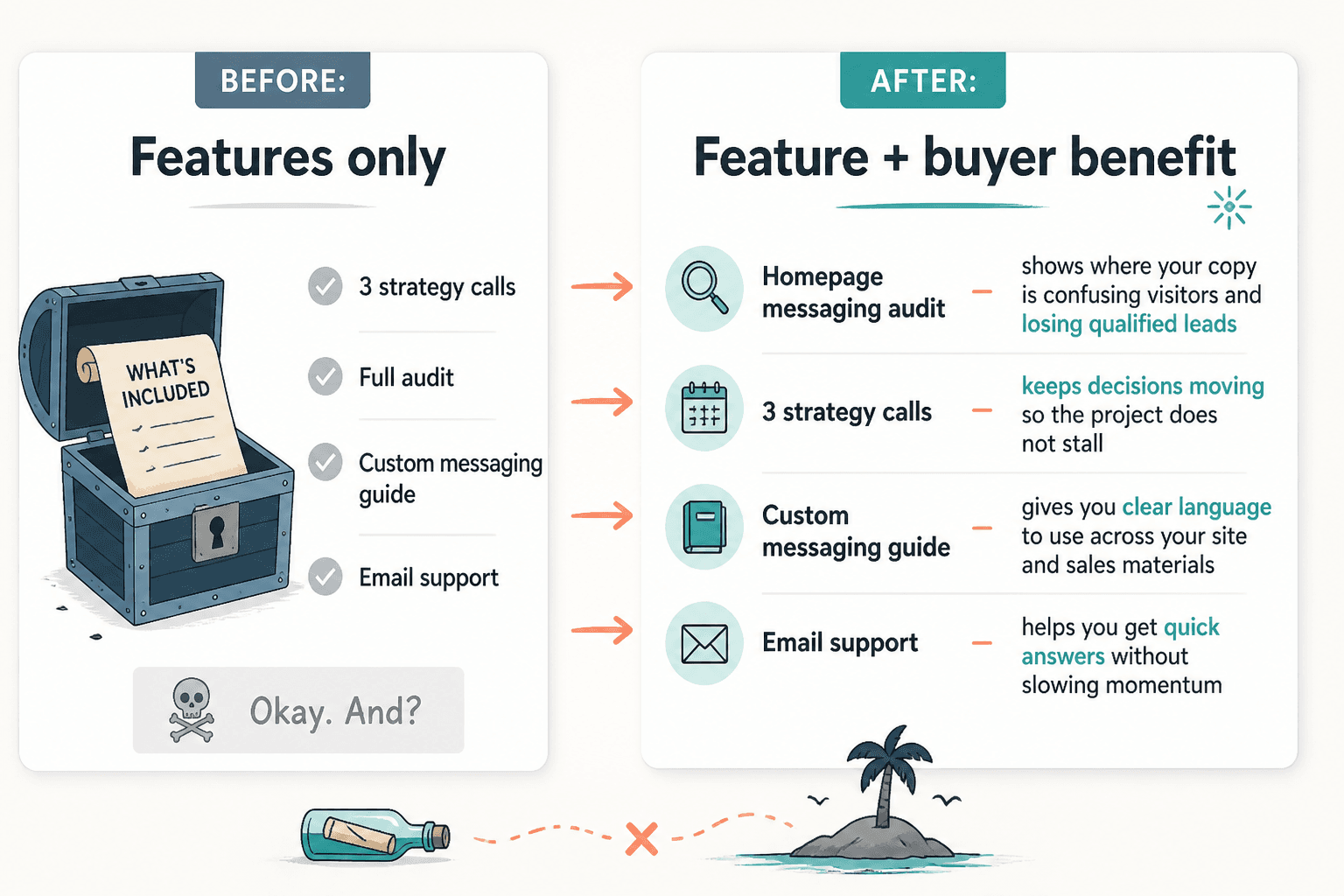
Features are helpful. But features alone do not create clarity. They create inventory.
For example:
- 3 strategy calls
- full audit
- custom messaging guide
- email support
Okay. And?
People need to understand what those pieces do for them. Why does the audit matter? What changes because of the messaging guide? How does email support help the project move better?
Use a simple feature-to-meaning pattern:
- Feature: homepage messaging audit
- Meaning: shows exactly where your copy is confusing visitors and losing qualified leads
That extra line does a lot of conversion work.
8. Burying the most important detail
Sometimes the clearest, most persuasive part of the offer is technically present. It is just stuck in paragraph five, hiding under a pile of scene-setting.
That is still a clarity problem.
Your strongest details should appear early, especially if they answer one of these:
- What is this?
- Who is it for?
- What result does it help create?
- How is it different?
- What is included?
If a reader has to hunt for the important part, many will leave before they find it. Harsh, yes. Also true.
9. Overexplaining simple offers
Not every description needs a mini manifesto.
Some offers are simple. A one-hour consultation. A template pack. A copy audit. A messaging workshop. If the thing is easy to understand, adding layers of explanation can actually reduce clarity by making it sound more complicated than it is.
Good description writing matches the complexity of the offer. A straightforward product usually needs straightforward copy. You do not need seven paragraphs to describe a focused service just because the page feels empty without them.
10. Using weak labels and generic section headings
Clarity is not just in the main paragraph copy. It also lives in your labels, headings, and section names.
Headings like these do very little:
- What We Do
- Our Approach
- The Experience
- Why It Matters
They are not offensive. They are just lazy.
Stronger headings carry meaning on their own:
- What’s Included in the Website Copy Package
- How the Strategy Session Works
- Who This Service Is Best For
- What You’ll Walk Away With
That kind of structure helps people scan and understand the page without needing to read every line. Which, to be clear, many of them will not.
How to fix clarity without making your copy boring
A lot of people resist clearer descriptions because they think the result will sound flat. It does not have to.
You can keep voice. You can keep personality. You can even keep a little edge. The trick is making sure the personality sits on top of the meaning instead of replacing it.
Use this simple clarity check when rewriting a product or service description:
- Name the offer clearly. Say what it is in plain English.
- Name the audience. Tell the right people this is for them.
- Name the problem or result. Show what changes because of the offer.
- Show what is included. Reduce uncertainty.
- Add proof or specificity. Use examples, outcomes, or concrete deliverables.
- Cut decorative language. If a phrase sounds nice but explains nothing, it goes.
That does not mean your copy has to sound clinical. It just means every sentence should earn its place.
A quick before-and-after clarity rewrite
Here is what this looks like in practice.
Before:
I help purpose-driven brands create aligned messaging ecosystems that support visibility, connection, and expansion across every stage of the client journey.
There are recognizable words in there, sure. But the actual offer is still blurry.
After:
I write website and sales page copy for coaches and consultants who have solid offers but unclear messaging. The goal is simple: make your value easier to understand, trust, and buy.
That version is clearer because it tells us what is being sold, who it is for, and what result it aims to create. No atmospheric fog required.
If you want more examples like this, read how to rewrite boring product and service descriptions.
What clearer descriptions usually improve
Better clarity does not just make the page “read nicer.” It usually improves the parts of performance people actually care about.
The bigger point is simple: clearer structure and clearer writing make the piece more useful. That is usually what makes the ending land better too.