
Most boring product and service descriptions are not boring because the offer itself is boring.
They are boring because the copy is vague, padded, self-important, and weirdly proud of saying nothing. You get paragraphs about “tailored solutions,” “high-quality service,” and “results-driven excellence,” which is a lovely way to make sure nobody feels anything at all.
If you want to know how to rewrite boring product and service descriptions, the job is not to make them louder. It is to make them clearer, sharper, and more useful. You are not adding glitter to stale bread. You are finally saying what the thing is, who it is for, why it matters, and what makes it easier, faster, safer, smarter, or more valuable than the alternatives.
This is where a lot of businesses fumble it. They describe the offer from their own point of view instead of the buyer’s. They list features with no context. They use polished filler instead of specifics. Then they wonder why people skim the page and quietly vanish.
Here’s how to fix that without turning your copy into a fake hype parade.
If you want the bigger picture, start with the parent guide.
Why most product and service descriptions fall flat
Bad descriptions usually fail in one of four ways:
- They are too vague
- They focus on the business, not the buyer
- They list details without explaining why they matter
- They sound like they were approved by six nervous managers and one chatbot
That last one is common. The copy sounds polished enough to avoid complaints and bland enough to avoid interest. Safe language kills buying momentum because buyers are trying to answer practical questions fast:
- Is this for someone like me?
- What problem does it solve?
- What do I actually get?
- Why this instead of the other options?
- What happens next?
If your description does not answer those cleanly, people fill the gaps with doubt. And doubt is very good at closing tabs.
For a broader look at this category, see product and service descriptions. If your copy is also muddy on a sentence level, these clarity fixes and common mistakes will help too.
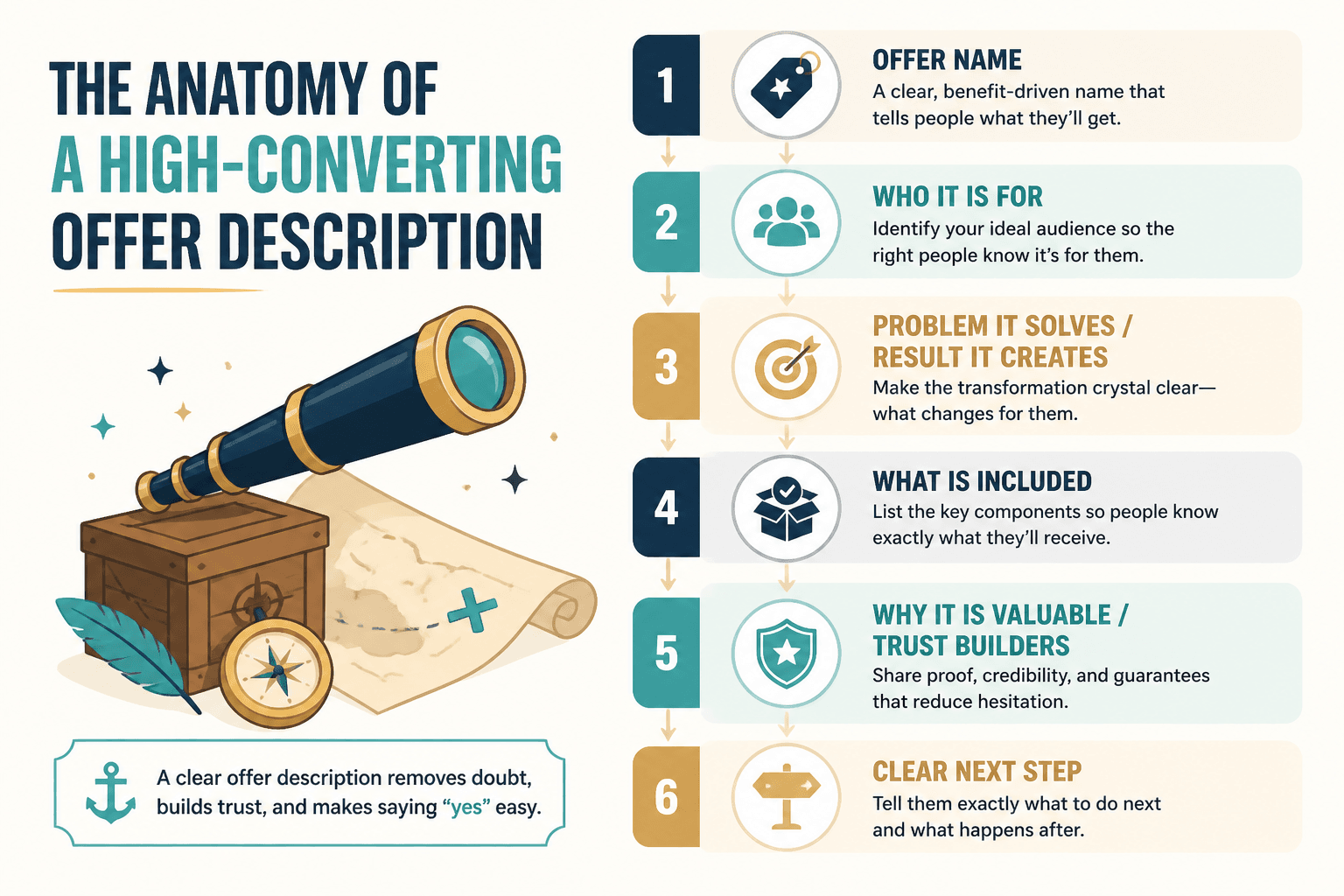
What a strong description actually needs to do
A good description does not perform poetry. It reduces friction.
Whether you sell coaching, consulting, design, software setup, templates, photography, strategy sessions, or physical products, the same principle applies: your description should help the right person quickly understand the value and feel safe taking the next step.
In plain English, a strong description should cover:
- What it is
- Who it is for
- What problem it solves
- What is included
- What makes it useful or different
- What outcome or improvement the buyer can expect
- What to do next
Notice what is not on that list: “sound impressive.” Buyers do not need your offer to sound important. They need it to sound relevant.
How to rewrite boring product and service descriptions step by step
1. Find the actual point of the offer
Before you rewrite anything, strip the offer down to its core function.
Ask:
- What is this really helping someone do?
- What annoying, expensive, slow, stressful, or confusing thing does it reduce?
- Why would someone want this now, not vaguely someday?
Very often, the strongest version of the offer is simpler than the original copy suggests.
Weak: “A comprehensive brand messaging intensification package for ambitious businesses.”
Better: “A messaging package that helps service businesses explain what they do clearly, so more of the right people get it and inquire.”
The second version may sound less fancy to the person who wrote the first one. It sounds much more useful to the person considering buying it.
2. Cut the throat-clearing
Boring descriptions often begin with a ceremonial fog cloud.
Stuff like:
- We are proud to offer
- Our premium solution is designed to
- In a fast-paced world
- With a commitment to excellence
- We understand that every client is unique
None of that helps the buyer decide. It is just copy warming up before saying anything. Cut it.
Start closer to the value.
Before: “Our premium resume service is designed to support professionals in today’s competitive job market.”
After: “We rewrite your resume to make your experience clearer, stronger, and easier for hiring managers to scan.”
3. Replace vague claims with specifics
Specifics create trust. Vague claims create wallpaper.
Look for empty phrases like:
- high-quality
- tailored
- innovative
- end-to-end
- results-driven
- customer-centric
- seamless
- comprehensive
Then force each one to prove itself.
| Vague phrase | Better rewrite |
|---|---|
| Tailored support | Weekly 1:1 feedback based on your goals, niche, and existing content |
| Comprehensive package | Includes strategy call, homepage copy, services page copy, and two rounds of edits |
| Seamless onboarding | Start with a 10-minute intake form and get your first draft within 5 business days |
| Results-driven design | Designed to help visitors understand the offer quickly and click through to book or buy |
Specifics do not have to mean stuffing every line with numbers. They just need to make the offer feel concrete.
4. Translate features into buyer value
Features matter. But unsupported feature lists are one of the fastest ways to make a description die on the page.
If you mention a feature, explain why the buyer should care.
Feature only: “Includes a 90-minute strategy session.”
Feature with value: “Includes a 90-minute strategy session so we can spot the gaps in your funnel, tighten the message, and prioritize what actually needs fixing first.”
This is one of the cleanest ways to rewrite boring product and service descriptions. Stop assuming the value is obvious. Spell it out without sounding needy about it.
5. Use the buyer’s language, not your internal jargon
Your customer probably is not searching for “a holistic visibility accelerator.” They want more qualified leads, a clearer website, better conversion copy, faster onboarding, stronger positioning, or less mess in their process.
Good copy meets the buyer where their brain already is. That means using familiar words for familiar frustrations.
- Say “rewrite your services page” instead of “optimize messaging architecture”
- Say “make the offer easier to understand” instead of “enhance audience comprehension pathways”
- Say “book more qualified calls” instead of “increase conversion opportunity flow”
Some businesses hide behind jargon because they think plain English sounds too simple. It does not. It sounds expensive in the right way: like you know what you are doing and do not need smoke machines.
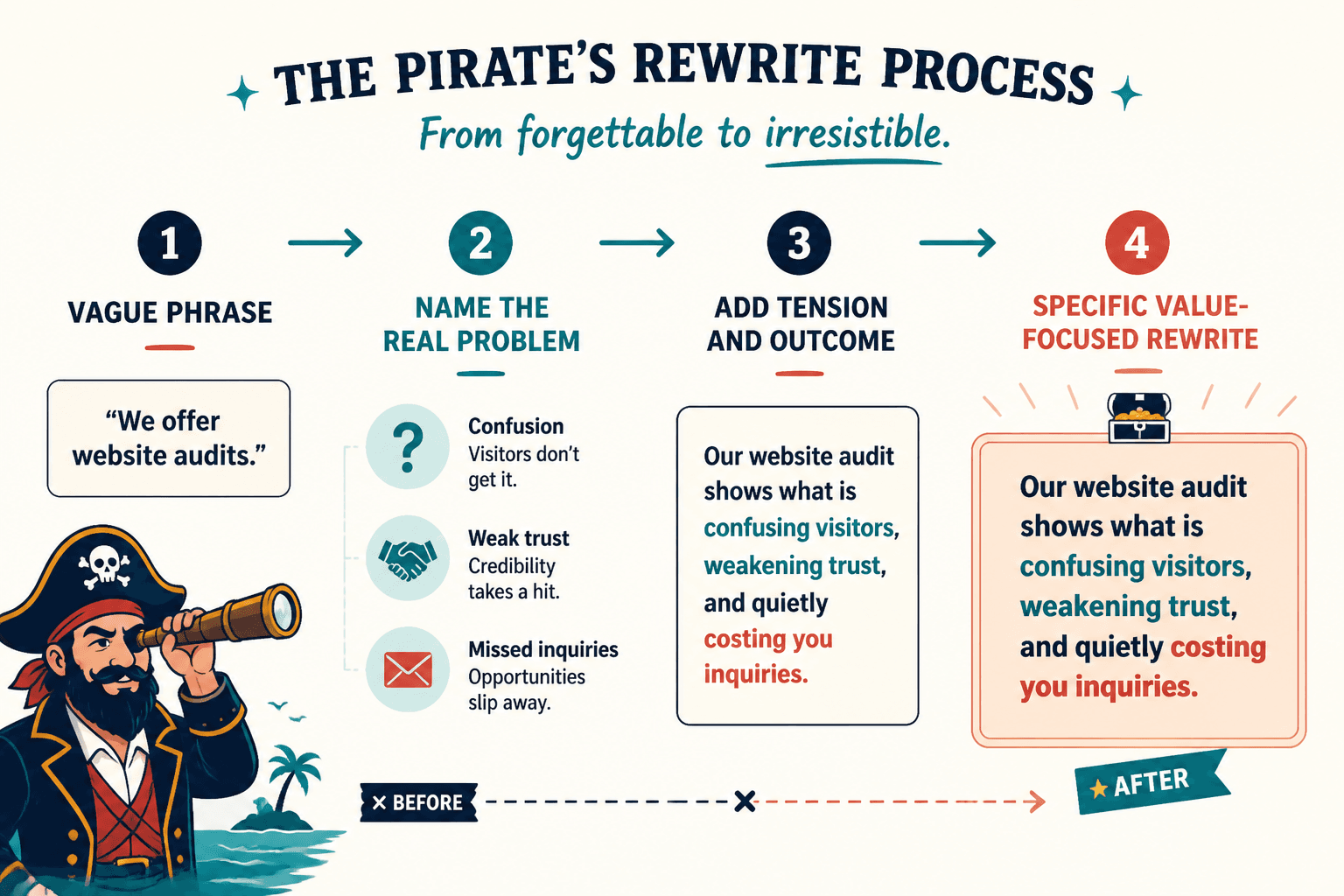
6. Add tension or contrast
Boring copy often describes an offer in neutral terms, as if every option is equally fine and nothing is at stake. But buyers pay attention when the writing highlights a real problem, tradeoff, or frustration.
That does not mean fake drama. It means honest contrast.
Flat: “This course teaches email marketing strategy.”
Sharper: “This course helps you write email sequences that do more than politely exist in people’s inboxes.”
Flat: “Our website audit reviews your current site.”
Sharper: “Our website audit shows you what is confusing visitors, weakening trust, and quietly costing you inquiries.”
Tension gives the description energy. It reminds the buyer there is a reason this matters.
7. Make the structure easier to scan
Sometimes the description is not terrible. It is just trapped inside a giant slab of text no sane person wants to read.
Fixing the structure can improve performance fast.
A simple description structure often works well:
- One strong opening sentence
- One short paragraph explaining the problem and value
- A bullet list of what is included
- A line or two on who it is best for
- A clear next step
For services in particular, people want to see both the promise and the process. Not a full diary entry. Just enough shape to reduce uncertainty.
8. Tighten the CTA so it fits the offer
A limp description often ends with an equally limp CTA.
Examples:
- Contact us today
- Learn more
- Get started now
- Reach out for more information
These are not evil. They are just generic. A better CTA matches the level of intent and tells the buyer what actually happens next.
Weak: “Learn more”
Better: “See what’s included and decide if this is the right fit.”
Weak: “Book now”
Better: “Book a consult and we’ll map out the biggest conversion gaps first.”
If you want more help with tone, read how to write product and service descriptions without sounding salesy or robotic.
A simple rewrite formula that actually works
If you need a repeatable process, use this:
- Name the offer plainly
- State the problem it solves
- Explain who it is for
- Show what is included
- Add 1 to 2 specific outcomes or benefits
- End with a clear next step
Template:
[Offer name] helps [specific type of buyer] [solve problem / achieve result] without [common pain, waste, confusion, or obstacle].
You’ll get [what’s included], so you can [practical value/outcome].
[CTA]
Filled example:
Services Page Rewrite helps consultants and solo service businesses explain what they do more clearly, so more qualified visitors actually stick around and inquire.
You’ll get a rewritten services page, tighter positioning, stronger section flow, and CTA improvements, so your offer feels easier to understand and easier to buy.
See what’s included and decide if it fits your site.
Before-and-after rewrites
Example 1: coaching service
Before: “This transformative coaching experience is designed to empower ambitious professionals with the tools and strategies needed to achieve their fullest potential.”
After: “This coaching program helps experienced professionals make clearer career moves, communicate their value better, and stop second-guessing every decision with a salary attached to it.”
Why it works: less fog, more person, more specific struggle, more believable value.
Example 2: web design offer
Before: “We create stunning, user-friendly websites tailored to your unique brand identity.”
After: “We design websites that make your business easier to understand, easier to trust, and easier to contact.”
Why it works: “stunning” is subjective wallpaper. Clarity, trust, and action are things buyers actually care about.
Example 3: digital product
Before: “Our all-in-one content toolkit streamlines your workflow and boosts productivity.”
After: “This content toolkit gives you plug-and-use templates, planning prompts, and workflow trackers so you spend less time staring at blank pages and more time publishing useful work.”
Why it works: now the buyer can picture the thing and the relief it provides.
Common mistakes when rewriting descriptions
The bigger point is simple: clearer structure and clearer writing make the piece more useful. That is usually what makes the ending land better too.
The bigger point is simple: clearer structure and clearer writing make the piece more useful. That is usually what makes the ending land better too.