
Most boring LinkedIn posts do not fail because the writer lacks expertise. They fail because the hook arrives half-asleep, and the formatting makes the whole thing look like admin work.
You can have a smart point, a solid opinion, even a useful takeaway, and still get ignored if your first line sounds like everyone else trying to sound “professional.” Add clunky spacing, generic transitions, and a weak close, and now your post has all the charm of a compliance memo.
If you want to know how to rewrite boring LinkedIn hooks & formatting, the fix is not “be more creative.” It is much more practical than that. You need to find the real point faster, lead with tension instead of warm-up fluff, and format the post so it reads like a person with a pulse wrote it.
This will show you how to do that, with examples, rewrites, and a simple process you can use on your own posts in about ten minutes.
For the main guide behind this topic, visit the parent guide.
Why most LinkedIn hooks are boring before the post even starts
A boring hook usually has one of three problems:
- It says something vague instead of something specific
- It starts too late because the writer is throat-clearing
- It tries to sound important rather than useful
This is why so many first lines feel dead on arrival:
- “I’ve been thinking a lot about leadership lately”
- “Here’s something I learned on my journey”
- “A quick reminder for anyone building a brand”
- “I used to think success looked like this…”
None of these give the reader a reason to care. They are not hooks. They are preambles wearing office clothes.
Good LinkedIn hooks do not need to be dramatic. They need to create enough tension, specificity, or relevance that the right person thinks, “Hang on, I need to read that.”
If you want a broader foundation for this, the parent resource on LinkedIn hooks and formatting is worth bookmarking.
The quickest way to rewrite a boring LinkedIn hook
Before you rewrite the first line, figure out what the post is actually trying to say.
This is where a lot of people go wrong. They try to improve the hook without improving the point. So they swap one bland line for another slightly shinier bland line. That is how you end up with posts that sound polished but still get polite silence.
Use this fast rewrite sequence:
- Find the actual point of the post in one sentence
- Identify the most interesting part of that point
- Move that part to the front
- Cut any scene-setting that does not earn its place
- Rewrite the first line so it creates contrast, tension, specificity, or consequence
If the hook could be pasted onto 5,000 other LinkedIn posts without anyone noticing, it is not done yet.
Here is a simple example.
Original opening:
“Over the years, I’ve learned many lessons about content creation and personal branding.”
Actual point:
Most creators post decent advice but package it so vaguely that nobody remembers it.
Stronger hook options:
- Good advice gets ignored on LinkedIn for one boring reason: it sounds like everyone else’s.
- Most LinkedIn posts do not fail because the idea is bad. They fail because the packaging says nothing.
- If your post is useful but forgettable, the problem is probably not the insight. It is the opening.
Same general topic. Much better entry point.

What strong LinkedIn hooks usually do instead
A strong hook usually earns attention in one of five ways.
1. It makes a clear claim
Example: Most “thought leadership” posts are just diary entries with better spacing.
This works because it has shape. It has an opinion. It does not mumble.
2. It names a painful mistake
Example: You are not being ignored on LinkedIn because people hate long posts. You are being ignored because your first line asks for patience instead of earning interest.
3. It creates contrast
Example: Being clear beats being clever on LinkedIn almost every time.
4. It makes the reader feel seen
Example: If your LinkedIn post sounds smart but gets no traction, it probably opens too politely.
5. It hints at a payoff
Example: One small rewrite can make your LinkedIn post feel sharper, faster, and a lot less corporate.
Notice what these do not do. They do not manufacture fake suspense. They do not tease like bad clickbait. They simply make a real point in a sharper way.
7 boring LinkedIn hook patterns to stop using
Some hook formats are not always wrong. They are just wildly overused, usually weak, and often a sign the post has not found its angle yet.
“I used to think…”
This can work if the contrast is sharp. Usually, it is just a slow runway into a predictable lesson.
Weak: I used to think consistency was the key to growth.
Better: Consistency is overrated when you are consistently posting forgettable content.
“Here’s what nobody tells you…”
Usually, plenty of people have told us. Loudly. Repeatedly.
Weak: Here’s what nobody tells you about building a brand.
Better: Building a personal brand gets easier once you stop trying to sound impressive to strangers.
“A quick reminder…”
Instant energy drop. It sounds like a calendar notification.
Weak: A quick reminder that your network matters.
Better: Most people do not need more networking. They need to stop sounding interchangeable.
“I’m excited to announce…”
Fine for real company news. Not a hook for a useful post. Also, most readers are not excited yet. You have not given them a reason.
“Unpopular opinion…”
If it is actually unpopular, you do not need to label it. If you label it, there is a decent chance it is “Drink water and set boundaries.”
“I’ve been reflecting…”
Private journaling energy. Too soft for a first line unless the insight that follows is very strong.
“Three lessons I learned…”
Sometimes useful. Often bland. Lists are not the problem. Generic lessons are.
If your openings keep slipping into these patterns, it helps to study stronger alternatives in how to write better LinkedIn hooks and formatting and how to start LinkedIn hooks and formatting without a weak opening.
How to rewrite boring LinkedIn hooks & formatting together
The hook and the formatting are not separate issues. A good first line can still die if the next eight lines look messy, padded, or exhausting.
LinkedIn is a skim-first platform. People do not sit down with tea and reverence. They scan. They pause when something catches. They continue if the structure feels easy.
That means formatting should do three jobs:
- Make the post easier to scan
- Support the rhythm of the idea
- Guide the eye toward the payoff or CTA
It should not look like you are pressing return every four words to simulate importance.
Bad formatting usually looks like this
- Huge walls of text
- Every sentence isolated for no reason
- Random one-line paragraphs with no flow
- Emoji used as scaffolding because the writing cannot carry itself
- Long intros with no visual structure
Better formatting usually looks like this
- Short paragraphs grouped by idea
- Natural line breaks where the thought shifts
- Occasional lists when they genuinely help
- Enough white space to keep it readable
- A visible path from hook to point to takeaway to CTA
Formatting is there to serve meaning. If your spacing is doing theatrical jazz hands while the idea itself is weak, no amount of airy line breaks will save it.
For a deeper look at spacing specifically, see how to improve LinkedIn hooks and formatting line breaks without sounding generic.
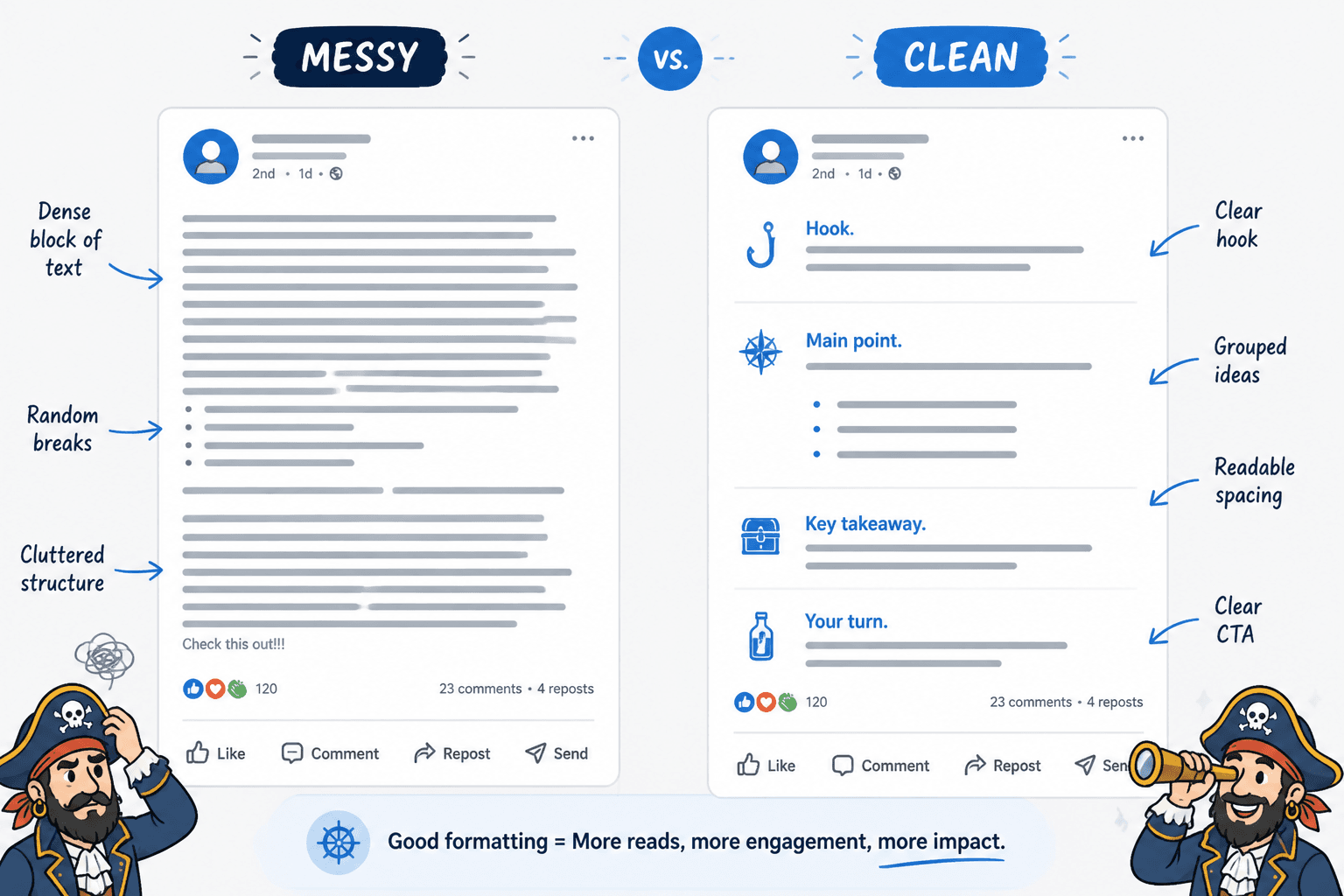
Before-and-after rewrites: boring LinkedIn hooks fixed
Here are a few practical rewrites.
Example 1: Generic lesson post
Before
I have learned a lot in my journey as an entrepreneur.
One of the biggest lessons is that consistency matters.
Keep showing up.
After
“Keep showing up” is useless advice if what you keep showing up with is bland.
Consistency matters.
But consistent clarity matters more.
If your LinkedIn posts are saying the same vague thing as everyone else, posting more often just spreads the problem faster.
Why it works: stronger opening, real tension, cleaner rhythm, and a point people can actually use.
Example 2: Soft insight post
Before
Lately I’ve been reflecting on the importance of authenticity in content marketing.
After
“Be authentic” is nice advice. It is also too vague to help anyone write a better post.
On LinkedIn, authenticity is not oversharing.
It is sounding like a real person with a real point.
Why it works: it challenges a fuzzy cliché and replaces it with something more concrete.
Example 3: Overlong announcement style
Before
I’m excited to share some thoughts today about what I think many professionals get wrong when posting on LinkedIn.
After
Most professionals do not have a LinkedIn content problem.
They have an opening-line problem.
Their posts start so politely that nobody sticks around long enough to find the useful part.
Why it works: quicker entry, clearer claim, better pacing.
A simple formatting template that usually works on LinkedIn
You do not need one rigid formula, but this structure works well for a lot of insight-led LinkedIn posts:
- Hook: one sharp first line
- Expansion: one to three short paragraphs building the point
- Proof or example: a quick story, observation, or contrast
- Takeaway: make the lesson explicit
- CTA: one clean next step, if needed
Here is what that might look like:
The bigger point is simple: clearer structure and clearer writing make the piece more useful. That is usually what makes the ending land better too.