Most creators assume more AI research means better ideas.
Usually, it just means you gave the machine too much room to wander around in a bathrobe, bringing back a pile of vaguely relevant notes and calling it strategy.
When Short Creator AI Research and Ideation Beats Long Ones comes down to one thing: short workflows often force better thinking. They reduce fluff, keep the brief clear, and stop you from mistaking volume for insight.
If you create content, sell expertise, or build a personal brand, that matters a lot. You do not need a 2,000-word AI brainstorm every time you want a post angle, email idea, offer concept, or content series. In plenty of cases, the shorter prompt, shorter research pass, and shorter idea list will give you cleaner outputs faster.
This article will help you spot when short AI research and ideation is the smarter move, where long exploration still earns its keep, and how to keep your workflow useful instead of bloated. If your current process feels “productive” but somehow still ends in mushy content ideas, this is probably the missing correction.
For the main guide behind this topic, visit the parent guide.
Why short AI research often works better
AI is very good at giving you more.
That is not the same as giving you better.
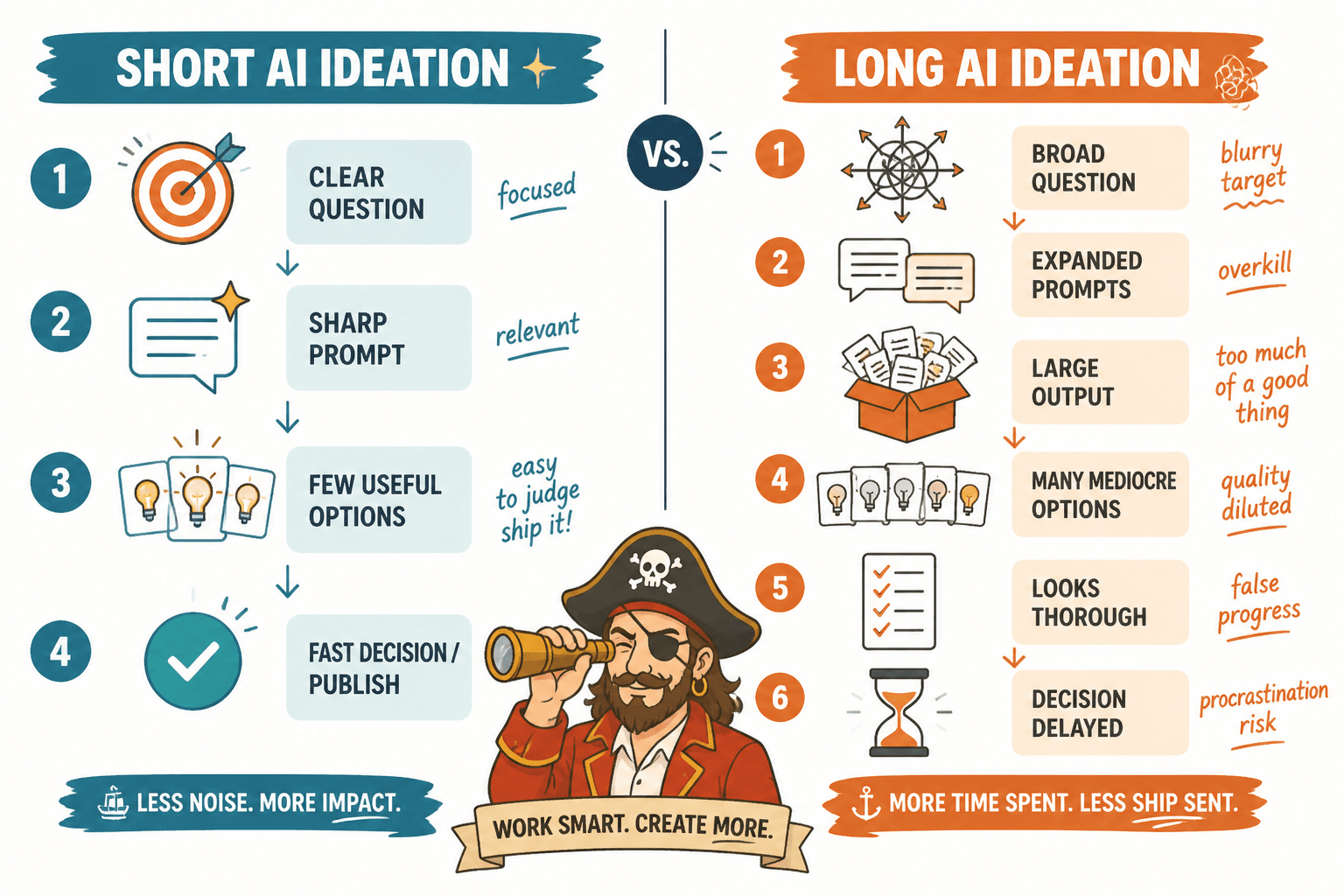
Long creator AI research sessions tend to create three problems fast:
- They blur the actual question
- They generate too many mediocre options
- They make weak ideas sound thorough
Shorter ideation sessions do the opposite. They narrow the target. They force sharper prompts. They make it easier to judge output based on usefulness instead of sheer amount.
That matters because most creators do not actually have a research problem. They have a decision problem. They need a better angle, a stronger hook, a clearer argument, a more relevant content theme, or a faster way to turn what they already know into something publishable.
And for that, long AI sessions are often overkill. Worse, they can become a nice-looking form of procrastination. A very modern one, sure. Still procrastination.
When short creator AI research and ideation beats long ones
Short AI research wins when the goal is clarity, not comprehensiveness.
That includes more situations than people think.
1. When you already know the subject
If you are a coach, consultant, writer, strategist, or founder working in your own lane, you usually do not need AI to “teach” you the topic. You need it to help structure, sort, challenge, compress, or expand what you already know.
In that case, short prompts work better because they stay close to your real expertise.
For example, this is a useful short ideation prompt:
Give me 12 strong content angles for creators who overuse AI for research and end up with generic content. Keep them practical, opinionated, and specific to solo business owners.
That is usually enough. You do not need a sprawling prompt asking for market analysis, trend forecasting, audience pain maps, content pillars, objections, psychological triggers, and a fake Stanford energy. Calm down.
2. When you need content ideas quickly
Short research is ideal for everyday publishing workflows.
If you are trying to create:
- a LinkedIn post
- an X thread
- a Facebook post
- an email topic
- a list of hooks
- a fresh angle on a familiar point
you usually need speed plus sharpness. Not an AI-generated whitepaper.
A short prompt with a narrow outcome often beats a longer one because it leaves less room for drift. The model has fewer ways to get cute, generic, or bloated.
3. When the idea needs your taste more than more data
Some content problems are not solved by gathering more inputs. They are solved by better judgment.
If you are choosing between angles, prioritizing which opinion is worth posting, or trying to make a boring point more distinct, the bottleneck is taste. AI can help you generate options, but it cannot decide which one sounds most like you, fits your audience best, and actually deserves oxygen.
Shorter ideation helps here because it gives you fewer, cleaner options to react to. Long ideation often creates a swamp of half-usable ideas, and then you get stuck sorting compost.
4. When you are validating instead of building
There is a big difference between testing an idea and building a full content asset around it.
If you are just trying to validate whether an angle has legs, short AI research is usually enough. Ask for:
- 10 hook variations
- 5 opposing takes
- 3 audience objections
- 7 post angles for one claim
- examples of how this topic gets phrased poorly
That gives you enough to test the shape of the idea without disappearing into a three-hour “thinking” session that was mostly prompt fiddling.
5. When your audience needs simple, not exhaustive
A lot of creator content performs better when it is focused and digestible. Your readers are usually not asking for the maximum number of subpoints possible. They want clarity they can use.
So if the output you need is supposed to become a concise post, clean article section, carousel, thread, or sales email, a shorter ideation process often fits the final product better.
This is where people go wrong: they use an oversized research process to create a piece of content that should have been tight from the start. Then they spend the next hour cutting it back down to something readable.
What short AI research is actually good for
Short creator AI research and ideation is especially useful for small, high-leverage tasks inside a content workflow.
- Finding sharper framing for a topic you already understand
- Generating headline or hook options
- Pressure-testing an argument
- Surfacing common audience objections
- Turning one rough idea into 10 usable angles
- Identifying themes across your own notes or transcripts
- Condensing messy thinking into a cleaner structure
- Creating first-pass outlines for posts, emails, and short articles
In other words, it works well when AI is acting like a fast thinking assistant, not a substitute for your actual perspective.
If you want a broader view of where this fits, the main creator AI research and ideation category is a useful place to keep building your process.
Where long AI research still makes sense
Short is not always better. It is just often better than people assume.
Longer AI research and ideation deserves the time when you are working on something that genuinely benefits from depth, synthesis, or wider input.
- Building a big content strategy
- Planning a new offer or product ecosystem
- Researching an unfamiliar industry
- Creating long-form authority content
- Developing a multi-part funnel
- Comparing multiple customer segments
- Analyzing a large body of source material
If the work requires breadth, nuance, or layered decision-making, longer sessions can help. But they still need structure. Long and loose is how you end up with expensive-looking nonsense.
If you are trying to figure out the right scope in general, this guide on how long creator AI research and ideation should be can help you choose the right length for the task instead of defaulting to “more.”
How to know if your AI research session should stay short
Use this simple test.
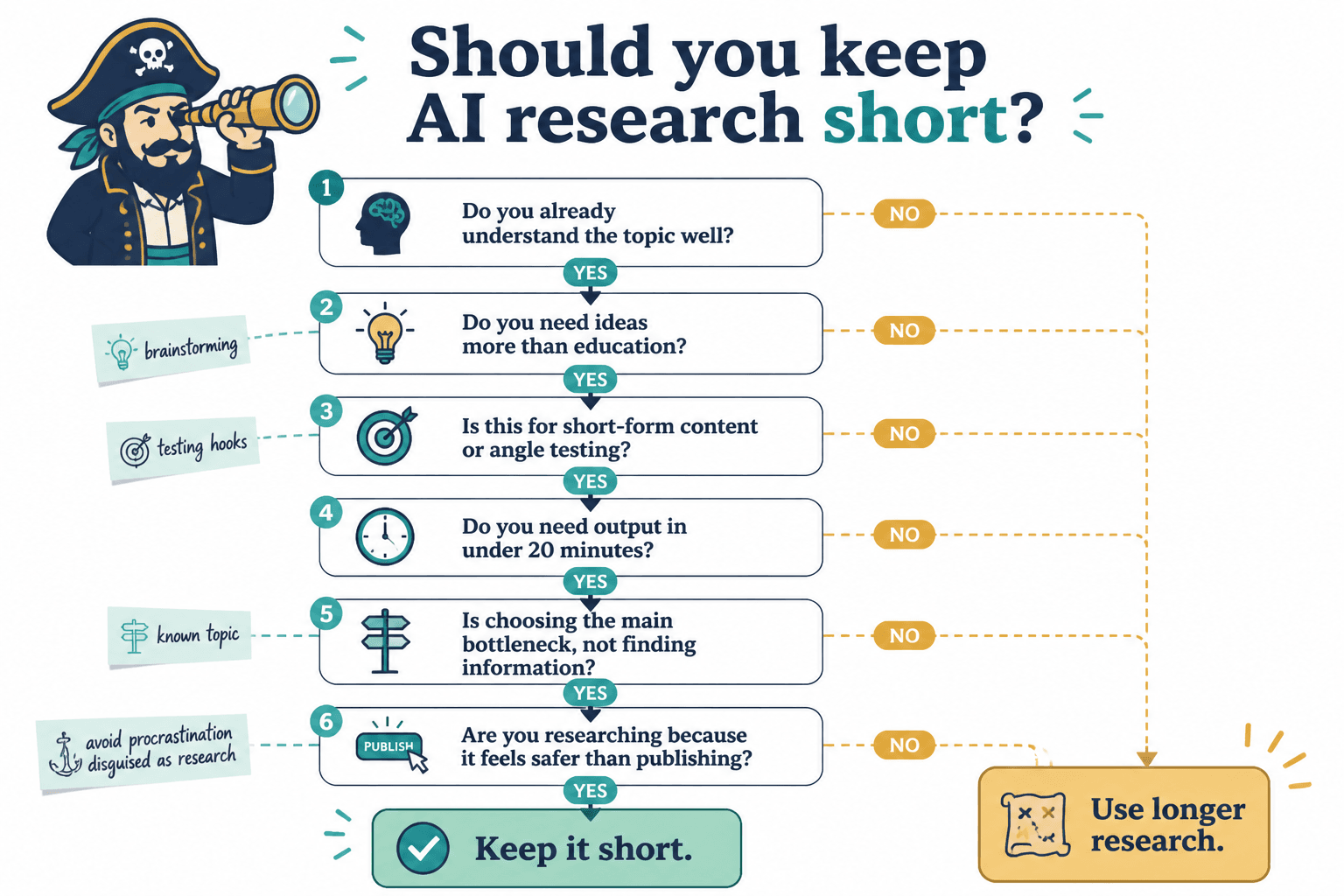
Your AI research and ideation session should probably stay short if:
- You already know the topic well
- You need ideas, not education
- You are creating short-form content
- You are testing angles rather than finalizing strategy
- You need output in under 20 minutes
- The real bottleneck is choosing, not finding
- You are likely to over-research because it feels safer than publishing
That last one deserves a little attention.
A lot of creators use long AI ideation the same way other people use color-coded planning systems: it feels serious, so it feels productive. But if you already have enough signal to make the post, write the article, record the video, or send the email, then more ideation may just be hesitation wearing a nicer outfit.
A simple short AI ideation workflow that actually works
You do not need a dramatic prompt architecture. You need a clean process.
Step 1: Start with one narrow question
Bad:
Help me research my audience, create a brand strategy, identify content pillars, and brainstorm content ideas around AI for creators.
Better:
Give me 10 content angles about how creators overcomplicate AI ideation. Make them specific to consultants and solo founders.
One question. One outcome. Better output.
Step 2: Ask for fewer options than you think you need
People ask for 30 ideas because they think abundance helps. Usually it just lowers the average quality.
Ask for 7 to 12. Then refine from there.
That keeps the list usable. You can actually scan it, react to it, and spot what has teeth.
Step 3: Make the model choose
After the first output, do not just ask for more. Ask it to rank, filter, or tighten.
For example:
- Which 3 ideas are strongest for trust-building?
- Which 5 are most distinctive?
- Which 3 would work best as LinkedIn posts?
- Trim these into sharper, less generic phrasing.
- Which ones sound too broad or overused?
This is where short workflows shine. You are not trying to build a giant knowledge dump. You are trying to improve the signal.
Step 4: Bring your own judgment back in fast
Do not keep the AI in the driver’s seat too long.
As soon as you have 2 to 3 promising directions, step out of ideation mode and start shaping the actual piece. Add your examples. Add your opinion. Add your proof. Add the thing the machine cannot manufacture: your real point of view.
If you want more concrete prompts and structures, these creator AI research and ideation ideas and examples will give you solid starting points without turning your workflow into soup.
Short vs long AI ideation at a glance
| Use short AI ideation when | Use longer AI ideation when |
|---|---|
| You already know the topic | You need to learn or map a new topic |
| You need fast content angles | You are planning a larger strategy |
| You are creating posts, hooks, or emails | You are building long-form assets or funnels |
| You want clearer options, not more options | You need synthesis across many inputs |
| You are testing ideas | You are developing a broader system |
| Your taste matters more than more data | The work requires deeper comparison and context |
Mistakes people make with short AI workflows
Short does not mean sloppy.
Here is where people still ruin it:
They stay vague
A short prompt still needs a clear target. “Give me ideas about content” is not a target. It is a cry for help.
They ask for too much in one go
If you want hooks, outlines, objections, examples, CTA ideas, and platform rewrites all at once, you are not running a short workflow. You are just writing a crowded prompt.
They confuse first output with final quality
The point of short ideation is not to get flawless copy on the first try. It is to reach a strong direction quickly. Then you refine.
They skip the human filter
This one is expensive. Not financially. Reputationally.
If you publish AI-shaped thinking without running it through your own standards, you get the usual symptoms: vague claims, soft opinions, and content that sounds technically competent but oddly hollow. Readers can smell that. Maybe not in one line, but across a brand? Absolutely.
What this looks like in a real creator workflow
Say you are a consultant writing about why creators overcomplicate authority-building.
A short AI ideation workflow could look like this:
- Prompt 1: Give me 10 content angles on why authority is often built through clarity, not volume.
- Prompt 2: Which 3 of these would work best for LinkedIn?
- Prompt 3: Rewrite those 3 to sound more specific and less generic.
- Prompt 4: Give me 5 hook options for the strongest one.
- Human step: Choose one, add your point of view, proof, and CTA.
That is enough to get to a strong draft quickly.
You do not need a giant exploratory session unless you are also trying to develop a full editorial strategy, new offer messaging, or audience segmentation model.
If you need a broader walkthrough for building cleaner processes, this creator AI research and ideation guide for better results is the next useful step.
Short ideation also pairs well with short editing
There is a bigger workflow point here.
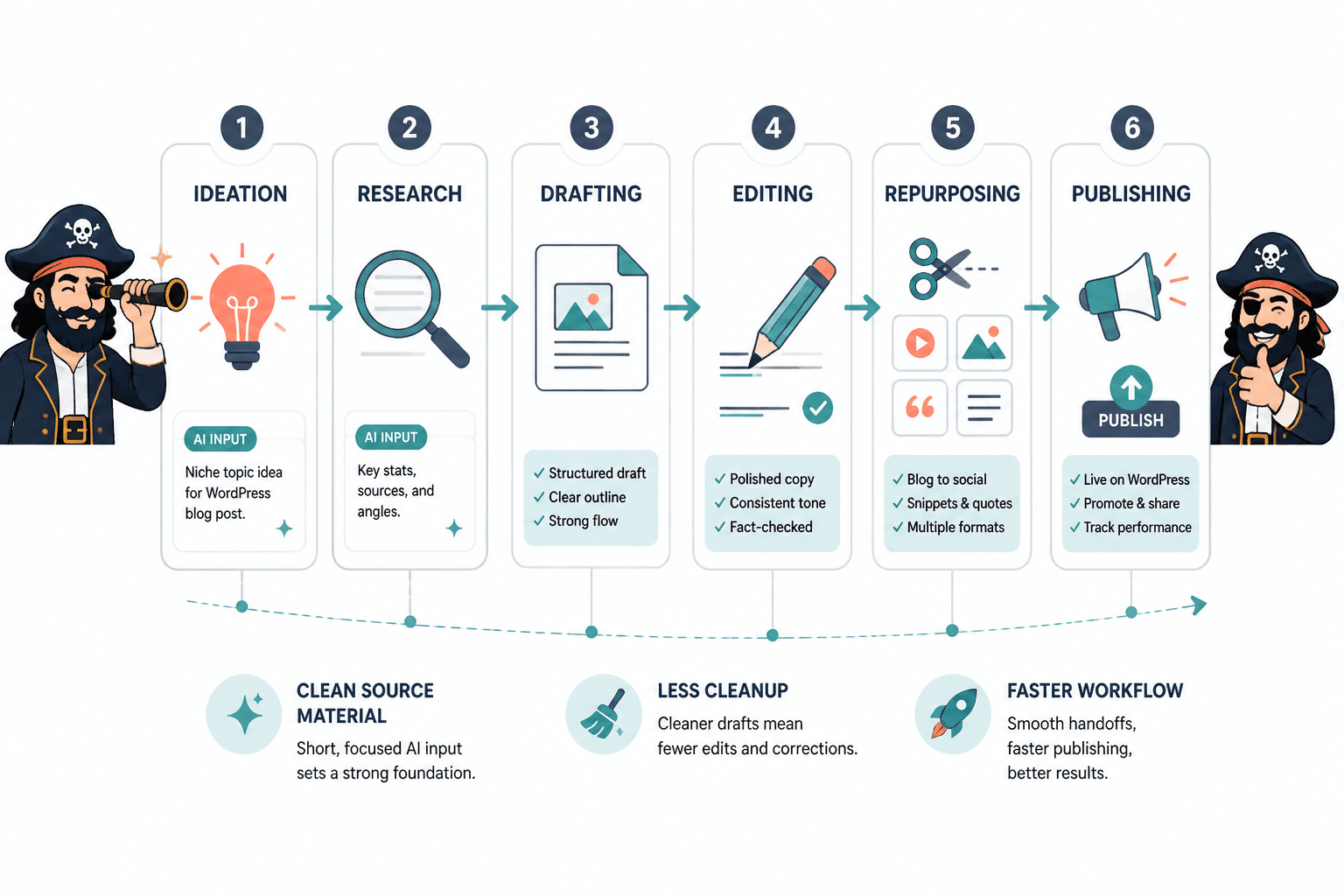
When your ideation process gets tighter, your editing and repurposing usually gets tighter too. You start with cleaner source material, which means less cleanup later. That saves time across the whole system, not just the first prompt.
If that is where you are heading, this piece on when short creator AI editing and repurposing beats long ones connects well with the workflow logic here.
You can also browse the broader AI writing tools and workflows paths if you are tightening the whole content system, not just the ideation stage.
Quick FAQ
Is short AI research less accurate?
Not necessarily. It is often more useful because it stays focused. Accuracy usually depends more on prompt clarity, source quality, and your review than on sheer length.
How short should a short ideation session be?
Often 5 to 20 minutes is enough. The point is not the exact time. The point is staying narrow, getting signal, and moving back into human judgment quickly.
Should I use short AI research for every content piece?
No. Use it when you need sharper thinking fast. Use longer workflows when the project genuinely needs depth, synthesis, or broader exploration.
What is the biggest benefit of short AI ideation?
It helps you avoid drowning in average ideas. You get faster options, cleaner choices, and less temptation to confuse more output with better strategy.
Use the shortest workflow that gets you to a strong idea
That is really the standard.
Not shortest because speed is trendy. Shortest because unnecessary complexity usually makes creator workflows worse. It adds friction, buries your point, and makes AI look smarter than it is.
When Short Creator AI Research and Ideation Beats Long Ones, it is because the job was never to generate maximum material. The job was to get to a useful, distinct, publishable idea without wasting an afternoon on synthetic beige.
So next time you open the chat box, do not ask for everything. Ask for the next useful thing. That is usually where the better content starts.
The bigger point is simple: clearer structure and clearer writing make the piece more useful. That is usually what makes the ending land better too.