
Longer AI workflows are not automatically smarter. A lot of the time, they are just slower, messier, and weirdly worse.
Creators love the idea of a massive repurposing machine: one long transcript in, fifty polished assets out, everything optimized, everything everywhere. Sounds efficient. Usually is not. What actually happens is you get bloated drafts, flattened ideas, generic spins on the same point, and a pile of content you now need to fix by hand.
That is why When Short Creator AI Editing and Repurposing Beats Long Ones is not really a question about length. It is a question about fit. Sometimes the short workflow wins because the source idea is simple, the content goal is narrow, and speed matters more than squeezing every possible crumb out of one piece of content.
If you are using AI to clean up posts, spin out platform variations, trim clips, turn notes into threads, or reshape one idea into a few useful assets, this is where shorter workflows often beat longer ones by a mile. Less drag. Less fluff. Less cleanup. Better output.
For the main guide behind this topic, visit the parent guide.
Why long repurposing workflows often underperform
Long workflows promise leverage. In practice, they often create friction disguised as productivity.
Here is the basic problem: AI gets worse when you ask it to do too many layered tasks at once without enough judgment in the loop. “Take this 4,000-word transcript, find the best insights, adapt them for five platforms, preserve my voice, make them original, improve the hooks, and tailor each one to different audience awareness levels” sounds impressive. It also invites blandness.
The model starts averaging. It smooths the edges off your thinking. It repeats itself. It fills gaps with polished nonsense. Then you sit there editing the “time-saving” output for an hour and wondering why this felt harder than writing the post yourself.
- Long source material often contains too many possible angles
- Big prompts encourage generic summaries instead of sharp choices
- Heavy repurposing chains create version fatigue
- Each extra transformation increases drift from your original point
- The review load gets heavier, not lighter
None of this means long workflows are useless. Some are worth it. But people overuse them because “more content from one source” sounds efficient in a spreadsheet. Your audience, sadly, does not read spreadsheets.
When short creator AI editing and repurposing beats long ones
Short workflows win when the content has one job and one clear point.
If you already know what the takeaway is, you usually do not need a giant repurposing system. You need a clean edit, one or two format changes, and enough human judgment to keep the idea sharp. That is where short creator AI editing and repurposing tends to outperform the longer version.
1. When the original idea is already tight
A strong source does not need ten layers of transformation. If you have a punchy LinkedIn post, a clear email section, a useful comment, or a concise video transcript with one real point, a short workflow preserves what made it good.
Example: turn a clear 180-word post into:
- a stronger LinkedIn version
- a shorter X post
- a 3-post thread
- a short email intro
That is enough. You do not need to force it into a carousel, article, reel script, lead magnet, and 14 hook variants unless the idea genuinely deserves that treatment.
2. When speed matters more than coverage
Some content is meant to stay fresh and useful, not become a full content franchise.
If you are reacting to a common client objection, a trend in your niche, a question from comments, or a small lesson from a recent project, the short workflow is usually the better call. Capture the point, adapt it fast, publish, move on.
Trying to build a giant repurposing chain around every decent thought is how creators end up with an elegant workflow and no pulse.
3. When platform differences are minor
Not every adaptation needs a full rewrite. Sometimes it just needs compression, formatting, and a different ending.
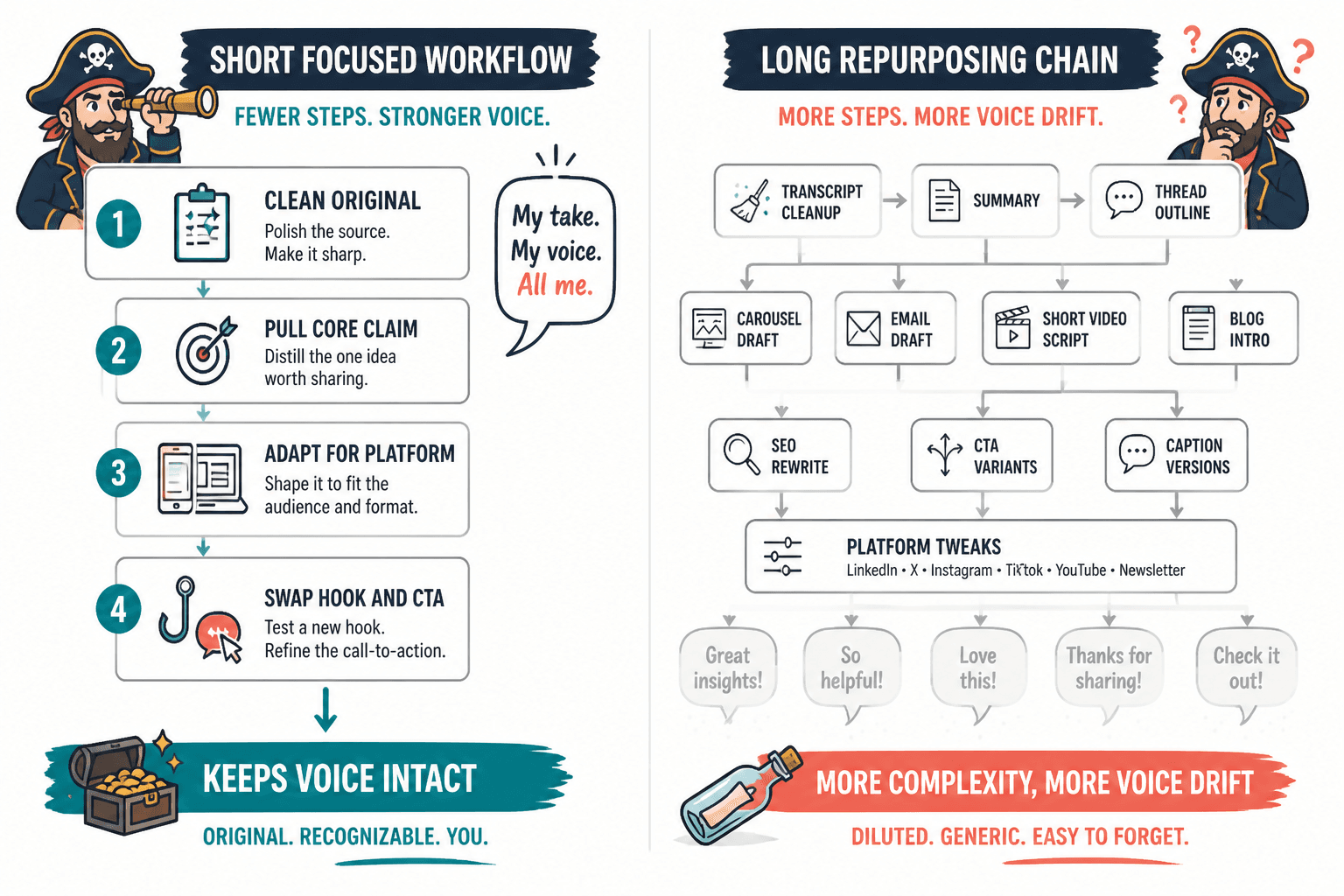
A practical point can often move across LinkedIn, X, email, and a Facebook post with a short workflow like this:
- Clean the original
- Pull the core claim
- Shorten or expand based on platform
- Swap the hook and CTA
That is editing and repurposing. Not ritual sacrifice.
4. When your voice matters more than volume
The more content versions you ask AI to create in one go, the more likely your voice gets flattened into “competent internet person.” Clean, readable, forgettable.
Shorter workflows let you stay closer to your original phrasing, pacing, and point of view. That matters a lot for creators, consultants, and personal brands. People do not just follow the information. They follow the way you frame it.
5. When you are testing ideas, not building assets
Short workflows are great for validation.
Before turning one idea into a full article, a long video, a lead magnet, and six social posts, test the angle. Use AI to help you tighten the wording, create two or three variations, and see what gets traction. If the idea lands, then maybe it earns the bigger workflow.
This is especially useful if you are still refining your positioning or content pillars. Better to test ten sharp ideas lightly than overproduce one mediocre idea into every format known to man.
What “short” actually means here
Short does not just mean fewer words. It means fewer transformation steps, tighter scope, and less decision clutter.
A short creator AI editing and repurposing workflow usually has three traits:
- one source piece with one main idea
- one or two clear output formats
- one editing pass with human judgment
For example, these are short workflows:
- transcript clip to caption plus X post
- LinkedIn post to email intro plus thread
- rough note to polished post plus CTA variation
- podcast excerpt to quote post plus short article outline
And these are not:
- one webinar to 30 assets across 8 platforms
- one article to carousel, thread, script, newsletter, captions, nurture emails, and DM scripts in one chain
- multi-tool workflows where each tool rewrites the output of the previous one
If the workflow starts needing project management software just to explain it, there is a decent chance it is no longer saving you much.
Where short workflows work especially well
Editing social posts
This is one of the best uses for short AI help.
If you already wrote the post, AI can tighten the hook, cut repetition, improve formatting, and give you alternate endings. That is a short, useful editing pass. It works because the machine is not inventing the substance. It is helping you shape it.
Turning one point into a few platform-native versions
You do not need a giant system to convert one strong idea into:
- a LinkedIn post with more context
- an X post with more punch
- a Facebook post with a more conversational opening
- an email paragraph with a stronger bridge to a CTA
That kind of repurposing works because the adaptation is intentional, not industrial.
Clip extraction and caption cleanup
For video and podcast creators, short workflows often beat longer ones because the useful moment is small.
You do not need AI to “analyze the full emotional arc” of a 42-minute episode every time. Sometimes you need it to identify three strong 30-second clips, draft clean captions, and suggest two hook lines that do not sound like a late-night infomercial.
Rewriting rough notes into publishable drafts
If your source material is short but clear, AI can be excellent at turning fragments into a usable draft without overcomplicating the process.
Say you have:
- three bullet points from a client call
- a voice memo with one insight
- a quick lesson from a launch
- a half-written caption
That is often enough for a short editing and repurposing workflow that gives you something publishable fast.
Where long workflows still make sense
To be fair, long workflows are not the villain. They are just overprescribed.
Longer creator AI editing and repurposing workflows make more sense when the source material is rich, the stakes are higher, and the outputs genuinely need different treatments.
- turning a detailed webinar into an article, email sequence, and sales page draft
- repurposing a strong podcast interview into multiple authority assets
- building a proper content system around a research-heavy pillar piece
- creating evergreen assets from a case study with real proof
In those cases, the depth is earned. The source can support it. The workflow has enough substance to justify the extra handling.
If you want a broader framework for building better systems around this kind of work, read Creator AI Editing and Repurposing Guide for Creators Who Want Better Results. And if you are comparing workflow size more directly, How Long Should Creator AI Editing and Repurposing Be in 2026 helps sort out what deserves more depth and what absolutely does not.
How to decide if the short workflow is the better one
Use this filter before you build a whole content machine around one asset.
| Question | If the answer is yes |
|---|---|
| Is there one clear takeaway? | Short workflow is probably enough |
| Do you only need 1 to 3 outputs? | Go short |
| Is the content timely or reactive? | Go short and publish faster |
| Does your voice carry a lot of the value? | Stay closer to the source with a short workflow |
| Are you testing the idea first? | Short wins |
| Does the source include multiple deep subtopics? | A longer workflow may be worth it |
| Do the output formats need very different structures? | Longer workflow may help |
Simple rule: if the value is mostly in the original idea, keep the process short. If the value is in extracting multiple substantial assets from a rich source, longer may be justified.
A practical short workflow that actually works
You do not need a cinematic prompt stack. You need a sane process.
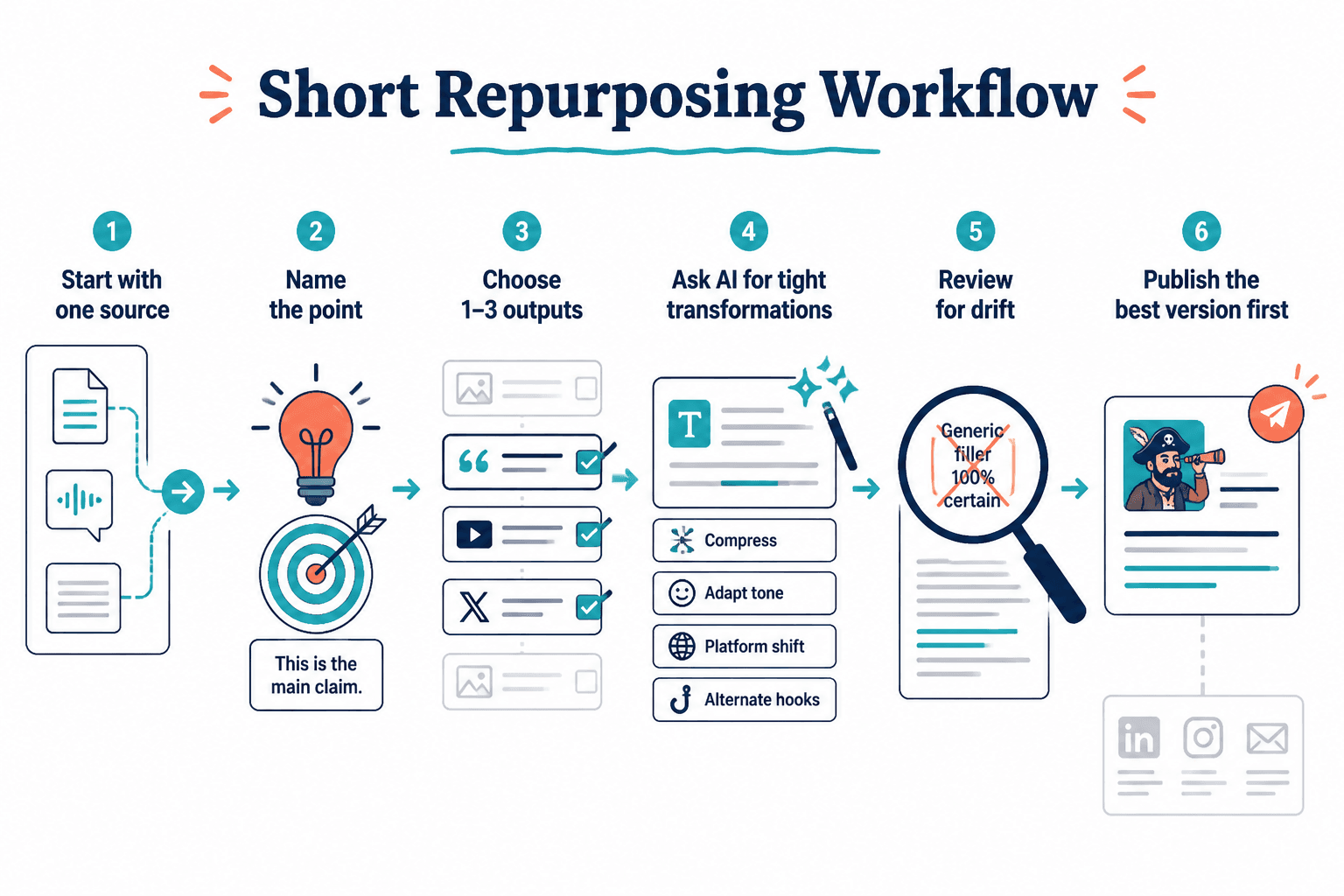
- Start with one source. A post draft, transcript clip, note, voice memo, email section, or article paragraph.
- Name the actual point. What is the claim, lesson, or useful tension?
- Choose only 1 to 3 outputs. Not nine. You are not feeding a content furnace.
- Ask AI for tight transformations. Edit, compress, adapt tone, change platform, create alternate hooks.
- Review for drift. Remove generic filler, fake certainty, or anything that sounds suspiciously polished and empty.
- Publish the best version first. Then repurpose further only if the idea earns it.
This approach works especially well if you already have some source material and just need help shaping it faster.
Mistakes people make when trying to keep workflows short
Short does not mean careless. There are still a few easy ways to ruin it.
Using vague source material
If the original note says basically nothing, the output will also say basically nothing, just with better punctuation.
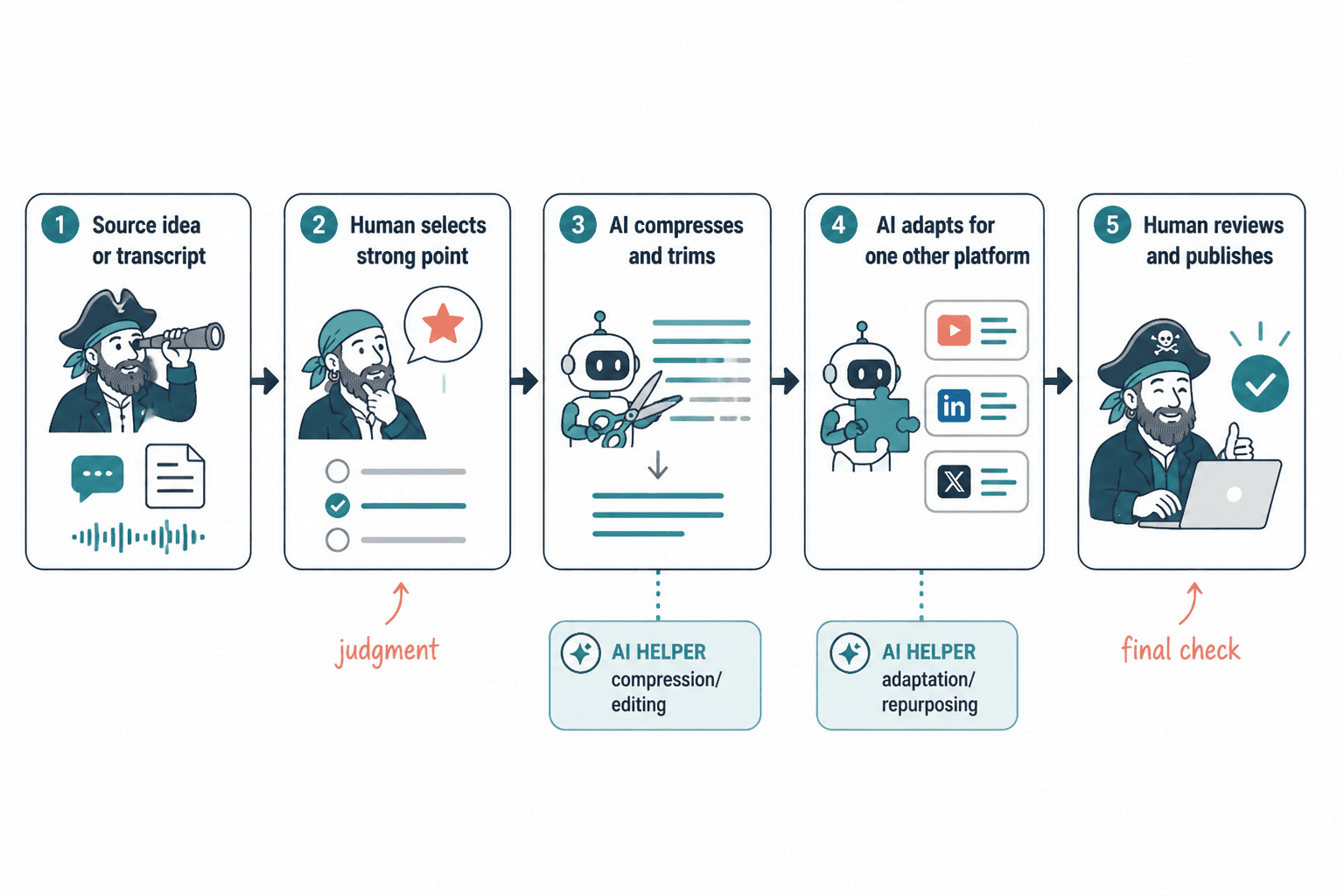
Skipping the human selection step
AI can generate options. It is not great at taste. You still need to decide which angle is strongest and which version actually sounds like you.
Trying to force every idea into every channel
Some ideas are made for short posts. Some are better in email. Some should have remained a private note. Not every thought needs cross-platform citizenship.
Confusing output quantity with useful repurposing
Five weak versions of one point are not leverage. They are clutter with a workflow attached.
Examples of short workflows beating long ones
Example 1: Client insight to social content
Long version: Turn one client call transcript into a newsletter, thread, article, caption set, lead magnet, and webinar outline.
Short version: Pull one clear insight from the call, write a LinkedIn post, then adapt it into an X post and email paragraph.
Short wins here because the insight is singular. The giant workflow just stretches it until it tears.
Example 2: Video clip repurposing
Long version: Analyze a full video, generate summaries, create scripts for reels, write ten quote posts, and build a content calendar from it.
Short version: Extract the strongest 20-second segment, clean the caption, create two hook options, and adapt the takeaway into one text post.
Short wins because the best value often lives in one clean moment, not the entire file.
Example 3: Article excerpt repurposing
Long version: Repurpose a full article into every possible social format before knowing which point resonates.
Short version: Pull one strong paragraph, turn it into a short post, and test three hooks.
Short wins because you learn faster. Then you can build more if the angle gets traction.
If you want more specific use cases and examples, Best Creator AI Editing and Repurposing Ideas and Examples for Creators is the natural next read.
Short workflows also pair well with short research cycles
This part matters more than people think. A short editing and repurposing workflow works best when it starts from a well-shaped idea. If your research and ideation process is also lean, you can move from insight to publishable content much faster without creating mush in the middle.
That is why short repurposing often works beautifully alongside short research loops: spot a pattern, frame the point, draft the asset, adapt it lightly, publish. Clean. Fast. Still thoughtful.
Related: When Short Creator AI Research and Ideation Beat Long Ones.
Use tools for compression, not content cosplay
The best short creator AI editing and repurposing setups use tools for very specific jobs:
- cleaning rough copy
- trimming transcripts
- generating a few hook variations
- adapting one point for another platform
- saving reusable prompt patterns
- organizing source ideas and outputs
That is useful. What tools do not do well is replace judgment, sharpen a weak insight, or magically create a point of view where none exists. If the source is dull, no repurposing chain is rescuing it. It is just dressing the corpse nicely.
For more workflow-related articles, the broader hubs at AI Writing Tools Workflows and Creator AI Editing and Repurposing are worth bookmarking. They are useful if you are trying to build a system without building a monster.
FAQ
Is short repurposing better for small creators?
Usually, yes. It helps you publish faster, test more ideas, and avoid spending hours turning one okay idea into a bloated content package.
How many outputs should a short workflow include?
Usually one to three. Enough to extend the idea, not enough to dilute it.
Can short workflows still support SEO and authority?
Yes, especially when they feed into bigger assets over time. Short social and email adaptations can help you test ideas before expanding them into articles or guides.
What is the biggest sign a workflow is too long?
If editing the AI output takes nearly as long as creating the original, the process is probably bloated.
Keep the workflow as short as the idea deserves
The best answer to When Short Creator AI Editing and Repurposing Beats Long Ones is simple: when the idea is clear, the goal is narrow, and speed plus signal matter more than squeezing every possible asset from the source.
Do not confuse more steps with more sophistication. Most creators do not need a larger machine. They need a cleaner one.
Start with one strong point. Edit it well. Repurpose it lightly. Publish the version people might actually want. That beats a majestic workflow full of beige content every single time.
The bigger point is simple: clearer structure and clearer writing make the piece more useful. That is usually what makes the ending land better too.