
Most people do not have a content creation problem. They have a content waste problem.
They publish something decent, maybe even strong, then leave it to die after one post, one email, one thread, or one article. A week later, they are back at the blank page acting like they have never had a useful thought before. Not ideal.
How to Turn Old Content Into Better Creator AI Editing and Repurposing is not really about squeezing more posts out of the same material like some sad content factory. It is about finding the ideas that already worked, sharpening them with AI, and rebuilding them into formats people actually want to read, save, click, and respond to.
If you do this well, old content becomes a source of stronger hooks, cleaner structure, better positioning, faster drafts, and more consistent output. If you do it badly, you get lazy reposts, generic summaries, and AI sludge wearing your voice like a cheap Halloween mask.
Here’s how to use old content properly so your creator AI editing and repurposing gets sharper, faster, and much more useful.
For the full path around this topic, head to the parent guide.
Why old content is usually more valuable than your next fresh idea
Fresh ideas are overrated when your archive is full of underused good ones.
Old content already gives you something new content does not: evidence. You can see what got attention, what earned replies, what led to profile visits, what sparked DMs, what made people save the post, and what quietly died in public. That is useful data, even if it is not fancy dashboard data.
When creators repurpose well, they are not just recycling. They are doing three smarter things:
- Identifying ideas worth keeping
- Improving weak packaging around strong substance
- Matching the same core insight to better formats and buyer intent
This is where AI can genuinely help. Not by replacing judgment, but by speeding up pattern recognition, restructuring, rewriting, extraction, summarizing, and variation testing.
That means the goal is not “make 27 posts from one newsletter” just because some content bro on X said so. The goal is to make one solid idea work harder across your ecosystem without making it thinner every time you touch it.
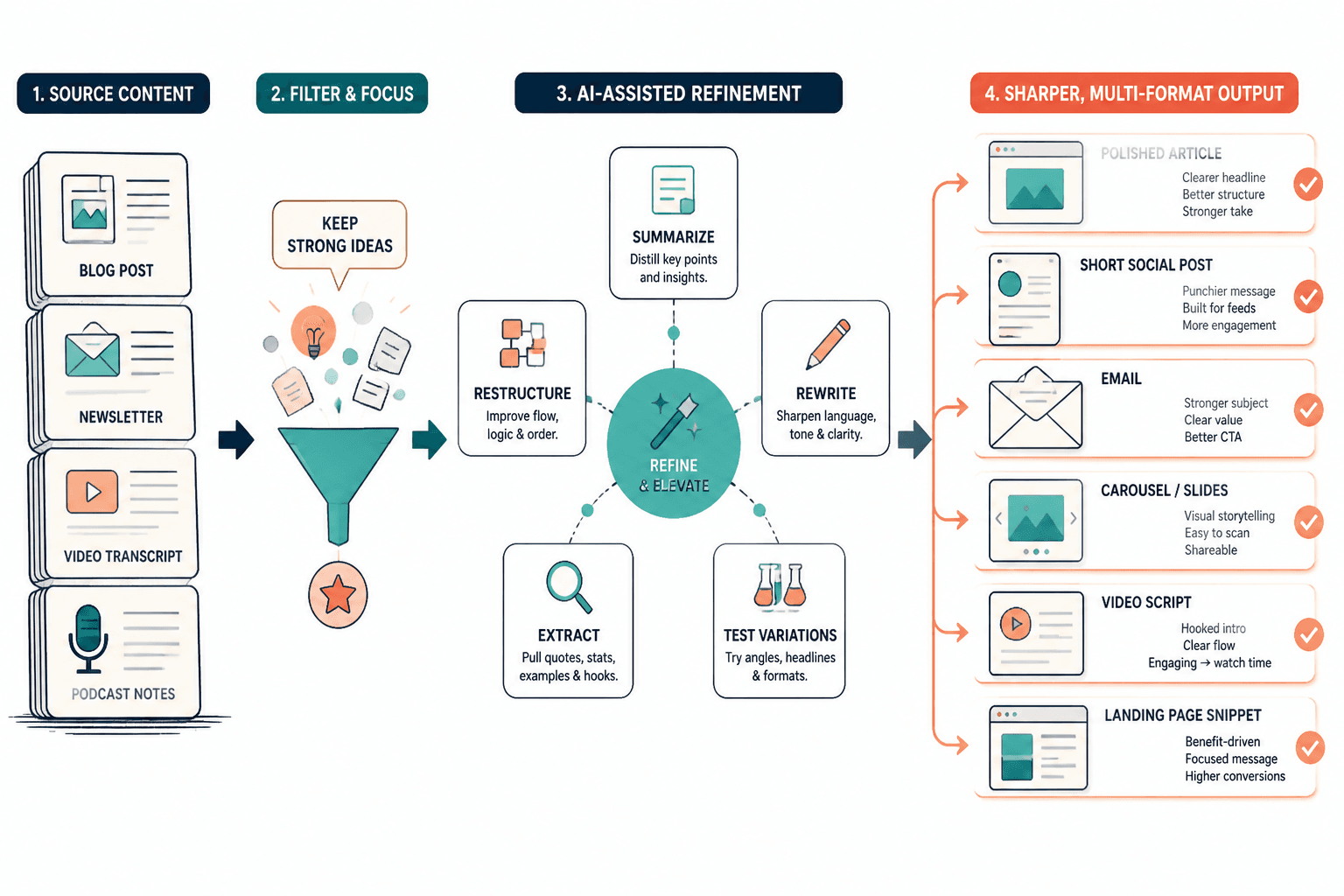
Start by choosing the right old content
Not every old post deserves a second life. Some of it was mediocre the first time. Some of it was timely but is now stale. Some of it got attention for the wrong reason. You do not need to preserve all of it like a museum curator for half-finished thought leadership.
Start with content that has at least one of these qualities:
- It performed well with the right audience
- It explained a core problem you solve
- It led to inquiries, calls, email signups, or useful conversations
- It contains a strong opinion, framework, story, or lesson
- It is still relevant and not tied to outdated platform noise
- It almost worked, but the hook, format, or structure was weak
A quick content audit filter
Before repurposing anything, run it through this short filter:
- What is the actual point?
- Who is this useful for?
- What proof, example, or angle makes it credible?
- What format would serve this idea better now?
- What needs rewriting because it sounds bland, dated, or AI-generated?
If you cannot answer those quickly, the content may not need repurposing. It may need burial.
Use AI to extract the real idea, not just summarize the post
This is where a lot of creator AI editing and repurposing goes sideways.
People dump a post into AI and ask it to “repurpose this into 10 social posts.” AI obediently produces 10 slightly different versions of the same vague thing. Technically efficient. Strategically useless.
Instead, use AI to identify the building blocks inside the original content. You want extraction before generation.
Ask AI for these pieces first
- The main claim or argument
- The audience problem being addressed
- The strongest quote or line worth reusing
- The practical takeaway
- Any examples, stories, or proof points
- Possible alternate angles for different formats
- What feels vague, repetitive, or weak
That gives you something more useful than a bland summary. It gives you raw material.
For example, if an old LinkedIn post was about why most creators post useful tips that nobody remembers, AI should help you identify the stronger sub-ideas hiding inside it:
- Useful content often lacks a distinct angle
- Memory comes from contrast and specificity
- Bland advice is usually a packaging problem, not an expertise problem
- Repurposing should emphasize what made the idea sticky
Now you have four possible assets instead of one weakly cloned post.
Turn one old asset into multiple stronger formats
The best repurposing is not copy-paste with minor makeup. It is format translation.
A good email may become a sharp LinkedIn post, a deeper article section, a short X thread, a Facebook discussion starter, a lead magnet talking point, or a sales page FAQ answer. Same idea. Different job.
That matters because formats carry different expectations. A thoughtful article can go broader and deeper. A LinkedIn post needs a stronger front door. An X post needs compression. A sales asset needs clearer proof and next steps.
Simple repurposing map
| Original content | Best repurpose options | What to change |
|---|---|---|
| Long article | LinkedIn post, X thread, email, carousel outline | Cut filler, isolate one point, tighten the opening |
| LinkedIn post | Article section, email intro, short video script | Add proof, examples, and structure |
| Sales call notes | Problem-focused post, FAQ content, lead magnet ideas | Translate client language into clearer teaching |
| Newsletter | Thread, post series, article draft, CTA sequence | Break one big idea into distinct angles |
| Podcast transcript | Quote posts, article draft, story post, email | Clean rambling speech and rebuild flow |
If you want a broader foundation for this process, the creator AI editing and repurposing hub is the right place to keep open while building your workflow.
What AI should actually help with in repurposing
AI is useful in repurposing when the task is mechanical, structural, or exploratory. It is much less useful when the task requires taste, positioning, or audience intimacy you have not supplied.
Good uses of AI in creator editing and repurposing
- Extracting themes from old posts, emails, transcripts, or articles
- Grouping similar ideas into content clusters
- Rewriting weak hooks in multiple styles
- Turning long content into shorter drafts by format
- Pulling quotes, steps, frameworks, and objections from source material
- Cleaning rough transcripts into usable text
- Creating first-pass variations for CTAs, intros, and headlines
- Identifying repeated filler phrases or vague language
Bad uses of AI in creator editing and repurposing
- Asking it to invent authority you do not have
- Using generic prompts with no audience context
- Publishing first drafts untouched
- Trusting it to preserve nuance without review
- Turning every asset into the same polished beige voice
- Mass-producing content with no strategic goal
If your repurposed content sounds smoother but less true, AI did not help. It just ironed the life out of it.
A practical workflow for How to Turn Old Content Into Better Creator AI Editing and Repurposing
Here is a workflow that is simple enough to repeat and strong enough to produce content worth publishing.
1. Build a small archive, not a content graveyard
Collect your old assets in one place. Posts, newsletters, article drafts, transcripts, webinar notes, comment threads, sales call notes, even voice memos if they contain real ideas.
Tag them by:
- Topic
- Audience problem
- Format
- Performance
- Offer relevance
- Stage of buyer journey
You do not need a cinematic workspace. A spreadsheet, notes database, or simple doc system is enough if you can find things later.
2. Pick one strong source piece
Choose one asset with proven relevance. Not three. Not your whole library. One.
This keeps the process focused and makes it easier to judge whether the repurposed outputs are actually better.
3. Extract reusable assets with AI
Use AI to pull out:
- Main insight
- Sub-points
- Examples
- Strong phrases
- Objections
- Questions the content answers
- Potential CTA angles
Think of this like separating ingredients before cooking. You are making the next steps much less messy.
4. Match each idea to a format with a job
Do not create five assets just because you can. Create assets with different jobs.
- One post for attention
- One article section for authority
- One email for nurture
- One FAQ answer for conversion
- One short post for testing angle strength
This is also where repurposing starts connecting to leads and sales, not just output volume. If you want that side of the system more clearly mapped, read how to turn creator AI editing and repurposing into more leads or sales.
5. Rewrite for the platform instead of pasting the source
This is where actual quality happens.
A LinkedIn post needs a clean first line, quick context, and a point with teeth. An article needs stronger structure and more proof. A thread needs momentum. A Facebook post needs more conversation energy and less polished lecture mode.
If your repurposed asset still sounds like the original format wearing a fake mustache, rewrite harder.
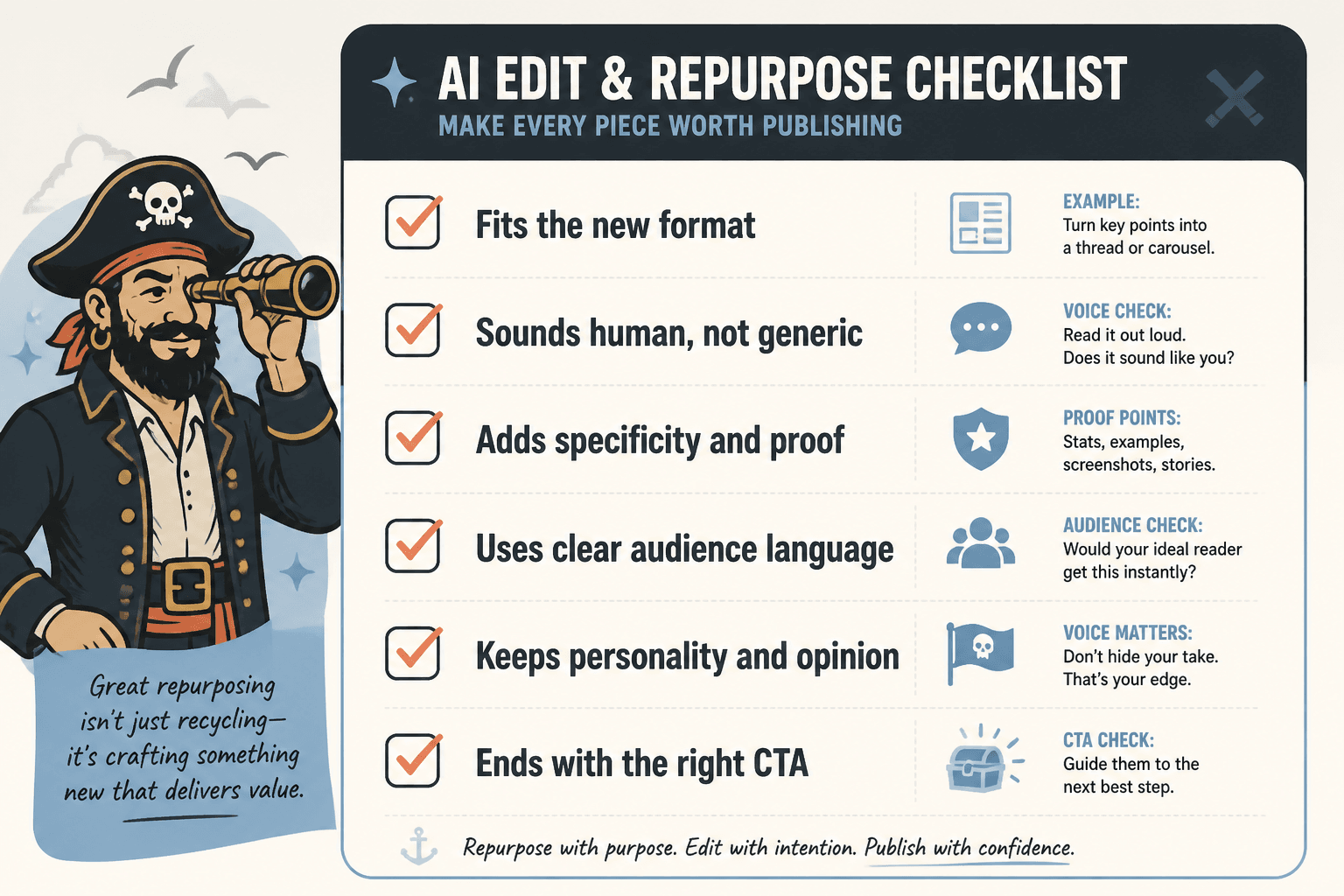
6. Add specificity, proof, and personality back in
AI usually strips this stuff out unless you deliberately put it back.
Add:
- Concrete examples
- Clearer audience language
- More precise claims
- Small opinionated edges
- Relevant proof or outcomes
- A CTA that fits the format and trust level
This is often the difference between “pretty solid” and “worth publishing.”
Before and after: what better repurposing actually looks like
Example 1: old article paragraph to LinkedIn post
Before: Many creators struggle to remain consistent with content production because they often feel pressure to constantly generate new ideas. Repurposing previous content can help reduce this burden and improve efficiency.
After: Most creators are not inconsistent because they lack ideas. They are inconsistent because they keep starting from zero.
Your old content is full of usable raw material:
hooks
examples
objections
proof
half-finished angles
The fix is not “be more creative.”
It is building a repurposing habit that turns good buried ideas into better new assets.
Same point. Much better packaging.
Example 2: newsletter to X thread
Say your newsletter covered why AI-generated content sounds generic.
Instead of asking AI to “make a thread,” extract 5 tighter points:
- AI defaults to average language
- Generic prompts create generic output
- Specific source material improves voice
- Editing matters more than drafting
- Repurposing works best when the original idea had a real edge
Now the thread has structure. It can move. It has a reason to exist.
Example 3: sales call notes to authority content
If clients keep saying, “I know what I do is valuable, but my content sounds like everyone else,” that is not just sales context. That is content fuel.
AI can help turn repeated client language into:
- A LinkedIn post about why useful content gets ignored
- An article section on vague positioning
- A bio rewrite checklist
- A lead magnet section about fixing bland messaging
Some of your best repurposing material is hiding in conversations, not published posts.
Common mistakes that make repurposed content worse
Repurposing saves time only if the output is still good. Here is what usually wrecks it.
1. Repurposing weak content instead of strong ideas
If the original point was vague, AI will not rescue it. It will just produce cleaner vagueness.
2. Keeping the original structure when the format changed
An article paragraph pasted into LinkedIn usually reads like someone trapped a blog post in a social feed.
3. Removing all the friction
Not every sentence needs to be smooth. Some sharpness is good. Some tension is memorable. If AI makes everything too polite, your content gets forgettable fast.
4. Chasing volume over usefulness
Ten mediocre assets are not better than two strong ones. They are just more things to regret scheduling.
5. Forgetting the business goal
Repurposing should support attention, trust, authority, leads, or sales. If it is not helping one of those, you are mostly reorganizing words for sport.
If you need help improving flat source material before you repurpose it, how to rewrite boring creator AI editing and repurposing is a useful next read.
How to make your repurposed content sound like you again
This part matters more than people think.
The more you use AI to edit and repurpose, the more tempting it becomes to accept clean, generic phrasing because it is fast. But creators do not build trust through grammatical competence alone. They build it through pattern, taste, point of view, clarity, and a voice people can recognize after a few lines.
That means your final pass should sound less like “polished AI content” and more like you on a sharp day.
A few practical ways to do that:
- Keep phrases you naturally use
- Cut corporate filler and generic transitions
- Restore your actual opinions where AI softened them
- Use examples from your work, clients, audience, or process
- Read the draft aloud and fix anything that sounds oddly formal or fake-wise
If you want a more complete framework for getting better outputs from this whole category, creator AI editing and repurposing guide for creators who want better results pairs well with this article.
Format shifts that usually improve old content fast
The bigger point is simple: clearer structure and clearer writing make the piece more useful. That is usually what makes the ending land better too.
The bigger point is simple: clearer structure and clearer writing make the piece more useful. That is usually what makes the ending land better too.