
Most creators use AI research and ideation backwards.
They ask the tool to come up with fresh ideas from scratch, then wonder why the result feels generic, repetitive, or weirdly disconnected from what they actually know. The tool is not the problem. The input is. If you feed it blankness, it gives you polished blankness right back.
If you want better creator AI research and ideation, your old content is not dead weight. It is the raw material. Past posts, newsletters, threads, captions, sales pages, client notes, podcast transcripts, workshop outlines, and even half-finished drafts can become much better fuel for finding patterns, extracting stronger angles, and generating ideas that still sound like you.
That is the real move here: stop treating AI like a slot machine for content ideas and start using it like a pattern finder with a very fast highlighter.
This article will show you how to turn old content into better creator AI research and ideation without drowning in your archive or outsourcing your taste to a chatbot with suspicious confidence.
For the full path around this topic, head to the parent guide.
Why old content works better than cold prompts
Old content gives AI context. Context is where the quality lives.
When you use your existing content as source material, you give the model access to your recurring themes, real language, useful examples, audience pain points, strongest opinions, and the questions people actually respond to. That is much more valuable than typing something like, “Give me 25 content ideas for personal branding.”
One of those approaches is grounded in evidence. The other is content roulette.
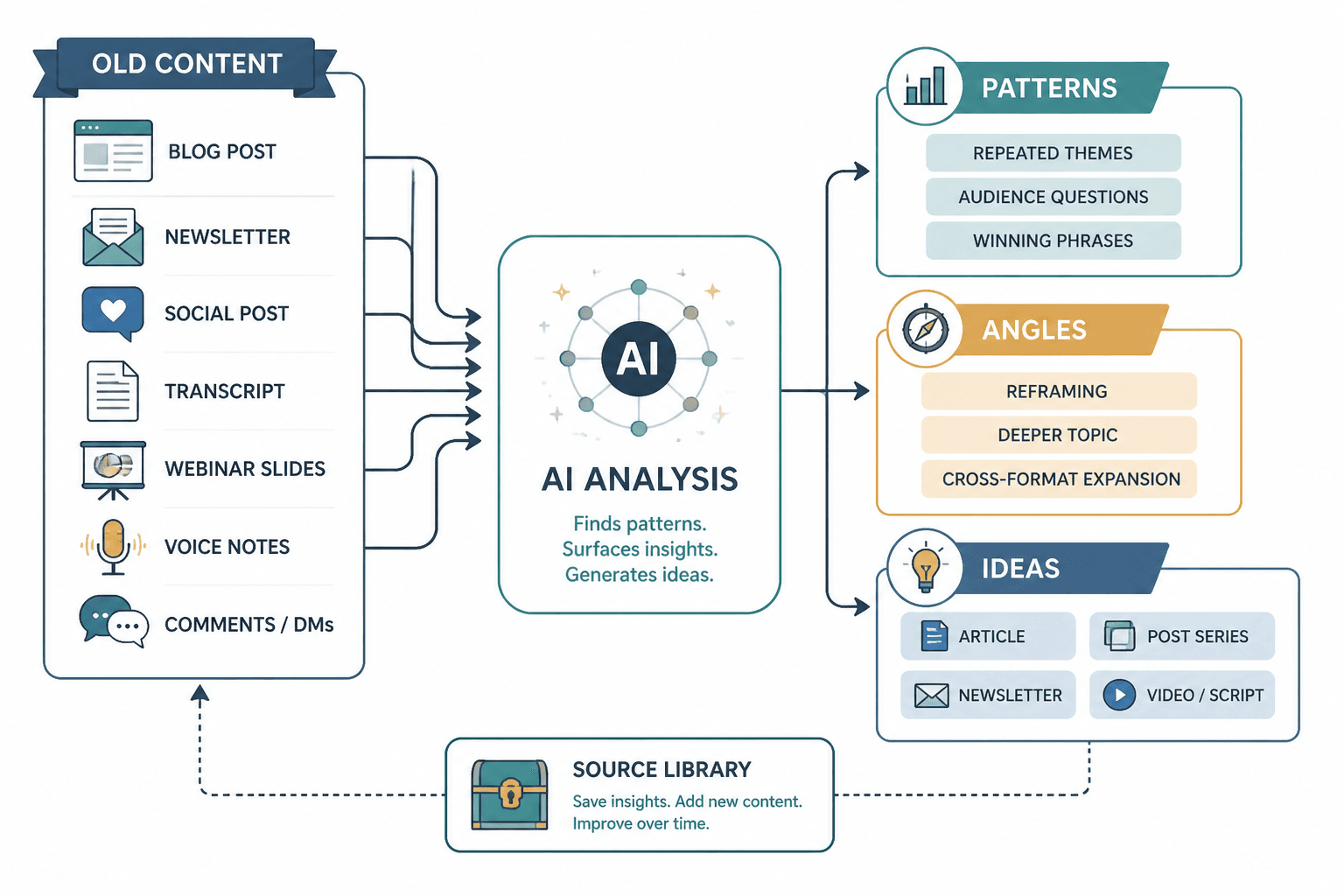
Old content is especially useful because it helps AI identify things you often miss when you are too close to your own work:
- Patterns in what you keep teaching
- Topics you mention casually but should develop more deeply
- Ideas that performed well in one format but were never expanded
- Repeated audience objections and questions
- Sharp phrases worth reusing
- Weak spots where your ideas are too broad or too safe
If you are building a repeatable system, it helps to understand the broader category too. The bigger picture lives in AI writing tools and workflows, and more specifically inside creator AI workflows and this hub on creator AI research and ideation.
What counts as old content
More than you think.
People hear “old content” and picture published blog posts from two years ago. Sure, that counts. But some of your best research inputs are messier than that. You are not building a museum. You are building a source library.
- LinkedIn posts, X posts, Facebook posts, and captions
- Newsletters and email sequences
- Blog posts and articles
- Sales pages and offer descriptions
- Client call notes and coaching transcripts
- Podcast transcripts or video transcripts
- Workshop decks and webinar notes
- Comment sections and DM screenshots you are allowed to use
- Voice notes, rough drafts, and idea documents
- Frequently asked questions from leads or clients
The less polished material is often the best. Why? Because it captures your real phrasing, real objections, and real specificity before you cleaned it up into “content.” Raw material tends to be more honest. AI can do a lot with honest.
How to turn old content into better creator AI research and ideation
Here is the practical process. It is not complicated, but it does work better when you stop trying to do everything in one giant prompt.
1. Gather a focused content set
Do not dump your entire internet history into a tool and pray. Pick a useful batch.
A good starting set usually has 10 to 30 pieces around a common theme, audience, or offer. For example:
- 20 posts about content strategy
- 10 newsletters sent to coaches
- 15 client call transcripts from the same service
- 1 sales page plus 12 related posts and 20 audience questions
Focused inputs produce cleaner outputs. If you mix five unrelated topics, three audiences, and two years of changing opinions, the model will give you a blended soup of all of it. Soup is lovely at lunch. It is not great for positioning.
2. Organize by source type or goal
Before you prompt anything, lightly sort your material. You do not need a giant content database with color-coded tags and a Notion dashboard that ate your weekend. A simple structure is enough.
Group your content by one of these:
- Topic: content strategy, lead generation, creator workflows, messaging
- Audience: coaches, founders, freelancers, consultants
- Stage: awareness, trust, consideration, sales
- Format: posts, articles, calls, emails, comments
- Goal: idea generation, offer research, objection mining, repurposing
This matters because your prompts get sharper when your source material is intentionally grouped. You are not asking AI for “ideas.” You are asking it to analyze a specific body of work for a specific reason.
3. Extract patterns before asking for new ideas
This is where most people mess it up. They upload content and immediately ask, “Give me 50 new post ideas.” Too early.
First, make the tool earn its keep by finding patterns in the material you already gave it.
Ask for things like:
- Repeated themes across the content
- Frequently mentioned pain points
- Ideas that appear strong but underdeveloped
- Distinct opinions or contrarian angles
- Questions implied by the content but not directly answered
- Audience sophistication level
- Language patterns and signature phrasing
- Gaps in explanation, examples, or proof
You are trying to map your existing intellectual territory first. Then you can expand it. That one shift makes AI research and ideation far more useful because the new ideas are anchored in something real.
4. Turn patterns into angle buckets
Once the patterns are visible, sort them into angle buckets. This gives you an actual ideation system instead of an ever-growing note pile.
Common angle buckets include:
- Myths you keep correcting
- Mistakes your audience keeps making
- Simple frameworks you repeat often
- Strong opinions you can defend
- Tactical how-to topics
- Case-study style lessons
- Objections blocking people from buying
- Behind-the-scenes process breakdowns
Once your old content is sorted this way, ideation gets faster and better. Instead of asking for “content ideas,” you can ask for “10 strong post angles from the myths bucket for skeptical consultants who think AI makes content sound generic.” That is a proper prompt. It has bones.
If your prompts are still too fluffy, it is worth improving the question quality itself. That is exactly where better creator AI research and ideation question gathering for personal brands becomes useful.
5. Ask for research, not just ideas
Better creator AI research and ideation is not just about generating headlines. It is also about helping you understand what your audience needs, what your content already covers well, and where your next useful angle lives.
Once your old content is loaded and patterns are clear, ask AI to help with research tasks like:
- Identify unanswered audience questions
- Surface objections that appear across sales and content material
- Compare your messaging across formats for consistency
- Find claims that need examples or proof
- Spot topics you mention often but never fully explain
- Separate beginner-level content from advanced-level content
- Suggest adjacent topics your archive naturally points toward
This is where AI starts acting less like a lazy intern and more like a fast research assistant. Not perfect. Still occasionally strange. But useful.
6. Generate ideas from gaps, not randomness
Now you can generate new ideas. But the best ones come from identified gaps.
For example, if your archive shows that you often mention “clarity beats volume” but never explain how to audit unclear content, that gap can produce:
- A post on signs your content is clear to you but confusing to readers
- An article on content clarity audits
- A thread breaking down vague messaging rewrites
- A lead magnet checklist
- A sales email tied to your messaging offer
That is much stronger than asking for 25 random ideas in your niche. Randomness feels productive because the list is long. It usually is not.
A simple prompt flow that actually works
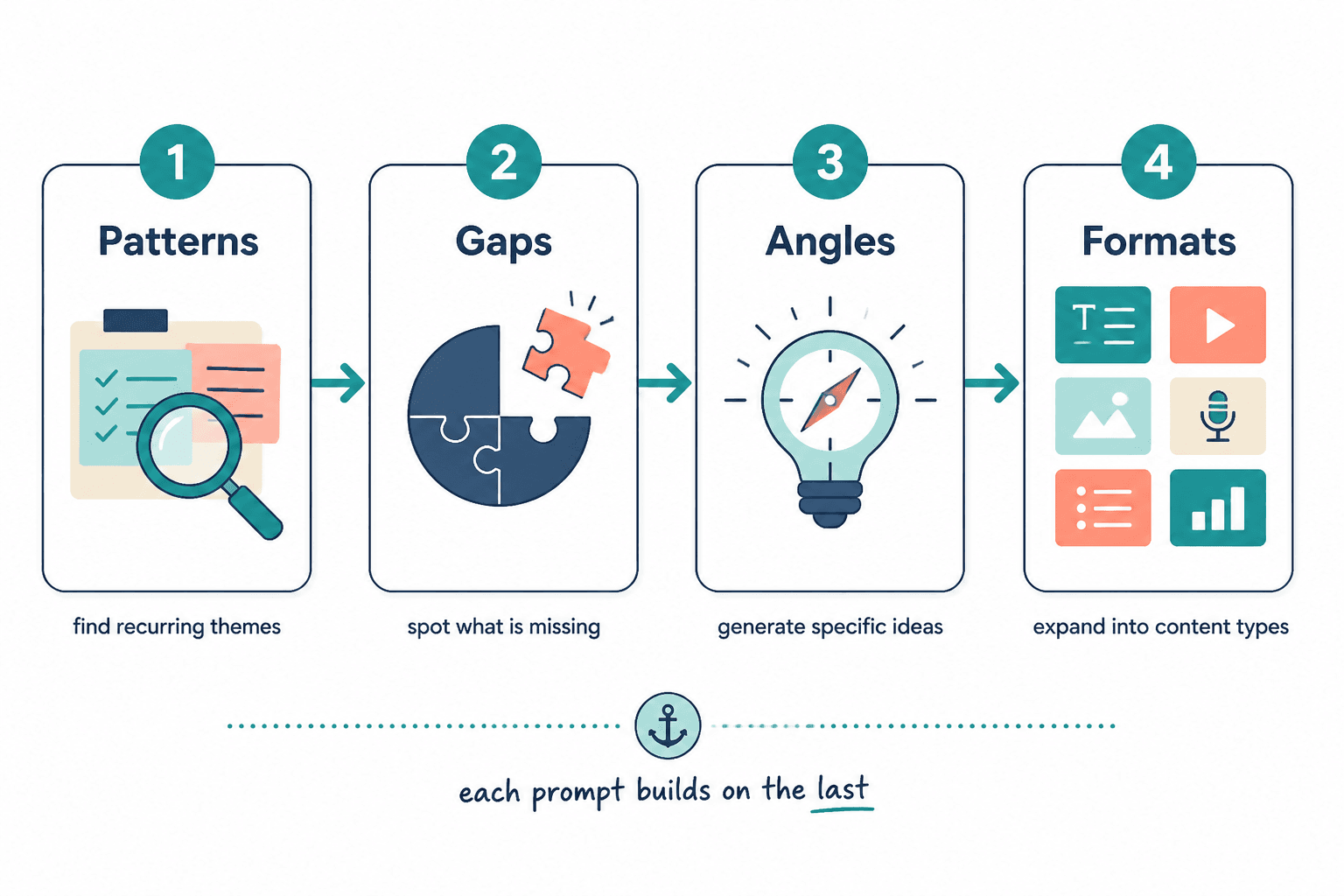
You do not need one massive master prompt with 19 instructions and a personality profile taped to it. A short sequence works better.
Prompt 1: Pattern extraction
Analyze this content set and identify the recurring themes, audience pain points, repeated claims, useful phrases, and topics that appear important but underdeveloped. Organize the output into clear categories and cite examples from the material.
Prompt 2: Gap analysis
Based on these patterns, identify the biggest content gaps. Focus on questions left unanswered, ideas mentioned but not fully explained, objections not addressed, and topics that could be expanded into stronger educational or conversion-focused content.
Prompt 3: Angle generation
Generate 15 content angles based on the gaps above. Keep them specific, practical, and aligned with this audience. Avoid generic topics. For each angle, explain why it matters and what type of content format would suit it best.
Prompt 4: Format expansion
Take the strongest 5 angles and turn each into: one short social post, one long-form article idea, one lead magnet concept, and one soft-sell content idea connected to a relevant offer.
This sequence works because each prompt builds on the last one. That sounds obvious, but many people skip straight to output mode and then act surprised when the output is shallow.
How to clean old content before feeding it into AI
You do not need to scrub every sentence. But a little cleanup helps.
- Remove duplicated sections if possible
- Label the source type if it matters
- Keep related pieces together
- Add light notes on audience or goal
- Strip out irrelevant chatter if the transcript is messy
- Flag high-performing content if you know what resonated
If something is boring, vague, or badly written, do not assume AI will somehow alchemize it into brilliance. It may extract a useful pattern from weak material, but the quality ceiling is still shaped by the input. If your archive is full of generic content, one smart move is to improve the source material first. That is where how to rewrite boring creator AI research and ideation can help.
What AI can help with here, and what it cannot
It helps to stay realistic.
What AI is good at
- Summarizing large amounts of content quickly
- Spotting repeated themes and phrases
- Grouping ideas into categories
- Suggesting expansions, angles, and spin-offs
- Turning one idea into multiple formats
- Surfacing likely audience questions and objections
- Helping you build a reusable research workflow
What AI is not good at
- Knowing which ideas are truly worth your brand
- Understanding your audience better than you do
- Creating originality from empty source material
- Replacing editorial judgment
- Knowing which opinions you can actually defend
- Magically making dull positioning interesting
That last one matters. A lot of creators use AI to avoid doing the hard thinking. Then they blame the tool for sounding bland. But bland in, bland out is still the rule. Just faster.
Best source combinations for stronger ideation
Some content pairings are especially useful because they combine what you say with how people respond.
| Source combination | What it helps uncover |
|---|---|
| Posts + comments | Which ideas create discussion, confusion, or pushback |
| Newsletter + sales page | Gaps between teaching and conversion messaging |
| Client calls + published content | What you explain well privately but underuse publicly |
| Workshop transcript + follow-up questions | Topics worth expanding into articles or offers |
| Old threads + current offer | Repurposing angles tied to present business goals |
| FAQ notes + content archive | High-value educational topics and objection handling |
This is also where ideation can stop being just an audience-growth exercise and start serving the business. If you want that bridge, read how to turn creator AI research and ideation into more leads or sales.
Common mistakes that make this process worse
- Uploading everything at once: More data is not always more useful. Messy in, messy out.
- Asking for ideas too early: Extract patterns first or you will get generic filler.
- Ignoring source quality: Weak content limits strong ideation.
- Using no business context: Great ideas that do not fit your audience or offer are still not great.
- Keeping prompts vague: “Give me better ideas” is not a serious instruction.
- Accepting the first output: The first pass is usually a draft, not a verdict.
- Confusing volume with insight: Fifty mediocre ideas are not better than five sharp ones.
A quieter problem is that some creators only feed AI their top-of-funnel public content. That means the model sees your polished teaching but misses the richer material from sales calls, objections, FAQs, and service delivery. Often, the best ideas are hiding in the places where people get specific.
A lightweight weekly workflow
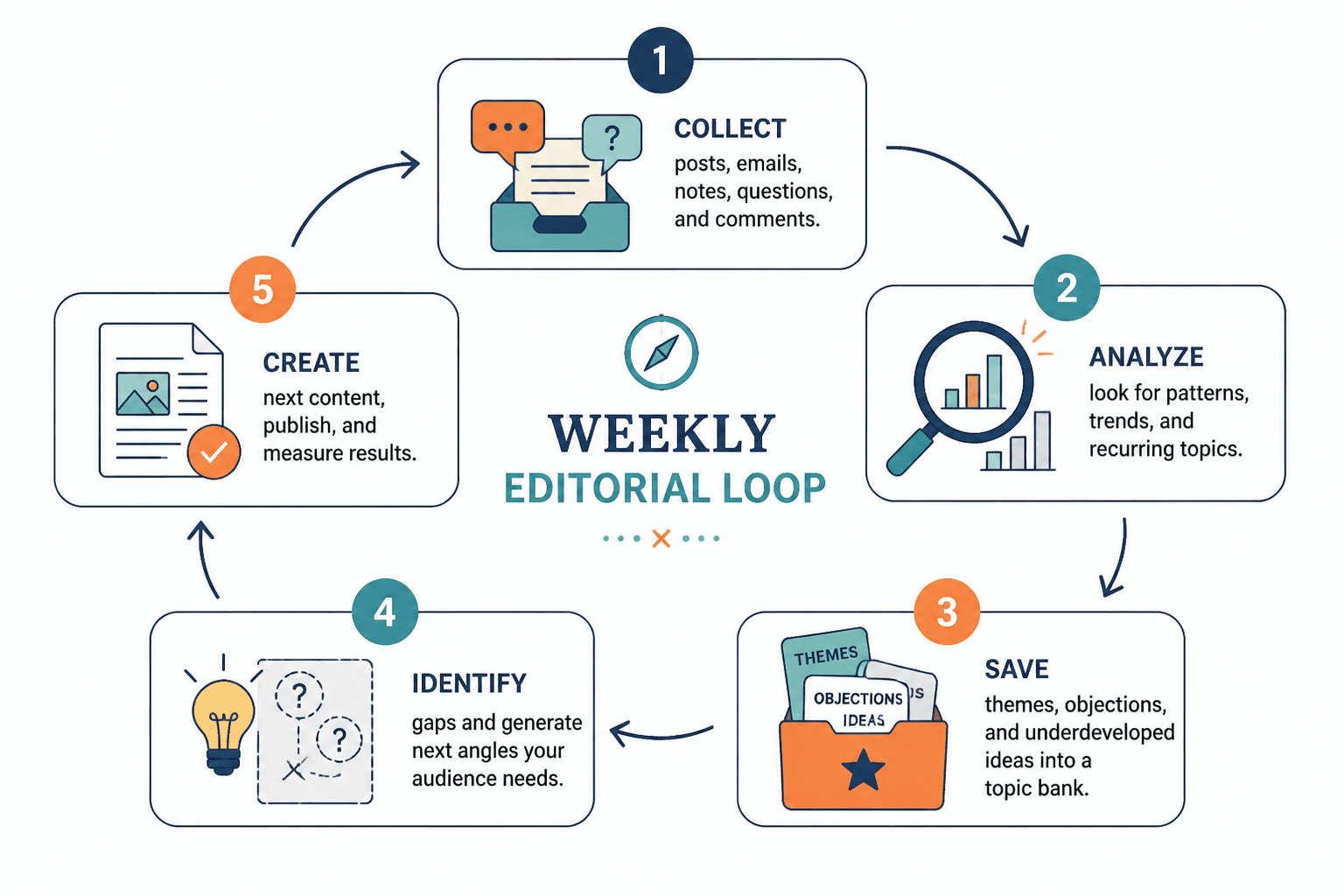
If you want to keep this useful without turning it into a whole department, use a weekly loop.
- Collect that week’s posts, emails, notes, questions, and comments.
- Add them to a topic-based content bank.
- Run a quick pattern analysis at the end of the week or month.
- Save recurring themes, objections, and underdeveloped ideas.
- Generate a short list of next angles from those gaps.
- Pick only the ideas that fit your current audience and offers.
That is enough. You do not need a baroque content operating system. You need a habit of feeding your best raw material back into the machine in a structured way.
If you want a stronger foundation for that system, this creator AI research and ideation guide for creators who want better results is the next sensible step.
How to tell if your old content is producing better ideas
The test is not “did AI give me a lot of suggestions.” The test is whether the suggestions are more usable.
You are on the right track if the outputs start doing a few things:
- Sound more like your real expertise
- Use language your audience actually uses
- Reveal patterns you had not named clearly before
- Connect naturally to offers, services, or next steps
- Create sharper distinctions between beginner and advanced content
- Make repurposing easier because the angle is clearer
The bigger point is simple: clearer structure and clearer writing make the piece more useful. That is usually what makes the ending land better too.