
Most people using AI for content research and ideation are not actually researching. They are asking for “50 post ideas,” getting a pile of stale oatmeal, and pretending volume is strategy.
That is how you end up with content that sounds polished, generic, and weirdly disconnected from what your audience actually cares about. The tool is not the problem. The lazy prompting is. Also the habit of treating AI like a vending machine for instant authority.
Creator AI Research and Ideation Examples for Coaches, Consultants, and Personal Brands matter because AI can be genuinely useful here, but only if you use it to sharpen your thinking instead of replacing it. Used well, it helps you spot patterns, organize ideas, find angles, and turn messy expertise into publishable content. Used badly, it gives you 37 interchangeable hooks about mindset.
This article will show you practical ways to use AI for research and ideation without losing your voice, your positioning, or your standards. You will get prompt examples, workflows, and use cases built for coaches, consultants, and personal brands who want better ideas, not just more of them.
If you want the bigger picture, start with the parent guide.
What AI research and ideation should actually do for a creator
Good creator research is not just collecting facts. It is finding the tension, language, objections, examples, and recurring questions that make content land.
Good ideation is not “give me content ideas.” It is more like this:
- Find what your audience keeps worrying about
- Identify what they misunderstand
- Spot where your opinion differs from common advice
- Turn one useful insight into several angles
- Match ideas to formats like posts, threads, articles, emails, and lead magnets
- Keep your content focused on problems that actually connect to your offers
If AI is not helping you do those things, it is probably just helping you procrastinate with better formatting.
For a broader workflow, you can pair this article with the creator AI research and ideation hub and the more complete guide for creators who want better results.
The core mistake: asking AI for answers before you give it context
AI gets dramatically better when you stop prompting like a distracted intern manager.
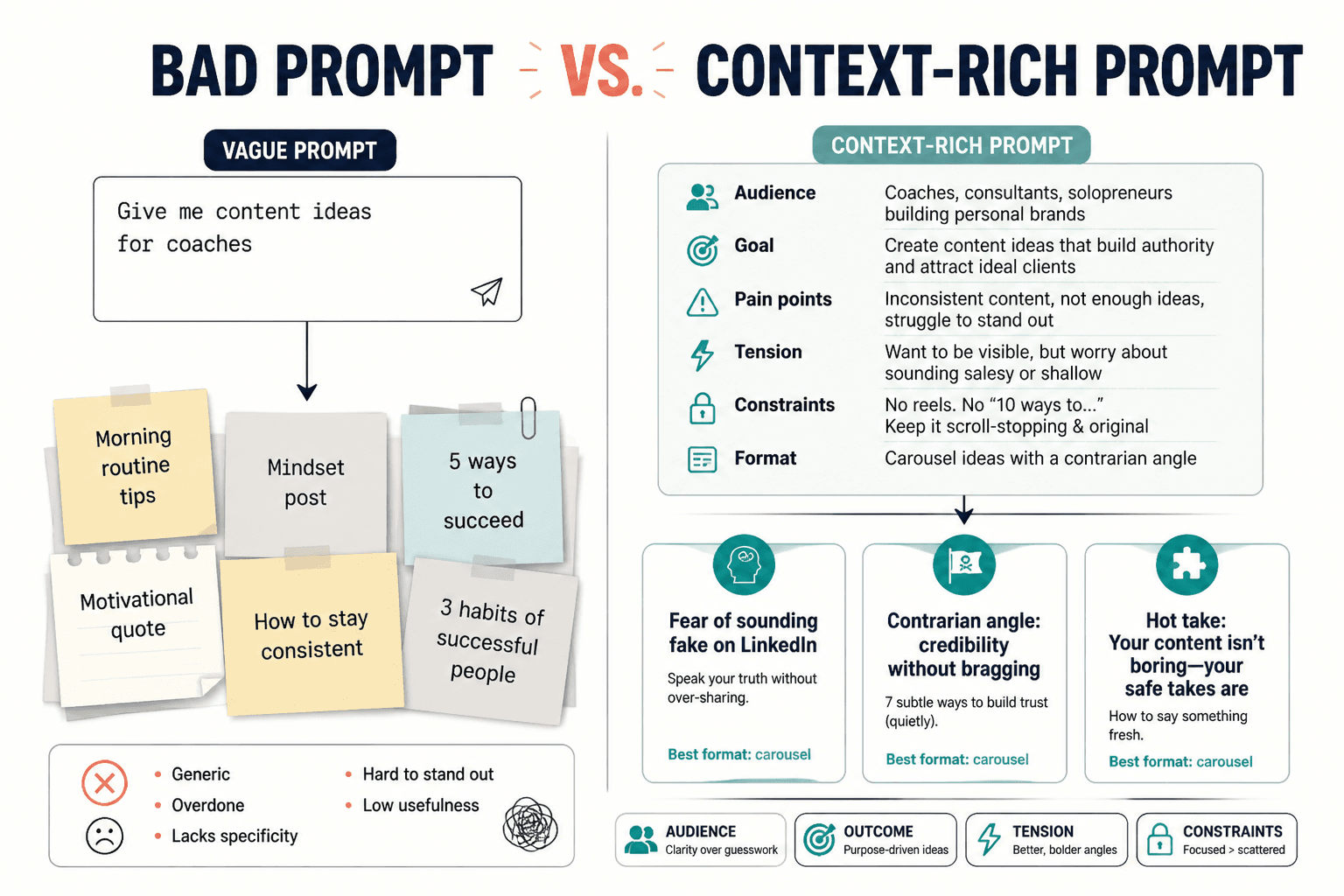
Bad prompt:
Give me 25 content ideas for my coaching business.
That will usually produce broad, obvious topics with no edge, no audience fit, and no sense of what makes your perspective different.
Better prompt:
I am a career coach for mid-career professionals trying to move into better-paying leadership roles without sounding fake in interviews or on LinkedIn. My audience struggles with self-promotion, visibility, and positioning. Generate 15 content ideas based on their fears, bad advice they keep hearing, and mistakes they make when trying to look more credible online. For each idea, include the audience pain point, a contrarian angle, and the best format.
Now the tool has something to work with. You gave it audience, outcome, tension, and constraints. That is usually the difference between generic sludge and usable raw material.
If your prompts still feel vague, read better creator AI research and ideation question gathering for personal brands. Better inputs fix a lot.
A simple AI research and ideation workflow that does not wreck your voice
Here is a clean workflow for using AI without handing it the keys to your brain.
1. Start with real audience signals
Feed AI things your audience has actually said or done:
- Client questions
- Discovery call notes
- Sales objections
- Comments and DMs
- FAQs from your website
- Past posts that got strong responses
- Podcast or interview transcripts
This step matters because AI is much better at analyzing and expanding than inventing something deeply audience-aware from thin air.
2. Ask AI to find patterns, not final copy
Before asking for content ideas, ask for:
- Recurring themes
- Repeated frustrations
- Misconceptions
- Emotional language
- Decision triggers
- Gaps between what people say they want and what they actually do
This gives you better strategic material than jumping straight to captions.
3. Turn patterns into angles
Once you have patterns, ask for multiple content angles around each one:
- Contrarian take
- Common mistake
- Myth vs reality
- Step-by-step teaching
- Case study angle
- Story angle
- Quick checklist
4. Choose what fits your brand and offer
Not every decent idea belongs in your content plan. Some ideas are interesting but irrelevant to what you sell. Others attract people who will clap politely and never buy anything.
That is why you still need judgment. AI can help you generate options. It cannot decide what is strategically smart for your business.
5. Rewrite in your actual voice
Use AI for the bones. You add the muscle, scars, standards, and point of view.
If a sentence sounds like it belongs in a beige corporate carousel, cut it. Ruthlessly.
Creator AI research and ideation examples by business type
Now for the useful part: actual examples. These are not magic prompts. They are starting points you can adapt.
Example 1: Career coach researching audience fears
Use case: You help professionals improve positioning, job-search visibility, and interview confidence.
Prompt:
Analyze this list of client questions and discovery call notes. Group them into recurring fears, hidden motivations, and common mistakes. Then suggest 10 content ideas for LinkedIn posts that address those issues with a practical, credibility-focused tone. Avoid generic motivation and focus on career positioning, communication, and trust-building.
Why it works: It asks AI to synthesize real inputs first, then ideate from those patterns. Much better than “write LinkedIn posts for job seekers.”
Potential outputs:
- Why “just be confident” is terrible interview advice
- The difference between sounding accomplished and sounding rehearsed
- How underexplaining your wins quietly wrecks your credibility
- What hiring managers actually trust on LinkedIn profiles
Example 2: Business consultant finding contrarian angles
Use case: You help service businesses fix messy operations and improve profitability.
Prompt:
I help small service businesses improve profit by fixing operations, pricing, and delivery systems. My audience hears bad advice about scaling, hiring, and automation. Generate 20 content angles that challenge popular but unhelpful business advice. For each angle, include the bad advice, why it sounds appealing, why it fails in practice, and a sharper alternative.
Why it works: Contrarian content gets stronger when it has structure. This prompt forces the tool to go past vague disagreement and build a usable argument.
Potential outputs:
- Why “hire before you are ready” is expensive nonsense for many small firms
- Why automation is not a personality trait and will not save a broken service model
- Why some businesses do not need more leads, they need fewer delivery bottlenecks
Example 3: Personal brand creator turning one topic into a month of content
Use case: You help creators build authority content and sell offers without sounding like a funnel goblin.
Prompt:
Take the topic “why useful content still gets ignored” and turn it into a 4-week content plan for a personal brand. Include short-form post ideas, one long-form article angle, one email angle, one client-story angle, and one soft CTA idea per week. Keep the tone sharp, practical, and trust-focused.
Why it works: Instead of asking for random ideas, it asks for structured repurposing around a strategic theme.
That is one of the best uses of AI for creators. Not invention from nothing. Expansion with coherence.
Example 4: Executive coach using AI to identify language patterns
Use case: You help senior leaders communicate with more clarity and authority.
Prompt:
Review these 30 comments and client questions from senior leaders. Extract the exact phrases they use when describing communication problems, visibility concerns, and leadership tension. Then turn those phrases into 12 post hooks that feel natural, specific, and credible.
Why it works: Audience language is gold. AI can help you pull it out fast, which makes your hooks sound more like the reader and less like a content intern trying to sound wise.
Use AI to research questions, not just topics
Topics are too broad to be useful on their own.
“Personal branding” is a topic.
“Why smart consultants still look vague on LinkedIn” is a usable angle.
“What makes a consultant bio instantly more credible?” is an even better question.
One of the strongest ways to use AI is to generate question sets around your audience, offers, and content themes. Questions produce better content because they surface tension. They also help you escape bland educational posting.
Try prompts like these:
- Generate 25 questions my audience is likely asking before they hire someone like me, including the skeptical and unspoken ones.
- What questions would a consultant ask if they were frustrated that their content gets views but no inquiries?
- List 20 specific questions hidden inside the broad topic of thought leadership for coaches.
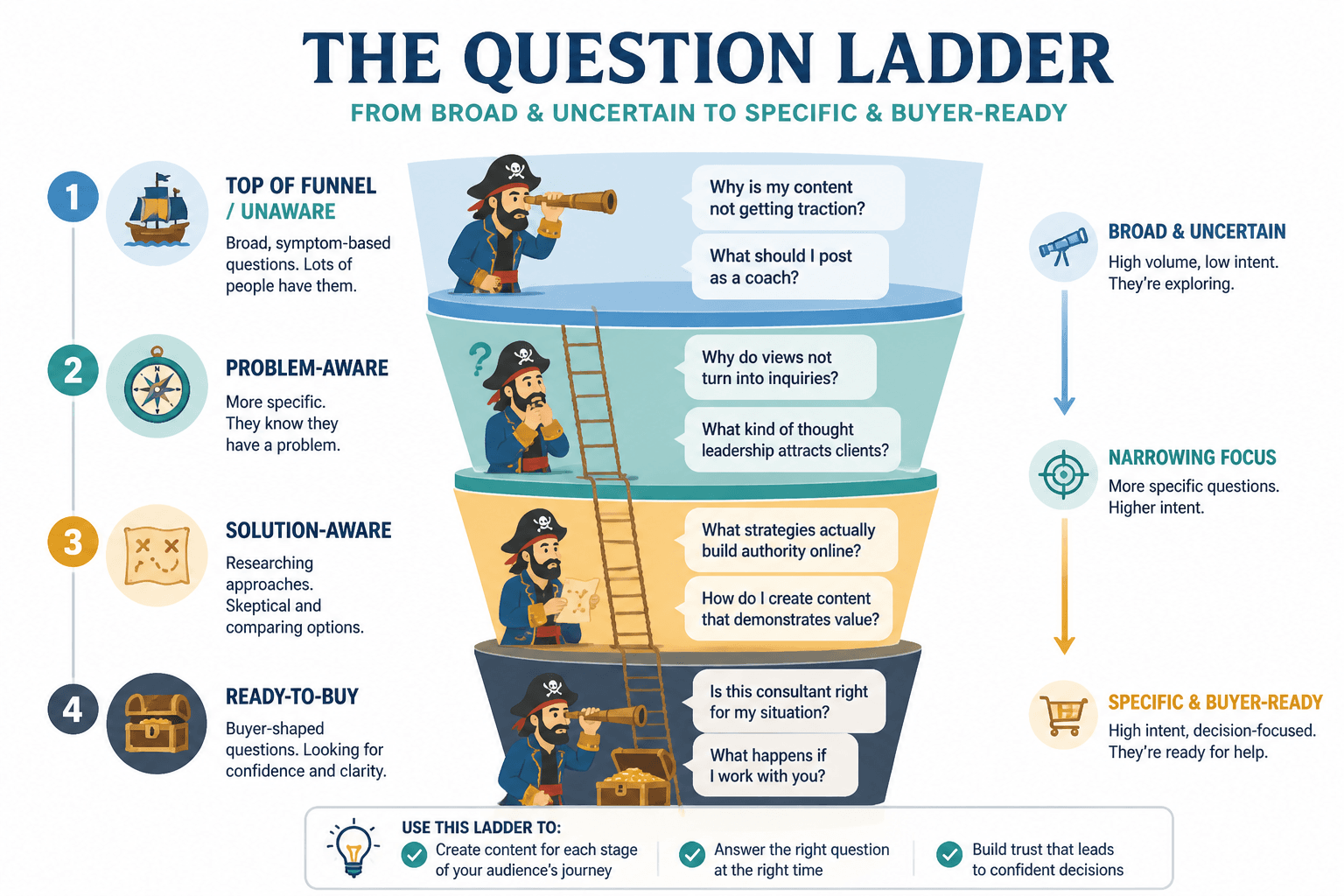
- Break this service offer into audience questions by awareness level: unaware, problem-aware, solution-aware, and ready-to-buy.
This is especially useful if you create content across a funnel. Top-of-funnel questions tend to be broad and symptom-based. Bottom-of-funnel questions are more specific, skeptical, and buyer-shaped.
If you want more help building better question sets, the article on question gathering for personal brands goes deeper on that part of the process.
How to turn AI research into strong content ideas
Once AI helps you surface themes, objections, and language, the next job is turning that material into angles people will actually read.
Here are a few reliable transforms.
Turn a fear into a myth-busting post
Research finding: “I do not want to sound self-promotional.”
Post angle: Why sounding clear about your work is not the same as sounding self-important.
Turn a repeated mistake into a checklist
Research finding: Clients keep writing vague bios.
Post angle: 5 things missing from most consultant bios that quietly cost them trust.
Turn audience language into a hook
Research finding: “I know what I do, I just cannot explain it simply.”
Post angle: If people keep saying “I’m not sure what you actually do,” your problem is probably not your expertise.
Turn a contradiction into a thread or article
Research finding: People want leads from content but avoid clear positioning.
Article angle: Why creators who want better clients often hide the exact thing that would make them easier to hire.
This is the part a lot of people skip. They gather inputs, maybe get a decent AI output, then publish it too quickly. Slow down long enough to ask: what is the sharpest, most useful version of this idea?
What AI is good at here, and what it absolutely is not
| Useful for | Not useful for |
|---|---|
| Grouping audience questions into themes | Inventing a differentiated brand voice from nothing |
| Expanding one idea into several content angles | Knowing which angle best fits your offer without context |
| Spotting repeated objections or language patterns | Replacing real market research |
| Summarizing transcripts, notes, and comments | Guaranteeing strategic quality |
| Helping you brainstorm hooks, structures, and variations | Making boring expertise interesting on its own |
| Organizing messy raw material faster | Giving you taste, judgment, or conviction |
This distinction matters. A lot of creators expect AI to do the high-value thinking and then wonder why the output feels hollow. Of course it does. The sharpest part of your content is usually the part that comes from your standards, your client pattern recognition, and your ability to call something clearly.
AI can assist the process. It cannot replace the reason anyone should listen to you in the first place.
Prompt templates you can actually reuse
Here are a few flexible prompt templates for Creator AI Research and Ideation Examples for Coaches, Consultants, and Personal Brands.
Template: analyze audience questions
Analyze these audience questions and group them into themes, emotional concerns, misconceptions, and buying triggers. Then suggest content angles for each group, including a post idea, article idea, and email idea.
Template: generate contrarian ideas
I help [audience] achieve [result]. List common advice in this space that sounds smart but often fails in practice. For each one, explain why it is appealing, where it breaks down, and what I could say instead in a useful content piece.
Template: create multi-format content from one insight
Take this idea: [insert idea]. Turn it into 10 content variations across LinkedIn posts, X posts, an article, a client email, and a lead magnet angle. Keep each version distinct, not repetitive.
Template: surface hidden objections
I sell [offer] to [audience]. List the obvious and unspoken objections they may have before buying. Then suggest content ideas that address those objections without sounding defensive or pushy.
Template: organize messy notes into useful themes
Here are rough notes from client conversations, comments, and call transcripts. Clean them up, identify the strongest recurring topics, and rank them by relevance to my offer, emotional intensity, and content potential.
If you want more idea formats beyond these, this examples article for creators is a useful next stop.
How to keep AI-generated ideas from sounding like everybody else
This part is important, because decent structure alone does not save bland thinking.
- Add your own opinion: What do you disagree with?
- Add proof: What have you seen with clients, buyers, or your own content?
- Add specificity: Which audience, which situation, which mistake?
- Add standards: What do you think people should stop doing?
- Add voice: What would you actually say out loud, not just in a polished doc?
A useful test: if another coach or consultant in your niche could post the exact same thing without changing much, the idea probably still needs your fingerprints on it.
And no, adding “authenticity” three times does not count as differentiation.
Choosing tools without getting weird about tools
You do not need a baroque stack of 14 apps to do good AI research and ideation. Usually you need:
- An AI assistant for analysis and ideation
- A place to store raw inputs like notes, transcripts, comments, and FAQs
- A simple system for organizing promising ideas by audience, offer, and format
That is enough for most creators. Maybe add a scheduler or writing workspace if your process needs it. But the stack should support thinking, not become a hobby.
The bigger point is simple: clearer structure and clearer writing make the piece more useful. That is usually what makes the ending land better too.