Creator AI Research and Ideation for Creators With Small Audiences can go wrong fast if you use AI the way most people do: asking for “viral content ideas,” getting 40 dead-eyed topic suggestions back, and pretending that counts as strategy.
If your audience is still small, that approach is even worse. You do not need more generic ideas. You need better raw material. Better signals. Better questions. Better angles that fit the people you actually want to reach.
AI can help with that. Quite a lot, actually. But only if you stop treating it like a vending machine for instant thought leadership and start using it like a research assistant, pattern spotter, angle generator, and rough-draft sparring partner.
Here’s how to use AI research and ideation when you have a small audience, limited feedback, and no desire to publish another beige post that gets three likes and one pity comment from a networking guy named Darren.
For the main guide behind this topic, visit the parent guide.
Why small creators need a different AI ideation approach
Big creators can get away with sloppier content ideation because distribution does some of the work for them. Their audience already expects to hear from them. They can post a half-formed opinion, a lazy hot take, or a decent-enough list and still get traction.
Small creators do not have that luxury.
When your audience is small, every post has to earn attention harder. That does not mean every post must be brilliant. It means your ideas need to be more relevant, more specific, and more obviously useful to the right people.
That is why Creator AI Research & Ideation for Creators With Small Audiences should focus on depth over volume.
- Not 100 random post prompts
- Not “10 hooks for entrepreneurs” again
- Not recycled trends dressed up in your niche language
You need AI to help you uncover:
- what your audience is confused about
- what they keep comparing badly
- what they believe that is almost right but still costs them results
- what they are afraid to say publicly
- what they would gladly click, save, reply to, or buy from someone who explained it clearly
That is a much better game than asking a chatbot to “give me content ideas.”
What AI is actually good for in research and ideation
AI is useful when you already have a direction and want help expanding, organizing, stress-testing, or sharpening it. It is less useful when you have no positioning, no audience clarity, and no clue what you want to be known for.
So yes, AI can speed things up. No, it cannot replace taste.
- Good for: brainstorming angles, clustering themes, summarizing research notes, generating counterarguments, drafting outlines, turning messy notes into content options, spotting repeated audience questions
- Not good for: inventing a clear market position for you, creating trust from thin air, knowing what your audience actually cares about without strong input, rescuing bland expertise
This matters because small creators often overestimate how much the tool can do and underestimate how much better the input needs to be. If you feed AI vague sludge, it will return polished sludge. Slightly cleaner sludge, sure. Still sludge.
If you want a broader foundation first, read this guide to creator AI research and ideation. If you already want concrete prompts and examples, these ideation examples pair nicely with what we are covering here.
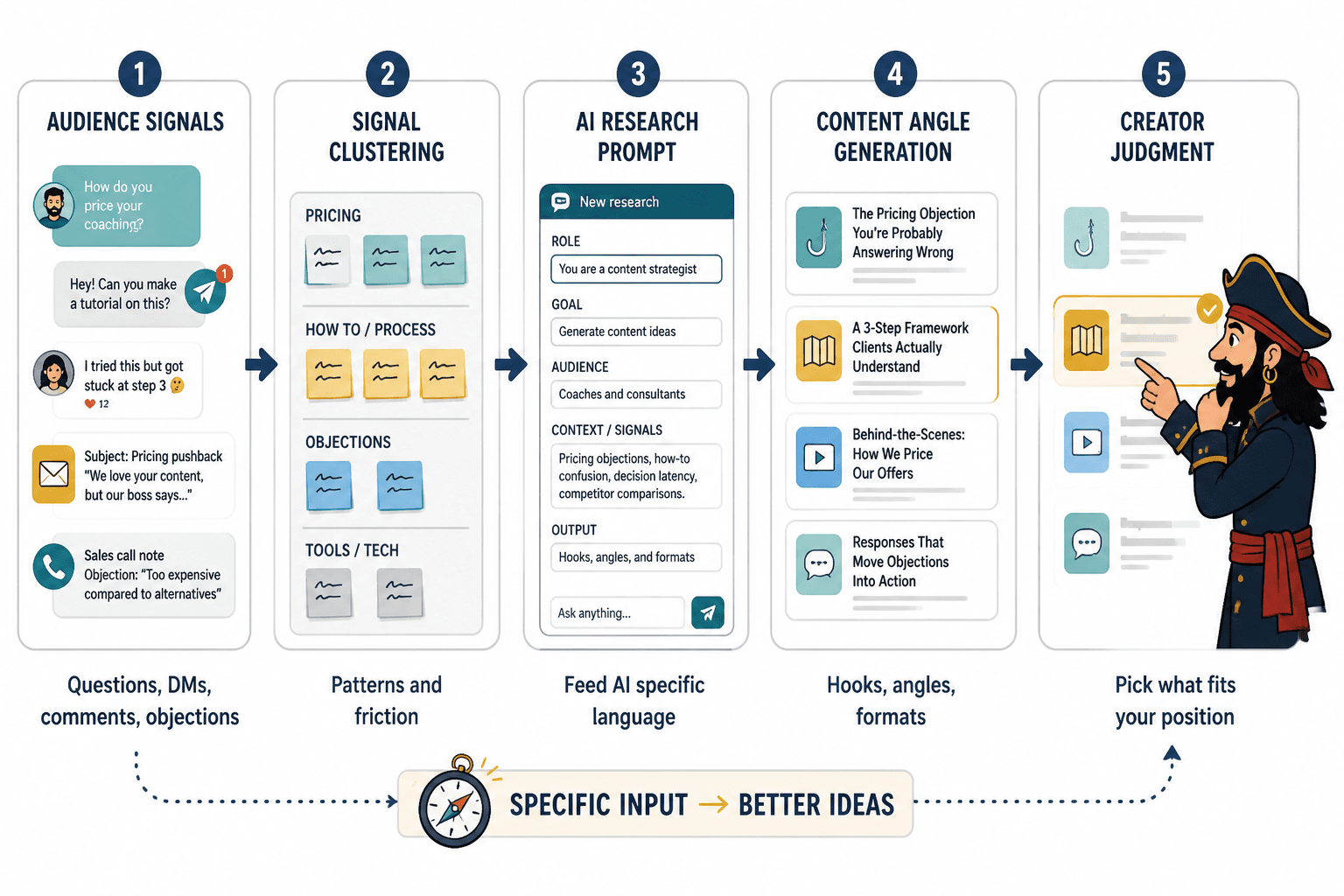
Start with signal collection, not idea generation
The best AI ideation starts before the prompt.
If you are a creator with a small audience, your research pile should come from places where real friction shows up. Not trend reports. Not vague “content inspiration.” Actual language from actual humans.
What to collect
- questions from clients or discovery calls
- DMs and email replies
- comments on your posts and other creators’ posts
- objections that slow down sales
- phrases people use to describe their problem badly
- before/after situations from your own work
- recurring myths in your niche
- examples of content that got stronger replies than average
Even if you only have a few comments or client conversations, that is enough to start. Small audiences still generate signal. You just have less room to ignore it.
How AI helps once you collect it
Drop your raw notes into AI and ask it to organize patterns instead of spitting out finished content. That is the move.
- group these questions into 5 recurring themes
- identify the underlying frustrations behind these comments
- show me where these audience quotes reveal confusion, fear, or bad assumptions
- turn these notes into content buckets by buyer stage
- find which examples point to beginner problems versus advanced problems
Now the tool is doing useful work. It is helping you sort the mess, which is often the part creators avoid because it is less fun than posting and more useful than posting.
A practical AI ideation workflow for small creators
You do not need a giant system. You need a repeatable one. Here is a simple workflow that works well for creators, coaches, consultants, writers, and solo businesses trying to build attention with a small but relevant audience.
1. Pick one audience slice
Do not ask AI for content for “entrepreneurs” or “creators.” That is how you get generic output wearing a blazer.
Instead, narrow the audience:
- health coaches struggling to explain their offer
- B2B consultants with boring LinkedIn posts
- freelance writers trying to attract better-fit clients
- small creators with low engagement but decent expertise
2. Feed AI real audience material
Add your notes, transcript snippets, post comments, objections, testimonials, rough observations, and repeated questions. Give it substance.
3. Ask for patterns before ideas
Prompt for themes, gaps, friction points, myths, emotional drivers, and decision barriers. This is where most people skip ahead and ruin the output.
4. Turn patterns into angle types
Once you have patterns, ask AI to generate content angles in useful formats:
- myth-busting posts
- mistake breakdowns
- before/after rewrites
- contrarian takes
- framework posts
- short stories with a lesson
- checklists
- case-study angles
5. Stress-test the angles
Ask:
- which of these angles would matter most to a skeptical buyer?
- which are too broad or overused?
- which ideas are strongest for trust versus reach?
- which would work as a post, thread, article, or lead magnet?
This step is where you stop publishing filler and start choosing ideas with a job.
6. Write with your own judgment switched on
Use AI drafts if you want. Fine. But revise hard.
- cut robotic transitions
- replace vague claims with specifics
- add your proof, examples, or opinion
- remove anything that sounds like generic advice from a content goblin
The best prompts are diagnostic, not decorative
A lot of creators use AI prompts that sound fancy and produce nothing useful. The problem is not that the prompt is too short. The problem is that it asks for decoration instead of diagnosis.
Bad prompt:
Give me 30 viral content ideas for my niche.
Better prompt:
Here are 20 comments and client questions from small creators trying to grow with content. Identify the repeated fears, misconceptions, and stalled decisions behind them. Then turn those into 15 specific content angles split by awareness level.
See the difference? One asks for noise. The other asks for structure.
Useful prompt types for small creators
- Pattern prompts: “Group these audience comments into recurring themes and explain what each theme reveals.”
- Gap prompts: “What does this audience seem to misunderstand that prevents them from getting results?”
- Angle prompts: “Turn these 5 audience pains into post ideas with different tones: practical, contrarian, story-led, and checklist.”
- Proof prompts: “What kinds of examples or evidence would make each of these ideas more credible?”
- Channel prompts: “Which of these ideas are better as short posts, long-form articles, or lead magnets?”
- Objection prompts: “What objections would a skeptical buyer have to this advice, and how could I address them without sounding defensive?”
If you want tool suggestions to support this process, these AI tools for creator research and ideation can help you choose the right category instead of chasing one magical platform that allegedly fixes everything.
How to find better content angles with a small audience
When your audience is small, broad topics usually underperform unless your angle is sharp. “Content strategy tips” is too loose. “Why useful posts get ignored when they sound emotionally risk-free” is more interesting. It carries tension. It signals a point of view. It sounds like someone might actually learn something.
AI can help you create stronger angles by forcing contrast.
Try these angle lenses
- Common mistake: what people do wrong and why
- Bad assumption: what they believe that sounds right but hurts results
- Hidden friction: what quietly kills momentum
- Before/after shift: what changed and what that changed produced
- Overrated advice: what gets repeated too often and deserves a side-eye
- Specific audience fit: why standard advice fails for this type of person
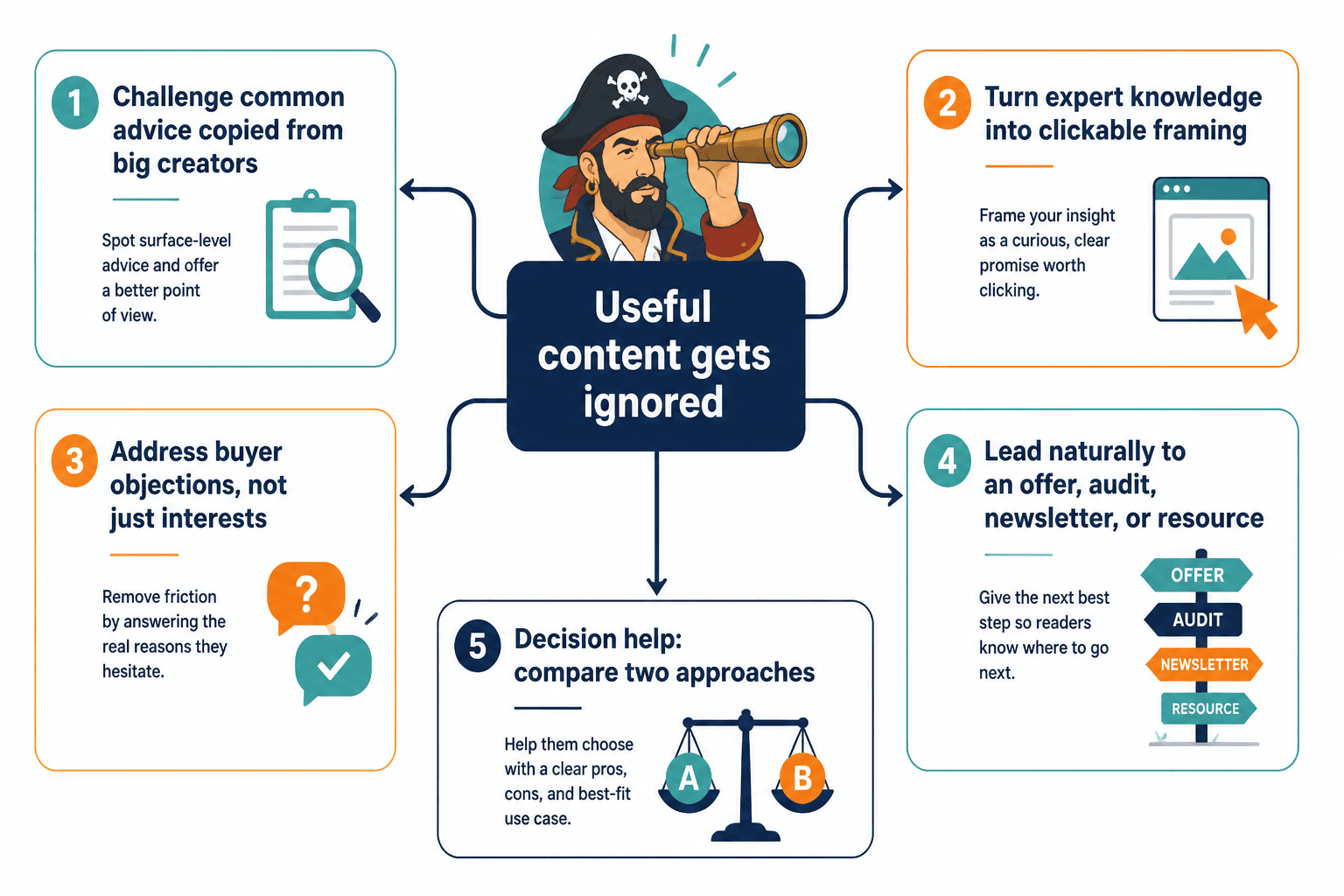
- Decision help: how to choose between two approaches
For example, instead of asking AI for “content ideas for creators,” ask it to generate angles like:
- ideas that challenge common advice small creators copy from large accounts
- topics that help experts turn underperforming knowledge into more clickable content
- post angles based on buyer objections, not just audience interests
- ideas that can lead naturally to an offer, audit, newsletter, or resource
That last point matters more than people admit. Content ideation should not be disconnected from what you sell or want to be known for. Otherwise you end up with attention from the wrong people and a content library full of attractive nonsense.
Use AI to make one idea stronger, not ten ideas thinner
One of the easiest traps in Creator AI Research and Ideation for Creators With Small Audiences is volume addiction.
You ask for 50 ideas. You get 50 ideas. You feel productive. You are not productive. You are now the owner of 50 vaguely plausible things you probably will not publish, or worse, will publish badly.
A smarter use of AI is to take one promising idea and deepen it.
Example idea:
Small creators often post useful content that gets ignored because it lacks a clear angle.
Now use AI to expand that idea into:
- 3 stronger hooks
- 2 examples of weak versus strong angles
- a short checklist for diagnosis
- a longer article outline
- a LinkedIn post version
- an X thread version
- a lead magnet teaser
- a CTA that fits a low-trust audience
That is leverage. One real idea. Multiple useful assets. Cleaner strategy.
If you want to turn those ideas into something commercial without making your content feel like a pitch in a trench coat, these funnel ideas for creator AI research and ideation can help.
What small creators keep doing wrong with AI ideation
There are a few repeat mistakes here, and they are painfully common.
- Using AI before clarifying audience: broad audience in, broad sludge out
- Asking for finished posts too early: you skip the thinking and inherit average structure
- Generating ideas with no commercial relevance: attention without trust or buyer fit
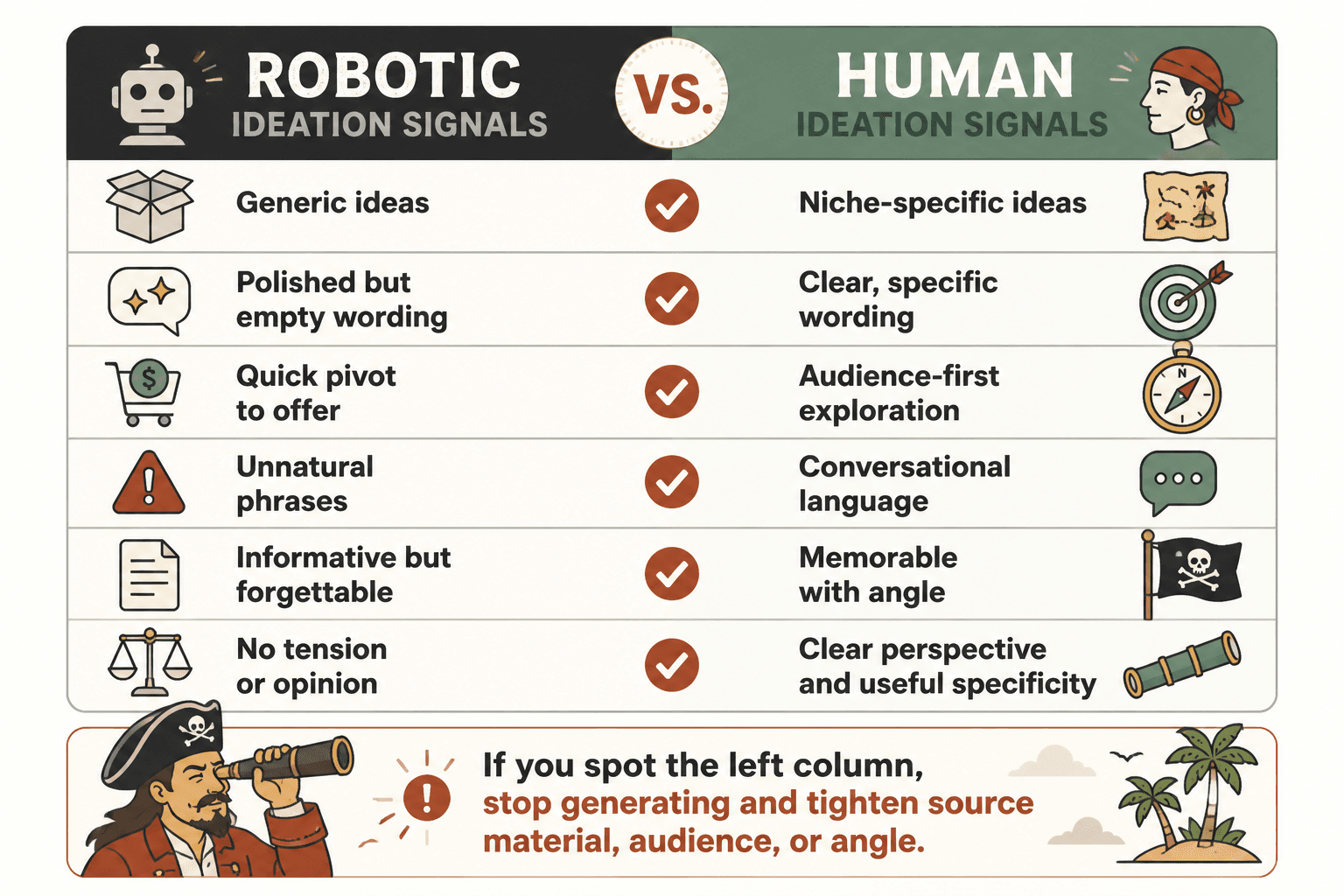
- Copying AI phrasing directly: now your content sounds like every other “value-driven” person online
- Confusing quantity with strategy: more prompts, weaker thinking
- Ignoring real audience language: your content sounds polished but not true
The biggest one is probably this: creators ask AI what to say before they understand what their audience is stuck on.
If you fix that, the rest gets easier.
A simple weekly AI research and ideation routine
You do not need a five-hour content lab. A lean weekly rhythm is enough.
| Day | Task | What AI does |
|---|---|---|
| Monday | Collect comments, DMs, questions, client notes | Sort and cluster signals |
| Tuesday | Review content goals for the week | Match ideas to trust, reach, leads, or authority |
| Wednesday | Develop 3 to 5 angles | Expand angles into hooks, outlines, examples |
| Thursday | Draft and revise | Help tighten structure or test variations |
| Friday | Review performance and replies | Summarize what resonated and what to test next |
This kind of system works because it keeps AI in the right role. Supporting role. Useful role. Not “please invent my voice, audience, and business model by lunchtime.”
For a broader category view, you can also explore the main AI writing tools and workflows section, the creator AI workflows hub, and the creator AI research and ideation pillar page.
How to know if your AI-generated ideas are actually good
Before you publish, run ideas through a quick filter.
- Is this clearly for a specific kind of person?
- Does it solve a real confusion, frustration, or decision?
- Does it sound like something a human would save, send, or reply to?
- Does it include tension, contrast, proof, or specificity?
- Could this connect naturally to what I offer or want to be known for?
- Would I still publish this if AI had not helped generate it?
If the answer to that last question is no, throw it out.
That sounds harsh. It is also efficient. AI should make your thinking sharper, not lower your standards just because the draft arrived quickly.
FAQ
Can small creators use AI research and ideation without a big audience?
Yes. You do not need a huge audience. You need usable signal from comments, DMs, client calls, email replies, and niche conversations.
What should I ask AI first?
Ask it to identify patterns in audience questions, frustrations, and misconceptions before asking for post ideas.
How many ideas should I generate at once?
Usually fewer than you think. Three strong angles are more useful than 30 forgettable ones.
Is AI good for finished posts?
Sometimes for rough drafts. It is much better for research support, angle development, outlining, and variation testing.
What if all the AI ideas sound generic?
Your inputs are probably too vague, too broad, or not based on real audience language. Fix the source material first.
Use AI to get closer to the market, not farther from it
The best use of Creator AI Research and Ideation for Creators With Small Audiences is not “how do I post more?” It is “how do I understand my audience better, package ideas more clearly, and create content that actually earns trust?”
That is the standard.
If your audience is still small, good. That often forces better habits. Better listening. Better specificity. Better content choices. AI can help you move faster, but it should move you toward sharper thinking, not mass-produced noise.
The bigger point is simple: clearer structure and clearer writing make the piece more useful. That is usually what makes the ending land better too.