
Most tool reviews do not fail because they are monetized. They fail because they read like someone got paid to be weirdly enthusiastic about a dashboard.
Readers can smell affiliate fluff almost immediately. It has a very specific odor: vague praise, no tradeoffs, fake certainty, and a suspicious number of phrases like “perfect for creators.” If your review sounds like it was written to please the tool company instead of help the buyer, trust leaves the building fast.
If you want to know how to write tool reviews without sounding like affiliate fluff, the fix is not “hide the affiliate link better.” It is to write like a useful adult. Show what the tool actually does well, where it gets annoying, who it is for, who should skip it, and what happens after the free trial glow wears off.
This is especially important if your content sits anywhere near monetization. Once readers suspect the review exists only to farm commissions, they stop trusting the review and, eventually, you. That is a bad trade.
This guide will show you how to make your tool reviews sharper, more credible, and much more likely to help readers make a decision without rolling their eyes halfway through.
Want the broader roadmap? Start with the parent guide.
Why most tool reviews feel like affiliate fluff
Because they are written backward.
Instead of starting with the buyer’s problem, they start with the creator’s incentive. The structure usually goes like this: introduce tool, praise tool, list features copied from landing page, mention “pros and cons” that are barely real, then slide into a CTA with the subtlety of a marching band.
That kind of review is not useful because it is not doing the actual job of a review. A review should reduce decision friction. It should help someone answer practical questions like:
- Is this tool worth paying for?
- Is it better than the obvious alternatives?
- Will it fit the way I actually work?
- What will annoy me after a week?
- Is the setup simple or secretly a project?
- Do I need this now, later, or not at all?
If your review does not answer those questions, it is not a review. It is product-adjacent content wearing a helpful hat.
If you cover monetized content regularly, it helps to understand the broader category your review sits inside. This tool reviews hub is a useful place to map related angles and avoid repeating the same thin review formula over and over.
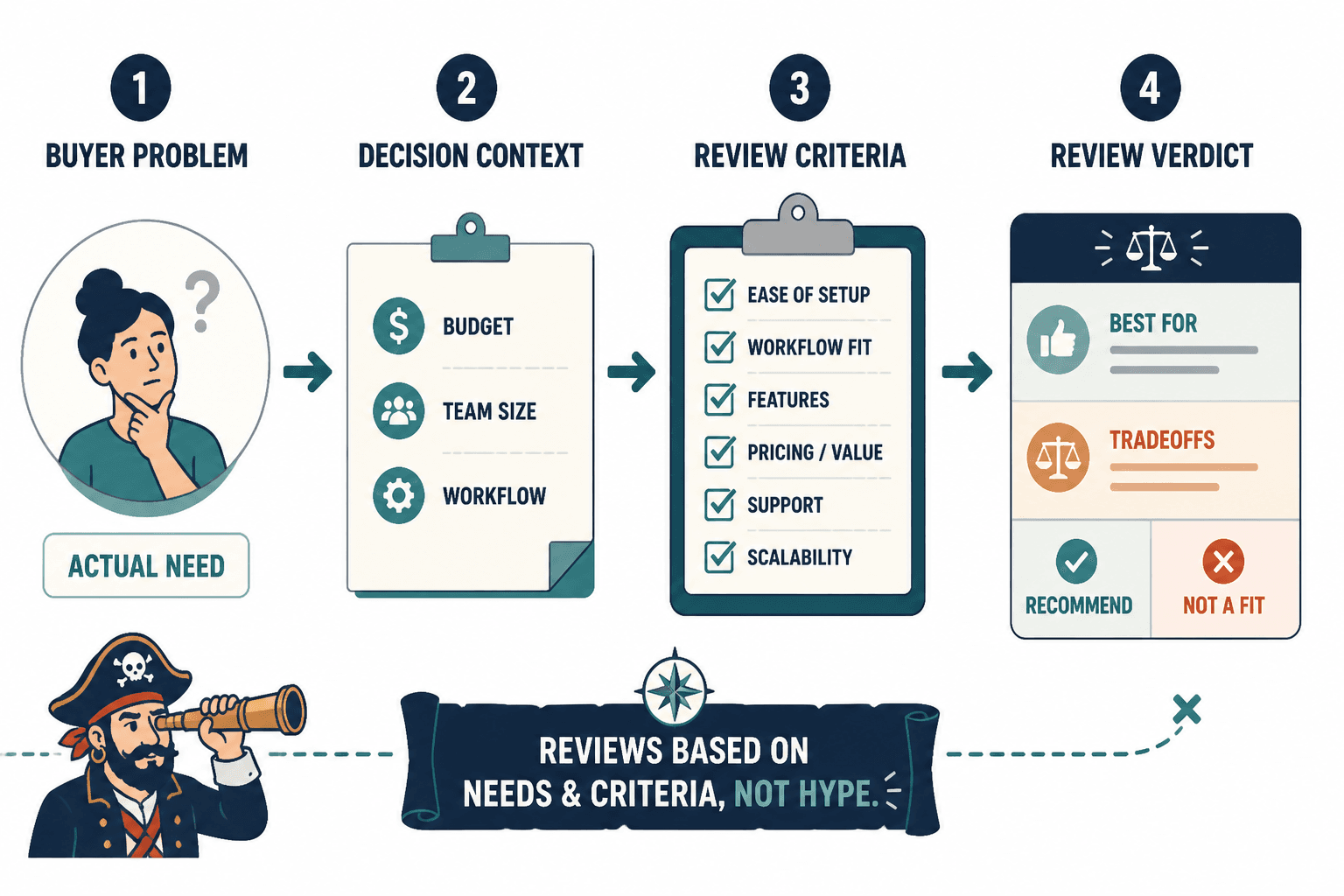
Start with the buyer, not the tool
A strong tool review starts before the product shows up on the page.
You need to define the situation the reader is in. Not every buyer is trying to solve the same problem, and not every tool is useful in the same context. A solo consultant trying to organize leads has different needs than a content team trying to manage approvals. If you blur those together, your review gets vague fast.
Start by naming the reader’s actual decision. For example:
- “You’ve outgrown spreadsheets and need a simple CRM, not a bloated sales machine.”
- “You need an AI writing tool to speed up drafts, but you do not want your posts to sound like reheated corporate soup.”
- “You’re choosing a scheduler and trying to figure out if better analytics actually matter for your workflow.”
That framing does two things. First, it proves you understand the reader. Second, it creates standards the tool now has to meet. Good. Tools should have to earn the recommendation.
Use buying criteria before you give opinions
Before saying a tool is “great,” decide what great means.
A simple review framework is to judge tools on 4 to 6 criteria that matter to the buyer, such as:
- Ease of setup
- Learning curve
- Core usefulness
- Workflow fit
- Pricing clarity
- Customization
- Reporting or analytics
- Collaboration features
- Support and docs
- Long-term value
Now your praise has somewhere to stand. “Easy to use” means more when you explain what setup involved, what was intuitive, and what required digging through tutorials like a raccoon in a bin.
What to include if you want the review to sound real
The easiest way to avoid affiliate fluff is to include the things fluff avoids.
1. The specific use case
Do not review “the tool” in the abstract. Review it for a job.
Bad: “This is a powerful content tool for marketers.”
Better: “This works best if you publish often, already know your voice, and want help turning one idea into multiple draft formats without building a full content machine around it.”
2. What the tool does well quickly
Readers do not need five paragraphs of warm-up. Tell them the strongest reason someone would choose it.
Example: “Its best feature is speed. If your main bottleneck is getting from blank page to rough draft, this solves that faster than most heavier all-in-one tools.”
3. What gets annoying in actual use
This is where trust starts showing up.
Real reviews mention friction. Maybe the interface is clean but rigid. Maybe the templates save time but produce samey output unless you guide them well. Maybe the analytics are there but too shallow to matter. Maybe the free plan is really just a teaser wearing a free-plan costume.
You do not need to be dramatic. You do need to be honest.
4. Who should skip it
This single section can do more for credibility than a page of praise.
Say things like:
- Skip this if you need advanced collaboration.
- Skip it if your process is still messy and you are hoping software will magically provide strategy.
- Skip it if budget is tight and the free version does not cover your real use case.
- Skip it if you need deep reporting, not surface-level dashboards.
That kind of filtering tells readers you are trying to help them decide, not trap them in your link.
5. The tradeoff, not just the feature
Features are not automatically benefits. Every tool choice comes with tradeoffs.
For example:
- More customization often means slower setup.
- More automation can mean less control.
- Cleaner UX can mean fewer advanced options.
- Lower price can mean weaker support or reporting.
When you explain tradeoffs, you stop sounding like promotion and start sounding like judgment. That is the whole game.
How to write tool reviews without sounding like affiliate fluff: the structure that works
You do not need a fancy review template. You need one that keeps you honest.
Here is a structure that works well for most tool reviews:
- The reader situation: what problem or decision this review is for
- Quick verdict: what the tool is good at, in one or two lines
- Best for / not for: who should consider it and who should skip it
- What stands out: 3 to 5 meaningful strengths
- What gets in the way: real drawbacks, limits, or frustrations
- Workflow notes: setup, learning curve, daily use, team fit, etc.
- Comparison angle: how it differs from common alternatives
- Pricing reality: where the value makes sense and where it does not
- Final recommendation: a clear, bounded verdict
That bounded verdict matters. Avoid pretending a tool is universally excellent. Usually it is excellent for a certain kind of user with a certain kind of need. Say that.
A simple review verdict formula
Try this:
This tool is best for [specific user] who needs [specific outcome] and cares most about [key benefit]. It is less suited for [user type] who needs [missing capability or different workflow].
That sentence alone will make your review sound more grounded than 80% of what gets published.
Write like you tested it, not like you copied the sales page
If your review reads suspiciously similar to the homepage, readers notice. Even if they cannot explain why, they feel the artificial shine.
The fix is detail. Not random detail. Useful detail.
Instead of saying “the interface is intuitive,” say what happened when you used it. What took two minutes? What was buried? What looked easier than it was? What part saved time immediately? What part required setup that less technical users might hate?
That kind of writing sounds human because it reflects contact with reality. Funny how that helps.
Before and after: affiliate fluff rewrite
Fluffy version:
This all-in-one tool offers powerful features, seamless integration, and an intuitive user experience for businesses looking to scale.
Better version:
The main appeal here is convenience. You can manage scheduling, basic reporting, and content planning in one place without stitching together three smaller tools. The catch is depth. If you need serious analytics or highly flexible workflows, it starts feeling shallow pretty quickly.
See the difference? The second version gives the reader something to do with the information.
For a related angle, this guide on comparing tool reviews without bias helps sharpen the questions your review should answer in the first place.
Be transparent about money without making it weird
Yes, disclose affiliate relationships. Obviously.
But disclosure alone does not create trust. Plenty of dishonest reviews disclose perfectly well. What creates trust is this combination:
- clear disclosure
- honest limitations
- specific use-case framing
- real drawbacks
- recommendations with boundaries
You do not need to perform moral theater about affiliate income. Just be direct. Something like: “If you buy through my link, I may earn a commission at no extra cost to you. I only recommend tools I think are worth serious consideration for the use cases described here.”
Then make sure the review earns that sentence.
The fastest ways to lose credibility
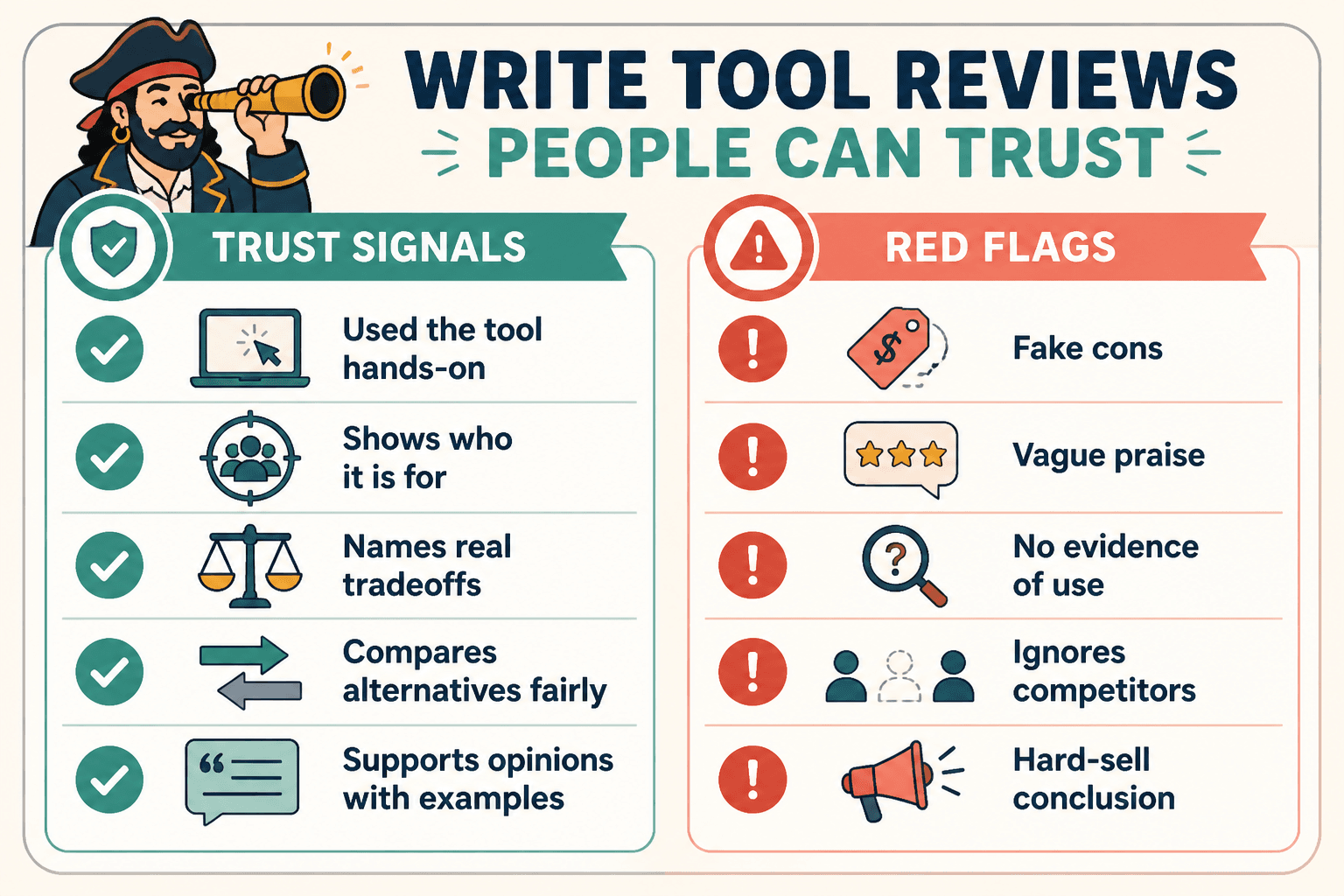
- Calling everything a must-have. Nothing says “I am farming links” like universal praise.
- Using fake cons. “So many features” is not a real downside unless complexity is actually the issue.
- Reviewing tools you clearly did not use. Readers do not always catch this consciously, but they feel the hollowness.
- Skipping alternatives. If there are obvious competitors, pretending they do not exist looks shady.
- Making the review too broad. “Best for everyone” is another way of saying “I have not thought this through.”
- Ending with a hard push. If the review was useful, the CTA can stay calm.
One more thing: stop trying to sound neutral if you do have a view. A good review is not lifeless. It is fair. You can have an opinion. You just need to support it like someone whose job is to help readers, not impress vendors.
How to compare tools without turning the review into a feature spreadsheet coma
Comparison is useful. Feature spreadsheet theater is not.
Readers usually do not need every checkbox. They need the differences that affect the buying decision. So compare based on what changes the outcome:
- speed versus flexibility
- simplicity versus depth
- solo use versus team use
- quick setup versus heavier customization
- lower cost versus better reporting
- template-driven output versus more control
| Weak comparison | Useful comparison |
| Tool A has 12 templates. Tool B has 18. | Tool A is faster to use out of the box. Tool B takes more setup but gives stronger control if you already have a defined process. |
| Tool A supports analytics. Tool B supports analytics too. | Tool A gives basic reporting good enough for solo creators. Tool B is better if analytics affect team decisions and client reporting. |
| Tool A has automation. | Tool A saves more manual work, but the automation feels rigid if your workflow changes often. |
If you need to tighten your buying lens before writing, this piece on choosing tool reviews without wasting money is a strong companion read.
Use a calm CTA, not a closing argument from a hostage negotiator
The CTA at the end of a tool review should match the confidence level of the review itself.
If the tool is a solid fit for a specific reader, say that. If it is worth trying with caveats, say that. If it is decent but not your top pick, also say that. Readers trust reviews that do not act like every conclusion must end in a dramatic conversion attempt.
Good CTA examples:
- “If speed and simplicity matter more to you than advanced customization, this is worth a look.”
- “Try this if you already know your workflow and want a tool that supports it without a lot of setup.”
- “I would skip this if reporting matters heavily to your business.”
- “If you want the cleaner option, choose this. If you want the deeper option, pick the alternative.”
Notice the absence of fake urgency. No one needs “grab it now before you miss out” energy at the end of a review. You are not selling concert tickets.
If monetization is part of your content model, these related reads can help: how to monetize tool reviews without thin reviews and how to turn tool reviews into affiliate revenue. Both matter if you want revenue without quietly torching trust.
A practical checklist for writing better tool reviews
The bigger point is simple: clearer structure and clearer writing make the piece more useful. That is usually what makes the ending land better too.
The bigger point is simple: clearer structure and clearer writing make the piece more useful. That is usually what makes the ending land better too.