
Most punchy X posts are not actually punchy. They are just short.
That is the mistake.
People trim a thought down to one line, add a bit of attitude, maybe slap on a hard stop, and assume they have written something sharp. What they usually have is a vague statement dressed like a strong opinion. It looks confident. It says very little.
If you want to know how to improve X punchy lines without sounding generic, the answer is not “be bolder” or “write shorter.” The answer is to make the line more specific, more earned, and more clearly aimed at a real reader with a real frustration.
X rewards compression. Fair enough. But compression only works when there is something solid being compressed. Otherwise you get those posts that sound clever for half a second and evaporate on contact.
Here’s how to write punchy lines that feel sharp instead of synthetic, memorable instead of recycled, and useful enough that people actually want more from you.
If you want the bigger picture, start with the parent guide.
Why most punchy X lines fall flat
Generic punchy writing usually breaks in one of four ways.
- It says something everyone already agrees with.
- It is too vague to picture, test, or argue with.
- It tries to sound profound instead of being clear.
- It borrows internet cadence instead of real conviction.
That is why so many lines on X blur together:
- Consistency wins.
- Energy matters.
- Stop overthinking and start doing.
- Most people quit too early.
- Be authentic.
None of those are exactly wrong. They are just too broad to be worth stopping for.
A strong punchy line creates a small jolt. It makes the reader think one of three things: “That is true,” “That is annoyingly accurate,” or “Wait, what do they mean?” A generic line does none of that. It just sits there in clean sneakers, hoping confidence will do the heavy lifting.
What a good punchy line on X actually does
A good punchy line is short, yes, but that is not the main feature. The real job is compression with force.
Usually, the best lines do at least two of these things at once:
- Make a clear claim
- Show contrast
- Name a real problem
- Use specific language
- Carry an opinion
- Hint at proof or lived experience
- Create tension
- Sound like a human, not a quote generator
Short is a format choice. Punchy is a writing result.
That difference matters. A five-word post can hit hard. A 30-word post can hit harder. The point is not minimalism for its own sake. The point is density.
If you also want help with the bigger structure around your posts, this guide on how to start X posts without a weak opening pairs nicely with this one. The opening gets attention. The punchy line makes it worth keeping.
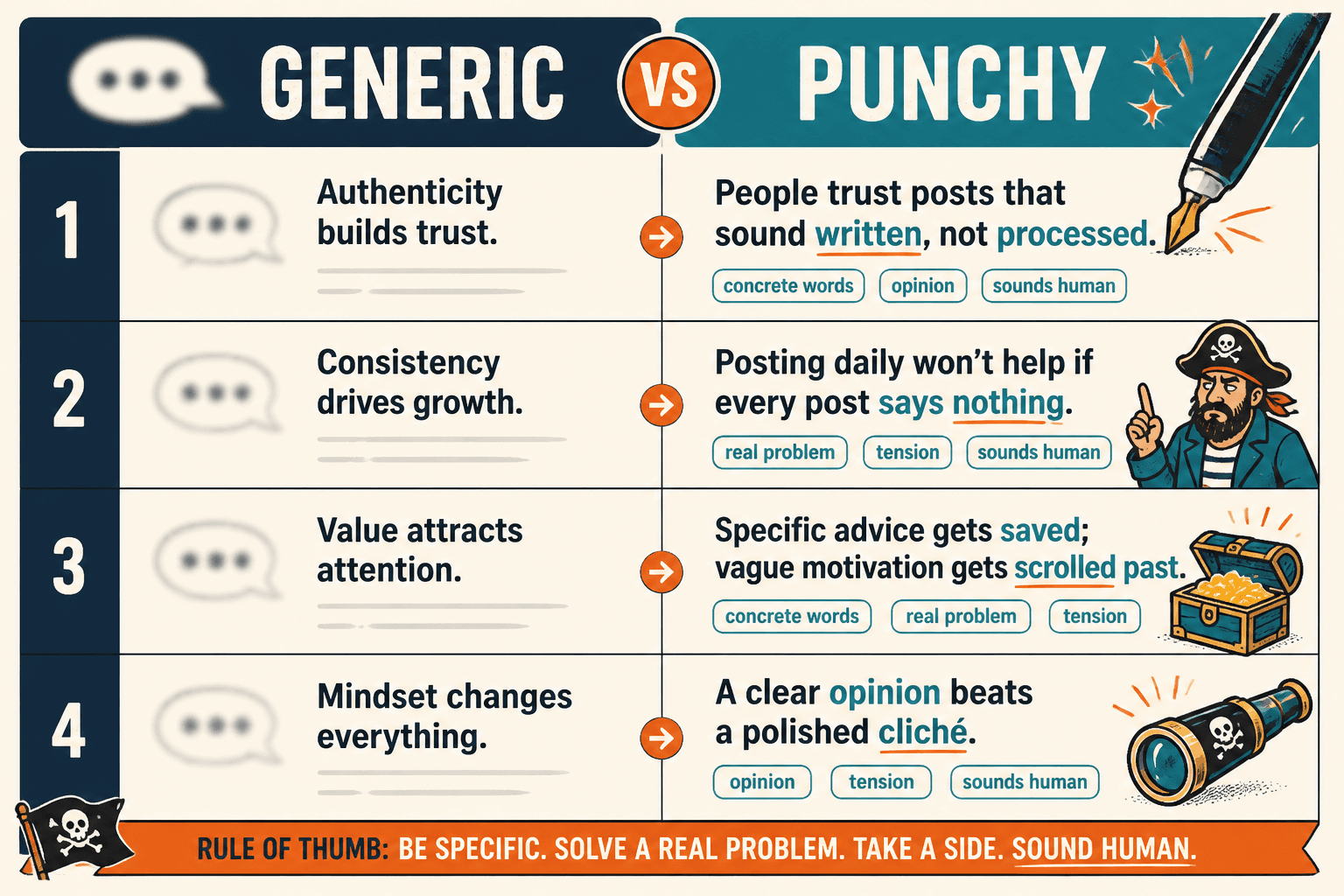
How to improve X punchy lines without sounding generic
1. Trade abstract words for concrete ones
Abstract words feel efficient, but they weaken the line fast. Words like success, value, growth, mindset, quality, consistency, and authenticity often carry too many meanings. They make your post sound broad and clean and forgettable.
Concrete words create texture. They let the reader picture something. They make the line feel observed, not manufactured.
Weak: Authenticity builds trust.
Better: People trust posts that sound written, not processed.
Weak: Consistency matters more than talent.
Better: One useful post every week beats seven vague ones nobody remembers.
The stronger version gives the reader something to latch onto. It is easier to believe, easier to repeat, and easier to build on.
2. Add tension, not just attitude
A lot of “punchy” writing is just attitude without substance.
It sounds like this:
- Nobody wants to hear this, but…
- Harsh truth:
- Most people are not ready for this conversation.
That stuff is usually throat-clearing in a leather jacket.
Real punch comes from tension. Tension means there is a contrast, contradiction, or uncomfortable truth inside the idea itself.
Generic attitude: Stop posting like everyone else.
Actual tension: The more your post tries to sound smart, the less people trust it.
Generic attitude: You do not need more content.
Actual tension: Most people do not have a content volume problem. They have a clarity problem wearing a volume costume.
That second version has shape. It creates friction. It gives the reader a reason to pause instead of scroll.
3. Write from a real observation, not a content formula
If a line could have been generated from a generic “creator advice” starter pack, it is probably too thin.
Better punchy posts usually come from noticing something specific:
- A repeated mistake in your niche
- A pattern in weak content
- A client objection
- A gap between what people say and what they do
- A misleading bit of platform advice
For example:
Formula line: Personal branding is about trust.
Observed line: A lot of personal brands sound polished enough to impress peers and bland enough to repel buyers.
One is a generic principle. The other feels like somebody has seen the problem in the wild. That is what gives it weight.
4. Use specificity that sharpens, not specificity that clutters
Specificity is good. Overloading the line is not.
On X, you do not have much room. So your details need to earn their place. Use the kind of specifics that sharpen the point:
- A clear audience
- A concrete behavior
- A recognizable mistake
- A useful contrast
- A vivid phrase
Too broad: Coaches need better messaging.
Sharper: If your coach bio says “helping you step into your power,” your messaging is not unclear. It is hiding.
Too broad: Threads should be actionable.
Sharper: A thread that needs 14 posts to say one obvious thing is not actionable. It is inflated.
Notice the pattern. The stronger line names something people can actually recognize in their feed.
5. Cut the fake profundity
X is full of lines that are trying very hard to sound timeless. They end up sounding airless.
Examples:
- Silence speaks louder than words.
- What is meant for you will find you.
- The strongest people move differently.
That style can get attention sometimes because it is smooth and familiar. It can also make your account indistinguishable from a thousand others posting soft-focus fortune-cookie dust.
If you want stronger writing, ask: can a reader tell what I actually mean here?
Fake profound: Clarity changes everything.
Useful: If people keep misunderstanding your offer, your problem is not visibility. It is wording.
The second line still has force. It just has bones now.
6. Borrow rhythm, not clichés
A lot of punchy writing works because of rhythm. Short sentence. Strong noun. Contrast. Clean ending. Great. Use that.
What you do not want to borrow is the same recycled phrasing everyone else already beat to death.
These patterns are often stale:
- X is not about Y. It is about Z.
- Read that again.
- Let that sink in.
- No one talks about this enough.
- Most people are not ready for this.
The structure may still work. The wording often does not.
Tired version: Content is not about going viral. It is about building trust.
Fresher version: Viral reach is nice. But trust is what gets the reply, the click, and the sale.
Same underlying idea. Better phrasing. More grounded. Less poster-on-a-wall.
7. Make sure the line sounds like you would actually say it
This is where a lot of otherwise decent posts get weird. The writer starts with a solid idea, then rewrites it into “internet thought leader.” Suddenly the sentence sounds like it was assembled from high-performing fragments instead of written by a person.
Read your line out loud. If it feels unnatural in your own mouth, it will probably feel unnatural in the feed too.
Too polished: Precision in communication is the foundation of audience trust.
More human: If your writing is fuzzy, people do not trust the offer behind it.
Not every line needs to sound casual. But it should sound written by someone with a pulse.
If this is also showing up in your calls to action, read how to write X posts without sounding salesy or robotic. A strong line can still lose the post if the ending sounds like a funnel script trying to blend in.
A simple rewrite process for punchier X lines
When a line feels flat, do not just make it shorter. Run it through this process instead.
- Find the real point. What are you actually trying to say?
- Cut the soft setup. Remove things like “I think,” “honestly,” “the truth is,” and other fluff.
- Add a real-world angle. What does this look like in practice?
- Sharpen the wording. Replace broad nouns with concrete language.
- Check the tension. Is there a contrast or consequence in the line?
- Read it out loud. If it sounds borrowed, rewrite it.
Here are a few before-and-after examples.
Before: Good writing helps you stand out online.
After: Most people do not need louder content. They need clearer sentences.
Before: Your audience wants honesty.
After: People say they want honesty. What they actually respond to is honesty with a point.
Before: Be consistent and keep showing up.
After: “Keep showing up” is lazy advice if nobody can remember what you stand for.
Before: Simplicity is the key to better content.
After: Simple writing is hard because vague writing lets you hide.
That last move is worth noticing. Great punchy lines often expose something people would rather avoid. Not in a melodramatic way. Just plainly. Plainly can hit hard.
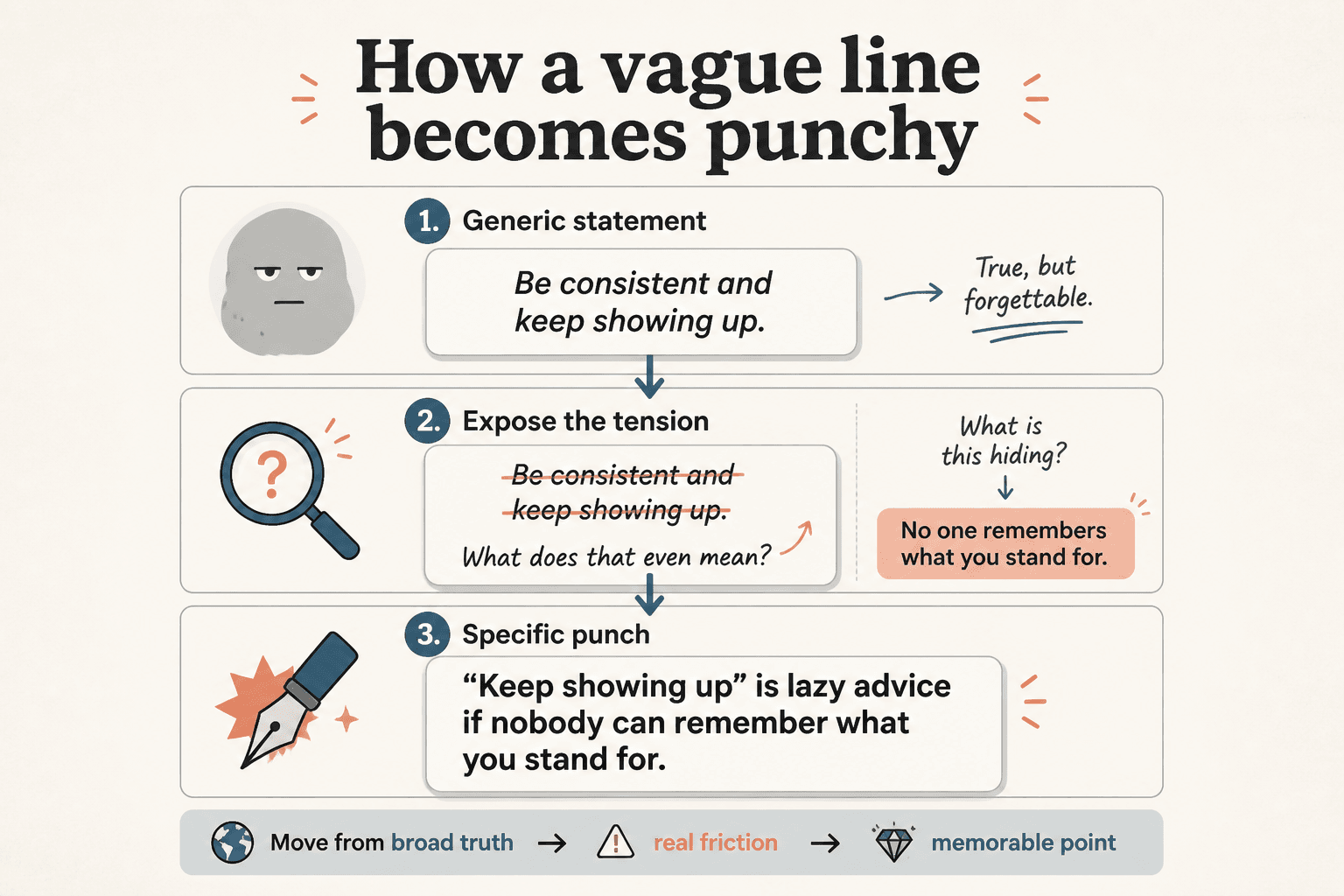
Templates for punchy X lines that do not feel canned
Templates are useful if you treat them like scaffolding, not finished writing. The structure helps. The observation still has to be yours.
The bigger point is simple: clearer structure and clearer writing make the piece more useful. That is usually what makes the ending land better too.