
Most X posts do not flop because the idea was terrible. They flop because the opening line had the charisma of expired toast.
On X, you do not get much runway. People are scrolling fast, half-distracted, mildly skeptical, and one bad opening away from ignoring you forever. So if your post starts soft, vague, or weirdly corporate, the rest of it may as well not exist.
This is where short hooks earn their keep. Not fake drama. Not recycled “hot take” sludge. Just sharp first lines that make the right people stop and think, “Alright, go on then.”
Here’s how to write better X short hooks, what makes them work, and a pile of examples creators can adapt fast without sounding like they borrowed a personality from someone else’s content calendar.
For the full path around this topic, head to the parent guide.
What a good short hook on X actually needs to do
X rewards compression. That does not mean every hook has to sound like a tough-guy slogan stamped onto a crypto profile. It means the opening line should quickly create one of a few useful reactions:
- Curiosity
- Recognition
- Disagreement
- Surprise
- Clarity
- Tension
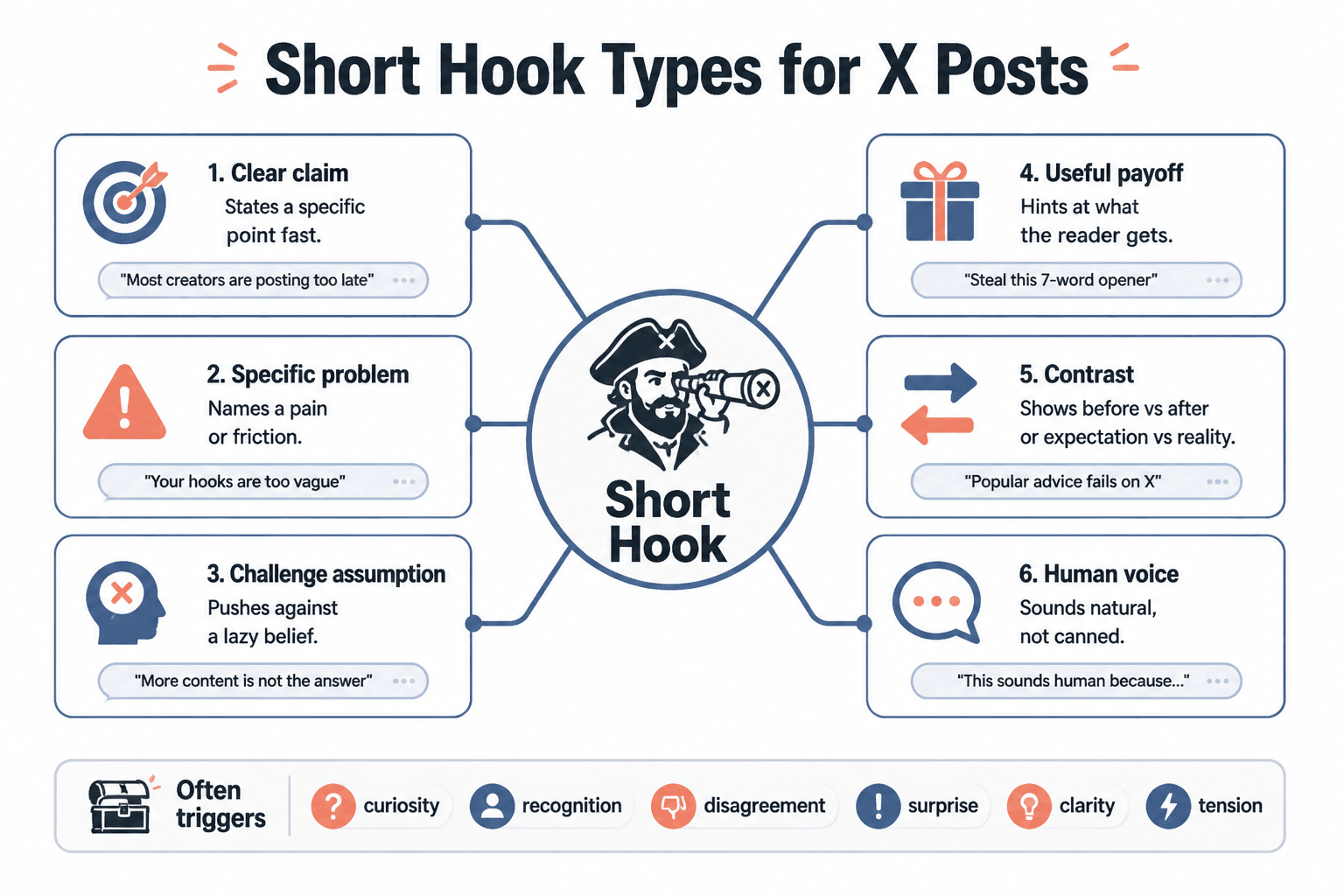
A strong short hook usually does at least one of these:
- Makes a clear claim
- Names a specific problem
- Challenges a lazy assumption
- Hints at a useful payoff
- Shows contrast
- Sounds like a real person, not a productivity fridge magnet
The bar is not “be clever.” The bar is “be worth another second of attention.” Different game.
If you want more context on platform-specific writing, the broader X posts guide here is a useful next step after this one.
Why most short hooks fail
Most weak hooks have one problem: they ask the reader to care before earning it.
That is why so many openings on X feel dead on arrival. They are technically clear, but not compelling. Or they are trying way too hard to be profound, which is somehow worse.
Common bad hook habits
- Starting with throat-clearing: “I’ve been thinking a lot about…”
- Being vague: “Something important creators need to understand…”
- Using fake suspense: “Nobody talks about this but…”
- Sounding copied: “Unpopular opinion:”
- Overexplaining too early
- Writing a hook that only makes sense after the full post
Short hooks work when they feel complete enough to matter on their own, but open enough to pull people into the rest of the post. That balance matters. Too closed, and there is nowhere to go. Too vague, and nobody bothers.
X short hook examples creators can adapt fast
Below are short hook types that work well on X, plus examples you can steal the structure from without becoming unbearably generic.
1. The clear opinion hook
Good for: creators, consultants, operators, marketers, and anyone trying to build authority through sharp thinking.
- Most creators do not need more content ideas. They need better standards.
- “Valuable content” is often just long content with good lighting.
- Personal branding gets weird the second people try to sound important.
- Consistency is overrated if your posts keep saying the same thing.
- More founders should write like humans and less like pitch decks.
- Your content strategy is probably too broad to work.
Why it works: it stakes a position fast. There is no fog, no warm-up lap, no “just sharing a thought.” On X, that directness helps.
2. The problem-first hook
Good for: educational posts, soft lead generation, and service-based creators who want to show they understand the reader’s situation.
- If your posts get polite likes but no leads, the problem is usually positioning.
- If people always praise your content but never buy, your CTA is probably too timid or too random.
- If writing feels hard every day, your system is broken.
- If your audience is growing but nothing is converting, the gap is trust.
- If your hooks are “fine” but reach stays flat, they are probably too vague.
This style works because it creates instant relevance. The right reader sees themselves in the sentence and keeps going.
3. The contrast hook
Contrast creates movement. It gives the brain something to compare. That is useful on a fast-moving platform.
- Good content gets attention. Clear content gets clients.
- Being insightful is nice. Being understandable pays better.
- More posts is not the same as more momentum.
- Reach looks impressive. Replies tell the truth.
- Posting daily helps. Posting distinctly helps more.
- Strong opinions attract attention. Strong explanations build trust.
Notice how these hooks do not just state two things. They create tension between them. That tension is the hook.
4. The “stop doing this” hook
This one works best when you are correcting a common bad habit. Use carefully. Too much of it and you sound like the hall monitor of the creator economy.
- Stop writing X posts like you are submitting them for approval.
- Stop mistaking vague advice for thought leadership.
- Stop opening threads with filler.
- Stop teaching everything you know in one post.
- Stop writing hooks that only impress other creators.
- Stop trying to sound premium if it makes you sound dead.
The trick here is to follow the hook with something useful fast. If all you do is scold people, congrats, you made the internet worse.
5. The specific observation hook
These hooks feel smart because they notice something real. They are excellent for creators who want a voice that feels original without trying too hard.
- A lot of “high-performing content” is just repackaged certainty.
- The fastest way to make your writing worse is to chase a style before you have a point.
- Many creators do not have a content problem. They have a courage problem.
- Most weak bios are trying to sound impressive instead of useful.
- People trust specific creators faster than polished ones.
- The internet rewards speed, but buyers still respond to clarity.
Good observation hooks make the reader feel like you noticed the thing they vaguely felt but had not phrased yet. That is powerful.
6. The mini-proof hook
When you have real experience, proof can make a short hook much stronger. Not because numbers are magic, but because they add weight.
- The posts that got me clients were rarely the longest ones.
- I tested short hooks against longer setup lines. Short won more often.
- The best-performing posts in my drafts folder were also the clearest.
- Every time I tighten the opening, the rest of the post works harder.
- The simplest CTA in my posts outperformed the clever ones.
You do not need to invent giant numbers or pretend to have cracked the matrix. Small, honest proof is often more believable anyway.
7. The anti-cliché hook
This is great when you want to cut through stale creator advice.
- “Just be consistent” is lazy advice.
- “Add value” is not a content strategy.
- “Be authentic” helps nobody if your positioning is still blurry.
- “Go viral” is not a business model.
- “Tell your story” is incomplete advice.
- “Post more” is usually the wrong first fix.
The follow-up matters here. Once you reject the cliché, replace it with something sharper. Otherwise you are just heckling from the back row.
If you want more examples to build from, this collection of the best X post ideas and examples for creators pairs nicely with these hook formats.
How to adapt these hooks without sounding copied
The fastest way to ruin a good hook is to copy the wording too literally. Short hooks are useful because they give you a structure, not because they give you a final sentence.
Here is the easy way to adapt one fast.
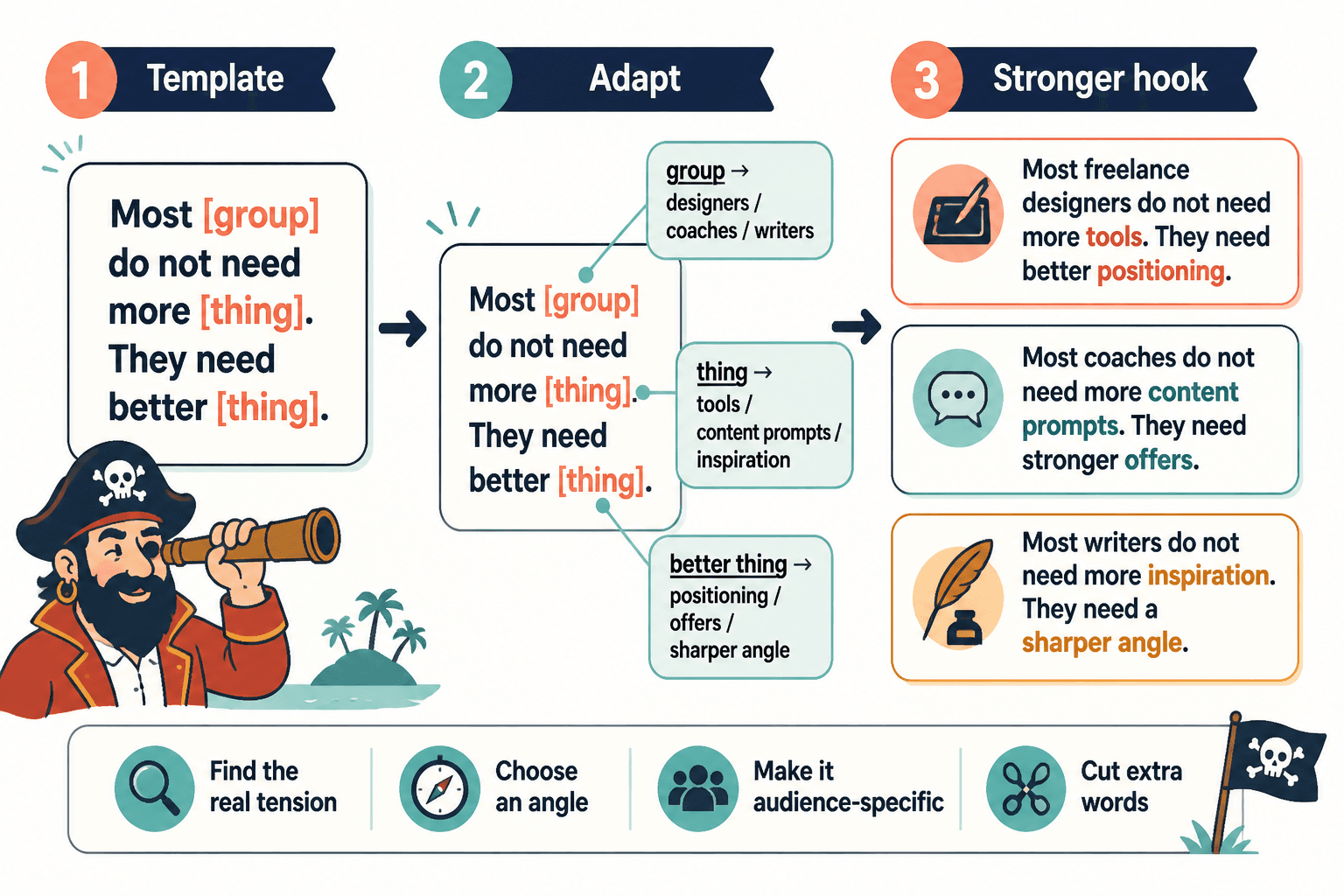
Use this 4-part hook formula
- Pick one problem, belief, or pattern.
- Decide your angle: challenge, clarify, contrast, or expose.
- Make it specific to your audience.
- Cut every extra word that does not earn its place.
For example:
- Template: “Most [group] do not need more [thing]. They need better [thing].”
- Adapted for designers: “Most freelance designers do not need more tools. They need better positioning.”
- Adapted for coaches: “Most coaches do not need more content prompts. They need stronger offers.”
- Adapted for writers: “Most writers do not need more inspiration. They need a sharper angle.”
That is the point. Same skeleton. Different truth. Much better than posting the exact same sentence every other creator used last week.
Before-and-after hook rewrites
Sometimes the easiest way to improve your X hooks is to see what weak ones look like beside stronger versions.
Example 1
- Weak: I’ve been thinking a lot about content lately.
- Better: Most content advice makes writing harder than it needs to be.
The second version has a point. The first one has a diary entry.
Example 2
- Weak: Here’s something nobody tells you about building a brand.
- Better: Building a brand gets easier once you stop trying to sound impressive.
The rewrite removes fake mystery and replaces it with an actual idea.
Example 3
- Weak: Unpopular opinion: creators should focus on quality.
- Better: “High quality” content still fails if nobody understands the point.
The better version is more specific and less painfully borrowed.
Example 4
- Weak: A thread on how I grew my audience.
- Better: Audience growth got easier when I stopped writing for everyone.
The stronger hook starts with the insight, not the filing label.
What kinds of short hooks work best for different creator goals
| Goal | Best hook style | Why it works |
|---|---|---|
| Get attention fast | Clear opinion, contrast | Creates immediate tension or agreement |
| Show expertise | Specific observation, mini-proof | Signals original thinking and experience |
| Start conversation | Problem-first, anti-cliché | Invites response without begging for it |
| Lead into education | Problem-first, stop doing this | Sets up a practical explanation well |
| Build brand voice | Observation, contrast | Feels distinct without being theatrical |
You do not need one hook style forever. But you do need to know what job the hook is doing. A line written for reach will not always be the best line for trust. Different jobs. Different openings.
A simple checklist for better X hooks
Before you post, run the first line through this:
- Can someone understand it instantly?
- Does it say something, not just introduce something?
- Would the right person feel seen, challenged, or intrigued?
- Could you cut 3 to 5 words without losing meaning?
- Does it sound like a human with taste wrote it?
- Would it still work if posted alone?
If the answer is no to most of those, the hook needs work.
When a short hook is the wrong move
The bigger point is simple: clearer structure and clearer writing make the piece more useful. That is usually what makes the ending land better too.
X posts tend to work better when the line gets sharper and the ending earns the reaction. Cleaner payoff usually beats louder phrasing.