
Reaction posts on X can work absurdly well, and people still manage to ruin them by sounding late, loud, or weirdly generic.
The problem is not that reaction posts are shallow. The problem is that most creators react without adding anything. They quote a trending post, say “this is so true” or “big if true,” and somehow expect attention, trust, and leads to tumble out of the sky.
If you want better results, your reaction posts need one of three things: a clear take, a useful angle, or a strong filter. Preferably all three. That is what makes someone worth following instead of just another person yelling into the timeline.
This guide gives you simple X reaction post templates for busy creators who do not have time to overthink every post. You will get fast formats, examples, and a few rules for making reaction posts sharper, more credible, and much less disposable.
If you want broader help with post structure and what tends to work on the platform, start with X Posts Guide for Creators Who Want Better Results or browse the main X posts hub.
For the full path around this topic, head to the parent guide.
What makes a reaction post worth posting
A good reaction post is not just commentary. It is commentary with direction.
It helps the reader do at least one of these things:
- Understand why something matters
- See the hidden problem in a popular opinion
- Apply an idea in the real world
- Spot a bad assumption
- Learn where the nuance actually is
That means your reaction post should not stop at agreement. Agreement is cheap. Interpretation is where your value starts.
On X, this matters even more because the platform rewards speed, clarity, and punch. You do not need a full essay. You do need a point.
When simple X reaction post templates are actually useful
Templates help when you already have taste but need speed. They are useful for busy creators who want to show up consistently without staring at the blinking cursor like it owes them money.
They are especially helpful when you are reacting to:
- Industry news
- Strong opinions from bigger accounts
- Bad advice going viral
- Useful studies or data points
- Shifts in creator behavior
- Trends in your niche
- Questions your audience keeps asking
They are less helpful if you use them to mass-produce bland takes. A template should speed up your thinking, not replace it.
5 rules before you post a reaction on X
1. React to something relevant to your niche
You do not need to comment on every trend. In fact, please do not. If your audience follows you for content strategy, they do not need your emergency statement on every app redesign, creator feud, or productivity gadget.
Pick things that connect back to your work, audience, or expertise.
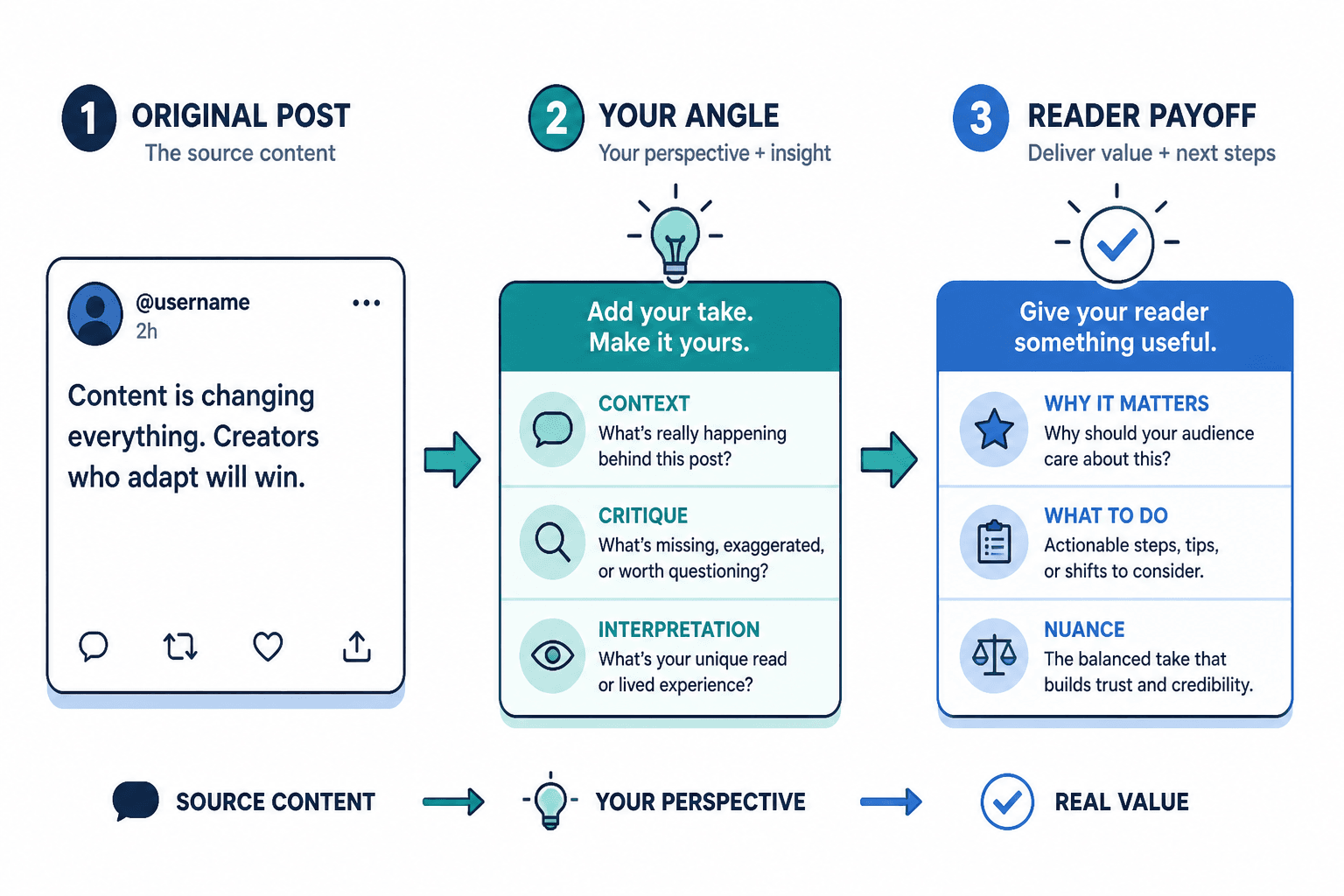
2. Add a layer
The easiest way to improve a reaction post is to add one layer beyond the original content.
- Original claim
- Your interpretation
- Reader takeaway
That structure alone fixes a lot of weak posts.
3. Be quick, not sloppy
Speed matters on X. Sloppiness does not help. If your reaction depends on context, include enough context. If you disagree, explain why. If you are making a practical point, make it usable.
4. Do not quote-post your way into looking needy
There is a fine line between “joining the conversation” and “borrowing someone else’s audience with all the grace of a raccoon in a pantry.” If you are constantly reacting upward with no original ideas of your own, people notice.
Mix reaction posts with standalone posts. If you need ideas for those, Best X Posts Ideas and Examples for Creators will help.
5. Do not force a sales pitch into every reaction
A reaction post can build trust, show taste, and attract the right people. It does not need to end with “DM me if you want help scaling your content engine.” Sometimes the strongest CTA is none at all.
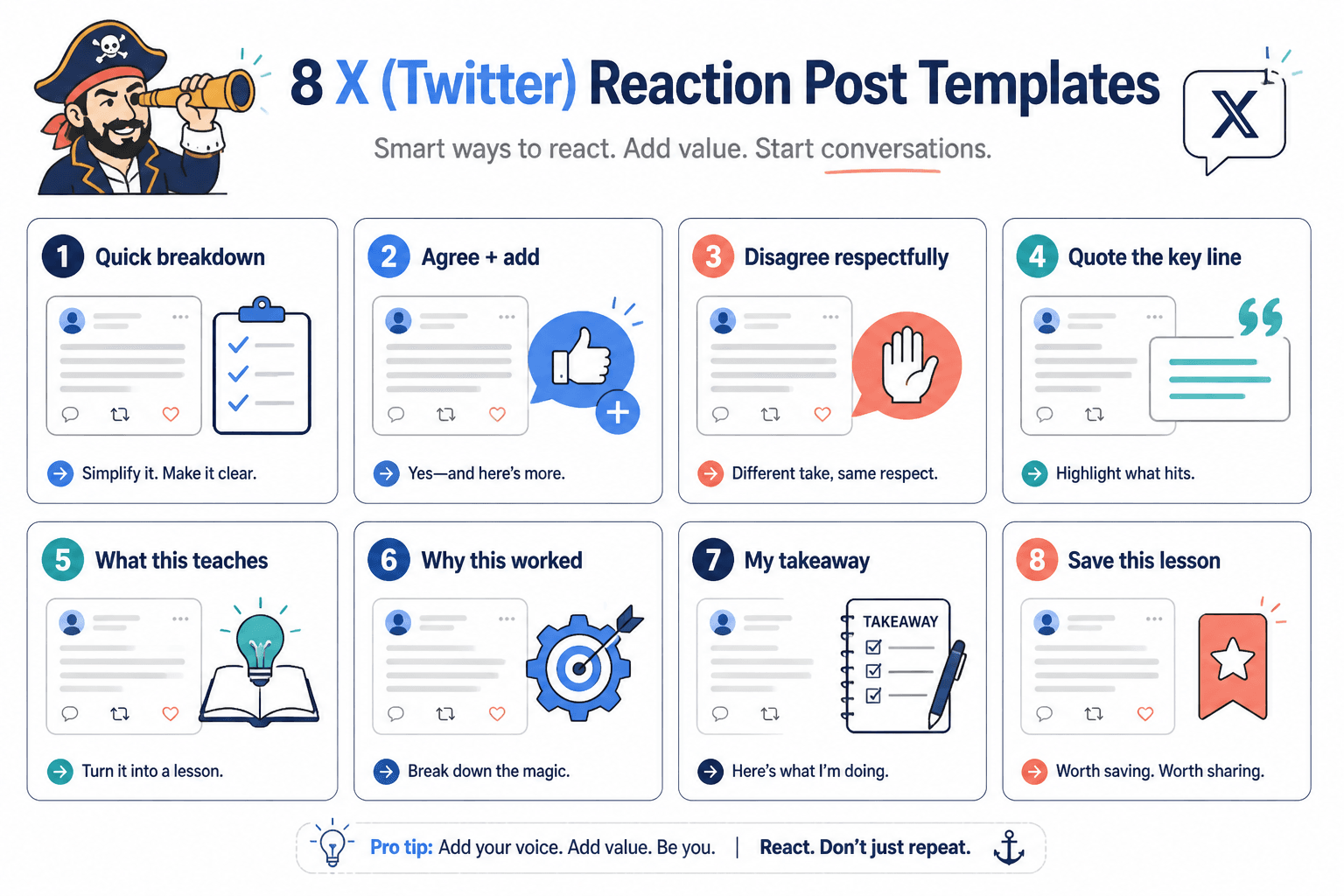
Simple X reaction post templates for busy creators
These are meant to be fast, adaptable, and actually readable. Use them as starting points, not little cages for your voice.
1. The agree-but-add template
Use this when a post is mostly right, but incomplete.
This is true.
But the part people miss is:
[missing nuance]
That is usually where the real result comes from.
Example:
This is true.
But the part people miss is:
Consistency is not just posting often.
It is posting from a clear position people can remember.
A lot of creators are consistent. They are just forgettable.
This works because it signals agreement without being redundant.
2. The polite disagreement template
Use this when a popular post sounds clean but falls apart in real life.
I do not think this is wrong.
I think it is incomplete.
For [audience], the bigger issue is [actual issue].
That is why [alternative view].
Example:
I do not think this is wrong.
I think it is incomplete.
For small creators, the bigger issue is not posting frequency.
It is weak positioning.
More posts do not help much if every post sounds like it could belong to 900 other people.
This is especially useful if you want to challenge an idea without sounding chronically furious. A nice change on X, frankly.
3. The practical takeaway template
Use this when you want to turn someone else’s point into something your audience can apply.
Good point.
Practical takeaway:
[tip 1]
[tip 2]
[tip 3]
That is how I would use this instead of just nodding at it.
Example:
Good point.
Practical takeaway:
1. Cut the soft opening
2. Lead with the opinion
3. Add one example people can steal
That is how I would turn this into a post that actually gets remembered.
If your audience likes practical content, this is one of the safest and most useful templates you can keep around.
4. The “this works, but not for everyone” template
Use this when a tactic is fine in one context and bad in another.
This works for [group].
It usually does not work for [other group].
Why:
[reason]
Context matters more than people want it to.
Example:
This works for creators with strong audience trust.
It usually does not work for newer creators.
Why:
If nobody knows you yet, vague hot takes are not intriguing. They are just vague.
Context matters more than people want it to.
This format is great for creators serving smaller or earlier-stage audiences. If that is you, read X Posts for Creators With Small Audiences too.
5. The myth-check template
Use this when bad advice is spreading fast.
A lot of people are going to read this and conclude:
[bad conclusion]
Better conclusion:
[better conclusion]
The difference matters because [reason].
Example:
A lot of people are going to read this and conclude:
short posts always perform better on X
Better conclusion:
clear posts perform better than padded ones
The difference matters because people keep cutting useful substance instead of cutting fluff.
6. The audience filter template
Use this when you want to show who your advice is really for.
If you are [specific audience], pay attention to this part:
[specific lesson]
Most advice on this topic is too broad to be useful.
Example:
If you are a consultant using X for leads, pay attention to this part:
You do not need to react to everything in your niche.
You need to react in ways that show judgment.
Most advice on this topic is too broad to be useful.
This template does a quiet but important job: it helps attract the right people by naming them.
7. The “here is what I would do instead” template
Use this when a post identifies a problem but offers a lazy solution.
Instead of [common advice], I would do this:
[better action]
[better action]
[better action]
Less impressive on paper. More useful in practice.
Example:
Instead of trying to “go viral” with reaction posts, I would do this:
React to ideas in your niche
Add one clear point of view
Make the takeaway usable
Less impressive on paper. More useful in practice.
8. The quick breakdown template
Use this when you want to explain why a post worked, failed, or matters.
Why this works:
1. [reason]
2. [reason]
3. [reason]
Good reminder that [broader lesson].
Example:
Why this works:
1. The point is clear fast
2. The language is concrete
3. It gives people a strong opinion to react to
Good reminder that punchy does not mean shallow.
This is one of the strongest simple X reaction post templates for busy creators because it turns your taste into visible expertise.
How to make your reaction post sound like you, not a template with shoes on
Templates get dangerous when every post starts sounding pre-cooked. That usually happens when the structure stays the same and the voice gets sanded down into polite mush.
To avoid that, vary these three things:
- Opening style: direct take, question, contrast, short observation
- Sentence rhythm: some posts can be clipped, others a little more developed
- Level of edge: not every reaction needs to be spicy, but not every reaction should sound afraid to say anything either
For example, compare these two reactions:
Bland: “This is a good post. I agree that creators should focus on clarity and consistency.”
Better: “Yes. But consistency without clarity is how creators post for six months and still sound strangely interchangeable.”
Same basic idea. Very different effect.
The bigger point is simple: clearer structure and clearer writing make the piece more useful. That is usually what makes the ending land better too.