
Most X posts do not flop because the algorithm hates you. They flop because the post is soft, vague, late, bloated, or trying way too hard to sound insightful.
X rewards sharpness. Not fake cleverness. Not vague “deep” one-liners. Not a recycled thread broken into smaller pieces and posted like scraps off the table.
If you want better results on X, you need tighter ideas, stronger phrasing, better timing, and a clearer sense of what each post is actually trying to do. Reach is nice. Replies are useful. Profile visits matter. But none of that starts until the post earns a fraction of attention in a very crowded feed.
This X Posts Guide for Creators Who Want Better Results will help you write posts that are punchier, more readable, more worth reacting to, and more likely to turn attention into trust instead of passing scroll-noise.
If you want the bigger picture, start with the parent guide.
What X posts are actually good at
X is not the place for long warm-ups.
It is good for fast opinions, sharp observations, concise lessons, timely reactions, clean contrarian takes, and compressed expertise. It is a testing ground. A conversation starter. A place to say one thing clearly enough that the right people notice you and think, “Alright, this person gets it.”
That means your average X post should usually do at least one of these jobs:
- Make a useful point fast
- Frame a common problem in a better way
- Challenge bad advice
- Show a specific lesson from experience or observation
- Invite reaction without begging for engagement
- Lead people toward your profile, offer, newsletter, or deeper content
What it is not great for: meandering context, vague life philosophy, giant setup before the point, and posts that need six disclaimers before they make sense.
If your post only becomes interesting after sentence four, it is already in trouble.
Why most creators get weak results on X
The biggest mistake is treating X like a mini-blog instead of a high-speed idea filter.
Creators often bring over habits from LinkedIn, email, or long-form content and wonder why the post dies quietly. On X, softness gets buried. Extra words cost you. Slow openings kill momentum. Generic takes disappear because there are already thousands of them floating around dressed as wisdom.
Common reasons posts underperform:
- The opening says nothing specific
- The idea is too broad to be memorable
- The tone sounds manufactured
- The post explains instead of lands
- There is no angle, tension, or point of view
- The phrasing is polite when it needs edge
- The creator posts advice with no proof, no texture, and no reason to care
Plenty of smart people write bad X posts. Not because they are bad thinkers. Because compression is hard. Saying something clearly in very little space takes more discipline than writing 600 words around the point and hoping the reader does the assembly work.
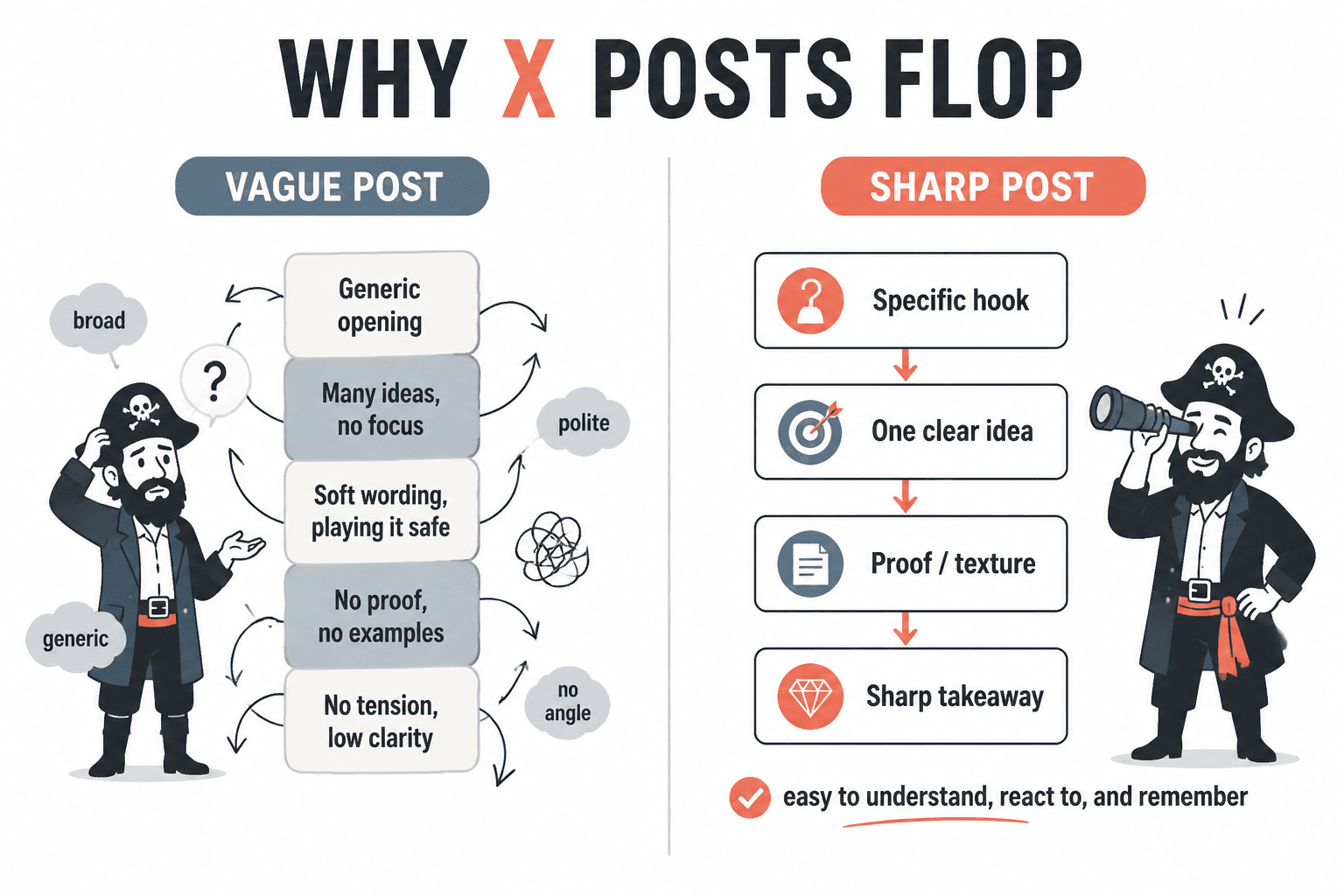
The core rule: one post, one clean idea
If you want better results, stop stuffing three half-developed thoughts into one post.
A good X post usually has one center of gravity. One claim. One observation. One contrast. One lesson. The tighter the post, the easier it is for someone to understand it, react to it, quote it, or remember you because of it.
That does not mean every post has to be tiny. It means every post needs a clear spine.
Weak version
Building a brand takes time, consistency, patience, experimentation, and really understanding your audience because content is always evolving and what works now may not work later.
Stronger version
Most people do not have a content consistency problem.
They have an idea clarity problem.
It is hard to post regularly when every draft sounds like a blur of “value.”
The second version gives the reader something they can grab onto. It names a real issue, creates contrast, and sounds like an actual person with a point.
How to write X posts people actually stop for
You do not need magic formulas. You need a repeatable way to sharpen what you already know.
1. Start with the sharpest part, not the setup
Most drafts begin too early. The writer is thinking on the page and making the reader sit through it.
Cut the warm-up. Start where the tension begins.
Instead of:
I have been thinking a lot lately about how creators approach content strategy and I think one thing that is often overlooked is…
Try:
Most creators do not need more content ideas.
They need better filters for which ideas are worth posting.
2. Make the idea specific enough to matter
Specificity is what makes a post feel real. Vague posts sound correct. Specific posts sound true.
Compare these:
- Vague: Good content builds trust.
- Specific: Content builds trust faster when it solves a real problem before asking for a call.
- Vague: Consistency matters on X.
- Specific: On X, 4 sharp posts a week beat 14 rushed ones that read like leftovers.
You do not need fake precision. You need enough detail that the post stops sounding like wallpaper.
3. Use tension, contrast, or a clean opinion
Flat statements rarely travel. Tension gives a post energy.
Simple ways to add it:
- What people think vs what actually works
- Common advice vs better advice
- Popular behavior vs smarter behavior
- Short-term gain vs long-term trust
- What sounds impressive vs what converts
Examples:
Being “consistent” on X is overrated if you are consistently posting forgettable things.
Some creators do not need a thread strategy.
They need one opinion strong enough to survive a single post.
4. Write for reaction, not applause
Good X posts often trigger one quick internal response: agreement, disagreement, curiosity, relief, recognition, irritation, interest.
That does not mean farming outrage like a content goblin. It means writing with enough clarity and edge that people have something to respond to.
If your post is so balanced and padded that nobody can tell what you mean, do not be shocked when nobody reacts.
5. End cleanly
A lot of X posts sag at the end. They make the point, then explain it again, then add a soft moral, then tack on a needy question.
Stop earlier.
If the point landed, leave it alone. Not every post needs a CTA. Not every post needs “What do you think?” hanging off the end like an afterthought.
Formats that work well on X for creators
You do not need to use every format. You need a handful that fit your voice, your audience, and your goals.
Opinion posts
These work when you say something clear, useful, and defensible.
“Be yourself” is lazy content advice.
Better advice:
be legible.
If people cannot quickly tell what you do, who you help, or why your perspective matters, personality will not save the post.
Observation posts
These point out a pattern your audience recognizes but has not phrased as cleanly.
A lot of “thought leadership” is just normal advice rewritten until it sounds allergic to plain English.
Mini-lesson posts
Teach one thing, fast.
Quick writing fix:
If your first line needs the second line to become interesting, the first line is probably dead weight.
Reaction posts
These work well when something in your niche happens and you have an actual take, not just a paraphrase of the room.
If you want more practical formats for this style, read simple X reaction post templates for busy creators.
Proof posts
Not chest-thumping. Just useful evidence.
One of the fastest ways to improve a weak post:
replace “share value” with one actual example.
Generic advice gets nods.
Specific examples get saved.
Question posts
These are risky because most of them are boring. But a sharp question can pull good replies if it gives people something specific to react to.
Weak:
What is your favorite productivity tip?
Better:
What content habit gave you the biggest improvement:
posting more,
editing harder,
or choosing better topics?
What creators should stop posting on X
Some post styles look active but produce very little.
- Vague aphorisms: They sound wise for eight seconds and disappear.
- Overexplained simple points: X is not where every thought needs a padded essay.
- Borrowed founder cosplay: If you sound like a template of somebody else’s voice, people can feel it.
- Fake-deep posting: “The universe rewards aligned action” is not doing much for anyone.
- Soft self-promo: If the post only exists to funnel people toward your thing, it usually shows.
- Thread fragments posted as singles: Some ideas need structure. Some should be cut. Posting a random middle sentence is not strategy.
Also: stop posting “just to stay visible” if the post has no real point. Visibility without usefulness is mostly just repetition.
And repeated mediocrity does not become brand-building because it happened on schedule.
How to make your X posts more useful and more shareable
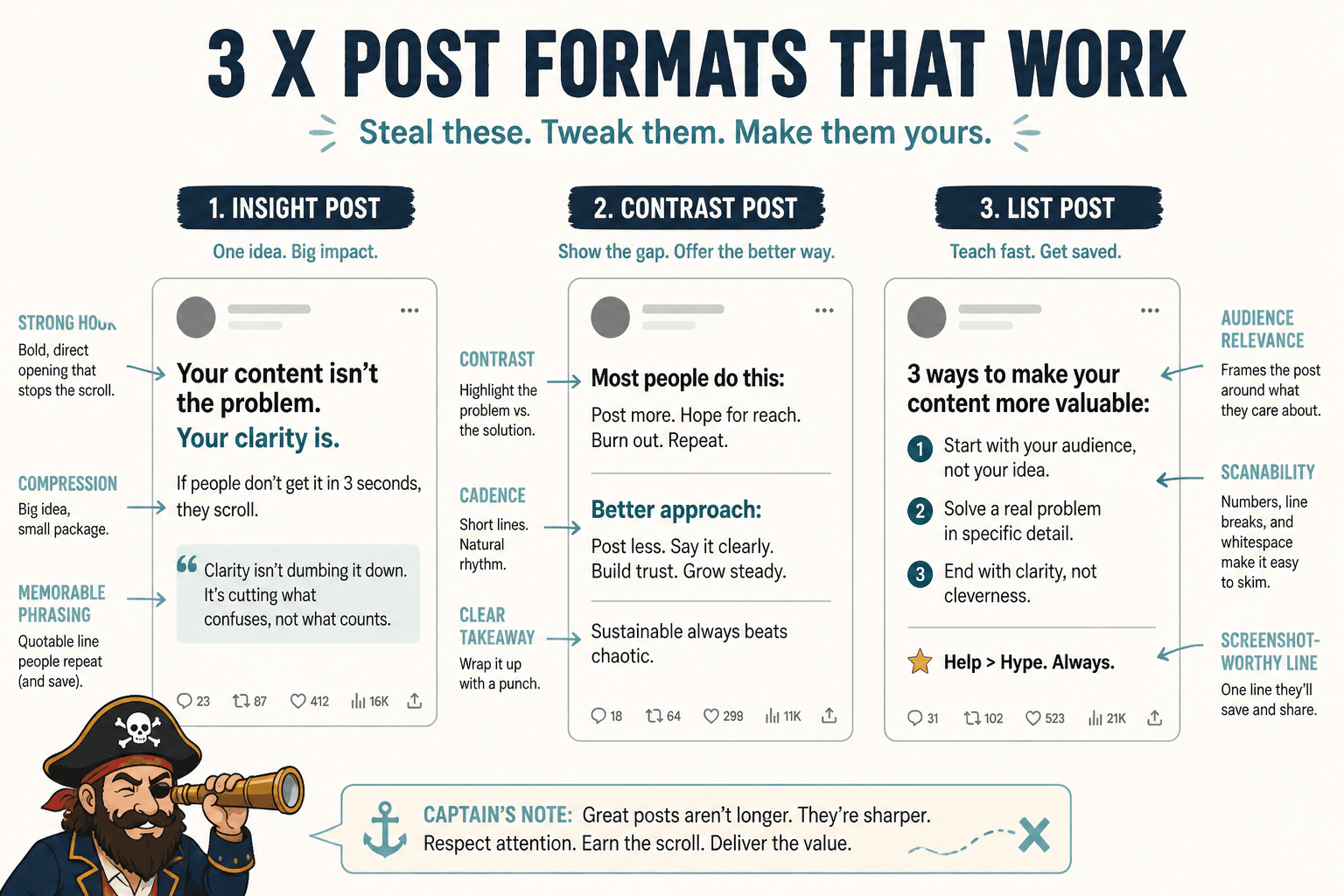
The best X posts are usually easy to repeat. They have a line, frame, or insight someone else wants to quote because it helps them express something cleanly.
Here is what helps:
- Compression: Cut anything the reader can infer.
- Contrast: Show a difference that matters.
- Cadence: Use line breaks when they improve rhythm, not because the keyboard is slippery.
- Memorable phrasing: One clean sentence beats five blurry ones.
- Audience relevance: Make sure the point fits what your people actually care about.
One useful test: if someone screenshots your post, what is the sentence they are trying to keep?
Write more of those.
A simple workflow for writing better X posts consistently
You do not need to be online all day harvesting thoughts from the timeline like a stressed little raccoon. A better system helps more than constant presence.
Step 1: Collect raw ideas
Save things you notice:
- Questions clients ask
- Bad advice you keep seeing
- Patterns from your own work
- Strong reactions to industry trends
- Lines from longer content that can stand alone
Step 2: Find the sharpest angle
Before writing, ask:
- What is the actual point?
- What part is surprising, useful, annoying, or clarifying?
- Can I say this in one sentence first?
Step 3: Draft long, then compress hard
It is fine to draft messy. But do not post the messy version.
Cut filler. Remove duplicated meaning. Tighten the language until the post feels like it has bones.
Step 4: Check the first line
If the first line does not carry weight, rewrite it.
Your first line should do one of these:
- State a useful opinion
- Name a real problem
- Create contrast
- Make a precise observation
- Trigger curiosity without sounding like bait
Step 5: Match the post to the goal
Not every post has the same job.
| Goal | Best post style |
|---|---|
| Reach | Sharp opinion, timely reaction, concise observation |
| Trust | Mini-lesson, proof post, clear insight from experience |
| Replies | Focused question, strong take, reaction post |
| Profile visits | Useful opinion with strong positioning signal |
| Leads | Problem-aware post that naturally points to a next step |
When you know the job, the writing gets easier.
How often should creators post on X?
There is no magic number. Annoying answer, yes. Still true.
For most creators, a realistic sweet spot is enough posting to learn fast without flooding your own standards into the floor. That often means posting regularly enough to test ideas, see patterns, and improve your writing rhythm, while leaving enough time to actually think.
If you can publish one sharp post a day, great. If you can do four to five solid posts a week, also great. If you are posting constantly but the quality is mush, that is not consistency. That is just public drafting.
Creators with smaller audiences should care less about hitting some mythical frequency target and more about relevance, clarity, and interaction. This is especially true if you are trying to attract clients, not just farm impressions. If that is your situation, this guide on X posts for creators with small audiences will help.
How to use AI without turning your X posts into synthetic mush
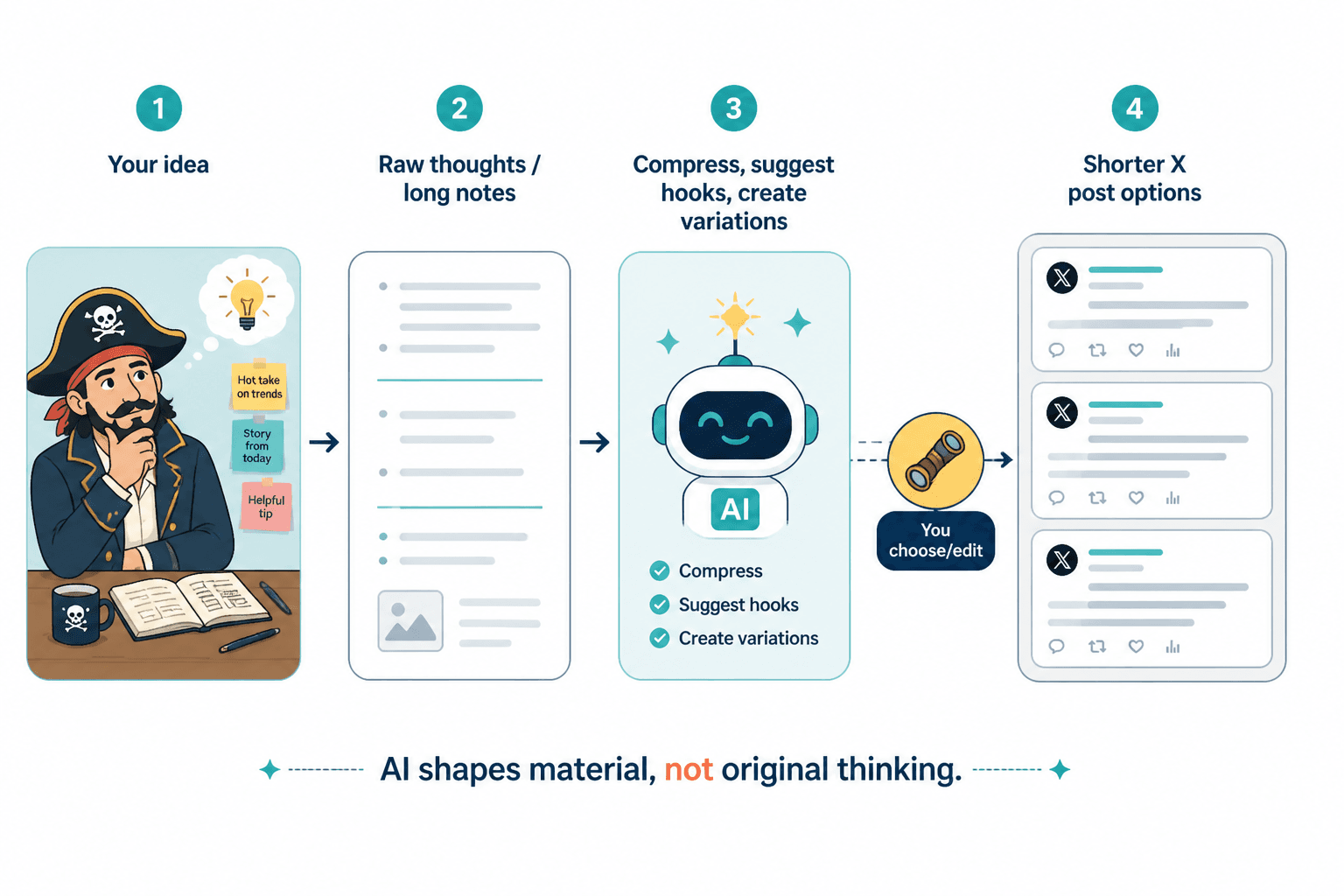
AI can help with speed. It cannot supply taste, timing, judgment, or lived perspective. Those are still your job.
Used well, AI can help you:
- Generate alternate hooks
- Compress a long idea into shorter versions
- Turn notes into rough drafts
- Create post variations for testing
- Organize raw ideas into categories
Used badly, it gives you polished emptiness. The kind of post that sounds vaguely competent and completely forgettable.
The fix is simple: do not ask AI to replace your thinking. Ask it to help shape material that already has a point. If you want tool suggestions, workflows, and realistic use cases, read the best AI tools for X posts.
Examples of stronger X post rewrites
Here is what better usually looks like in practice.
Rewrite 1: too vague
Before:
Building a personal brand takes patience and consistency. Keep showing up.
After:
“Keep showing up” is incomplete advice.
If your positioning is blurry, posting more just scales confusion.
Rewrite 2: too soft
Before:
I think many people underestimate the importance of editing in content creation.
After:
Most content does not need better ideas.
It needs one ruthless editing pass.
Rewrite 3: too long to get to the point
Before:
I have noticed over the past few months that many creators are spending a lot of time trying to optimize every detail of their systems when they might be better served by just focusing on the content itself and improving their message.
After:
Some creators do not need a better system.
They need a better sentence.
Rewrite 4: too generic
Before:
Engage with your audience and provide value consistently.
After:
“Engage with your audience” usually means nothing.
Reply like a person.
Ask better questions.
Say something specific enough that someone can answer it.
If you want more working formats to steal and adapt, check best X posts ideas and examples for creators.
How X fits into a broader content strategy
X works best when it is not carrying your entire business on its tiny, chaotic back.
Use it to test ideas, sharpen phrasing, build recognition, and start conversations. Then let your profile, offers, newsletter, long-form content, or services do the heavier lifting. A strong X presence can absolutely support leads and authority, but it usually works best as part of a system, not as the whole machine.
The bigger point is simple: clearer structure and clearer writing make the piece more useful. That is usually what makes the ending land better too.