
Small audiences usually do not have a content problem. They have a relevance problem, a clarity problem, or a “posting like they already have fans” problem.
That shows up fast on X. You post a vague insight, a polished mini-thread nobody asked for, or a generic motivational one-liner, and the platform gives you exactly what that deserves: not much.
X Posts for Creators With Small Audiences work when they are sharp, specific, and easy to react to. Not when they try to imitate bigger creators who can get traction by sneezing near a hot take.
If your audience is still small, that is not a reason to sound smaller. It is a reason to get more precise. The goal is not to post more “content.” The goal is to publish posts that make the right people think, “That is useful,” “That is true,” or “I want more from this person.”
Here’s how to write X posts that actually help small creators build attention, trust, and momentum without turning into another account posting recycled quote-tweet mush.
For the full path around this topic, head to the parent guide.
Why small creators should not copy big-account posting styles
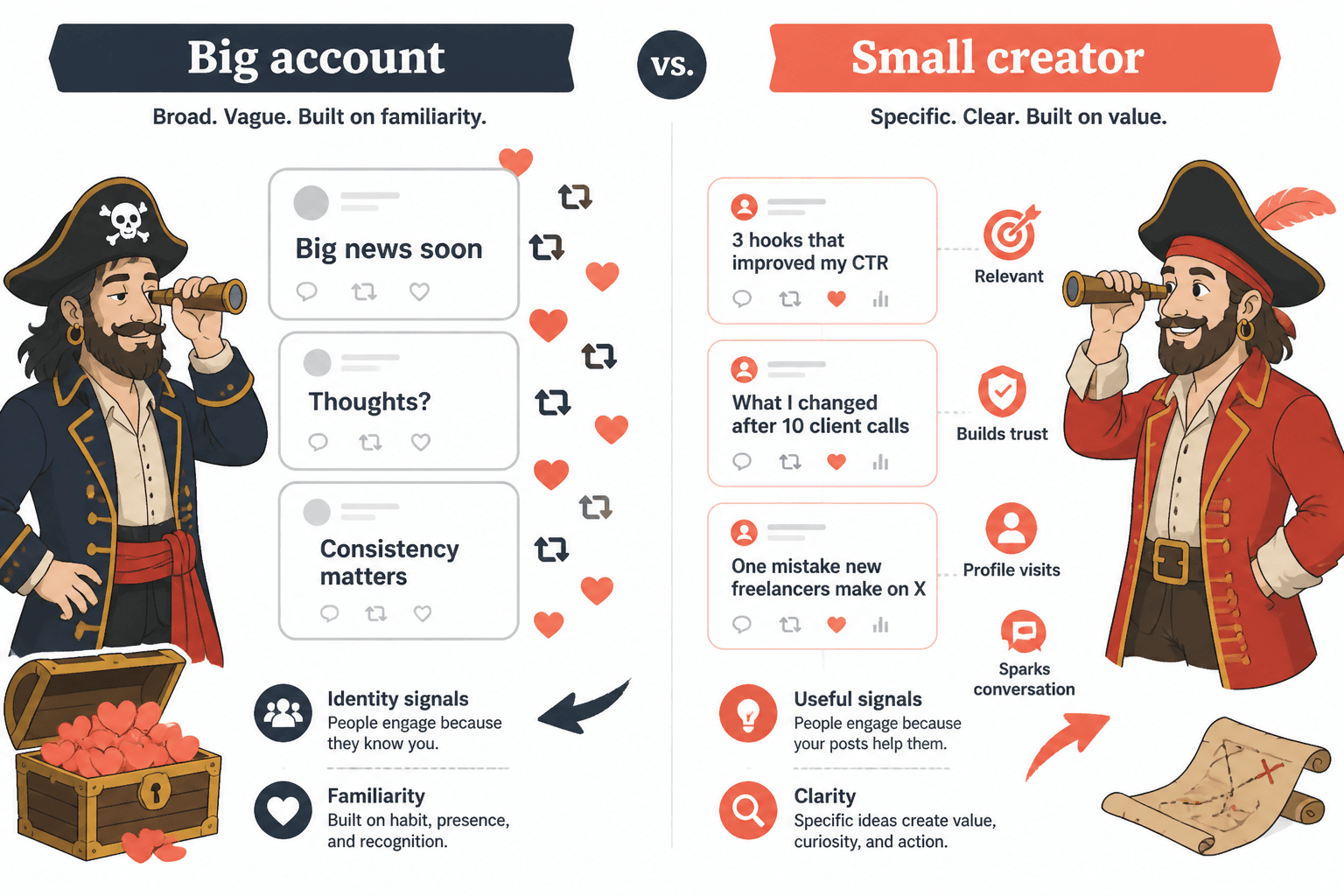
Big accounts can get away with things small accounts cannot.
They can post vague opinions. They can post weaker hooks. They can post half-finished thoughts because their audience already knows who they are and fills in the gaps for them.
You do not have that luxury yet.
When your audience is small, every post has to do a bit more work. It needs to earn attention from people who do not know you, make the point quickly, and give them a reason to care before they scroll into the next argument about AI, branding, or somebody’s weird productivity system.
- Big creators can rely on familiarity. Small creators need clarity.
- Big creators can post identity signals. Small creators need useful signals.
- Big creators can get engagement from audience habit. Small creators need relevance and sharp packaging.
That is why a lot of “just be consistent” advice feels useless. Consistency matters, sure. But consistent posting of bland, undercooked ideas is just an efficient way to get ignored on a schedule.
If you want broader platform guidance beyond this article, the site’s X posts library and the wider social media writing section are worth keeping nearby.
What X posts for creators with small audiences should actually do
If your account is still growing, your posts need to create one or more of these outcomes:
- Make your expertise obvious fast
- Show how you think
- Start small, relevant conversations
- Attract the right kind of follower, not just any follower
- Give people a reason to remember you
- Create enough trust that profile visits lead somewhere useful
Notice what is not on that list: “go viral.” That can happen, fine. But if you build your whole posting style around breakout reach, you usually end up sounding broader, safer, and less useful. Great for impressions maybe. Terrible for building a business-relevant audience.
For small creators, a post that gets 12 likes from the right people can be more valuable than a post that gets 800 from random drive-by accounts who will never read another thing you write.
A strong small-account post usually has these traits
- A clear point in the first line
- Specific language instead of vague life advice
- A useful opinion, observation, or lesson
- Enough edge to be memorable
- Enough substance to be worth saving or replying to
- No fake profundity dressed up as wisdom
The best types of X posts when your audience is still small
You do not need 47 content pillars. You need a handful of post types you can execute well and repeat without sounding repetitive.
1. Specific opinion posts
These work because they show taste. Taste is useful. It tells people how you think, what you notice, and whether your perspective is worth following.
Weak version: “Authenticity matters more than strategy.”
Better version: “A lot of creators do not have a strategy problem. They have a clarity problem wearing an authenticity hoodie.”
The better version has tension. It actually says something. It also sounds like a person, which helps.
2. Sharp practical posts
These are short, useful posts that solve a small problem fast.
Example:
If your post starts with 2 lines of context before the actual point, cut them.
Your first line should carry the idea, not warm up for it.
That kind of post works because it is immediately applicable. Small audiences respond well to things they can use now, not eventually.
3. Contrarian-with-a-point posts
You do not need fake controversy. You need useful contrast.
Example:
Most creators do not need more content ideas.
They need better standards for which ideas are worth posting.
This works because it pushes against a common assumption and gives the reader a cleaner way to think about the issue.
4. Micro case-study posts
Small creators often avoid proof posts because they think they need giant results. You do not. You need something concrete.
That could be:
- A post rewrite that improved engagement quality
- A content change that increased profile clicks
- A client messaging fix that improved replies
- A lesson from your own testing
Example:
I rewrote a client’s first line from “3 lessons from content strategy” to “Most content advice fails because it ignores buying intent.”
Same topic.
Better tension.
Way more profile curiosity.
5. Reaction posts with actual substance
Reaction posts are great for small accounts because they let you join active conversations without sounding like you are trying to hijack them. The trick is adding a real point, not just performing agreement in public.
Instead of:
This is so true.
Try:
Yes, and this is exactly why “post daily” advice falls apart for newer creators.
Volume helps only if the posts are clear enough to teach people what you’re about.
If you want more help here, this is a good place to link mentally to simple X reaction post templates.
How to write better X posts when nobody knows who you are yet
This is the part people skip because they want magic formulas. Annoying, but there is no magic formula. There is a process though, and it works better.
Start with a point, not a topic
“Content strategy” is a topic. “Most content strategy fails because creators write for approval instead of action” is a point.
X rewards compression. If you start with a broad topic, your post usually gets soft, abstract, and forgettable. Start with the sharpest version of what you mean.
Make the first line do real work
Your first line should carry one of these:
- A strong observation
- A useful challenge
- A sharp contrast
- A practical claim
- A surprising truth that still sounds believable
Bad first lines usually fail because they stall.
- “A quick thought on content…”
- “I’ve been thinking a lot about…”
- “Hot take:”
- “Unpopular opinion:”
If the line needs a warning label, it probably is not that strong.
Keep one post to one idea
Small creators often try to prove how much they know by cramming four ideas into one post. That usually weakens all four.
Pick one idea. Make it clean. Let the post breathe. If you have more to say, that is tomorrow’s post or a thread.
Write for reaction, not applause
Applause posts are polished statements people might like. Reaction posts create a response. Not fake outrage. Not bait. Just enough specificity or tension that the right people want to engage.
That could mean:
- Agreeing with a popular idea but adding a missing piece
- Disagreeing with a lazy industry cliché
- Turning a common mistake into a crisp lesson
- Naming something people feel but have not phrased well
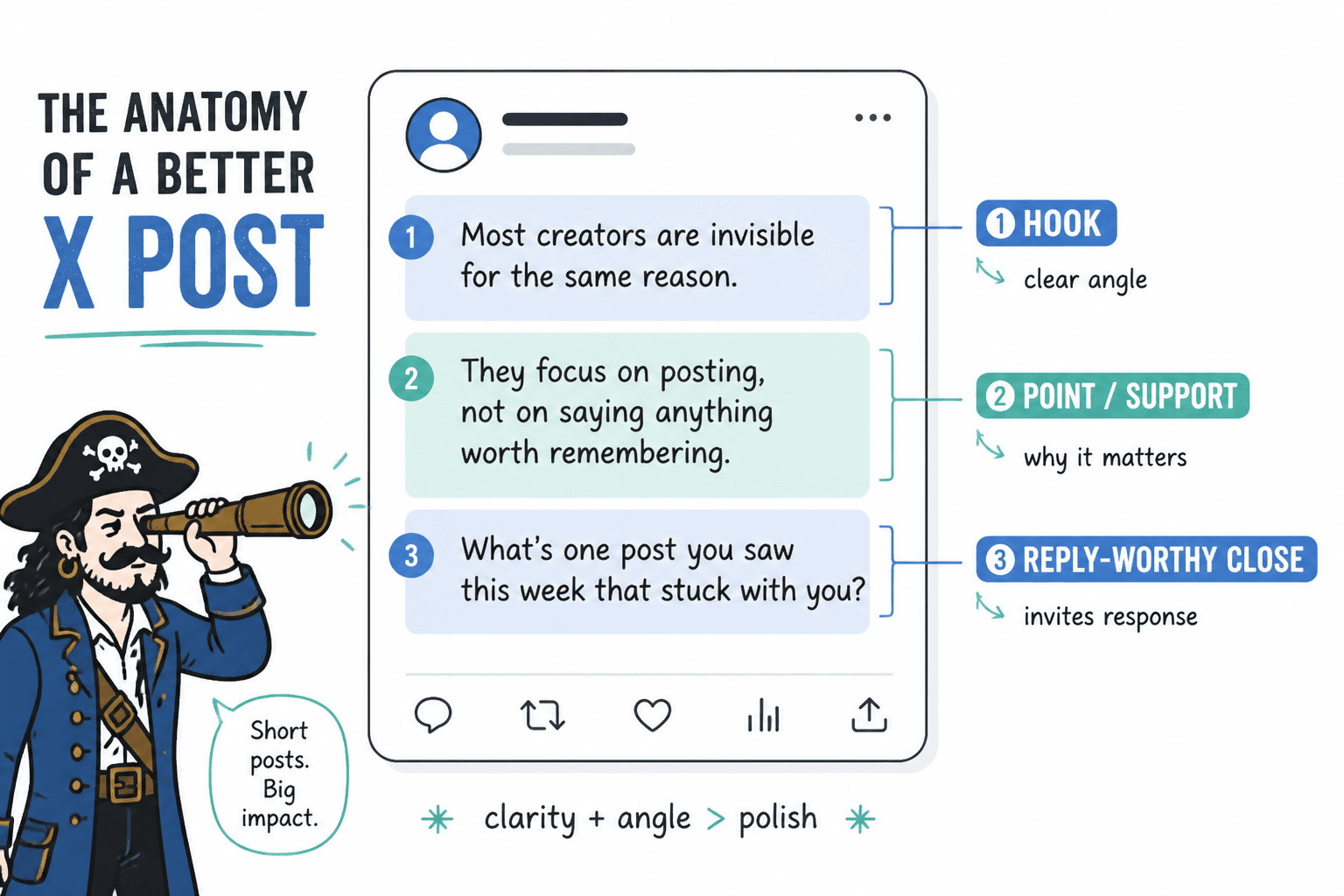
On X, clarity plus angle beats polish plus emptiness almost every time.
A simple framework for X posts for creators with small audiences
Use this when you want a post that is quick to write but still has some bite.
The Point → Why It Matters → Quick Payoff framework
- Point: Say the sharp thing.
- Why it matters: Give the consequence, contrast, or hidden reason.
- Quick payoff: End with a practical takeaway, a cleaner standard, or a reply-worthy closing line.
Example:
Most small creators are not losing on X because they lack value.
They are losing because their posts make people work too hard to find the value.
Clear beats smart-sounding almost every time.
Another one:
If your post could be copied by 500 other creators without changing a word, it is probably too generic to help you grow.
Style matters, but specificity matters more.
Say it in a way only you would say it.
This kind of structure is especially good for solo creators, coaches, consultants, and service businesses because it shows expertise without needing a huge story setup.
Common mistakes small creators make on X
Some of these are fixable in ten minutes. Some are personality issues with Wi-Fi. Either way, here are the big ones.
Posting vague “wisdom” instead of useful ideas
Example of weak vague wisdom:
Trust the process. Stay consistent. Great things take time.
That sounds nice. It also says absolutely nothing.
Better:
Consistency is overrated if your posts are too vague to teach people what you do.
Repetition helps only when the message is clear enough to stick.
Trying to sound bigger than they are
You do not need to sound like a keynote speaker. You need to sound observant, credible, and useful.
Over-polished authority voice often backfires on small accounts because it creates distance before trust exists. A cleaner, more direct voice usually performs better.
Using threads when a single post would do
Not every idea deserves a thread. If the point can be made in one strong post, make it in one strong post. Thread bloat is real, and readers can smell padding.
If you want broader structure ideas, pair this article with this guide to better X posts.
The bigger point is simple: clearer structure and clearer writing make the piece more useful. That is usually what makes the ending land better too.