Most LinkedIn posts do not fail because the writer is untalented. They fail because the post says something technically respectable in the blandest possible way.
You see it constantly: useful people with real expertise posting safe little paragraphs that read like they were approved by three middle managers and a timid AI prompt. The advice is not wrong. It is just forgettable.
If you want to learn how to write better LinkedIn posts, the fix is usually not “post more.” It is learning how to package your thinking so people actually stop, read, trust you, and remember you. That means stronger openings, sharper points, better proof, less waffle, and CTAs that do not sound like they escaped from a funnel from 2018.
This guide will help you write LinkedIn posts that feel clearer, more human, and more worth reading. Not louder. Not more “personal brand.” Just better.
To see how this fits into the wider strategy, open the parent guide.
What better LinkedIn posts actually do
A better LinkedIn post is not just polished. It does a job.
Usually that job is one of four things:
- Earn attention from the right people
- Build trust in your expertise
- Start relevant conversations
- Move readers toward a next step
That sounds obvious, but a lot of posts try to do none of those clearly. They just exist. They share a vague lesson. They announce a thought. They perform professionalism. Then the writer wonders why nothing happens.
Strong LinkedIn posts usually have a clear point, a relevant angle, and a reason for the reader to care now. They are not trying to impress everybody. They are trying to be useful, interesting, and credible to somebody specific.
If you want more depth on platform-specific strategy, the broader LinkedIn posts guide is a good companion to this one.

The biggest reason LinkedIn posts feel weak
Most weak posts are too abstract.
They say things like:
- Consistency matters
- Authenticity wins
- Relationships drive growth
- Storytelling is powerful
Sure. Fine. Nobody is fighting you on that. But those are poster slogans, not posts.
People engage when you make an idea concrete. Show where the principle breaks down. Show what people do wrong. Show what changed your mind. Show what to do instead. The more specific the point, the more likely it is to feel real.
Compare these:
Weak: Consistency on LinkedIn is the key to growth.
Stronger: Posting every day will not save weak positioning. A clear point twice a week beats seven posts that sound like business wallpaper.
One is a slogan. One is a point of view. LinkedIn rewards the second one a lot more often because it gives people something to react to.
Start with a sharper idea, not better wording
A lot of people try to fix boring posts at the sentence level. They swap in stronger verbs. They add line breaks. They ask ChatGPT to make it punchier. Meanwhile the underlying idea is still made of wet cardboard.
Before you write, pressure-test the idea itself.
Ask these five questions before drafting
- What is the actual point? Not the topic. The point.
- Who is this for? Founders? Coaches? Freelancers? Job seekers? Clients?
- Why would they care? Save time, avoid mistakes, get leads, sound smarter, convert better?
- What makes this angle not generic? A contrarian take, a specific example, a mistake, a framework, a pattern you keep seeing?
- What should the reader think or do after reading it?
If you cannot answer those cleanly, the post is not ready. Keep thinking.
Good posts are usually built on tension. Something people assume is true, but is not fully true. Something they are doing that feels sensible, but is hurting them. Something they say they want, but keep undermining in practice.
That tension is where the interesting post lives.
Your first line matters more than most of the post
If the first line is weak, the rest of the post rarely gets a chance.
LinkedIn is full of soft openings that burn the reader’s attention before the post has even started. Things like:
- I have been thinking a lot about this lately…
- Here is something I learned on my journey…
- I used to think X, but now I realize Y…
- I’m excited to share…
These openings are not evil. They are just tired. They signal that the real point is still warming up in the wings.
A stronger first line does one of three things fast:
- Makes a clear claim
- Names a mistake
- Creates useful curiosity
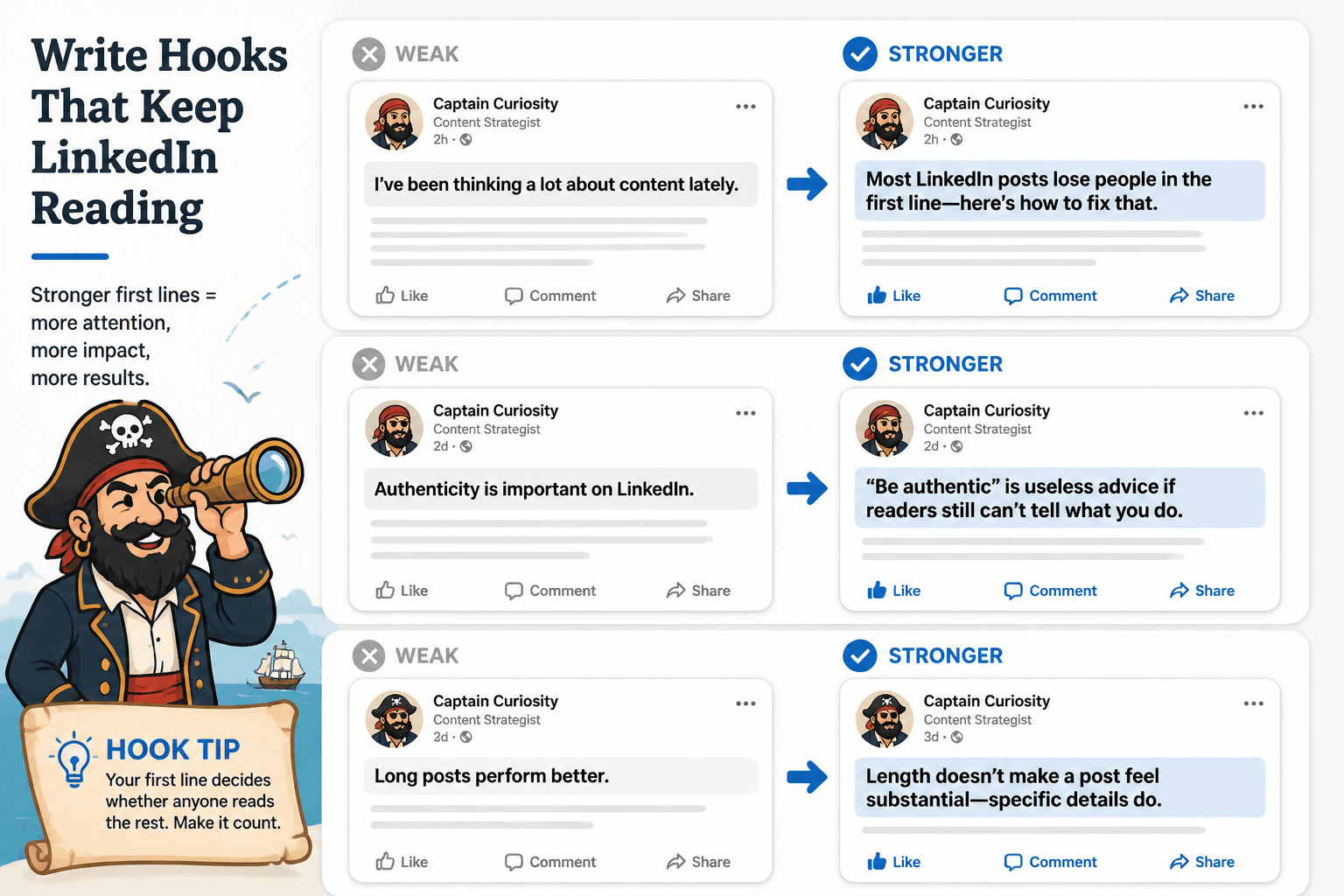
Examples of weak hooks and stronger rewrites
Weak: Here’s what nobody tells you about LinkedIn content.
Stronger: Most LinkedIn content does not fail because the writer lacks expertise. It fails because the post hides the expertise under vague, polite mush.
Weak: I used to think longer posts were better.
Stronger: Length is not what makes a LinkedIn post feel substantial. Specificity does.
Weak: Authenticity is important on LinkedIn.
Stronger: “Be authentic” is terrible LinkedIn advice if nobody can tell what you actually do.
If you want to get much better at this part specifically, read how to write better LinkedIn hooks and formatting and how to start LinkedIn posts without a weak opening.

Write one post around one clear idea
A common LinkedIn mistake is trying to fit three posts into one. The writer starts with a client lesson, pivots into mindset advice, adds a productivity point, then ends with a vague invitation to connect. The result feels blurry because it is.
One good post usually revolves around one core idea. You can support it with a story, a list, a contrast, a small framework, or an example. But the reader should be able to answer this question at the end:
What was this post actually trying to say?
If the answer comes back fuzzy, tighten the post.
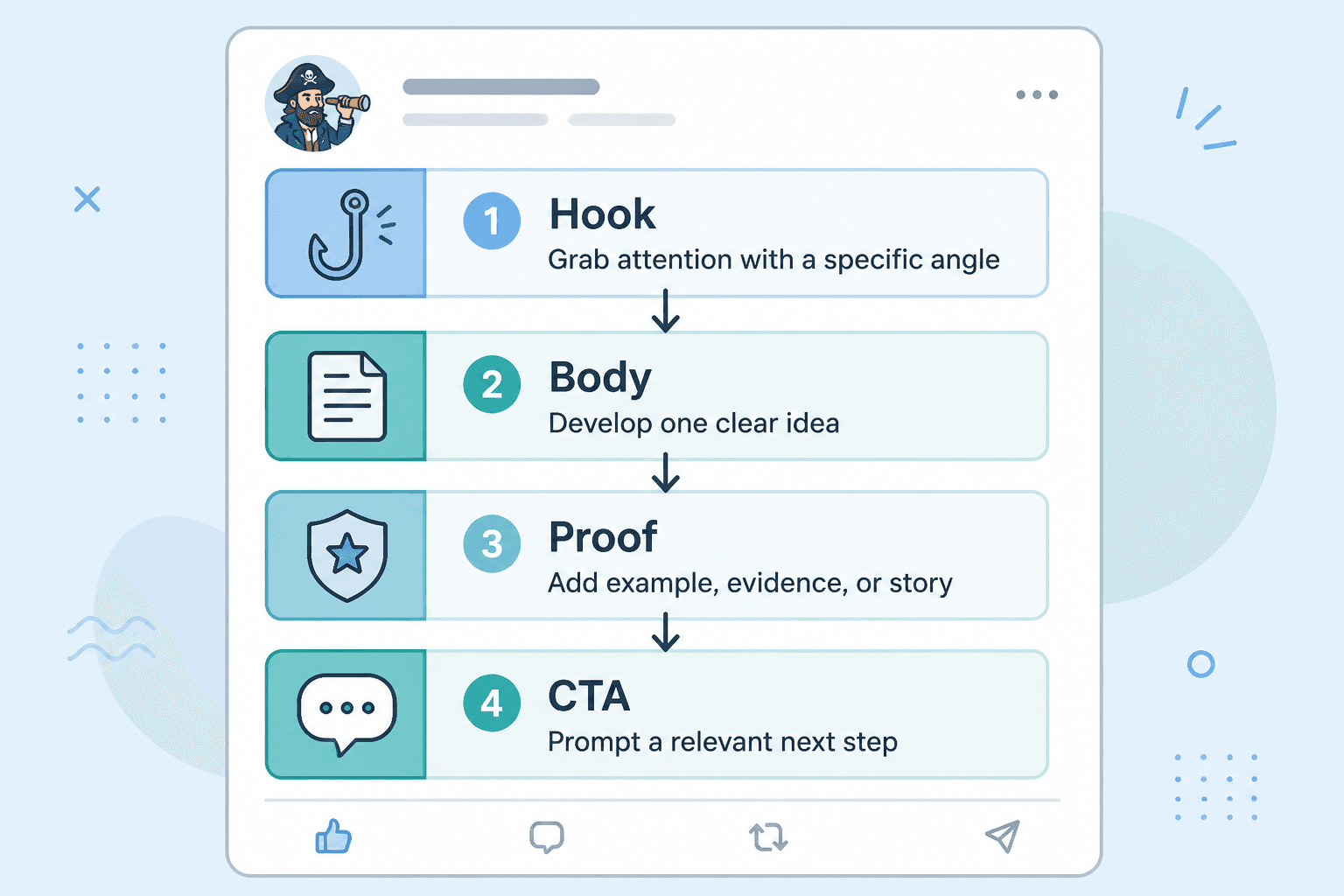
A simple post structure that works
- Hook: Open with the point, problem, or tension
- Context: Explain why it matters
- Development: Give examples, proof, contrast, or steps
- Takeaway: Land the lesson clearly
- CTA: Invite the next action without sounding needy
That structure is flexible enough for short posts, list posts, mini-rants, client insight posts, and thought-leadership posts that do not smell like they were grown in a corporate greenhouse.
Use proof, not just opinions
Opinions are useful on LinkedIn. Unsupported opinions are a bit less charming.
If you make a claim, help the reader trust it. That does not mean turning every post into a case study. It means giving the idea some weight.
Proof can look like:
- A pattern you have seen across clients
- A mistake you repeatedly notice in your niche
- A quick before-and-after example
- A tiny story with a real takeaway
- A clear explanation of cause and effect
- A result, if you can share it honestly and without chest-thumping
For example:
Flat claim: Most service providers need better positioning.
Stronger claim with proof: Most service providers do not need more content ideas. They need clearer positioning. You can see it in the bios: too many roles, no audience, no proof, and a CTA that asks people to “connect” as if that is a business model.
Now the point has texture. It sounds observed, not manufactured.
Make the post easy to read without formatting every line like it is panicking
Formatting matters on LinkedIn because big text blocks feel heavier on-platform than they do in a doc. But some people react by writing posts where every sentence gets its own dramatic line break.
That style can work occasionally for rhythm. Used constantly, it feels strained. Like the post is trying very hard to sound important.
Better LinkedIn formatting rules
- Keep paragraphs short
- Use line breaks to improve readability, not fake intensity
- Use lists when they genuinely help
- Put the strongest lines where tired scrollers can still catch them
- Cut filler transitions that slow momentum
If your post reads well only because it is broken into 19 tiny fragments, the issue is probably not formatting. It is weak writing wearing a visibility costume.
Sound like a person, not a polished content appliance
One of the fastest ways to make your LinkedIn posts worse is over-sanitizing them.
Writers often scrub out all personality in the name of sounding professional. The result is content that is technically competent and emotionally dead. It sounds like no one. Which means it connects with no one especially well.
You do not need to become wildly casual. You do not need forced vulnerability. You do not need to narrate your childhood wounds to explain your consulting offer. Please do not.
You just need to sound like a clear-thinking human with a real point of view.
What that usually means
- Use plain English
- Say “you” when you mean the reader
- Cut buzzwords you would never say out loud
- Keep a little texture in your sentences
- Allow mild opinion where it is earned
For help with this specific problem, see how to write LinkedIn posts without sounding salesy or robotic.
There is a difference between credibility and stiffness. A lot of LinkedIn writers still have not met it.
Stop writing posts that only say what everybody already agrees with
One underrated way to improve your LinkedIn writing is to stop aiming for universal approval.
Posts that try to offend nobody often say nothing memorable. You do not need to become inflammatory. You do need to stop sanding every idea down until it could decorate an airport lounge.
A useful LinkedIn point often has some edge to it:
- A misconception it pushes against
- A mistake it calls out
- A tradeoff it names
- An opinion it defends
Examples:
- “Thought leadership” is often just recycled advice with better spacing.
- More content is not always the fix. Better packaging usually comes first.
- If your CTA sounds like a brochure, readers will treat it like one.
- Personal stories only work when they support a relevant business point.
That kind of writing gives readers something to latch onto. It feels like a person made a choice.
Use stories carefully, not constantly
Stories work on LinkedIn because they create movement and make lessons easier to remember. But story-led posts are often overused, overlong, and oddly theatrical.
The point of the story is not the story. The point is the insight the story earns.
Good story posts usually do this
- Start with a moment of tension
- Stay relevant to the audience
- Get to the point quickly
- Extract a lesson people can use
- Avoid sounding like a movie trailer for your self-awareness
If the story takes 12 lines to arrive at a very normal insight, cut harder. Readers are generous, but not that generous.
Write CTAs people can say yes to
A lot of LinkedIn posts end badly. Not because the post was bad, but because the CTA suddenly shifts into weird webinar energy.
Things like:
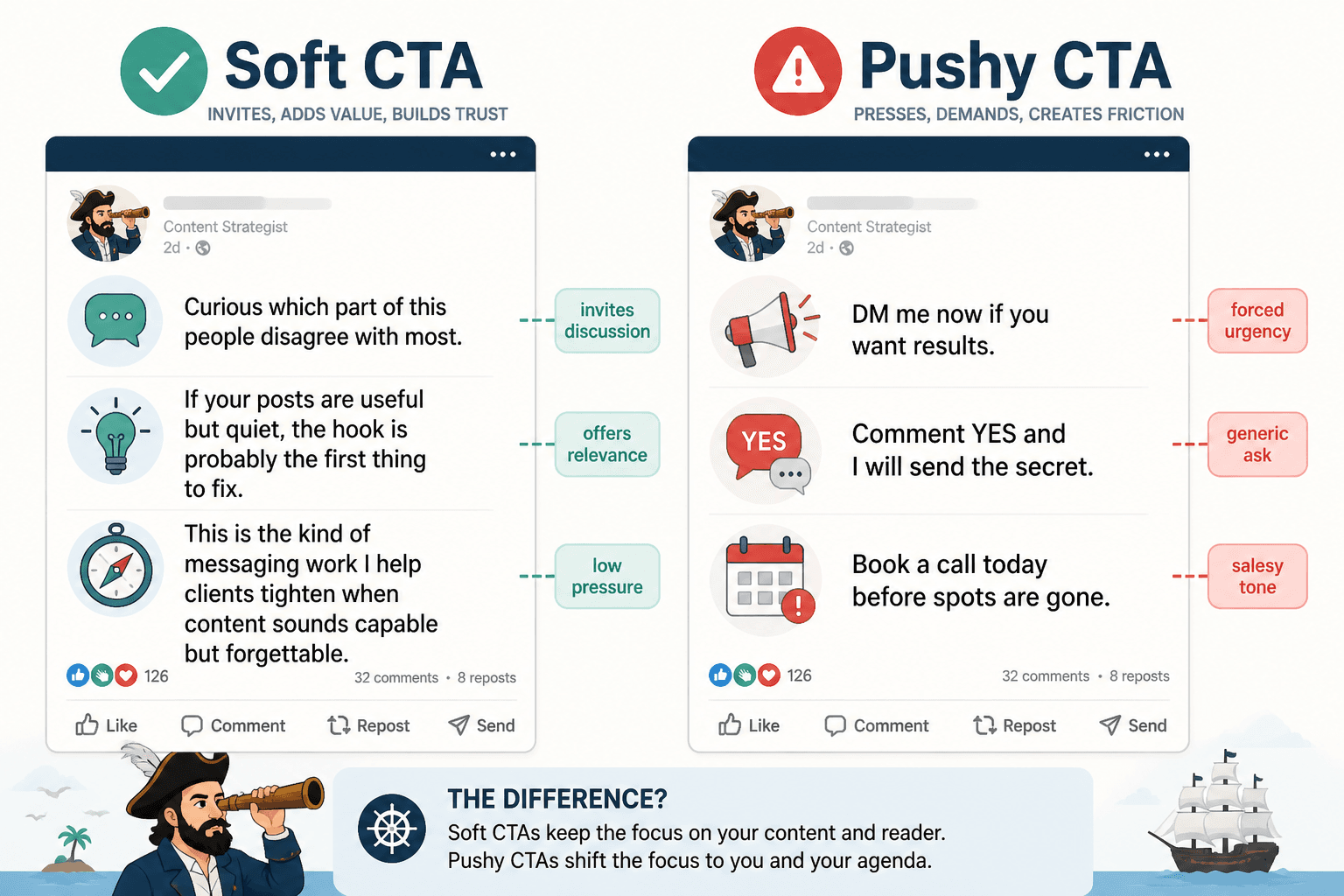
- DM me “GROWTH” for my framework
- Follow for more value
- Book a call if this resonates
- Comment YES if you agree
Sometimes those can work. Often they feel clunky, premature, or aggressively optimized.
A better CTA fits the post and the relationship stage. If the post is top-of-funnel, ask for a light action. If the post has real depth and relevance, you can ask for more.
Better LinkedIn CTA options
- Invite a specific opinion: “Curious which part of this people disagree with most.”
- Prompt reflection: “If your posts are useful but quiet, the hook is probably the first thing to fix.”
- Bridge to service softly: “This is the kind of messaging work I help clients tighten when their content sounds capable but forgettable.”
- Point to a resource: “If this is your current struggle, the next thing to fix is your hook and formatting.”
And if you want better endings specifically, read better LinkedIn posts CTA endings for personal brands.

A practical writing process for better LinkedIn posts
If writing LinkedIn posts feels harder than it should, the problem may not be talent. It may be that you are trying to improvise everything live.
A simple process helps. Here is one that works well for creators, consultants, coaches, and personal brands who want useful posts without turning content into a full-time job.
Step 1: Capture raw ideas from real work
Do not rely on “content inspiration.” It is flaky. Instead, collect ideas from actual client conversations, common objections, mistakes you keep seeing, useful phrases you repeat, and opinions that come up in your work.
That material is usually stronger than random brainstorming because it is already tied to reality.
Step 2: Find the sharpest angle
Take a rough topic like “content consistency” and ask:
- What are people getting wrong about it?
- What part is most misunderstood?
- What is the non-obvious takeaway?
- What would make this feel specific to my audience?
Now you have a post angle, not just a topic.
Step 3: Draft badly, then tighten
Get the point out first. Then edit for clarity, specificity, rhythm, and force. Trying to sound polished too early is how people end up writing frozen nonsense.
Step 4: Cut the throat-clearing
Delete any intro that merely warms up. Delete any sentence that repeats what the last one already said. Delete filler words that soften the point for no reason.
LinkedIn posts usually improve when you remove the first two lines and the last vague paragraph.
Step 5: Match the CTA to the post
Do not staple the same CTA onto everything. A reflective post, practical list, mini case study, and opinion post do not all need the same ending.
Before and after: a quick LinkedIn post rewrite
Here is what this looks like in practice.
Before:
Storytelling is one of the most powerful tools in marketing.
People connect with stories more than facts.
As business owners, we need to remember that our audience wants authenticity and connection.
So next time you create content, think about how you can use storytelling to build trust and grow your brand.
What do you think?
Nothing here is false. It is just generic enough to evaporate on contact.
After:
Most people are not bad at storytelling on LinkedIn.
They are bad at making the story matter.
A post about your rough Monday is not content strategy just because it ends with “people buy from people.”
A useful story does 3 things:
1. Starts with tension
2. Connects to a real business point
3. Gives the reader a takeaway they can use
If the story could disappear and the post would say the same thing, it was decoration.
That is the part worth fixing first.
The rewrite works better because it has a point, some tension, and a practical takeaway. It sounds like someone noticing a real problem, not reciting accepted content lore.
What to stop doing if you want better LinkedIn posts
- Stop opening with limp setup lines
- Stop posting vague lessons everybody already agrees with
- Stop trying to sound impressive instead of clear
- Stop using fake vulnerability as a trust shortcut
- Stop turning every post into a pitch
- Stop copying creators whose audience and business model are nothing like yours
- Stop assuming a good idea can survive weak packaging
This matters more than people think. A lot of LinkedIn improvement comes from subtraction. Better posts are often not more complicated. They are just less padded, less vague, and less desperate for applause.
A simple checklist before you publish
The bigger point is simple: clearer structure and clearer writing make the piece more useful. That is usually what makes the ending land better too.
LinkedIn posts usually improve when the point gets clearer and the fluff gets shorter. Stronger usefulness tends to outperform polished vagueness.