
Most LinkedIn CTAs are either too timid to matter or so thirsty they practically grab the reader by the lapels.
You have probably seen both versions. The soft one ends with “What do you think?” after a post that did not earn a discussion. The aggressive one jumps from a mildly useful insight straight into “DM me ‘GROWTH’ for my framework,” as if trust is just a fun optional extra.
If you want better LinkedIn CTA endings for personal brands, the fix is not making them louder. It is making them fit. Fit the post. Fit the reader. Fit the relationship. Fit the actual business goal.
That is what this article will help you do: write CTA endings that feel natural, get more of the right response, and do not make your posts sound like they were assembled by a webinar funnel from 2019. We will cover what good LinkedIn CTAs actually do, what kinds of endings work for different post goals, and how to write them without killing the post in the final two lines.
For the main guide behind this topic, visit the parent guide.
What a LinkedIn post CTA is actually supposed to do
A CTA is not just a closing sentence. It is the bridge between attention and action.
On LinkedIn, that action might be small: leave a comment, visit your profile, think differently about a problem, remember your name, or send a message later when the timing is right. It might also be more direct: download something, reply to a post, book a call, or ask for details.
The problem is that many personal brands treat every CTA like it has to do one of two things:
- manufacture engagement
- force a conversion
That is why so many endings feel off. They are trying to extract instead of extend.
A good CTA should feel like the next logical step after the post. Not a costume change.
If the post builds trust and the CTA breaks the vibe, the CTA is the problem, not the audience.
Why most LinkedIn CTA endings for personal brands fall flat
There are a few repeat offenders here, and LinkedIn is full of them.
1. The generic comment bait ending
Things like:
- What do you think?
- Agree or disagree?
- Thoughts?
- Have you experienced this too?
These are not always wrong. They are just very often lazy. If the post does not create a strong angle, tension, or clear prompt, readers have nothing useful to add. So you get silence, or worse, the deeply enriching comment “Great post.”
2. The sudden sales lunge
This is when the post offers a decent point, then ends with something wildly over-eager:
- DM me if you need help scaling your authority
- Book a call today
- I help founders do this, message me now
Could this work sometimes? Sure. But if there is no proof, no context, no clear audience fit, and no reason to act now, it feels premature. A post is not automatically a sales page because you typed one.
3. The awkward “engagement question” nobody wants to answer
Readers do not want homework at the bottom of every post. Especially not vague homework.
If your post ends with “What is your biggest struggle with content?” you are asking strangers to do emotional admin for your metrics.
4. The mismatched tone shift
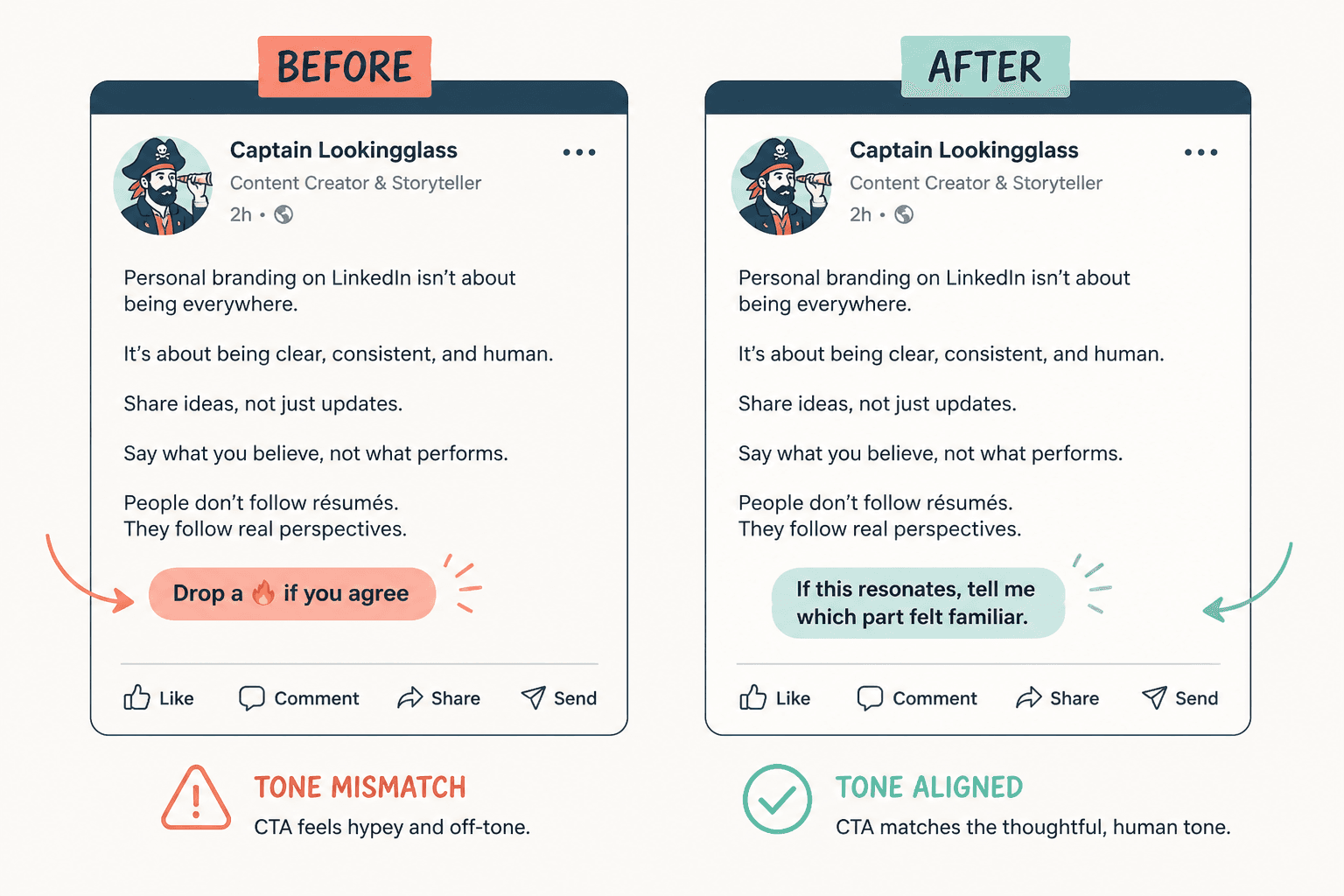
A thoughtful, grounded post ends with a hypey CTA. Or a practical, no-nonsense post ends with something cringe and overpolished. That tonal mismatch is enough to weaken trust.
People notice when your post sounds human and your CTA sounds like it was borrowed from a sales enablement intern.
The real job of a LinkedIn CTA ending
Before writing your CTA, decide what the post is actually trying to do.
Not every post should aim for leads. Not every post should aim for comments. And not every post needs a hard action at all. Some posts are there to sharpen positioning, build familiarity, or make the right person think, “This is exactly how I have been trying to say it.”
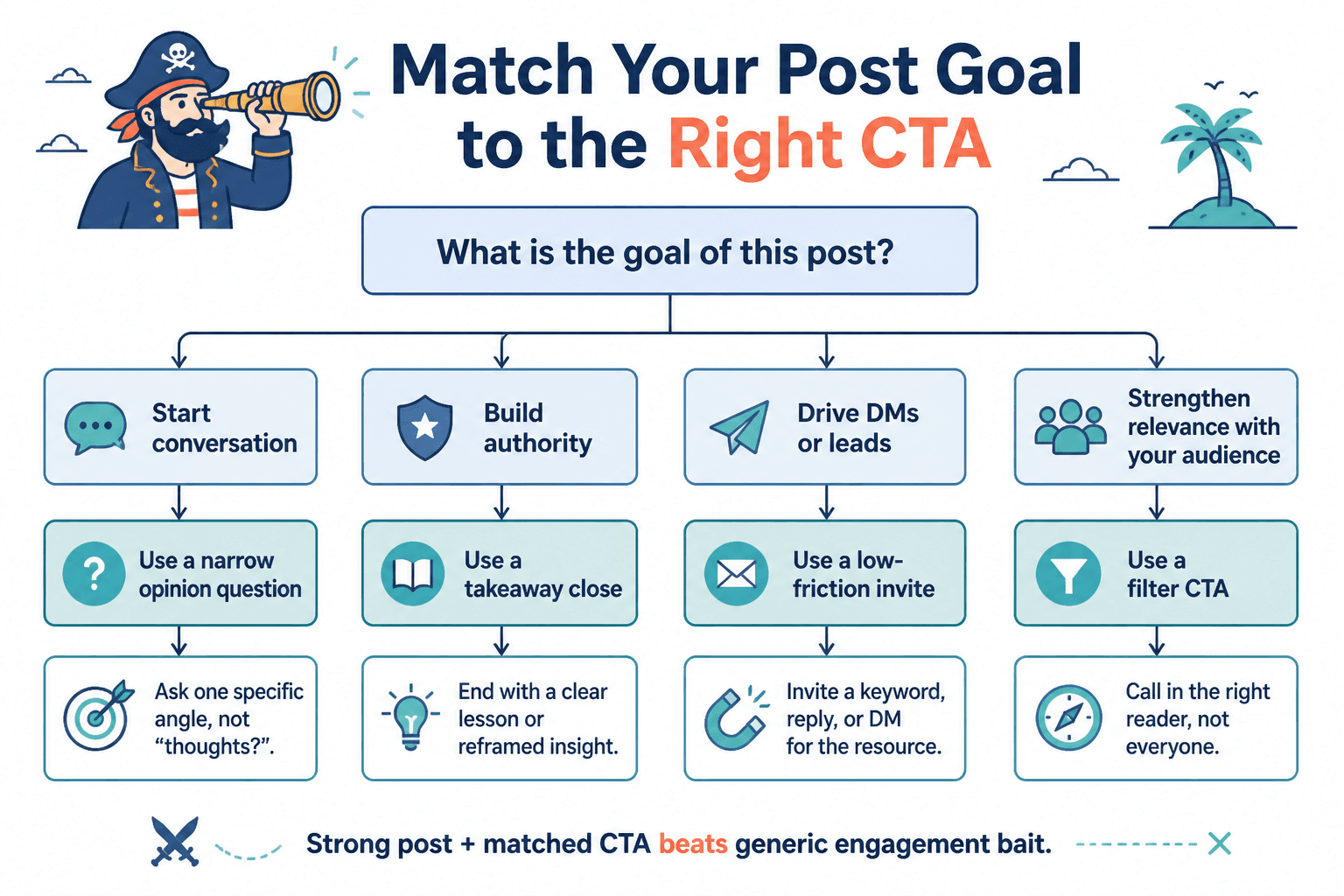
That means your CTA should match one of these common goals:
- Conversation: get thoughtful comments or stories
- Signal: reinforce what you stand for
- Profile action: nudge readers to check your profile or offer
- Lead generation: invite a message, reply, or opt-in
- Relationship building: encourage low-friction interaction
- Authority: leave the reader with a memorable final point
Once you know the goal, writing the ending gets much easier. You stop stuffing “What do you think?” onto everything like parsley on bad hotel eggs.
5 types of LinkedIn CTA endings that work better
You do not need dozens of CTA formulas. You need a few solid ones, used at the right time.
1. The opinion prompt CTA
Use this when your post contains a clear viewpoint and you want real discussion, not random applause.
Weak: What do you think?
Better: Are you seeing the same thing, or is this just a consultant-heavy corner of LinkedIn?
Better: Curious where you land on this: helpful simplification or oversold nonsense?
Why it works: It gives the reader a frame to respond to. There is tension. There is a point. There is an actual reason to answer.
2. The relevance filter CTA
Use this when you want the right people to identify themselves without sounding desperate.
Examples:
- If you are trying to turn expertise into posts without sounding like a motivational fridge magnet, this matters.
- This is especially useful if you sell through trust, not volume.
- If your content is getting polite likes but no real business traction, start here.
Why it works: It helps the right reader self-sort. That is useful on LinkedIn, where broad advice often gets broad and useless reactions.
3. The soft direct-response CTA
Use this when you actually want leads, but you do not want to sound like a damp sales script.
Examples:
- If you want help tightening your LinkedIn content strategy, send me a message. Happy to point you in the right direction.
- If this is the part your posts keep missing, DM me and I can show you the framework I use.
- If you are rebuilding your content around better-fit leads, that is part of my work. Feel free to reach out.
Why it works: It is direct, but not pushy. It sounds like a person, not a nurture sequence.
4. The profile-visit CTA
This one is underrated. Sometimes the best next step is not “comment below.” It is “go see who I am and what I do.”
Examples:
- If you are working on stronger LinkedIn content, there is more on this in my profile.
- I write about this a lot because most people are making the same few mistakes. More examples are in my profile.
- If this is your lane, you will probably find the pinned resources useful.
Why it works: It creates low friction. The reader can stay curious without committing to a public comment or a private message.
5. The clean closing line that is not really a CTA, but still works
Not every LinkedIn post needs a formal ask. Sometimes the strongest ending is just a sharp final thought that leaves a mark.
Examples:
- Clarity usually outperforms cleverness. Especially when money is involved.
- If people keep missing the point, the point probably is not clear enough yet.
- A lot of content does not need more polish. It needs more nerve.
Why it works: Strong endings increase memorability. And memorability matters more than forced engagement a lot of the time.
How to choose the right CTA ending for the post
Here is the simple version: match the CTA to the stage of trust and the type of post.
| Post type | Best CTA style | What to avoid |
|---|---|---|
| Opinion post | Opinion prompt | Generic “thoughts?” |
| Educational post | Profile visit or soft response | Hard sell out of nowhere |
| Story post | Reflection or conversation prompt | Forcing a lead magnet pitch |
| Proof/case-study post | Soft direct-response CTA | Vague engagement bait |
| Positioning post | Relevance filter or clean closing line | Asking everyone to comment |
This matters because CTA failure is often a strategy problem wearing a writing problem costume.
If your post is light, broad, or forgettable, no CTA will save it. But if the post is solid and the ending fits, the CTA can quietly do a lot of work.
For a stronger foundation, it helps to tighten the full post, not just the last line. These guides on how to write better LinkedIn posts and the broader LinkedIn posts guide for creators who want better results will help if your CTA is not the only weak spot.
Before-and-after examples of better LinkedIn CTA endings
Here is where this gets easier to use. Below are common weak endings and sharper rewrites.
Example 1: educational post
Weak: What do you think?
Better: If your posts are useful but forgettable, the issue is often not the advice. It is how the point gets framed.
Why this works: it extends the lesson instead of begging for a comment.
Example 2: opinion post
Weak: Agree?
Better: I think “just be consistent” is some of the laziest content advice on LinkedIn. Better message, worse cadence still wins. Curious if you see it the same way.
Why this works: it gives readers an actual opinion to respond to.
Example 3: service post
Weak: DM me if you need help with your content.
Better: If your LinkedIn posts are getting attention but not trust, that gap is fixable. Message me if you want help tightening the strategy behind them.
Why this works: it names a specific problem and makes the offer feel grounded.
Example 4: story post
Weak: Have you ever felt this way?
Better: A lot of creators do not need more content ideas. They need the nerve to say the sharper version out loud.
Why this works: it lands the point instead of dragging the reader into a vague feelings circle.
A simple formula for writing better LinkedIn CTA endings for personal brands
If you want a repeatable approach, use this:
The bigger point is simple: clearer structure and clearer writing make the piece more useful. That is usually what makes the ending land better too.