
Most LinkedIn story posts are not bad because they tell stories.
They are bad because they tell the safest, flattest, most pre-chewed version of a story possible. A polite little anecdote. A vague lesson. A predictable ending. Then a CTA that sounds like it was assembled from discarded webinar scraps.
That is usually why they get ignored.
If you want to know how to write better LinkedIn story posts without sounding generic, the fix is not “be more authentic” and it is definitely not “just tell personal stories.” The fix is learning how to make a story carry an actual point, a clear perspective, and enough specificity that it feels lived-in instead of manufactured for engagement.
Here’s how to write LinkedIn story posts that sound sharper, more credible, and much more like a real person with a brain than a content machine trying to cosplay relatability.
To see how this fits into the wider strategy, open the parent guide.
Why LinkedIn story posts so often sound generic
Most generic story posts follow the same tired formula:
- start with a dramatic but vague setup
- reveal a challenge everyone has already heard before
- land on a lesson so broad it could fit literally any profession
- end with “What do you think?” as if the post has earned a discussion
It is not the structure that ruins it. Story structure works. The problem is that the writer removes all the texture in an attempt to sound polished, inspiring, or broadly relevant.
So the post stops sounding true.
LinkedIn readers do not need your life story. They need a story that helps them see something useful: how you think, what you learned, what mistake mattered, what changed your approach, or why your perspective is worth paying attention to.
A story post works when it does at least one of these well:
- builds trust through specificity
- teaches through a concrete example
- shows judgment, not just emotion
- makes your expertise easier to believe
- gives a reader language for a problem they already have
If it does none of that, it is just diary content in a blazer.
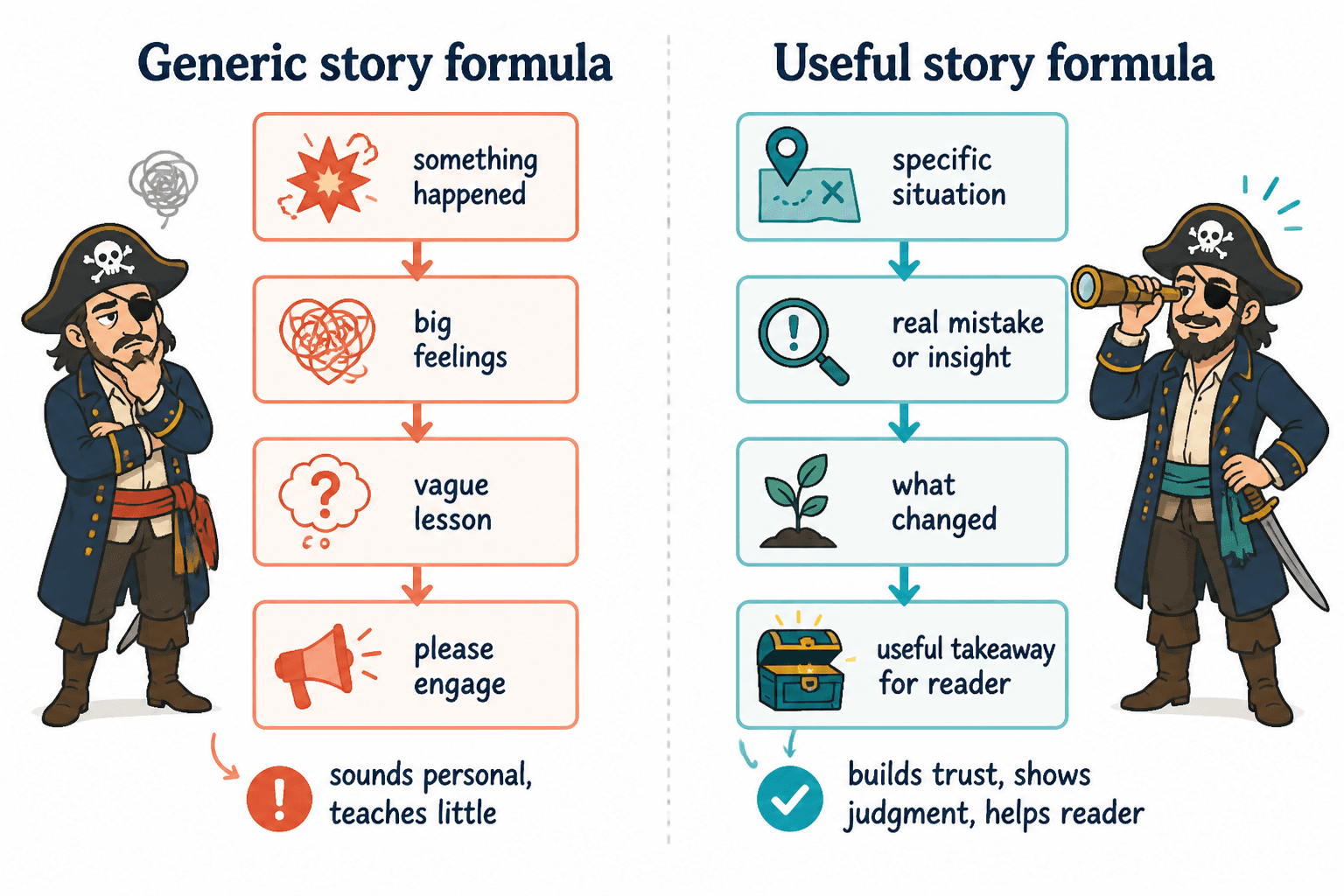
A good LinkedIn story post is not just a story
This is the part people miss.
A strong story post on LinkedIn is usually a mix of story, meaning, and positioning. It tells us what happened, but it also tells us what the event revealed, why it matters, and what kind of work or judgment you bring to the table.
That does not mean every post needs a dramatic transformation arc. Please do not manufacture one. It means the story should lead somewhere more useful than “I learned to believe in myself.”
Think of it like this:
- Story gives the post movement.
- Specificity gives it credibility.
- Perspective gives it value.
Without perspective, a story post is just content confetti.
Start with a moment, not a motivational slogan
Weak story posts often open with lines like:
- “I learned an important lesson this week.”
- “Success is not linear.”
- “Sometimes life teaches you what business cannot.”
- “I never thought this would happen to me.”
These are not openings. They are fog.
A better opening starts with a moment the reader can actually picture. A conversation. A mistake. A sentence someone said. A weird tension. A concrete scene. That is what creates attention.
Weak opening vs stronger opening
Weak: I learned a huge lesson about leadership last month.
Stronger: Halfway through the client call, I realized I was answering the question they asked instead of the problem they actually had.
Weak: Rejection can lead to redirection.
Stronger: A prospect told me, “You sound smart, but I still don’t know what you actually help people do.” Annoying. Also fair.
Weak: I used to think personal branding was about visibility.
Stronger: I spent three months posting consistently and got attention from people who were never going to buy, refer, hire, or matter. Visibility was not the problem. Relevance was.
If your first line feels like it could belong to 9,000 other creators, it is not ready. For more help with this part, readers should also check how to start LinkedIn posts without a weak opening and how to write better LinkedIn hooks and formatting.
Use more specificity and less summary
Generic story posts summarize too much.
They say things like:
- I faced a challenge
- I had doubts
- I worked hard
- I learned a lot
- It changed my perspective
Fine. But none of that lets the reader see anything.
You do not need to drown the post in detail. You just need enough texture to make it believable and useful. One sharp detail often does more than five abstract lines.
What specificity looks like in practice
- Name the real mistake, not “I made a mistake”
- Use the actual objection, not “I got pushback”
- Reference the real tension, not “it was difficult”
- Include the line someone said, not “I got feedback”
- Show the decision you made, not “I adapted”
For example:
Generic: I realized I needed to communicate more clearly with clients.
Better: I realized my proposal spent four paragraphs describing my process and one weak sentence explaining the outcome. Clients were not confused because they were inattentive. They were confused because I buried the part they actually cared about.
That second version gives the reader something they can steal, fix, or recognize in their own work. That is why it lands better.
Make the lesson narrower and more earned
The lesson is where many story posts fall apart.
The writer tells a decent story, then ruins it with a giant soft-focus conclusion like:
- Hard work pays off
- Authenticity wins
- You should always believe in yourself
- Challenges help us grow
Those are not insights. They are poster text.
A better lesson is smaller, sharper, and tied directly to what happened.
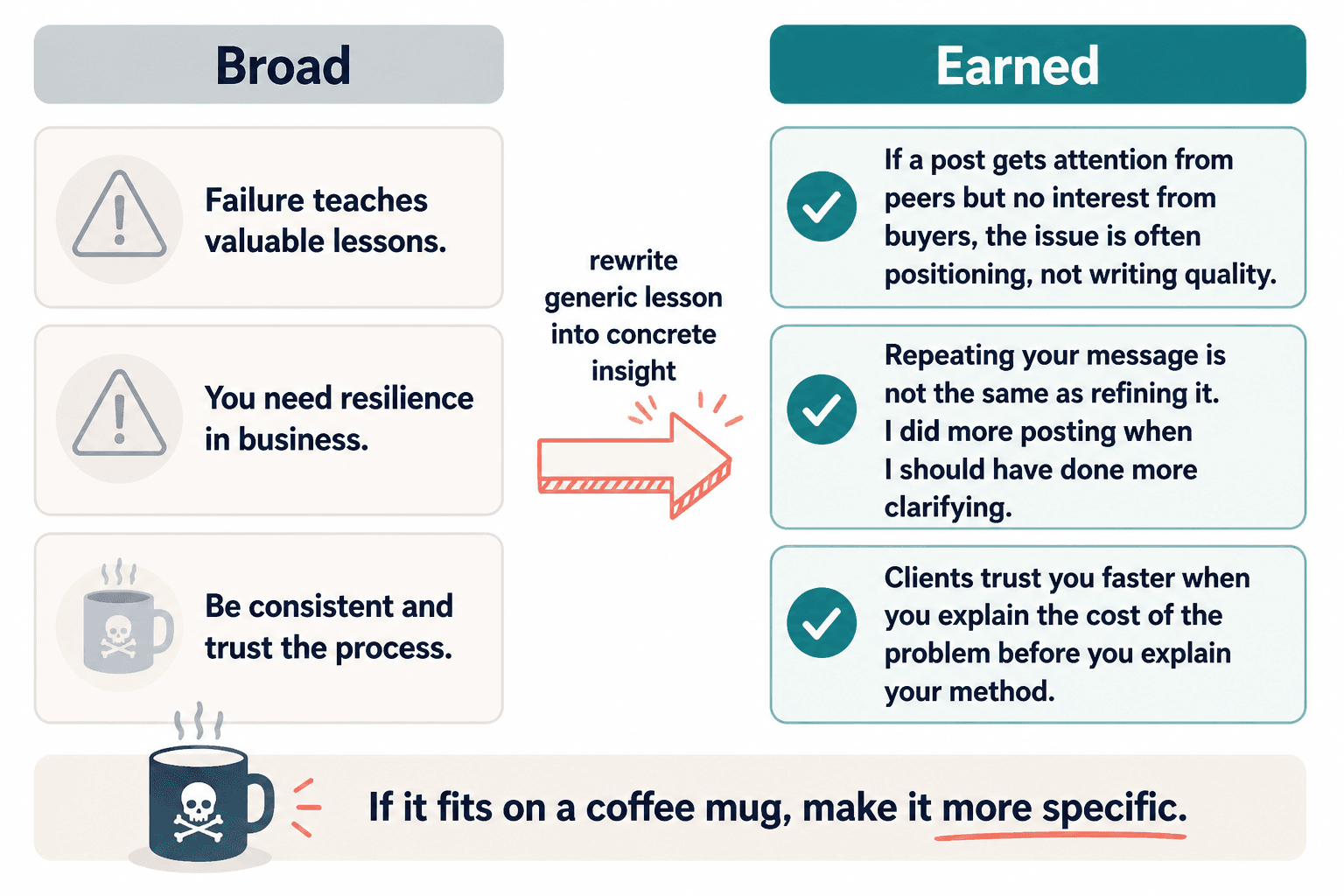
Broad lesson vs earned lesson
Broad: Good communication matters.
Earned: Clients trust you faster when you explain the cost of the problem before you explain your method.
Broad: Failure teaches valuable lessons.
Earned: If a post gets attention from peers but no interest from buyers, the issue is often positioning, not writing quality.
Broad: You need resilience in business.
Earned: Repeating your message is not the same as refining it. I did more posting when I should have done more clarifying.
This is a useful test: if your lesson could be copied onto a coffee mug, it probably needs work.
Do not confuse vulnerability with usefulness
LinkedIn has trained a lot of people to think story posts need emotional exposure to perform. They do not.
You can be honest without being performative. You can be personal without narrating your entire nervous system. And you can absolutely write strong story posts without dragging your private life onto the platform every three days like it owes rent.
The question is not “Am I sharing something vulnerable?”
The better question is “Does this story help the reader understand something useful about the work, the problem, the decision, or the lesson?”
Good story posts often reveal one of these instead:
- a professional mistake
- a shift in strategy
- a wrong assumption
- a client insight
- a behind-the-scenes decision
- a moment of clarity that changed your approach
That kind of honesty usually builds more trust than dramatic over-sharing ever will. Readers do not need your wounds. They need your judgment.
Use a simple structure that does not feel manufactured
You do not need a fancy framework, but structure helps. Especially on LinkedIn, where weak pacing kills attention fast.
Here is a simple structure that works well for story posts:
- Open with the moment
Start with a specific scene, tension, or line. - Show what was actually happening
Give enough context to make the moment meaningful. - Name the shift
What did you realize, change, or finally understand? - Extract the useful point
Turn the story into a lesson that applies beyond you. - End with a clean CTA or closing line
Not every post needs a question. Sometimes a sharp final line is better.
Mini template
Try this:
- Moment: “During [specific situation], [something revealing happened].”
- Context: “At the time, I thought [assumption].”
- Shift: “What I missed was [real issue].”
- Lesson: “That changed how I now [approach, write, sell, lead, build].”
- Close: “If you’re struggling with [relevant issue], check this in your own work.”
That gives your story shape without turning it into stiff corporate theater.
Before and after: turning a bland story post into a stronger one
Before
Last year, I had a difficult experience in my business that taught me a lot about resilience.
I was working hard, but things were not clicking.
I started to doubt myself.
Eventually, I realized success takes time and consistency.
Keep going. Your breakthrough might be closer than you think.
This is clean. It is also forgettable.
After
For three months, I posted consistently on LinkedIn and got the kind of feedback that sounds nice but pays terribly.
“Love this.”
“So true.”
“Great insights.”
No calls. No qualified leads. No real conversations.
I thought the problem was reach.
It was not.
The real problem was that my posts sounded thoughtful, but they did not make my work easy to understand. I was writing for approval, not clarity.
Once I started tying ideas to specific problems I solve, the response changed.
Less applause. Better leads.
Useful reminder: engagement can flatter you while your positioning quietly fails you.
That version works better because it gives us:
- a concrete setup
- recognizable tension
- a sharper realization
- a lesson relevant to the audience
- a closing line with actual bite
Formatting matters more than people admit
Even a good story can die in bad formatting.
LinkedIn readers skim first. Then maybe they commit. So your post needs to look readable before it proves it is readable.
That means:
The bigger point is simple: clearer structure and clearer writing make the piece more useful. That is usually what makes the ending land better too.