
A draft is open in one tab, keyword notes are in another, a headline analyzer is flashing red like a dashboard with a caffeine problem, and the AI tool you opened “just to get a few ideas” has produced twelve variations that all sound like they were written by the same overconfident intern. That is the usual headline stack: too many tools, not enough judgment, and a title that somehow gets less clear with each handoff. The fix is not more software. It is a lean system that helps you move from rough topic to a title worth publishing.
This guide focuses on the best AI tools for blog titles and headlines by job, not by hype. Some tools are good at brainstorming. Some are useful for tightening language. Some help with keyword direction and search intent. A few do all three badly. The point is to choose a small set that supports the writing process instead of turning it into a committee meeting.
If you want the broader framework behind title strategy, start with how to write better blog titles and headlines. For a related set of examples and patterns, see best blog titles and headlines ideas and examples for creators. And if titles are only half the problem, the next step is turning blog titles and headlines into more leads or sales.
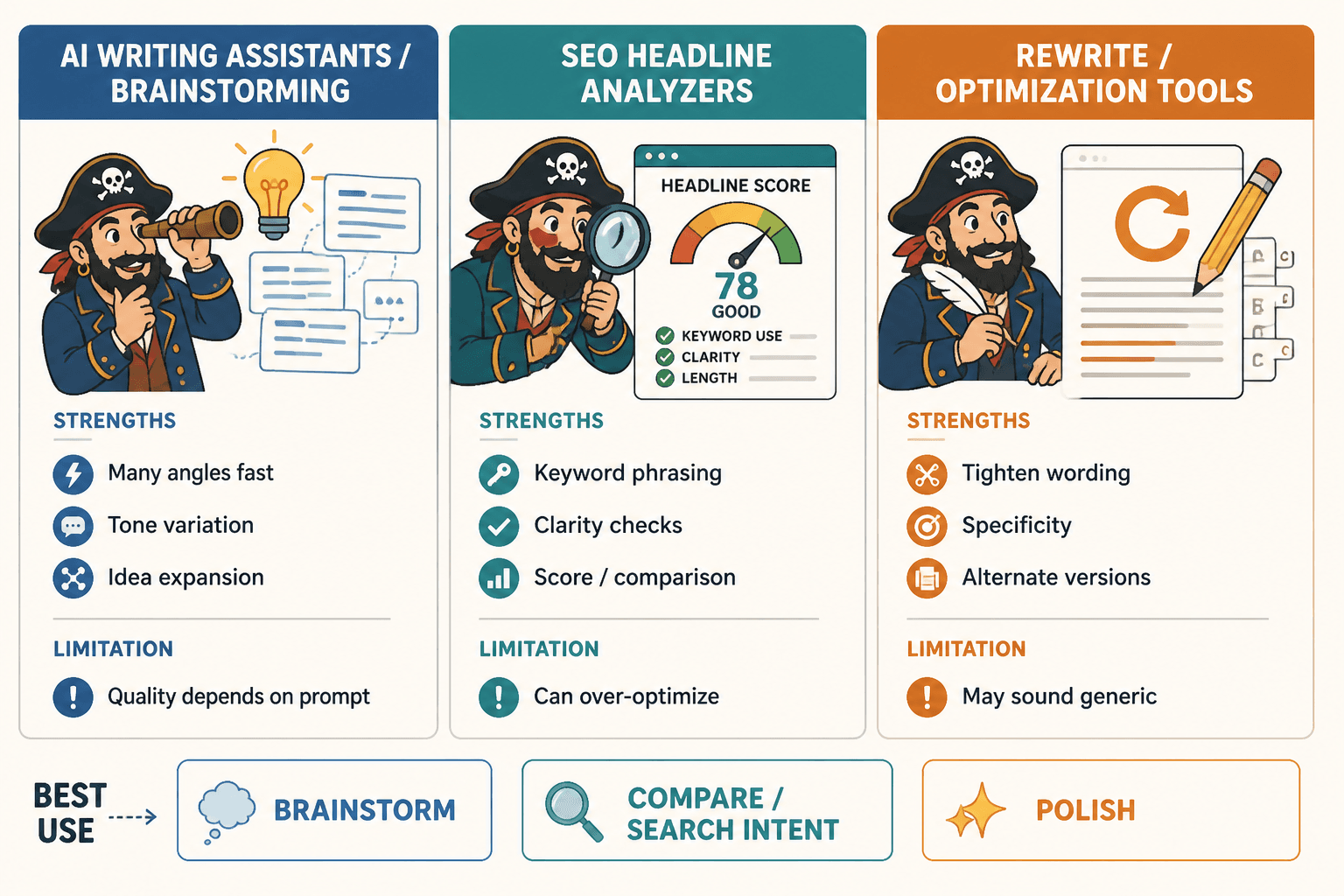
What AI headline tools actually help with
Good headline tools do not replace judgment. They reduce the number of bad options you have to inspect manually. That matters because blog titles and headlines tend to fail in predictable ways: they are vague, overstuffed, keyword-stuffed, or so polished they stop sounding like anything a real person would click.
The most useful tools usually help with one or more of these tasks:
- Brainstorming: generating a range of angle options fast
- Tightening: trimming filler and making the promise clearer
- SEO support: surfacing keywords, phrasing, and intent signals
- Comparison: showing which version is stronger on clarity or likely click appeal
- Workflow speed: getting you from topic to shortlist without blank-page drama
That is the job. Not “write the perfect headline.” Perfect is where drafts go to die.
The main types of AI tools for blog titles and headlines
Headline tools are easier to use when you sort them by function. The label on the homepage is often less useful than the actual job the tool performs.
1. Brainstorming tools
These are the broad AI writing tools and chat-based assistants that generate many headline variants from a prompt. They are useful when the topic is clear but the angle is not.
Best for:
- Starting with a rough topic
- Finding alternate angles
- Testing tone shifts, such as practical, bold, or curiosity-led
Watch out for:
- Generic phrasing
- Overuse of formulas
- Titles that sound slick but do not say much
Brainstorming tools are useful in the first 10 minutes of the process. They are less useful when you keep asking for “better” versions and end up with the same headline wearing different shoes.
2. Headline analyzers
These tools score or critique a title based on factors like balance, length, emotional language, or perceived click potential. They can be handy for trimming obvious problems.
Best for:
- Spotting overlong titles
- Finding weak or vague words
- Comparing two near-identical options
Watch out for:
- Scores that look objective but are really just one model’s preferences
- Encouragement to game the tool instead of improve the title
- False confidence when the wording is technically “good” but strategically wrong
Use analyzers as editors, not judges. They are good at saying, “This is too long,” and less good at saying, “This title actually serves the article.”
3. SEO and keyword tools
These tools help identify search terms, variations, and intent patterns. They are most useful when a post is meant to earn organic traffic and the title needs to match how people actually search.
Best for:
- Finding the core query
- Discovering related wording people use
- Checking whether a title aligns with search intent
Watch out for:
- Keyword phrases that sound unnatural in a headline
- Titles that chase volume but ignore the article’s actual promise
- Over-optimization that makes the headline feel machine-built
Google’s own guidance on helpful, people-first content is a good reminder here: write for clarity and usefulness first, not for keyword theater. See Google Search Central’s helpful content guidance for the principle behind that.
4. Rewrite and variant tools
These tools take one working title and produce alternates. They are the fastest way to get from “close” to “probably better.”
Best for:
- Testing different angles on the same promise
- Reducing fluff
- Making a title more direct
Watch out for:
- Synonym swapping that creates the illusion of progress
- Loss of nuance
- Headlines that become shorter but weaker
These are especially useful after you already know the angle. Before that, they can just rearrange the fog.
5. Content planning assistants
These are broader planning tools that help map a topic into sections, related questions, and possible title directions. They are more useful for editorial structure than for a final polished headline.
Best for:
- Turning one topic into a cluster of post ideas
- Spotting subtopic gaps
- Connecting the headline to the article’s structure
Watch out for:
- Planning outputs that are too generic to be useful
- Title ideas that do not match the eventual draft
For a broader systems view, the parent guide on blog titles and headlines is the right home base.
A lean workflow for choosing a strong headline
The best workflow is not “open every tool.” It is “use the fewest tools that answer the real question.”
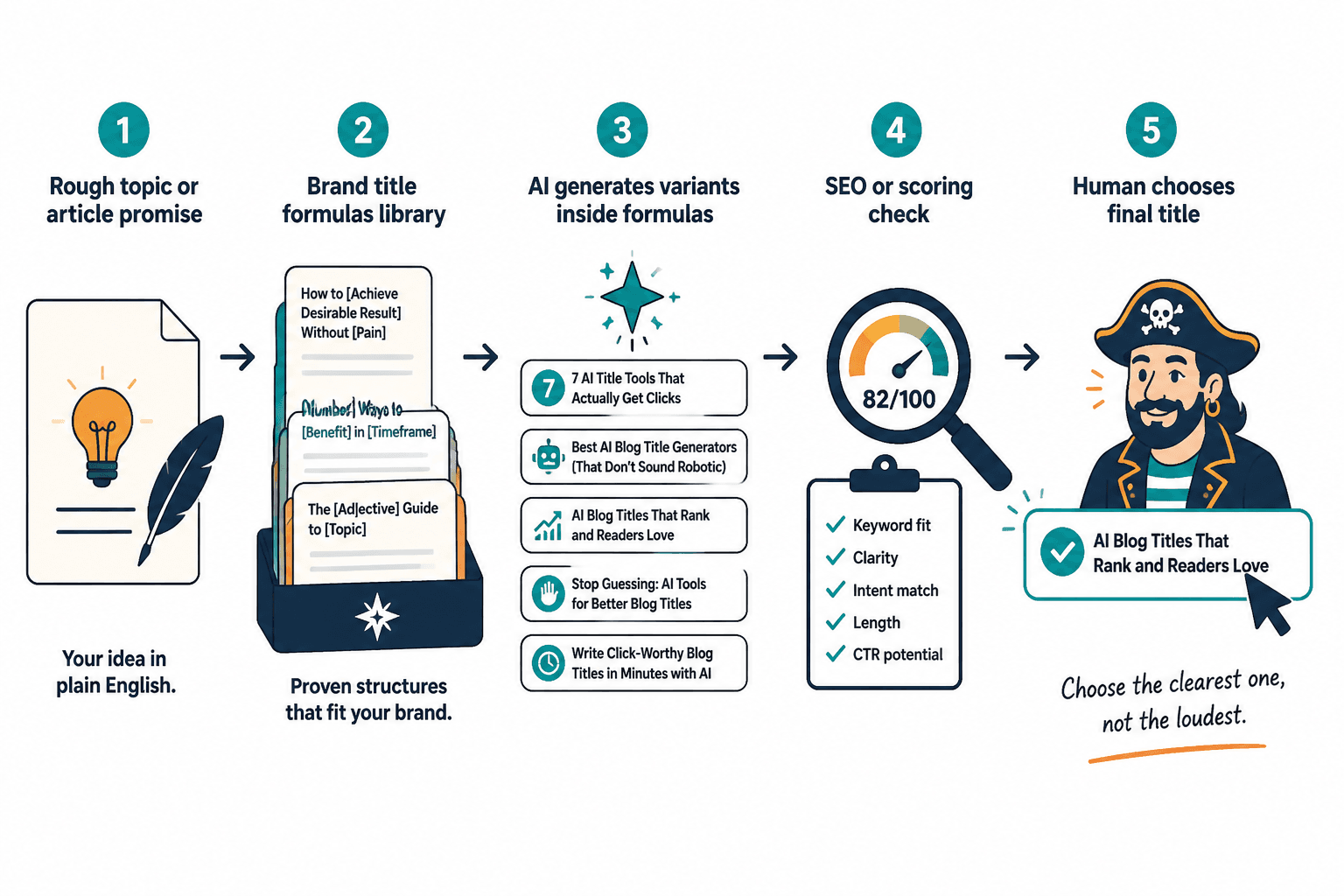
- Start with the topic and purpose. Decide whether the post is meant to rank, persuade, explain, or convert.
- Use one brainstorming tool. Ask for 10 to 20 options across a few angles, not 100 identical variations.
- Pull out the useful pattern. Look for a promise, a benefit, a keyword phrase, or a clear audience signal.
- Run the best 3 to 5 options through an analyzer. Use it to catch length, vagueness, and weak wording.
- Check search intent with keyword data if SEO matters. Keep the title aligned with how the article is actually framed.
- Make the final human edit. Tighten rhythm, remove filler, and confirm the title sounds like a person wrote it on purpose.
This sequence is boring in the best possible way. Boring systems tend to publish better headlines.
What to look for in an AI title or headline tool
Not every shiny headline app is worth the tab space. A useful tool should do a few specific things well.
- Clear output: you should understand why the tool likes or dislikes a title
- Flexible prompts or inputs: it should let you specify audience, tone, and goal
- Useful variation quality: the suggestions should differ in angle, not just wording
- SEO awareness when needed: keyword support should be practical, not robotic
- Fast comparison: the best tools help you narrow, not linger
- Easy human editing: you should be able to take the output and improve it without fighting the interface
If a tool only gives you “catchier” as a result, that is not enough. Catchy is not a strategy. Sometimes it is just noise with confidence.
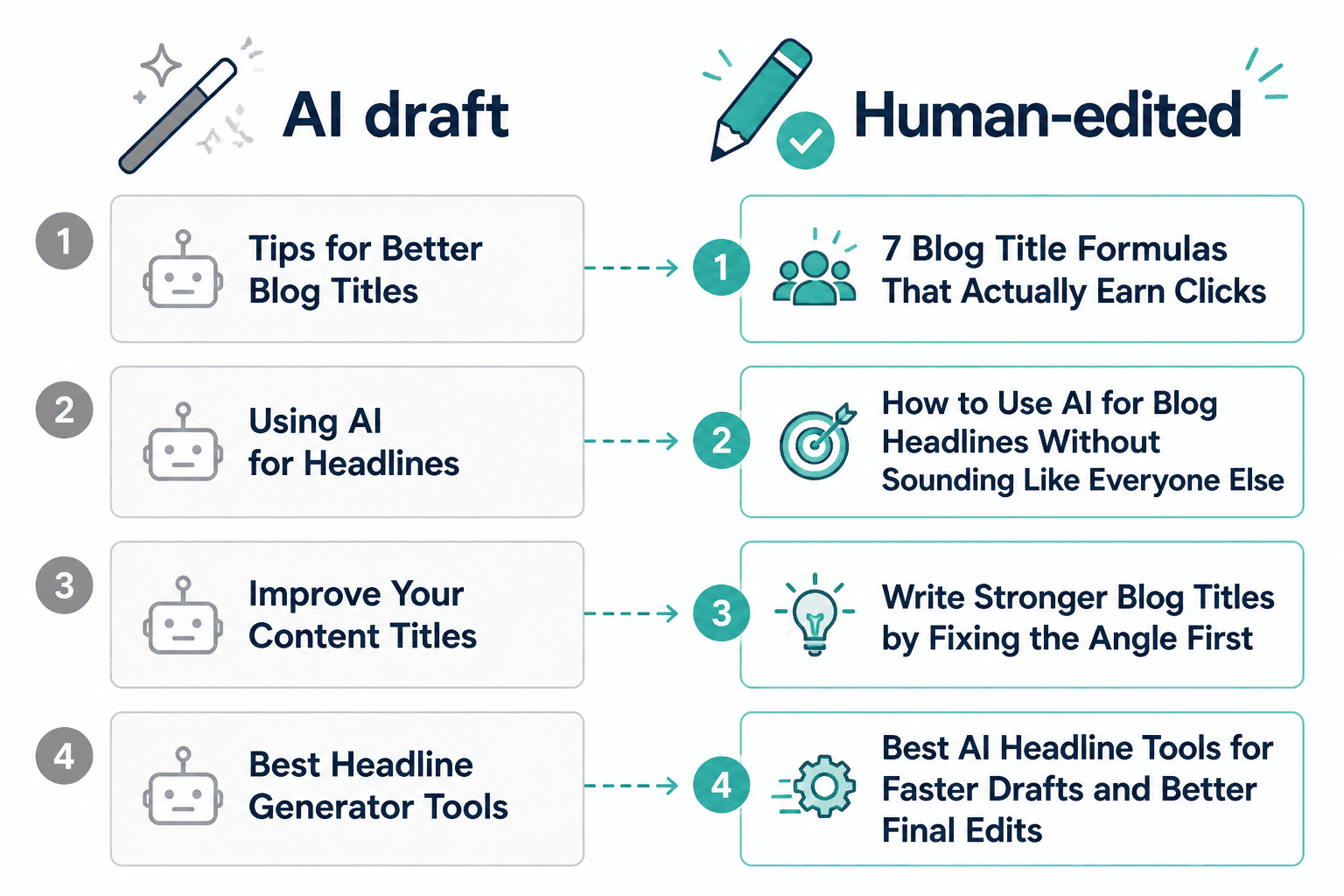
Best practices for using AI without flattening the writing
AI headline tools are best at expanding and compressing options. They are not great at understanding tone, context, or editorial risk unless you give them very clear instructions.
- Give the tool a real brief. Include audience, subject, and the job of the post.
- Ask for different angles. Request benefit-led, curiosity-led, and direct options separately.
- Keep the article honest. The title should match the promise of the content.
- Edit for voice. A technically strong headline can still sound like it came from a sterile vending machine.
- Use one source of truth. Don’t let every tool invent its own version of the article’s purpose.
For examples of title shapes that work in practice, the ideas in best blog titles and headlines ideas and examples for creators can help you spot the difference between a pattern and a gimmick.
Common mistakes to avoid
- Using too many tools: a larger stack does not automatically produce a better title
- Chasing scores: if the analyzer likes it but the headline feels flat, trust the flatness
- Ignoring search intent: a clever title that misses the query is often dead on arrival
- Overwriting the best idea: if a simple headline says the thing well, don’t decorate it to death
- Letting AI decide the final version: that is how you get a title that reads polished and forgettable
When templates still beat tools
AI tools are useful, but templates still earn their keep. A strong template can anchor the structure, and the tool can then help generate variations without drifting into nonsense.
Templates are especially helpful when the article has a clear job:
- How-to posts: “How to [do the thing] without [pain point]”
- Comparison posts: “X vs. Y: which one is better for [goal]?”
- Lists and collections: “Best [tools/ideas/examples] for [audience]”
- Problem-solving posts: “Why [problem] happens and how to fix it”
That mix of template plus tool is usually better than either one alone. The template gives the shape. The AI gives the variations. The human decides which version still sounds like it belongs in the same universe as the article.
Conclusion
The best AI tools for blog titles and headlines are the ones that simplify the process without taking over the job. Use brainstorming tools to widen the field, analyzers to trim bad options, SEO tools to check intent, and rewrite tools to improve the final phrasing. Then stop. A lean workflow beats a sprawling one, and a clear human decision beats a stack of automated opinions every time.
If you want to keep building the system around this guide, start with the parent framework on blog titles and headlines and then move into practical examples and conversion-focused follow-up work as needed.