
Most affiliate articles do not fail because the product is bad.
They fail because the article does not move the reader anywhere. It gets a click, maybe. It shares some tips, sure. But it does not build enough trust to earn action, and it does not create enough buying momentum to turn attention into leads or sales.
That is the real problem behind How to Turn Affiliate Articles Into More Leads or Sales. A lot of creators publish “helpful” affiliate content that is basically a product mention wearing a blog post costume. Readers can smell that from across the internet.
If you want affiliate articles to perform better, you need more than links sprinkled through a decent post. You need intent, structure, trust, and a clear path to the next step. Sometimes that next step is a sale. Sometimes it is a lead. Often, the smart play is both.
This is about building affiliate articles that actually convert without turning into hypey nonsense. We’ll cover what to fix, what to stop doing, and how to structure articles so readers move from interest to action without feeling shoved.
Want the broader roadmap? Start with the parent guide.
Why most affiliate articles underperform
A surprising number of affiliate articles are built backward.
The writer starts with the commission link, then tries to wrap a few paragraphs around it. That usually creates thin advice, vague praise, and a CTA that sounds like it came from a coupon site with trust issues.
Readers do not buy because you mentioned a product seven times. They buy because the article helps them understand:
- what problem they actually need to solve
- why this solution fits that problem
- what tradeoffs matter
- why they should trust your recommendation
- what to do next
If any of those pieces are missing, your article may still get traffic, but it will struggle to produce meaningful action.
This gets even worse when the article tries to do everything at once. It wants to rank, persuade, review, compare, educate, and close the sale in the same breath. The result is usually a soft, bloated piece that kind of does all of it and excels at none of it.
Good affiliate content is not just “SEO content with links.” It is a conversion asset. It should help the right reader make a decision with less friction.
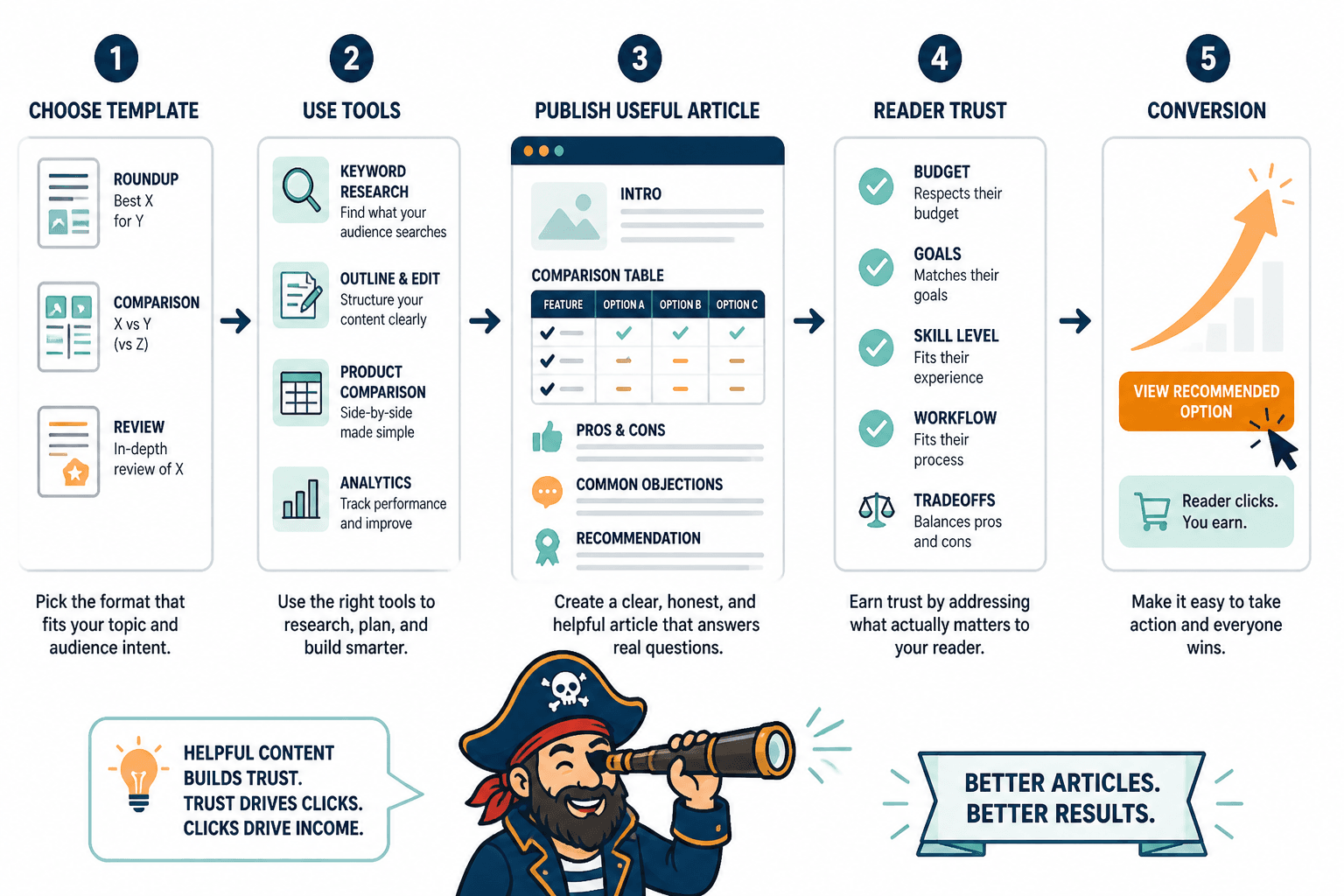
Start with the outcome: lead, sale, or both
Before you write or revise anything, decide what the article is supposed to do.
That sounds obvious. It is not. A lot of affiliate articles quietly hope the reader will somehow become a buyer without any deliberate path.
You usually have three reasonable goals:
- Direct sale: The reader is close to buying and just needs confidence, clarity, or a final push.
- Lead capture: The reader is interested but not ready yet, so you move them onto your email list or nurture path.
- Hybrid path: The article gives ready buyers a clean route to purchase and gives hesitant readers a softer next step.
This matters because a comparison article for high-intent readers should not behave like a beginner guide. And a beginner guide should not hard-close like a late-stage sales page. That mismatch is where conversions go to die.
How to choose the right goal
Use reader intent.
- If the article is “best email platforms for coaches,” you may be able to drive direct affiliate clicks and sales.
- If the article is “how to start an email list for your coaching business,” many readers will need more education first, so a lead magnet or email sequence may work better.
- If the article is “ConvertKit vs MailerLite for creators,” you can often support both: direct clicks for ready buyers, lead capture for readers still deciding.
That one decision changes your CTA placement, article structure, proof elements, and how aggressively you introduce offers.
If you need help thinking through the broader path around the article, read best funnel ideas to pair with affiliate articles. It will help you stop treating the article like the whole funnel.
Match the article type to buyer intent
Not all affiliate articles should convert the same way, because not all readers are in the same mental state.
Here is the cleaner way to think about it.
| Article type | Reader intent | Best conversion goal | What the article should do |
|---|---|---|---|
| Beginner guide | Low to medium | Lead capture | Teach the problem, frame the options, offer a next step |
| Best tools list | Medium to high | Sale or hybrid | Shortlist options, explain fit, reduce uncertainty |
| Comparison post | High | Direct sale | Clarify tradeoffs and help readers choose fast |
| Use-case article | Medium to high | Hybrid | Show who the product is for and when it makes sense |
| Problem-solution article | Medium | Lead or hybrid | Build desire, show method, introduce the tool naturally |
Too many creators use one generic affiliate article formula for all five. That is lazy, and readers can tell.
If you want a stronger structure for these buyer-intent moments, simple affiliate articles buyer intent sections templates for busy creators is worth reading next.
Build trust before you ask for action
This is the part people try to skip because they want the commission and do not feel like earning it. Unfortunate.
Affiliate articles convert better when the reader believes you are helping them make a good decision, not just steering them toward the thing that pays you. Trust is not a fluffy brand word here. It is conversion infrastructure.
Here is what builds trust inside affiliate content:
- Specific recommendations: not “this tool is great,” but “this works well for coaches who want simple automations without spending two weeks setting them up”
- Clear fit: who this is for, who it is not for, and why
- Tradeoffs: naming limitations makes your praise more believable
- Use-case clarity: what problem this actually solves in real life
- Reasoned comparisons: not just feature lists, but decision help
- Tone that sounds human: not polished to the point of suspicion
And here is what quietly wrecks trust:
- calling every tool “powerful,” “seamless,” or “a game-changer”
- pretending there are no downsides
- using generic claims with no examples
- making the article feel like one long setup for a link click
- dropping CTAs before the reader understands why they should care
If your CTAs are technically present but emotionally useless, read how to improve affiliate articles trust building CTAs without sounding generic. Most affiliate CTAs are not too short or too long. They are just weirdly empty.
Use a conversion structure instead of a loose blog structure
One of the fastest ways to improve How to Turn Affiliate Articles Into More Leads or Sales is to stop writing affiliate content like a school essay.
A conversion-friendly affiliate article usually needs a stronger sequence than intro, tips, conclusion, random CTA. Try this instead.
1. Open with the real buying problem
Do not warm up for six paragraphs. Start with the friction the reader is feeling.
Bad opening: “There are many tools on the market today for email marketing.”
Better opening: “Most creators do not need more email marketing features. They need a platform they can actually set up, trust, and keep using after week three.”
The second version points at the real decision. That is what keeps people reading.
2. Frame the choice clearly
Help readers understand what matters in the decision. Cost? Simplicity? Integrations? Speed? Beginner-friendliness? This stops the article from becoming a shapeless product parade.
3. Present options through fit, not just features
Readers care less about giant feature dumps than affiliate writers seem to think. They want to know what fits them.
Instead of this:
- Tool A has templates, automations, tags, analytics, and integrations
Write this:
- Tool A makes sense if you want clean automations without a steep learning curve, and you are not trying to build some enterprise-grade monster on day one
That is what a buying brain can work with.
4. Add proof and friction reduction
This can include:
- what the tool does well in practice
- common objections and who they matter for
- simple examples of usage
- why one option beats another in a specific scenario
You do not need to fake authority. You do need to help the reader feel safer making a decision.
5. Give a next step that matches readiness
A ready buyer should be able to click.
A hesitant reader should be able to opt in, compare further, or follow a softer path without disappearing forever.
That last point matters more than people think. A lot of affiliate content loses decent prospects simply because there is no middle step between “buy now” and “leave.”
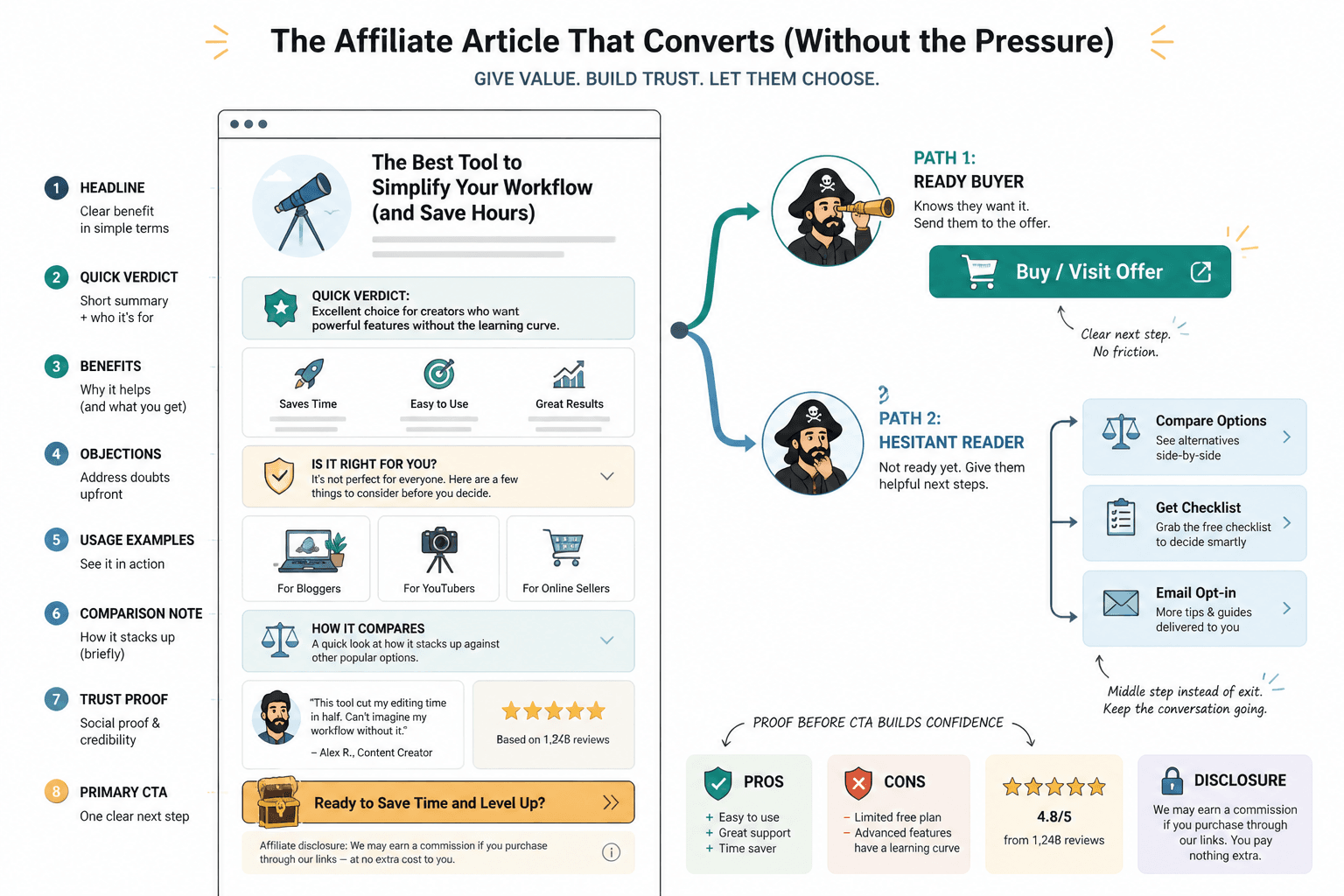
Turn one affiliate article into a small funnel
If your article only contains affiliate links, you are putting all your monetization pressure on one moment. That can work for high-intent comparison posts. It is weaker for a lot of other content.
A better approach is to let the article feed a simple funnel.
Here are a few practical ways to do that:
Article to affiliate click
Best for readers already close to a decision.
- use clear recommendation sections
- place CTAs after relevant proof, not randomly
- repeat the recommendation naturally near the end
Article to email opt-in to affiliate sequence
Best for readers who need more education or comparison help.
- offer a buyer’s guide, checklist, template, or shortlist
- use follow-up emails to address objections and fit
- introduce the affiliate recommendation with more context
Article to free resource to recommendation
Best when the product works as part of a method.
- teach the strategy in the article
- offer a worksheet or template that helps readers apply it
- recommend the tool as the easiest way to implement the process
Article to consultation or service inquiry
This works especially well if the affiliate product supports your service. For example, if you help clients set up systems and also recommend the software.
- position the article as decision support
- include a CTA for readers who want help choosing or implementing
- use the affiliate product as part of your broader trusted process
If this sounds more strategic than “put links in article and hope,” yes. That is because it is.
You can browse the broader topic cluster here: monetization funnels, money content, and affiliate articles.
Write CTAs that feel like decision help, not pressure
A bad affiliate CTA feels like a cashier leaning over the till before you have even found your wallet.
A strong CTA feels like the logical next step in the article.
That usually means your CTA should match what the reader just learned.
Weak CTA examples
- Check it out here
- Click here to learn more
- Try this amazing tool today
- Get started now
Stronger CTA examples
- If you want the simplest option for running email automations without overbuilding everything, this is the one I’d start with.
- If your main concern is price and you do not need advanced segmentation yet, this option makes the most sense.
- If you are comparing platforms and want to see how this one handles creator-friendly automations, it is worth a closer look.
Notice what these do:
- they anchor the recommendation to a use case
- they reduce ambiguity
- they sound like advice, not ad copy
And if the reader is not ready to buy, give them a softer CTA.
- Want the shortlist I use to compare creator tools? Grab it here.
- If you are still deciding, use this checklist before you choose a platform.
- Not ready yet? Get the buyer guide and avoid picking a tool you will resent in ten days.
Use buyer-intent sections inside the article
One of the easiest upgrades for affiliate content is adding sections designed for decision-making, not just information delivery.
Useful sections include:
- Best for: who this option suits
- Not ideal for: who should probably skip it
- Why you might choose this: the practical upside
- What to watch for: tradeoffs or limitations
- If you are deciding between X and Y: direct comparison guidance
These sections help readers self-sort. That means fewer empty clicks and better conversion quality.
It also makes the article more credible, because you are not pretending every option fits every person. That sort of vague positivity is great if your goal is sounding polished and useless.
Do not hide your affiliate intent, but do not make it the whole personality either
Readers are not offended by affiliate links. They are offended by feeling manipulated.
You can be transparent without turning the disclosure into a theatrical event. A brief, clear note is enough. Then get back to helping people.
More importantly, make sure the article still works as advice even if someone never clicks a link. That is a strong test for whether the content deserves trust.
If your article would collapse into dust without the product mention, it probably was not useful enough in the first place.
For a deeper look at this balance, read how to monetize affiliate articles without wrecking trust.
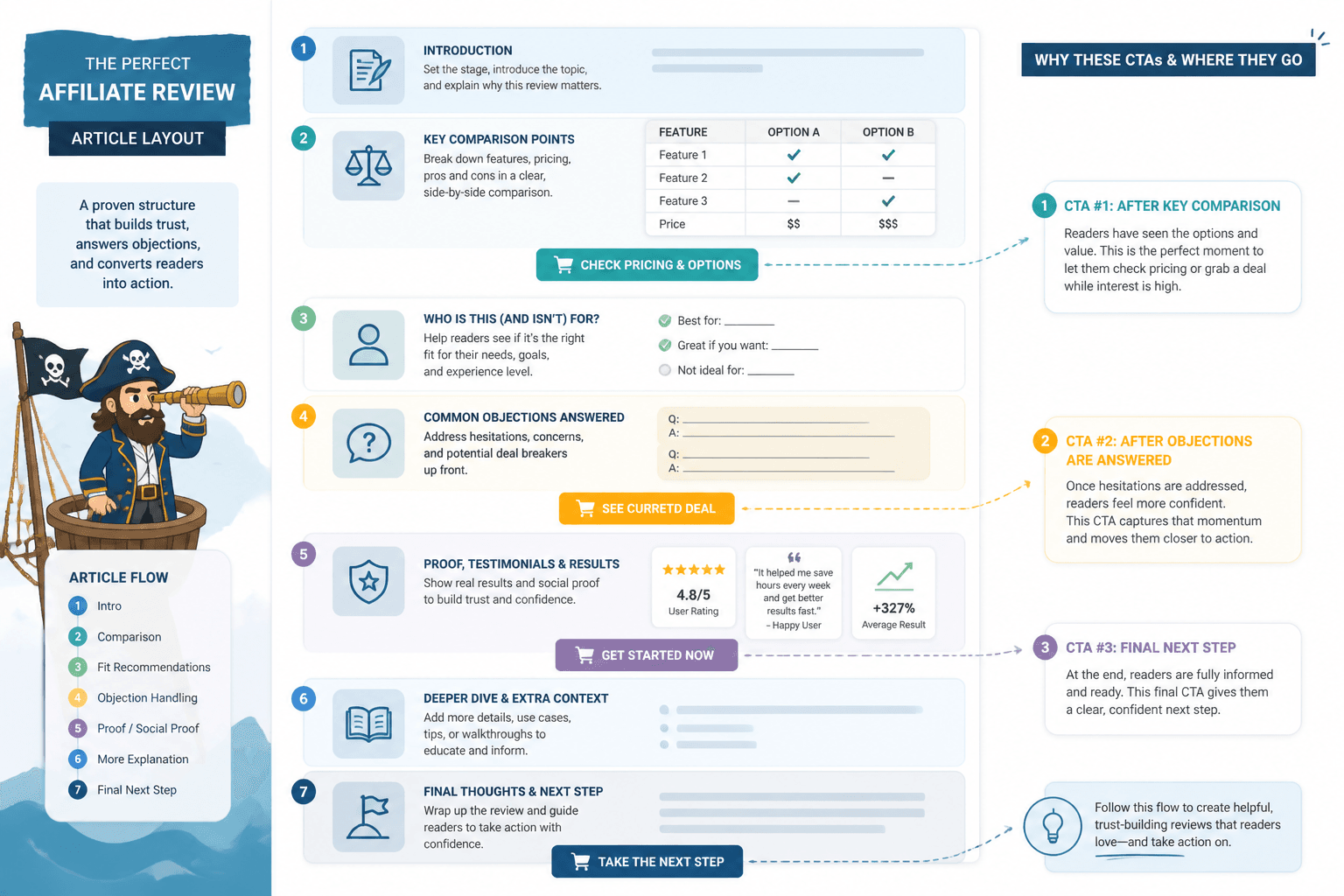
Improve the parts of the article where buying decisions actually happen
A lot of creators spend too much time on the intro and not nearly enough on the decision-making sections. But the intro does not close the sale. It just earns the right to continue.
The sections that usually matter most are:
- comparison points
- fit-based recommendations
- objection handling
- CTA placement
- end-of-article next step
So instead of endlessly polishing the opening line, put more effort into answering questions like:
- Why would someone choose this over the obvious alternative?
- What kind of buyer is likely to regret this choice?
- What concern is stopping the reader from clicking?
- Is there enough clarity to act right now?
That is where conversion lift usually comes from. Not from making the intro 4 percent “snappier.”
Before and after: a boring affiliate section vs a stronger one
Before
This email marketing platform offers powerful automation, analytics, templates, and integrations for online businesses. It is a great choice for entrepreneurs who want to grow their brand and improve results. Click here to get started.
After
If you want email automations that are easy to build without turning setup into a part-time job, this is a strong option. It is especially useful for creators and consultants who want solid segmentation and simple funnels without needing an advanced ops brain.
The main drawback is that it can feel limiting if you want highly customized workflows. But for most small businesses, that is a fair trade for speed and clarity.
If ease of use matters more to you than endless complexity, this is the platform I’d look at first.
The rewrite works better because it adds fit, tradeoff, specificity, and recommendation logic. Not because it used fancier words. In fact, the fancy words were part of the problem.
Track the right signals so you know what to improve
If an affiliate article is underperforming, do not just stare at pageviews and get dramatic.
Look at the chain.
- Is the article attracting the right kind of traffic?
- Are readers reaching the product sections?
- Are they clicking affiliate links?
- Are they opting into your lead capture path?
- Are those leads converting later?
Different weak points suggest different fixes:
| Problem | Likely issue | What to fix |
|---|---|---|
| Traffic but few clicks | Weak fit, vague recommendations, poor CTA timing | Improve decision sections and CTA clarity |
| Clicks but few sales | Wrong intent or weak product match | Target higher-intent topics or recommend better-fit tools |
| Good traffic but no leads | No compelling middle step | Add relevant opt-in tied to the buying decision |
| Readers bounce early | Weak opening or wrong search match | Tighten intro and align article with intent |
The goal is not just “more clicks.” The goal is more useful movement from the right readers.
Common mistakes that quietly kill affiliate conversions
- Writing broad articles with no buying angle: useful information is nice, but decision support converts better.
- Using generic praise: if every product is “great,” none of your recommendations mean much.
- Hiding tradeoffs: people trust honest guidance more than polished certainty.
- Forcing sales CTAs on low-intent readers: not everyone is ready now.
- Ignoring lead capture: you do not need to lose undecided readers.
- Stuffing affiliate links everywhere: this usually lowers trust, not friction.
- Copying vendor messaging: if the article sounds like the company wrote it, readers get suspicious.
This is where a lot of affiliate content starts sounding like recycled beige sludge with buttons. Helpful, in theory. Persuasive, not really.
A simple upgrade plan for older affiliate articles
If you already have affiliate posts getting some traffic, do not start from scratch. Upgrade them.
Use this quick process:
- Identify the article’s real intent level.
- Choose the primary goal: sale, lead, or hybrid.
- Rewrite the intro around the actual decision problem.
- Add fit-based recommendation sections.
- Include tradeoffs and “not for” guidance.
- Improve CTA language so it sounds like advice.
- Add a lead capture option for readers not ready to buy.
- Review link placement so it supports the reading flow.
- Check that the article still feels useful without the affiliate links.
You do not need a giant funnel machine with twenty-seven tags and a dashboard that requires emotional recovery time. You need a cleaner path from article to action.
FAQ
Should every affiliate article try to get a sale?
No. Some articles are better at generating leads first, especially when readers are still learning or comparing options.
Where should affiliate CTAs go in an article?
Place them after useful context, proof, or recommendation logic. Random button drops rarely help.
Can affiliate articles collect leads and sales at the same time?
Yes, if the path is clear. Give ready buyers a direct route and hesitant readers a softer next step.
What kind of lead magnet works well with affiliate articles?
Buyer guides, checklists, templates, comparison sheets, and implementation resources usually work better than generic newsletters.
How do I make affiliate articles feel less salesy?
Focus on fit, tradeoffs, decision help, and honest recommendations. Advice first. Link second.
Make the article earn the click
If you want better results from How to Turn Affiliate Articles Into More Leads or Sales, stop asking the article to magically convert on vibes.
Give it a job. Match it to reader intent. Build trust before the ask. Add a next step for readers who are interested but not ready. And write recommendations like a person trying to help someone make a good decision, not like a banner ad learned to type.
That is usually the difference between an affiliate article that technically exists and one that actually produces leads or sales.