
Most affiliate article CTAs do not fail because they are too short. They fail because they sound like they were copied from a lazy template, sprayed with fake sincerity, and shoved under a paragraph that did none of the trust-building work required to earn a click.
Readers can smell it. “Check it out here.” “This may help you.” “Grab yours now.” Fine. Technically a CTA. Also technically forgettable.
If you want to know how to improve affiliate article trust-building CTAs without sounding generic, the fix is not adding more enthusiasm or more persuasion words. It is making the CTA feel like a natural extension of the article’s actual value. The reader should feel guided, not nudged by a guy in a shiny funnel vest.
This is about writing affiliate CTAs that sound specific, credible, and useful. The kind that match the reader’s intent, acknowledge uncertainty, and make the next step feel reasonable instead of weirdly eager. Because affiliate content can absolutely make money without sounding like it lost a fight with a coupon blog.
If you are working on affiliate content more broadly, it also helps to tighten the article itself before obsessing over the CTA. These guides on how to write better affiliate articles and how to write affiliate articles without sounding salesy or robotic will make the CTA work a lot harder with less strain.
If you want the bigger picture, start with the parent guide.
Why generic affiliate CTAs kill trust fast
A trust-building CTA is not just a button line or a closing sentence. It is the final test of whether the article feels honest.
When the CTA is vague, pushy, or suspiciously polished, it creates a nasty little mismatch. The body says, “I am here to help.” The CTA says, “Anyway, please convert now.” That gap is where trust falls down the stairs.
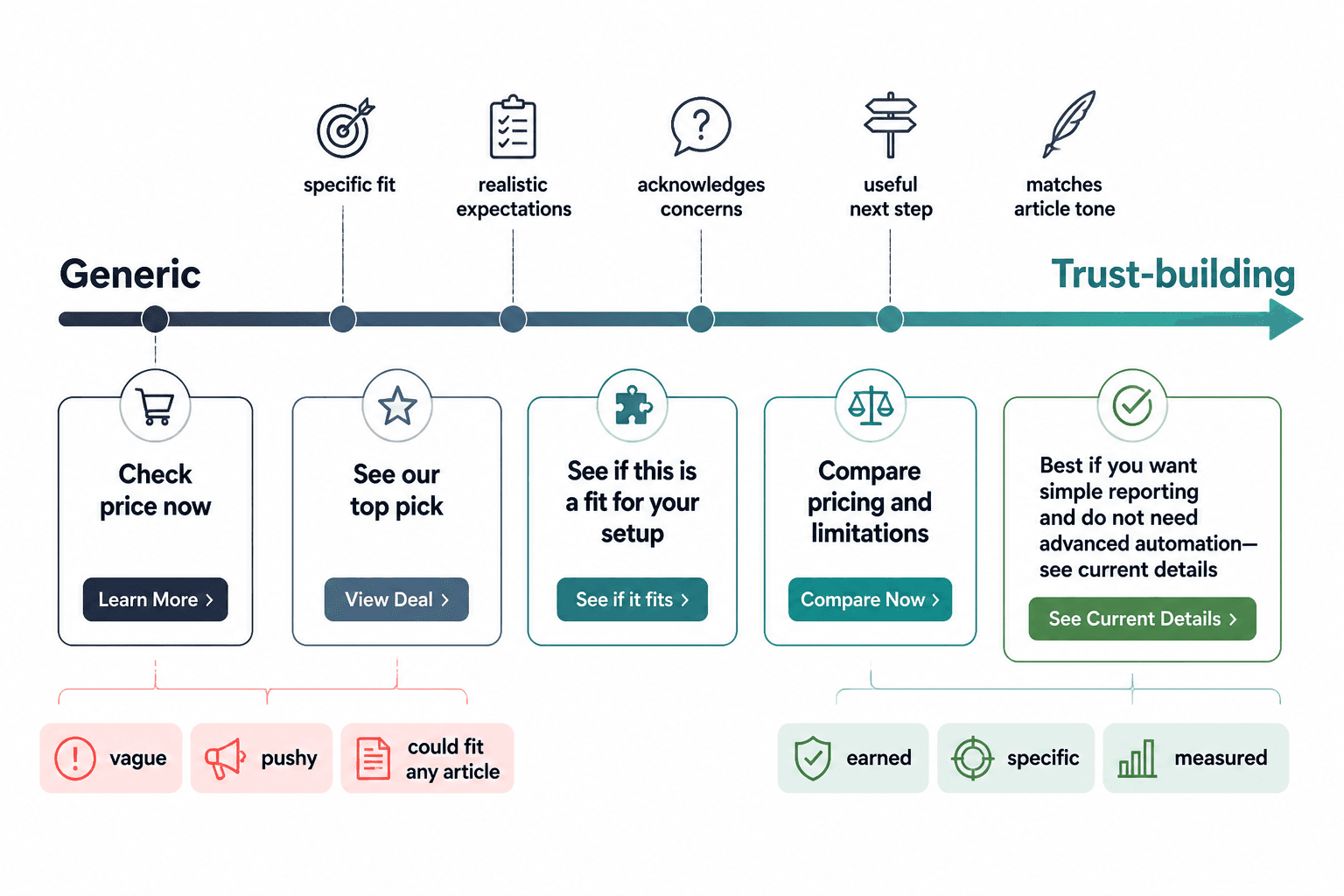
Generic CTAs usually have one or more of these problems:
- They say nothing specific about who the product is for
- They make every recommendation sound equally good
- They skip over concerns the reader obviously still has
- They sound too eager relative to the article’s tone
- They treat the click like the goal instead of the reader’s outcome
- They could be pasted into literally any affiliate article and still “work” grammatically
That last one is the killer. If your CTA could sit under a VPN review, a standing desk comparison, and a protein powder list without changing much, it is not trust-building. It is wallpaper.
Good affiliate CTAs feel earned. They reflect what was actually discussed, who the recommendation is best for, and what the reader should expect next. No drama. No fake urgency. No conversion cosplay.
What a trust-building CTA actually needs to do
Before you write the line, be clear on the job. An affiliate CTA is not just there to “get the click.” It needs to reduce friction without increasing skepticism.
A strong trust-building CTA usually does four things:
- Matches the article’s promise. If the article was practical and measured, the CTA should not suddenly become loud and glossy.
- Clarifies fit. It tells the reader who this tool, product, or service is actually for.
- Respects doubt. It leaves room for the reader to assess, compare, or decide without feeling hustled.
- Makes the next step feel useful. Clicking should feel like a continuation of the evaluation process, not a trapdoor into hard-sell nonsense.
This is especially important in affiliate articles because the reader already knows there is commercial intent somewhere in the room. You do not need to pretend otherwise. You need to prove that your recommendation still has standards.
How to improve affiliate article trust-building CTAs without sounding generic
Here is the practical part. If your CTAs keep sounding flat, salesy, or blandly “helpful,” fix them with these moves.
1. Tie the CTA to a specific use case
The easiest way to make a CTA less generic is to stop writing to everyone.
Bad CTA:
If you are looking for a great option, check this one out here.
Better CTA:
If you want a tool that is easy to set up, does not bury basic features behind six upgrade prompts, and works well for solo creators, this is the one I would start with.
That second version builds trust because it names the context. It gives the reader a reason the recommendation exists. Specificity feels considered. Generic praise feels rented.
2. Acknowledge limits instead of pretending the product is perfect
Trust grows when readers can see you are not trying to force a universal win.
You do not need to sabotage the recommendation. You do need to stop writing CTAs as if every affiliate product was handcrafted by angels and product-market fit.
Example:
If you want the cheapest option on the market, this probably is not it. But if you care more about reliability and cleaner reporting than shaving off a few dollars, it is worth a look.
That works because it filters. Filtering builds trust. Readers do not mind being guided. They mind being sold to with suspicious certainty.
3. Use the CTA to reinforce your evaluation criteria
A good affiliate article usually compares products based on things that matter: ease of use, speed, support, pricing logic, setup time, output quality, or fit for a certain kind of buyer.
Your CTA should echo those criteria so the recommendation feels connected to the analysis.
Weak:
Click here to learn more.
Stronger:
If fast setup and a cleaner interface matter more to you than advanced customization, this is the option from the list I would check first.
Now the CTA feels earned by the article instead of stapled on at the end.
4. Replace vague verbs with useful next steps
“Check it out” is lazy. “Learn more” is barely a sentence. “Get started” can work, but often sounds generic because it ignores what the reader is actually doing.
In affiliate content, the next step is often one of these:
- Review the pricing
- Compare plans
- See the feature breakdown
- Test the free version
- Read user examples
- Look at setup details
- Check compatibility
So say that.
Examples:
- If you are comparing plans, start with the mid-tier option. That is where the useful features stop feeling artificially rationed.
- If you want to see whether it fits your workflow, the free trial is enough to tell pretty quickly.
- If your main concern is integrations, check that part first before getting distracted by the homepage promises.
These CTAs guide action without sounding like a pitch deck intern wrote them.
5. Match the CTA to the reader’s stage of trust
Not every affiliate article reader is ready to buy. Some are still comparing. Some are problem-aware but not solution-ready. Some just want help not wasting money.
If your CTA assumes full buying intent too early, it can feel pushy even if the wording is polite.
Use softer trust-building CTAs when the article is higher in the funnel:
- If you are still narrowing down options, this is one of the easiest tools to evaluate quickly.
- If your main goal is simplicity, this is a strong first option to compare against the others.
- If you want to see how the pricing works before making any decision, start there.
Use stronger CTAs when the article is clearly bottom-of-funnel and highly specific:
- If you need this feature set and want the most straightforward setup, this is the one I would choose.
- If you have already ruled out the cheaper but clunkier alternatives, this is probably your best next move.
The point is not to be timid. It is to be accurate.
6. Stop hiding behind fake neutrality
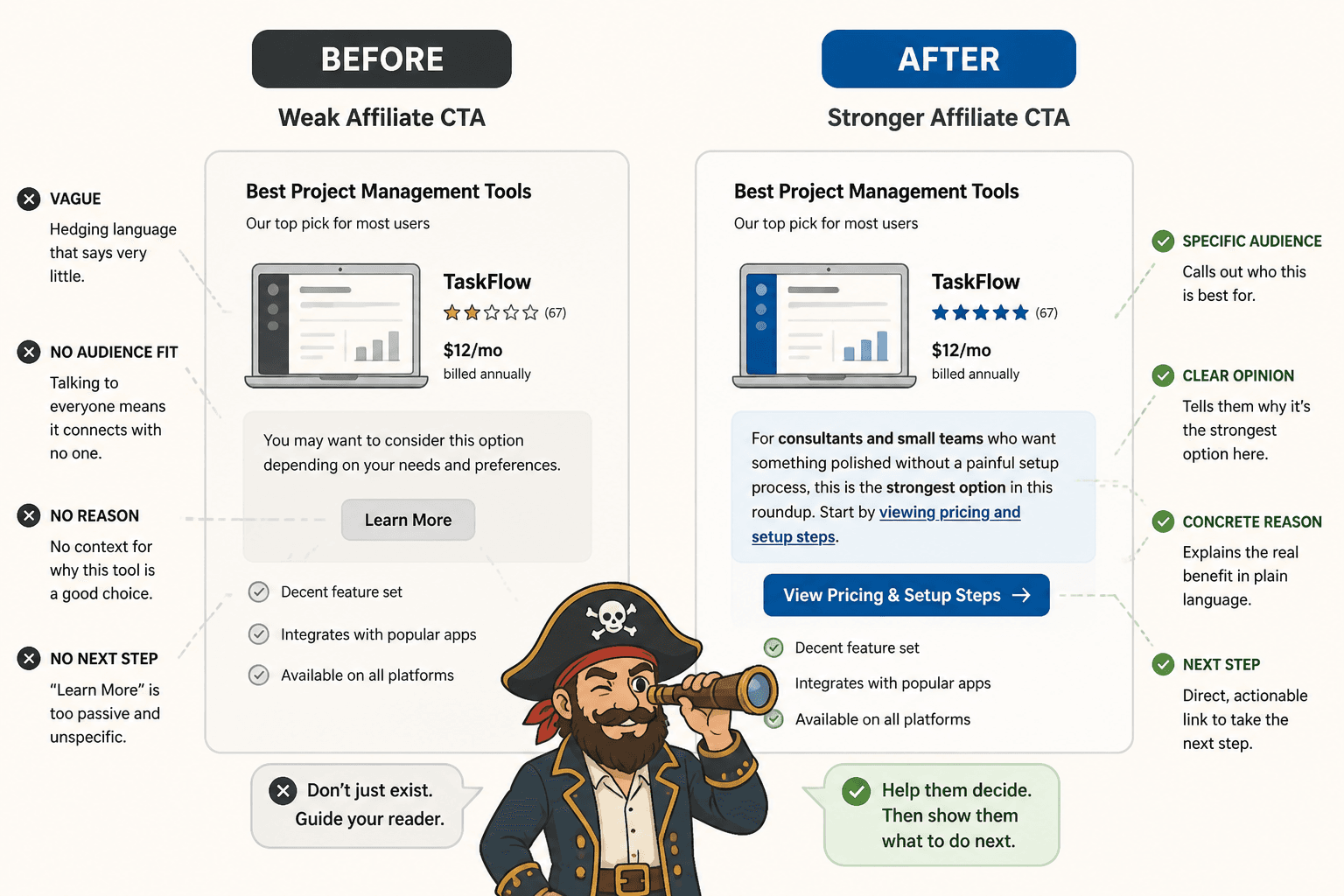
Some writers make affiliate CTAs so cautious they become useless. They are terrified of sounding salesy, so they produce mush like this:
You may want to consider this option depending on your needs and preferences.
That is not trust-building. That is a verbal shrug.
You can be clear without being pushy:
For consultants and small teams who want something polished without a painful setup process, this is the strongest option in this roundup.
Specific opinion builds credibility. Mush builds suspicion.
A simple framework for better affiliate CTAs
If you want a repeatable structure, use this:
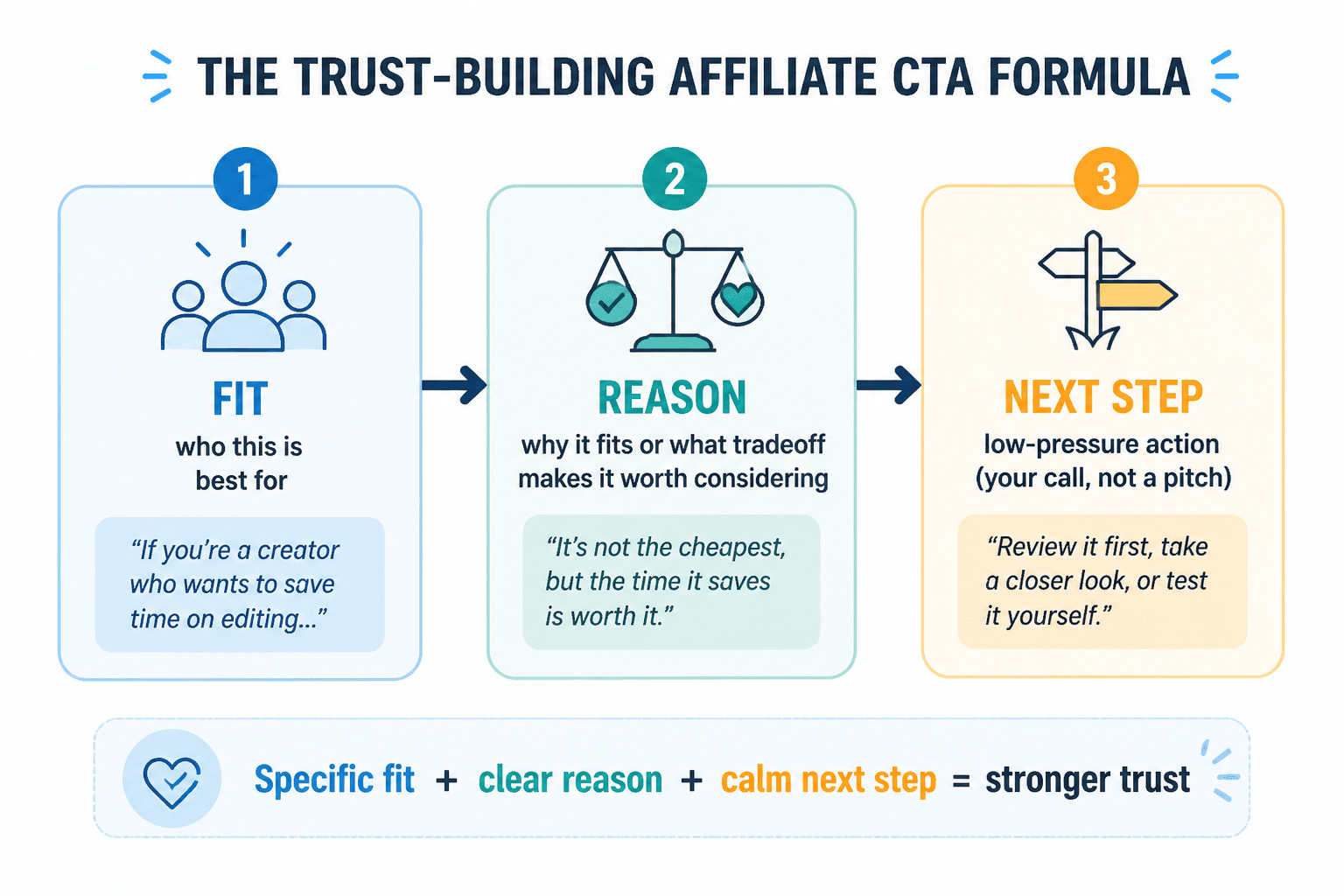
Fit + reason + next step
That means:
- Fit: who it is for
- Reason: why it stands out
- Next step: what the reader should do now
Template:
If you are a [type of reader] who cares most about [priority], this is worth checking first. Start by looking at [specific next step].
Filled examples:
- If you are a solo creator who cares most about ease of use, this is worth checking first. Start by looking at the free plan and setup flow.
- If you run a small service business and need reporting that does not require interpretive dance to understand, this is the option I would review first. Check the dashboard and client-facing features before anything else.
- If your main concern is writing speed without losing too much control, this tool is one of the better places to start. Compare the template quality and editing workflow first.
This framework works because it sounds like a recommendation from a thinking adult, not a popup.
Before-and-after CTA rewrites
Here is where most of this gets easier. You do not need to invent brilliant CTAs from nothing. You need to rewrite bland ones until they sound attached to reality.
| Before | After |
|---|---|
| Check it out here. | If you want the simplest option from this list, this is the one to review first. |
| Learn more about this tool. | If automation matters more to you than deep customization, start with this tool’s workflow features. |
| Get started today. | If it fits your budget, the trial gives you enough to see whether it will actually save you time. |
| This is a great option for anyone. | This makes the most sense for solo operators and small teams that want speed without a steep learning curve. |
| Click here to see pricing. | Check the pricing page first if your main question is whether the useful features are locked behind the higher tiers. |
Notice the pattern. The stronger versions do not yell louder. They narrow the fit, sharpen the value, and reduce uncertainty.
Where to place trust-building CTAs inside affiliate articles
The end-of-article CTA matters, but it should not be your only one. Readers skim. Some are ready earlier. Some need more proof first. Smart placement helps without turning the article into a carnival of links.
Use a soft CTA after key decision points
Good spots include:
- After explaining who the product is best for
- After comparing it to a common alternative
- After discussing pricing fit
- After noting a major strength or tradeoff
These work well because the reader has just learned something relevant enough to act on.
Make the final CTA a decision helper, not a hard close
Your final CTA should feel like the natural conclusion of the article’s reasoning.
For example:
If you want the easiest option on this list for getting up and running quickly, start there. If you need heavier customization, one of the alternatives above will probably suit you better.
That kind of CTA does something rare on the internet. It helps the reader choose, even if the choice is not always your favorite affiliate link. Funny how trust tends to like that.
Common mistakes that make affiliate CTAs sound generic
If your CTA still feels flat, one of these is usually the reason.
- Using recycled phrases. “Check it out,” “learn more,” “get started today,” and “grab yours now” are not illegal. They are just lazy.
- Overpraising. “Amazing,” “incredible,” and “best-ever” language tends to lower credibility unless the article has done serious proof work.
- Writing for everyone. Trust rises when the recommendation excludes people it is not for.
- Ignoring objections. If price, setup, quality, or fit are obvious concerns, pretending they do not exist makes the CTA feel slippery.
- Switching tone at the end. Calm, useful article. Weirdly hype CTA. Readers notice.
- Using the same CTA across every affiliate piece. Efficient, yes. Also deadening.
The best fix is usually simple: read the CTA out loud after the article. If it sounds like it belongs to another writer, another niche, or another decade of internet marketing, rewrite it.
Trust-building CTA examples you can adapt
Use these as starting points, not sacred text.
For comparison articles
- If ease of use matters more to you than advanced features, this is the one I would compare first.
- If you are deciding between simplicity and customization, start here if simplicity wins.
- If your goal is getting this live quickly without much setup drama, this option makes the most sense.
For review articles
- If the strengths above match what you actually need, the trial will tell you pretty quickly whether it is a fit.
- If your biggest concern is workflow friction, this is worth testing before the cheaper alternatives.
- If you want the cleaner experience and can justify the price, this is the one I would start with.
For “best tools” roundups
- For beginners, this is the least annoying place to start.
- For solo operators who want useful features without feature bloat, this is the strongest option on the list.
- If reporting and visibility matter more than low entry pricing, review this one first.
For problem-solution affiliate content
- If solving this fast matters more than finding the absolute cheapest route, this is worth a closer look.
- If you are tired of duct-taping three tools together to do one job, start with this option.
- If your current setup is costing more time than money, this is one of the better fixes to evaluate.
How trust-building CTAs connect to monetization
Here is the part people miss: trust-building CTAs are not the soft version of monetization. They are often the smarter version.
A CTA that gets fewer low-intent clicks but more qualified, confident ones can perform better where it actually counts. Better clicks. Better conversions. Less reader resistance. Less brand damage. Less “why does this article suddenly sound like a checkout page with adjectives?”
If you want to connect this more directly to revenue, read how to turn affiliate articles into more leads or sales and how to monetize affiliate articles without wrecking trust. Both matter because CTA quality is only one part of the bigger monetization system.
And if you are building a fuller content strategy around affiliate content, it is worth browsing the broader affiliate articles hub and related sections on money content and monetization funnels.
Quick CTA check before you publish
Before you hit publish, run the CTA through this short filter:
- Does it name who the recommendation is for?
- Does it reflect the article’s actual reasoning?
- Does it avoid hype, vagueness, or generic urgency?
- Would the CTA still make sense if you removed the affiliate link?
If the CTA still feels useful without the commission attached, you are usually in a much healthier place. That is a good test for whether trust is leading and monetization is following.