
Most boring Substack posts do not have an intelligence problem. They have a packaging problem.
The ideas are usually fine. Sometimes even strong. But they arrive buried under soft openings, swollen paragraphs, vague points, and a tone that sounds like the writer is apologizing for having a brain. Then the post underperforms, and the writer decides the topic was wrong. It usually was not. The writing was.
If you want to know how to rewrite boring Substack posts and series, the job is not to make everything louder, longer, or more dramatic. It is to make the point clearer, the structure tighter, and the read more rewarding. Same idea. Better delivery. Less beige.
This is especially true on Substack, where readers will give you more room than they would on social, but not infinite patience. They will read long. They will follow a series. They will stick around for nuance. But only if the writing earns it.
If you want the bigger picture, start with the parent guide.
Why Substack posts get boring in the first place
Boring writing usually comes from one of five things:
- The writer starts too far away from the point
- The topic is too broad to hold tension
- The post explains instead of argues
- The structure meanders
- The series repeats itself instead of building
Notice what is not on that list: lack of expertise.
A lot of Substack writers know plenty. They just publish drafts that still sound like notes to self. That is why rewriting matters. Good rewriting does not sterilize your voice. It reveals it. It cuts the fog so the sharp part can actually show up.
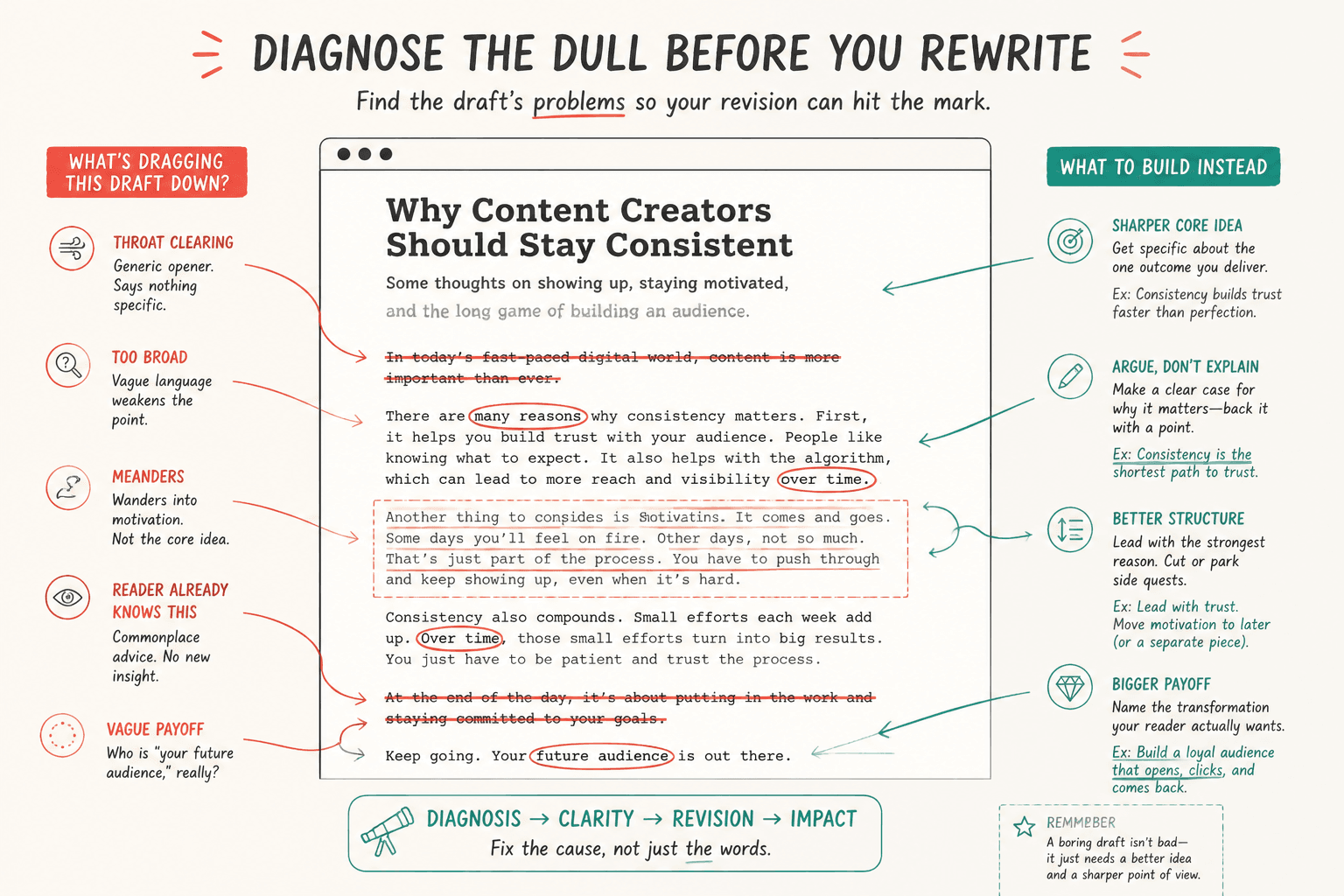
If your post feels dull, flat, or hard to finish, ask a more useful question than “Is this good?” Ask: “What is the reader actually getting from this section that they could not have guessed already?” If the answer is “not much,” there is your rewrite target.
How to rewrite boring Substack posts and series without ruining the idea
The simplest rewrite process is this:
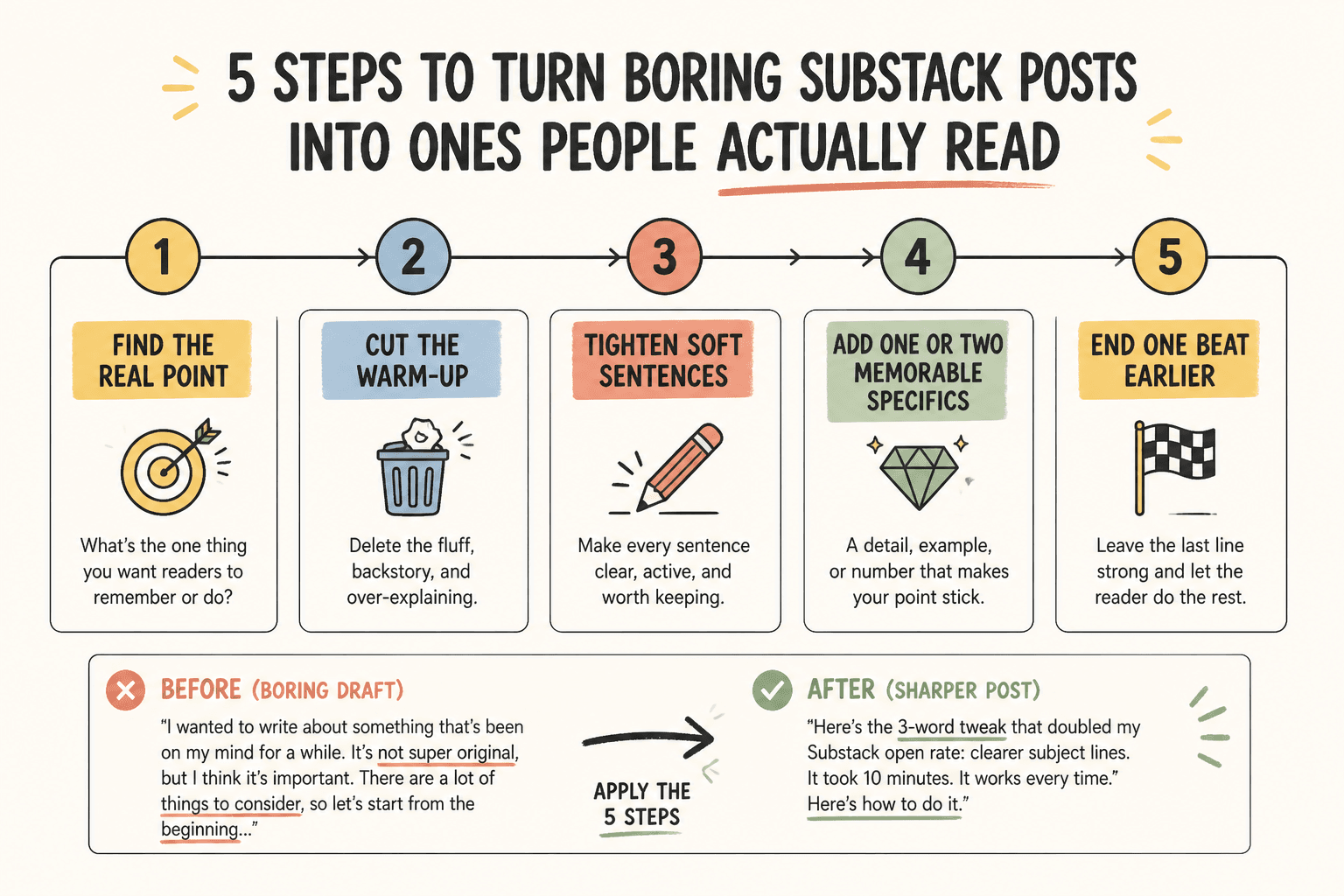
- Find the real point
- Cut the throat-clearing
- Add tension, specificity, or contrast
- Restructure for momentum
- Tighten the ending so it lands
That works for one-off posts and for series. The difference is that a post needs a clear payoff, while a series needs progression. One satisfying read versus repeated reasons to come back.
1. Find the real point before you rewrite anything
A boring post often has a hidden strong idea trapped inside a mushy draft. Before editing lines, define the actual claim in one sentence.
This post is really about ________.
Not the topic. The point.
For example:
- Weak: “This post is about building a newsletter.”
- Strong: “This post is about why most newsletter growth advice fails smaller writers because it assumes existing audience momentum.”
That second version gives you something to structure around. It has tension. It excludes fluff. It suggests examples. It can actually be rewritten into something sharp.
2. Cut the opening until the piece starts where the reader starts caring
This is where a lot of Substack posts quietly die.
Writers warm up on the page. Readers do not owe you that warm-up. If your first three paragraphs are context, mood, disclaimers, or scenic throat-clearing, your rewrite probably starts by deleting them.
Before:
Over the past few months, I’ve been thinking a lot about how creators approach consistency, and there are a lot of different opinions on this. I wanted to share a few thoughts that might be helpful if you’re trying to build a writing habit.
After:
Most advice about writing consistently assumes motivation is the problem. Usually it is not. Usually the problem is that your process is too annoying to repeat.
That rewrite does three useful things fast: it makes a claim, creates contrast, and gives the reader a reason to continue.
If your Substack intros need work, it is worth reading how to start Substack posts and series without a weak opening and how to improve Substack post openings without sounding generic. Bad openings waste good ideas every week.
3. Replace vague claims with concrete tension
A lot of drafts are technically clear but still boring because they stay at the level of polite abstraction.
Compare these:
- “Authenticity matters in newsletter writing.”
- “Readers can tell when you are using personal tone as a branding costume, and it makes the whole post feel weirdly slippery.”
The second line has texture. You can disagree with it. That is good. Useful writing does not need to be inflammatory, but it should have enough shape that readers can feel the edge of the idea.
When rewriting, look for lazy words like:
- valuable
- important
- helpful
- insightful
- authentic
- powerful
- effective
These are often filler words pretending to be meaning. Replace them with what specifically happens, changes, improves, fails, annoys, converts, or gets ignored.
4. Break explanation loops
One reason Substack posts drag is that writers explain the same point three different ways because they are trying to sound thorough. What they sound like is stuck.
If you have already made the point, do one of these instead of restating it:
- Give an example
- Show a before/after rewrite
- Add a counterexample
- Explain when the advice does not apply
- Move to the next implication
That keeps momentum without making the post feel thin.
Writers often confuse repetition with emphasis. It is not emphasis if it says the same thing with slightly different wallpaper.
A practical rewrite method for single Substack posts
Here is a simple editing workflow you can use on almost any flat draft.
Step 1: Highlight the strongest line in the draft
Somewhere in your draft, usually annoyingly far down, there is a sentence that contains the actual point. Find it. That line is often the start of the better version.
Step 2: Turn broad sections into clear jobs
Each section should do one thing:
- Set up the problem
- Make the claim
- Support it with example or proof
- Handle nuance or objection
- End with a useful takeaway or next step
If a section is doing none of those, cut it or merge it.
Step 3: Compress what the reader can infer
You do not need to explain every transition. Smart readers can bridge a lot. Over-explaining kills pace.
Before:
This matters because if you are not thinking carefully about what your readers actually want, then it can become more difficult to create content that resonates with them in a meaningful way.
After:
If you do not know what your readers want, your posts will feel relevant mostly to you.
Step 4: Add one or two memorable specifics
Specifics wake writing up. They also make you sound less synthetic, which is increasingly not optional.
For instance, “weak CTA” is abstract. “A CTA that reads like it escaped from a 2021 creator course” is more alive. Not because it is louder, but because it gives the reader something to picture.
Step 5: End one beat earlier than you want to
Many Substack posts have decent endings followed by two extra paragraphs of conclusion foam.
If the point has landed, stop. The strongest ending is often the line before the writer starts summarizing what you just read.
How to rewrite a boring Substack series
Series have a different failure mode. They are not boring because each installment is weak. They are boring because each installment feels too similar.
A reader should feel movement across a series. If every post sounds like “more thoughts on the same broad theme,” the series starts to feel like leftovers.
Give each installment a distinct job
A useful series does not just split one topic into chunks. It creates sequence.
For example, a series on improving Substack growth could be structured like this:
- Part 1: The common growth myths hurting smaller writers
- Part 2: The post formats that earn attention without cheap tricks
- Part 3: The profile, archive, and paid strategy fixes that improve conversion
- Part 4: The retention mistakes that quietly flatten momentum
Each part has a role. Each part creates a reason for the next one to exist.
Cut repeated setup across parts
Series drafts often repeat the same intro paragraph in new clothes. Readers notice. They may not complain, but they notice.
If you already established the premise in part one, part three does not need to re-explain your entire worldview. A quick callback is enough. Then move.
Instead of this:
As I mentioned in my previous posts, building a Substack takes time and there are many elements involved in creating a sustainable publication.
Try this:
If part one was about getting attention, this one is about not wasting it once readers arrive.
Cleaner. More forward motion.
Escalate the depth, not just the word count
Later parts in a series should usually get more specific, more practical, or more nuanced. Not just longer.
A series that keeps unfolding new layers feels rewarding. A series that keeps rephrasing the surface point feels like someone stretching a thread because they promised one.
Use bridges between installments
One simple rewrite upgrade for series: end each part with a genuine bridge to the next one.
- “Attention is the first problem. Conversion is the second.”
- “A strong post can earn a subscriber. A messy archive can lose them.”
- “Now that the opening works, the next issue is structure.”
This creates continuity without sounding like a TV trailer.
Before-and-after rewrites for common Substack problems
Problem: The post sounds thoughtful but says very little
Before:
There is something interesting about the way creators think about audience growth, and I think there are a lot of lessons we can take from observing what works and what doesn’t.
After:
Many creators say they want growth, but what they actually want is growth that does not require clearer positioning, better packaging, or a more consistent publishing habit.
Problem: The series installment feels like a rerun
Before:
In this next part of the series, I want to continue exploring some additional thoughts on the topic of writing better newsletter content.
The bigger point is simple: clearer structure and clearer writing make the piece more useful. That is usually what makes the ending land better too.