
Most blog posts do not need to be deleted. They need to be rescued.
That old article sitting on page three of Google, getting a few polite clicks a month and doing absolutely nothing for your business, is not always a lost cause. For coaches, consultants, and personal brands, the bigger issue is usually not “we need more content.” It is “we keep publishing decent ideas in weak packaging, then forgetting they exist.”
A good rewrite can turn a vague, sleepy post into something clearer, more useful, more searchable, and much more likely to build trust. A smart refresh can tighten structure, improve examples, fix outdated advice, and make the article actually pull its weight. That is what this guide is here to help with.
You will get practical blog rewrite and refresh examples for coaches, consultants, and personal brands, plus a simple process for deciding what to rewrite, what to update, and what to stop pretending is fine.
For the main guide behind this topic, visit the parent guide.
What a blog rewrite or refresh is actually for
Let’s clear up one thing first. A rewrite and a refresh are not the same job.
A blog refresh
A refresh improves what is already there.
- Update stale examples
- Improve the intro
- Tighten weak sections
- Add missing internal links
- Fix structure and formatting
- Improve the CTA
- Adjust for current search intent
A blog rewrite
A rewrite means the article has the right topic but the wrong execution.
- The angle is too broad
- The post sounds generic
- The piece misses the actual reader problem
- The structure is messy
- The examples are weak or nonexistent
- The article sounds like AI oatmeal with a CTA taped on at the end
If the bones are decent, refresh it. If the bones are weird, rewrite it.
That distinction matters because a lot of people waste hours “optimizing” posts that are still saying nothing. You cannot polish a vague idea into authority. Sometimes the whole thing needs to be rebuilt so it finally says one clear, useful thing to one clear type of reader.
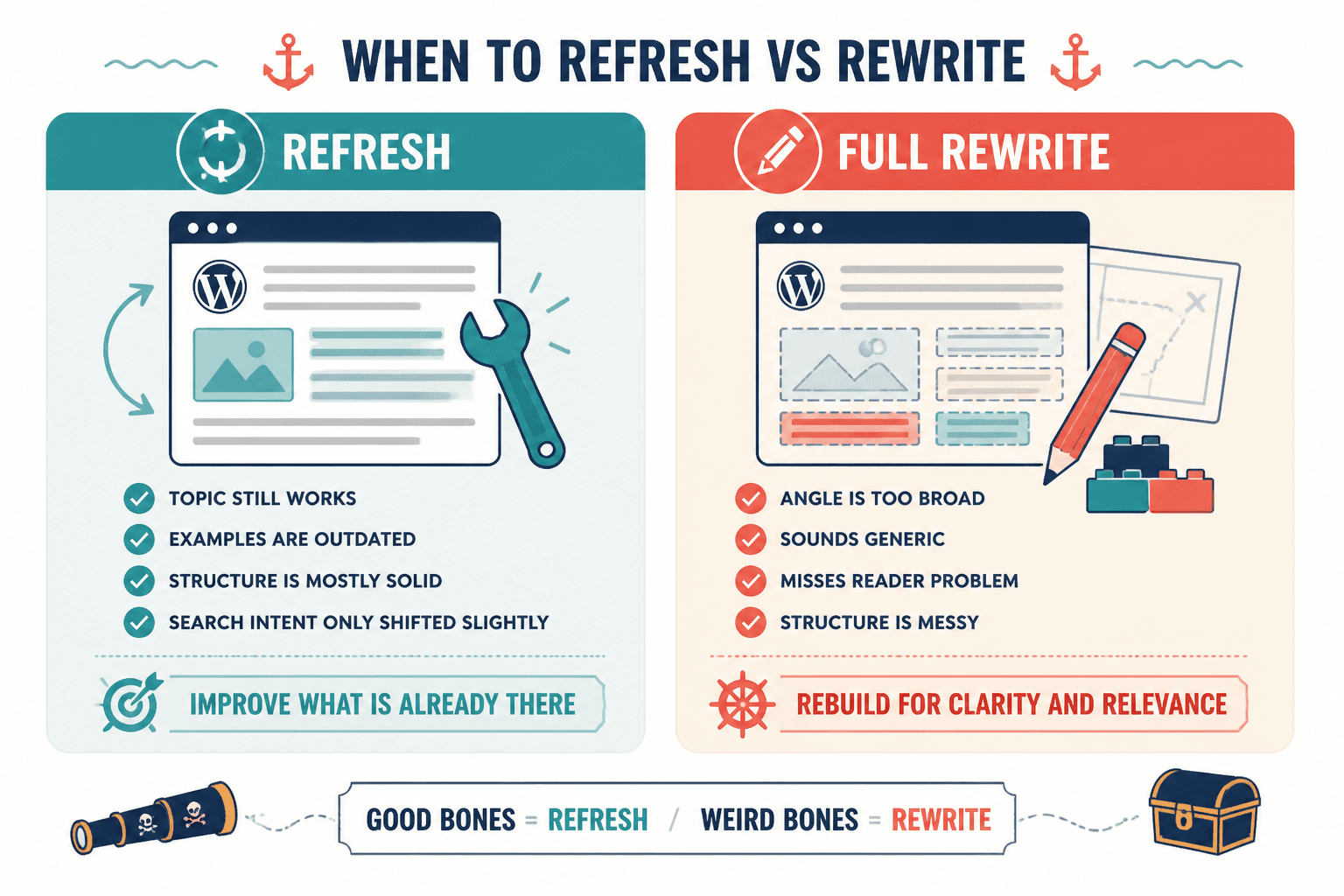
How to tell if a post needs a refresh or a full rewrite
Use this quick gut-check before you start editing.
| Problem | Better move |
|---|---|
| Topic is still relevant, but examples and references are dated | Refresh |
| Search intent has shifted a bit, but the post can adapt | Refresh |
| The intro is weak, but the middle is strong | Refresh |
| The article is broad, fluffy, and not targeted enough | Rewrite |
| The piece does not match what your audience actually wants | Rewrite |
| The content has traffic but poor conversions | Usually refresh first |
| The content has the right keyword but terrible usefulness | Rewrite |
| The article sounds nothing like your current brand or offer | Rewrite |
If you are a coach, consultant, or personal brand, there is one more filter worth using: does this article still reflect how you sell and serve now? If not, updating a few lines is not enough. A lot of older blog content quietly undermines trust because it reflects a version of your positioning you have already outgrown.
What makes a rewritten blog post better, not just newer
Plenty of people “update” content by changing the date, swapping a sentence, and calling it strategy. That is not a rewrite. That is admin cosplay.
A stronger post usually improves on five things:
- Clarity: the article says one thing clearly instead of seven things vaguely
- Specificity: it uses sharper examples, stronger language, and clearer takeaways
- Structure: it is easier to scan, follow, and remember
- Relevance: it matches current reader problems and intent
- Conversion: it points naturally to the next step without getting weirdly salesy
That is the standard. Not “is this technically updated.” Not “did we add a few keywords.” Better means more useful, more aligned, and easier to act on.
Blog rewrite and refresh examples for coaches, consultants, and personal brands
Here is where this gets practical. These examples show the kinds of changes that actually improve performance, trust, and readability.
Example 1: Career coach blog post with a vague intro
Original title: How to Build Confidence in Your Career
Original opening: Confidence is an important part of career success. Many professionals struggle with confidence in different ways. In this article, we will discuss some tips to help you become more confident in your career journey.
Nothing technically wrong there. Also nothing memorable, specific, or useful. It opens like it was approved by a committee that hates sentences.
Refreshed version: If you keep telling yourself you need “more confidence” before applying, pitching, speaking up, or raising your rates, that may not be a confidence problem. It may be a clarity problem. Most professionals are not lacking courage. They are lacking evidence, positioning, and practice. Start there.
Why it is better:
- Names the actual reader tension
- Challenges a lazy assumption
- Creates momentum fast
- Sets up a sharper argument
This kind of refresh works when the core topic is still fine, but the article opens with fog. Often, rewriting the first 150 words changes the entire quality of the piece because it finally earns attention instead of requesting it politely.
Example 2: Consultant article that is too broad to rank or convert
Original title: Marketing Tips for Small Businesses
Problem: too broad, too competitive, too generic, and not aligned with the consultant’s actual offer.
Rewrite direction: change the angle to match expertise and buyer intent.
Rewritten title: 7 B2B Content Marketing Fixes for Service Businesses With Traffic but No Leads
Why it is better:
- Narrower audience
- Clearer problem
- Closer to commercial intent
- Much easier to support with proof and examples
This is a full rewrite, not a refresh, because the original topic is doing too much and saying too little. Coaches and consultants do this all the time. They publish broad “awareness” content that attracts vague traffic and then wonder why none of it becomes leads. Usually the issue is not effort. It is targeting.
Example 3: Personal brand article with weak examples
Original advice section: Be consistent with your content, know your audience, and provide value.
That sounds fine until you realize it could appear in 400,000 other posts and help exactly no one do anything better.
Rewritten advice section:
- Be consistent with a format, not just a frequency. Posting three times a week is not useful if each post sounds like a different person wrote it. Pick two or three repeatable post types your audience actually responds to.
- Know what your audience is trying to solve this month, not in theory. “My audience wants growth” is lazy. “They need better discovery calls and less content guesswork” is usable.
- Provide value with proof. Instead of saying “storytelling matters,” show a before-and-after post rewrite or explain why one CTA got ignored and another got replies.
Why it is better: the vague advice becomes applied advice. That is the whole game.
Example 4: Old SEO blog post that still gets traffic but no leads
Original issue: the article ranks, but it ends with a generic line like “hope this helped.” Beautiful. Very generous. Very useless.
Weak CTA: If you need help with your content, contact me.
Improved CTA: If your blog is pulling traffic but not turning readers into inquiries, the problem may be the article structure, not just the topic. Start with a rewrite checklist, then tighten your intro, proof, and next step. You can also read these rewrite checklists and examples creators can adapt fast if you want a cleaner process.
That is still soft. It is still helpful. But now it moves the reader forward instead of just waving goodbye from the porch.
Example 5: Leadership coach post with outdated framing
Original angle: Why You Need a Personal Brand in 2021
Refresh problem: the timing language is stale, the examples are dated, and the phrase “you need a personal brand” has been said so many times it has basically dissolved into wallpaper.
Refreshed angle: What Executive Visibility Actually Looks Like When You Do Not Want to Become a Content Machine
What changed:
- Swapped a generic topic for a sharper audience tension
- Updated the language to fit current resistance
- Created room for practical advice, not recycled preaching
That kind of repositioning matters because your audience may still care about the broad topic, but they no longer search for or respond to it in the same way. Refreshing content is often less about changing facts and more about changing framing.

A simple rewrite process you can actually use
If you are staring at a pile of old content and feeling mildly attacked by all of it, use this process.
1. Find the actual point of the article
Before editing anything, answer this in one sentence: what should the reader understand or do after reading this?
If you cannot answer that quickly, the article is probably too broad. That is usually your first clue that a rewrite is needed.
2. Check if the post matches current search and business intent
A lot of old posts are misaligned in one of two ways:
- They attract the wrong reader
- They attract the right reader but do not lead anywhere sensible
If the article gets attention from people who will never buy, refer, subscribe, or trust you, that content may need a sharper angle. Not every post has to sell, but it should at least support the rest of your content system.
If you need a broader framework for this, the main blog rewrites and refreshes hub is a useful next step.
3. Rewrite the intro before you touch the middle
Do not spend 40 minutes polishing section six when the opening is still half asleep.
A stronger intro usually does at least two of these:
- Calls out a common mistake
- Names the real problem behind the surface problem
- Challenges a bad assumption
- Promises a practical outcome
If the intro does not create tension or relevance, the rest has to work too hard.
4. Replace vague claims with specifics
Look for lines like:
- be authentic
- provide value
- build trust
- stay consistent
- know your audience
Then force them to become real.
For example:
- Weak: Build trust with your readers
- Better: Add one proof point per major claim so the article does not sound like opinion dressed as strategy
Specificity is one of the fastest ways to make a blog post sound more human and more credible.
5. Add examples that fit your kind of buyer
If you are writing for coaches, consultants, and personal brands, your examples should sound like their world.
- Discovery calls
- Service pages
- Newsletter funnels
- Thought leadership posts
- Offer positioning
- Client trust
- Lead quality
Generic examples flatten authority. Relevant examples create it.
6. Tighten structure and scan flow
Good articles are not just informative. They are easy to move through.
- Break giant paragraphs
- Use stronger H2s
- Add bullet lists where they genuinely help
- Cut repeated ideas
- Move from problem to process to examples to next step
This is where refreshes often produce quick wins. Better formatting does not fix bad thinking, but it absolutely helps solid thinking land better.
7. Improve the next step
Every useful article should help the reader do something next.
- Read a related guide
- Use a checklist
- Review their own article
- Join a newsletter
- Book a consultation
The CTA should feel like a natural continuation, not an ambush. If someone just read 1,800 words about improving content and your next move is “book a high-ticket strategy call now,” calm down.
Common blog sections that usually need rewriting first
If you want the biggest improvement with the least wasted effort, start here.
The title
If the title is broad and bland, the whole post starts uphill.
- Weak: Content Marketing Tips
- Better: 9 Content Marketing Fixes for Experts Whose Posts Get Attention but No Leads
The first paragraph
Most weak intros are trying too hard to sound proper and not hard enough to be useful.
The subheads
Subheads should create momentum, not just label obvious categories. “Benefits of Blogging” is fine. “Why Your Blog Can Get Traffic and Still Fail to Build Trust” is better.
The examples
If your examples could fit any niche, they are too generic.
The CTA
A weak CTA either asks for too much too early or says nothing at all. Both are common. Neither helps.
Refresh ideas that do not require rewriting the whole post
Not every update needs a dramatic overhaul. Here are refresh moves that often improve performance fast.
- Add a sharper opening that frames the reader problem better
- Update examples so they reflect current platform or buyer behavior
- Insert internal links to related guides and category pages
- Replace vague subheads with more specific ones
- Add a short checklist near the end
- Improve the CTA so it leads somewhere useful
- Cut repeated sentences and obvious filler
- Add one table if comparison would help
- Include proof, mini case examples, or before-and-after rewrites
For example, if you are building out a rewrite library, you might point readers to the broader blog SEO writing category, the guide for creators who want better results, or a more focused piece on better search refreshes for personal brands.
What coaches, consultants, and personal brands often get wrong with blog rewrites
This part is worth saying plainly.
- They rewrite for keywords but not readers. The article may rank a bit better and still do nothing for trust.
- They keep the original angle out of guilt. If the framing is weak, let it go.
- They remove personality in the name of professionalism. Now the article sounds polished and dead.
- They add fluff to seem comprehensive. Long is not the same as useful. You know this. Your readers know this.
- They forget the business model. A consultant article should not sound like it was written for ad-driven lifestyle traffic.
The best rewrites feel more aligned, not just more optimized. They sound like your current expertise, your actual audience, and your real offer finally got in the same room.
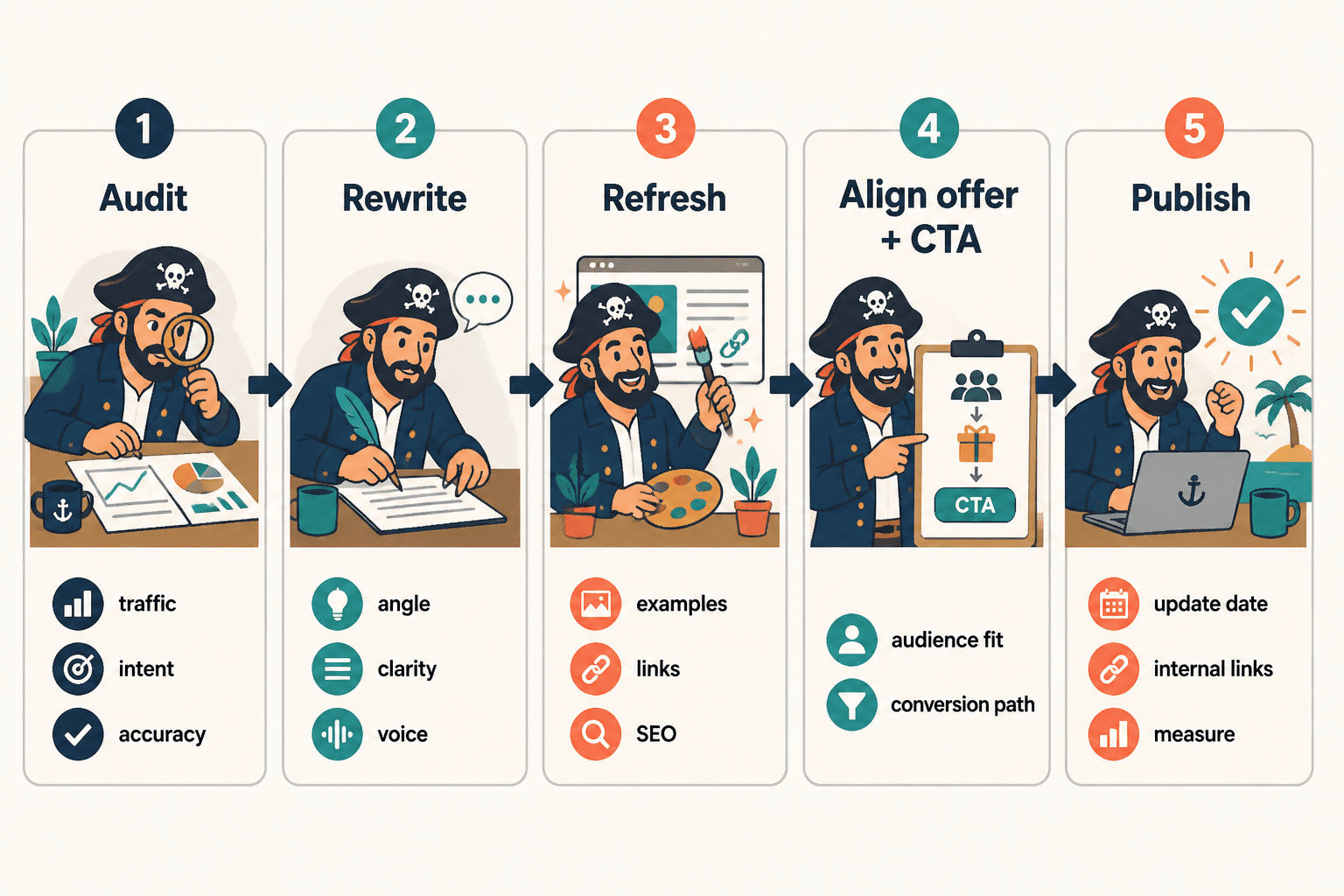
A practical blog rewrite checklist
Use this before republishing anything.
The bigger point is simple: clearer structure and clearer writing make the piece more useful. That is usually what makes the ending land better too.
Better rewrites and refreshes make the article clearer, more current, and easier to act on. A sharper update usually beats a bigger but messier rewrite.