
Most X story threads do not fail because the writer is bad at storytelling. They fail because the writer starts typing without a shape.
You get a decent idea, open a thread, write a strong first post, and then somewhere around post four the whole thing turns into a tired mini-blog with no momentum. The point gets blurry. The pacing dies. By the end, your “story thread” is just a pile of observations wearing a hook.
That is why simple X story thread templates for busy creators are useful. Not because templates make you magical, but because they stop you from rambling in public. They give your thread a spine.
This article will help you write story threads faster, keep them tighter, and make them more readable without sounding like a motivational vending machine. You will get practical thread structures, examples, and a few rules for not turning every story into a long, needy mess.
If you want broader thread strategy too, start with the X threads hub or the more complete X threads guide for creators who want better results.
Want the broader roadmap? Start with the parent guide.
Why story threads work on X when they are done well
X rewards clarity, compression, and momentum. A good story thread gives all three.
It pulls people forward because each post creates a small reason to keep going. Not fake suspense. Just enough tension, specificity, or movement that the next post feels worth reading.
Story threads also do something regular opinion posts often cannot. They let you show how you think, what you noticed, what changed, and why the lesson matters. That makes them useful for creators, consultants, coaches, and solo operators who want trust, not just impressions.
But there is a catch. On X, the story has to move. Fast. If your thread needs a nap halfway through, people are gone.
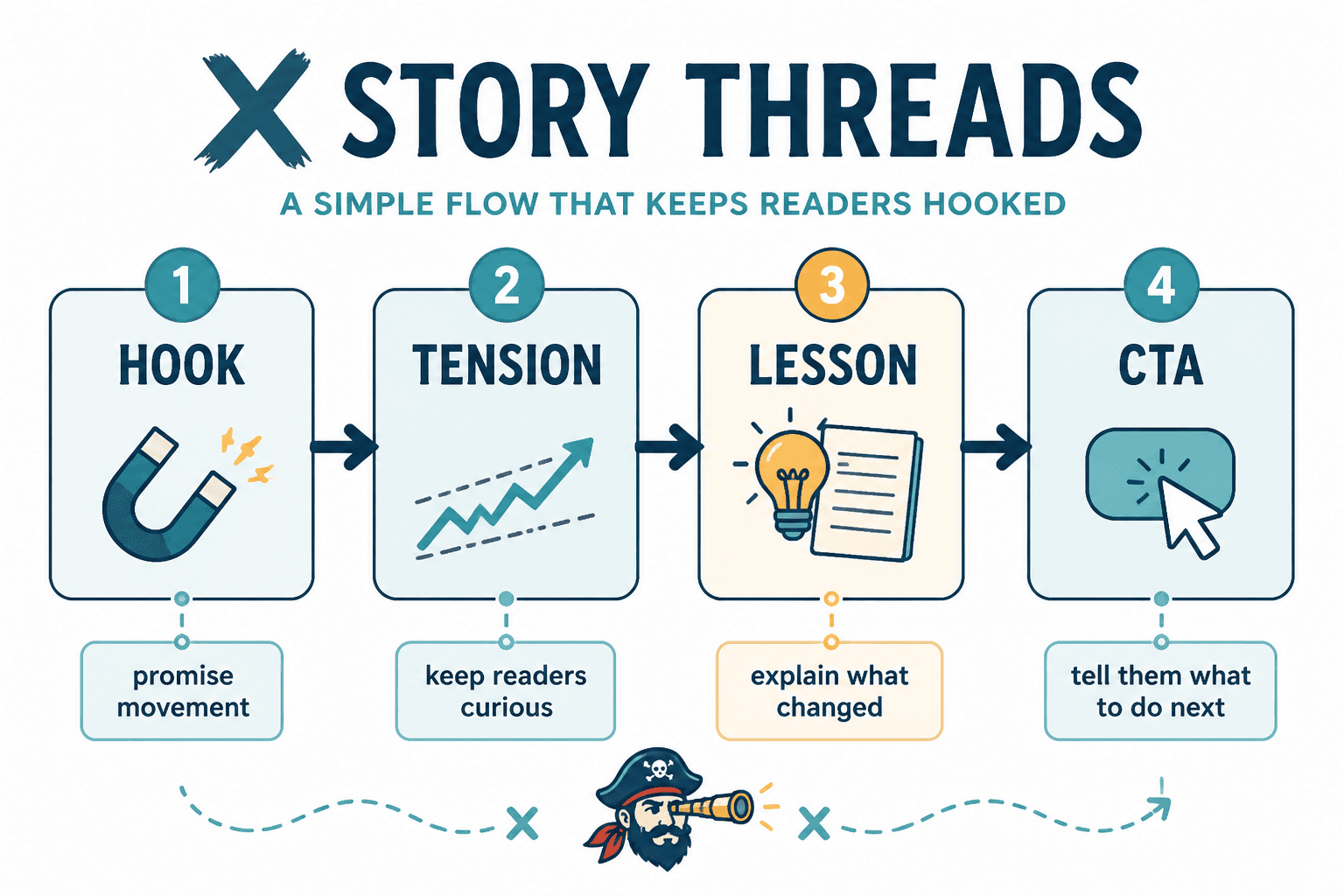
What makes a simple X story thread actually work
Before the templates, here are the basics. These are the parts that keep a story thread from becoming a wandering self-reflection exercise.
1. Start with a hook that promises movement
The first post should suggest something happened, changed, failed, worked, or got figured out.
Weak:
I want to share a story about my business journey.
Better:
I spent 6 months posting consistently and getting almost nothing from X.
Then I changed 3 things.
Here is what actually moved the needle.
The second version has tension and direction. The first one just asks for patience. People do not have much of that.
2. Give each post one job
One post sets context. One adds friction. One shows the mistake. One gives the shift. One delivers the takeaway. Do not cram five beats into one post and then stretch one weak insight across six more.
3. Keep the story about the reader often enough
Your story is the vehicle. It is not the product.
Readers are not asking, “What was your emotional growth arc on Tuesday?” They are asking, “Is there something in this for me?” So bring the lesson forward as you go. Do not hide it until the end like a dramatic reveal nobody requested.
4. End cleanly
A thread ending should do one of three things:
- land the lesson
- point to a practical next step
- invite the right kind of response
What it should not do is suddenly become a hard pitch that feels stapled on in a panic.
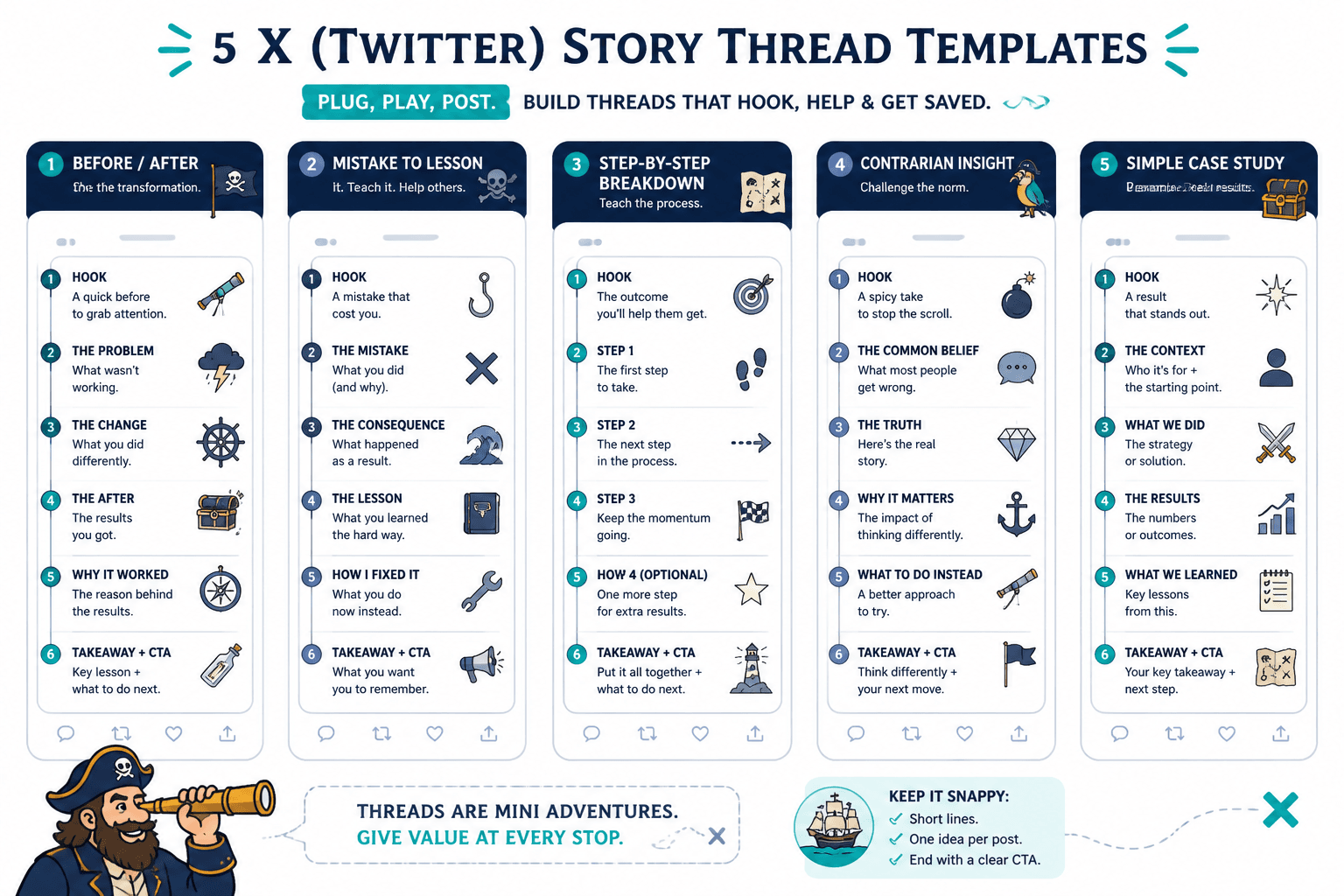
5 simple X story thread templates for busy creators
These templates are built for speed. You can write them quickly, adapt them across topics, and still sound like a person with a brain instead of a thread generator with caffeine issues.
Template 1: The mistake to lesson thread
Best for: creators sharing a specific error, failed approach, bad assumption, or wasted effort.
Structure:
- Hook: name the mistake or bad result
- Context: what you were trying to do
- What you assumed
- What actually happened
- What you changed
- The lesson
- Optional CTA
Template:
I kept [doing X] because I thought it would [result].
It did not.
Here is what I got wrong:
1) …
2) …
3) …What changed things was [better approach].
The real lesson: [clear takeaway].
If you are stuck with [problem], start there.
Filled example:
I kept writing “valuable” X posts that got polite silence.
I thought being useful was enough.
It was not.
Here is what I got wrong:
1) My hooks were soft
2) My posts had no tension
3) I was teaching before I earned attentionWhat changed things was packaging the lesson around a sharper problem.
The real lesson: usefulness matters, but packaging decides if anybody sees it.
Template 2: The small win with a bigger lesson thread
Best for: showing progress without sounding like a self-congratulatory mascot.
This works especially well for creators with smaller audiences. If that is you, also read X threads for creators with small audiences.
Structure:
- Hook: small but meaningful result
- Why it mattered
- What led to it
- What most people get wrong
- The repeatable lesson
- Simple CTA
Template:
[Result] is not huge, but it told me something useful.
It happened after I stopped [common bad approach] and started [better approach].
Most people focus on [wrong thing].
What helped instead:
1) …
2) …
3) …If you are trying to get [outcome], pay attention to that first.
Filled example:
One thread brought me only 12 email subscribers.
That is not a victory parade.
But it told me something useful.
It happened after I stopped writing broad advice threads and wrote one specific story about fixing a bad client onboarding process.
Most people focus on reach.
What helped instead:
1) One clear problem
2) One believable story
3) One relevant next stepSmall audience, yes. Better fit, also yes.
Template 3: The behind-the-scenes process thread
Best for: consultants, writers, designers, marketers, and service businesses showing how they do the work.
This kind of thread builds authority nicely because it shows thinking, not just conclusions.
Structure:
- Hook: result or task
- What the work looked like before
- Your process or framework
- Why each step mattered
- Final takeaway
- Optional invitation
Template:
Here is how I [did task / got result] without [common messy approach].
The starting point looked like this: [brief context].
My process was simple:
1) …
2) …
3) …Why this worked:
– …
– …
– …The point is not to copy my exact process.
The point is to stop treating [problem] like it solves itself.
Filled example:
Here is how I turn one client call into two weeks of X content without sounding recycled.
The starting point is usually messy: long transcript, scattered ideas, too much detail.
My process is simple:
1) Pull out repeated pains
2) Find one sharp opinion
3) Build 3 post angles and 1 story threadWhy this works:
– the content comes from real language
– the point is already proven
– the story has business relevanceThe point is not “repurpose everything.”
The point is to stop inventing content from thin air every morning.
Template 4: The belief shift thread
Best for: changing minds, refining positioning, or showing a more mature view on a common topic.
This one works because it carries natural contrast. Contrast is fuel on X.
Structure:
- Hook: what you used to believe
- Why you believed it
- What changed your mind
- What you believe now
- What others should do differently
Template:
I used to believe [old belief].
It sounded smart. It was also incomplete.
What changed my mind was [experience / result / pattern].
Now I think [new belief].
That matters because [practical implication].
If you are still doing [old approach], this is your sign to question it.
Filled example:
I used to believe consistency was the main reason creators grew on X.
It sounded smart. It was also incomplete.
What changed my mind was watching plenty of people post every day and remain incredibly ignorable.
Now I think consistency only helps after clarity does.
That matters because more posting will not save vague positioning.
If your content is stuck, fix the message before you increase the volume.
Template 5: The mini case study story thread
Best for: client work, your own brand experiments, launches, content tests, and process improvements.
Structure:
- Hook: result with context
- Starting problem
- What you changed
- Why it worked
- What others can copy
- Light CTA
Template:
[Result] came from a much simpler change than people think.
The problem was [starting issue].
So I changed 3 things:
1) …
2) …
3) …Why it worked:
– …
– …
– …If you want to improve [outcome], test that before you chase more complicated fixes.
If you want more angles after these, see best X threads ideas and examples for creators.
How to write these threads fast without making them bland
Busy creators do not need a more sacred writing ritual. You need a faster drafting method that still leaves room for thought.
Try this:
- Pick one story, not three vaguely related ones
- Choose the template that matches the point
- Write the hook last if needed
- Keep each post focused on one beat
- Cut anything that repeats the same lesson in softer words
- End before the thread starts explaining itself to death
That last one matters. A lot of mediocre threads are not weak because the idea is bad. They are weak because the writer did not stop when the point had already landed.
A quick drafting formula
- Write the final lesson in one sentence.
- Write the story beat that proves it.
- Write the mistake, shift, or result.
- Turn each of those into separate posts.
- Add the hook.
- Add a CTA only if it fits.
If you want help speeding this up, there are useful options in best templates and tools for X threads. Tools can help with organization and variation. They still cannot give you taste, judgment, or a decent point. Tragic, really.
The bigger point is simple: clearer structure and clearer writing make the piece more useful. That is usually what makes the ending land better too.