
Most X threads do not fail because the writer “needs better content.” They fail because the structure is mush.
You get a decent hook, then a pile of repeated points, a few vague claims, one random example, and a sales pitch wearing a fake mustache at the end. The thread looked useful from the outside. Then people clicked in and found 14 posts saying almost the same thing.
If you want to know how to improve X thread structure without sounding generic, the fix is not making the thread longer, smarter, or more “valuable.” It is giving the idea shape. A good thread moves. It earns attention step by step. It gives each post a job. And it sounds like a person with an actual point, not a template trying to cosplay authority.
Here’s how to structure X threads so they feel sharper, more readable, and much less like recycled content wallpaper.
If you want the bigger picture, start with the parent guide.
What generic X threads usually get wrong
Generic threads usually have one of three problems.
- No real progression: each post is just another version of the same point.
- No tension: the thread says useful-sounding things, but nothing pulls the reader forward.
- No distinct angle: it could have been written by anyone who has spent 12 minutes on content Twitter.
This is why some threads get likes but not much trust, traffic, or memory. They are not offensive. They are just frictionless in the worst way. Smooth, forgettable, and full of polished nothing.
X is a fast platform. Threads still need structure, but they also need compression. That means every post should either set up the next point, deepen the argument, add proof, or move the reader toward a payoff. If it is only there because “threads are supposed to be long,” cut it.
If you want more help on the platform itself, this broader X/Twitter writing guidance and this collection on X threads are worth keeping open in another tab.
The job of thread structure is simple
A strong X thread should do four things:
- Hook the right reader quickly
- Create momentum from one post to the next
- Deliver a clear payoff, not just fragments
- End with a next step that does not feel stapled on
That is it. You do not need 27 psychological tricks. You need a sequence that makes sense.
Think less like “I need to write a thread” and more like “I need to guide someone through an idea without wasting their time.” That small mental shift cleans up a lot of mess.
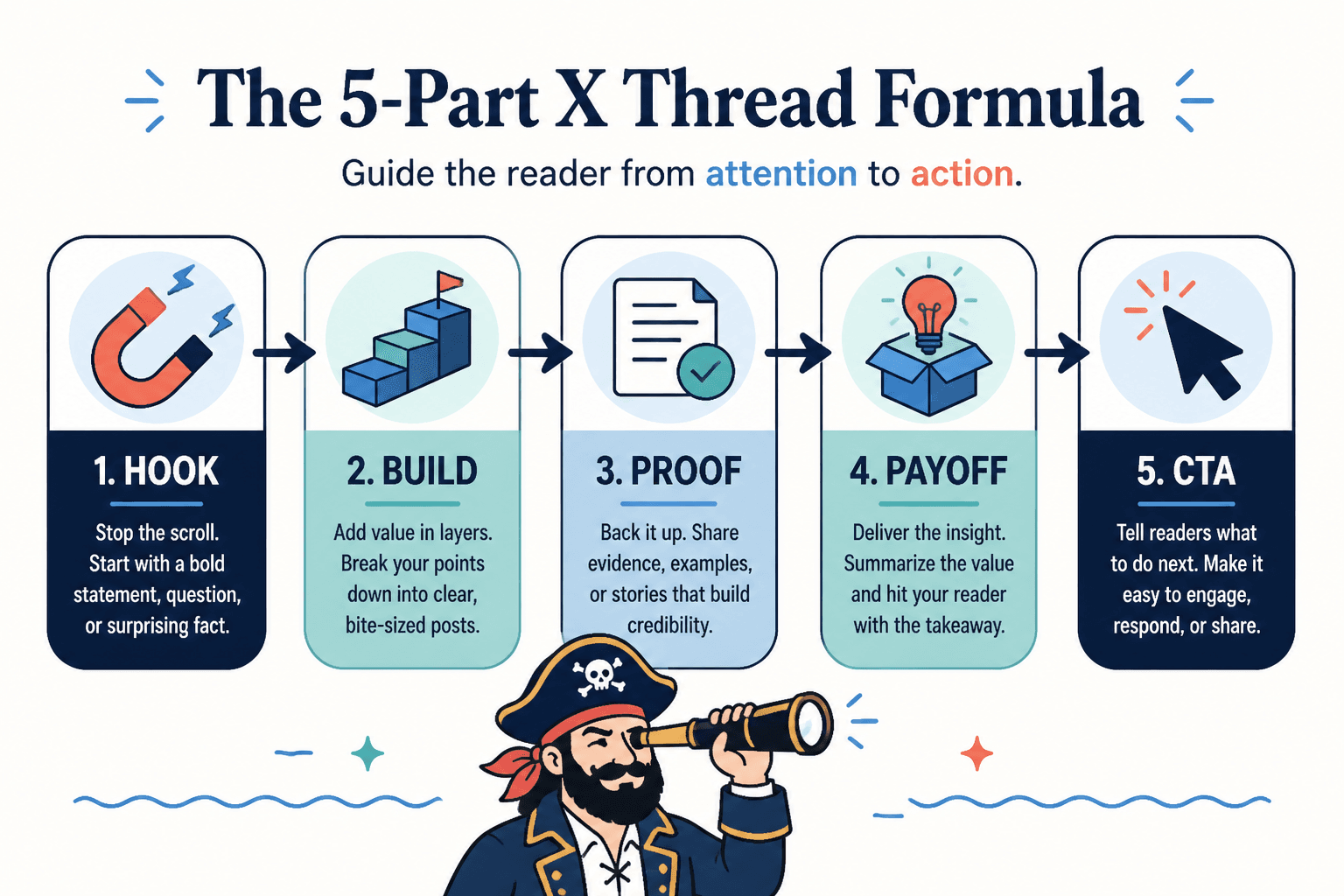
A better structure for X threads that do not sound generic
You do not need one rigid formula, but most good threads follow a version of this sequence:
- Hook: make a specific promise, claim, or tension point
- Context: show why the point matters
- Framework or sequence: deliver the main idea in logical order
- Proof: examples, contrast, mini case, or explanation
- Payoff: make the lesson usable
- CTA: invite the next step without turning weirdly needy
That structure works because it mirrors how people process ideas on X. First they decide if the topic matters. Then they want a reason to keep reading. Then they want something they can use, remember, or repeat.
1. Start with a hook that promises a shape, not just a topic
Bad thread hooks announce a subject. Better hooks imply a path.
Weak: “How to write better X threads:”
Stronger: “Most X threads lose people in post 3. Here’s how to structure yours so each post actually pulls to the next.”
The stronger version tells the reader what is broken and what they are about to get. There is a problem. There is a fix. There is movement.
If your opening still feels limp, this piece on how to start X threads without a weak opening will help.
2. Use the second and third posts to lock in attention
Too many writers waste the second post repeating the hook in slightly different words, which is a lovely way to lose momentum immediately.
Instead, use the next one or two posts to do one of these things:
- explain the common mistake
- raise the stakes
- define the lens of the thread
- show the cost of getting it wrong
Example:
1. Most X threads lose people in post 3. Here’s how to structure yours so each post actually pulls to the next.
2. The problem usually isn’t the idea. It’s that the thread turns into a list instead of an argument.
3. If each post could be deleted without changing the thread, the structure is weak.
Now the reader knows what to look for. You have created a frame. That matters.
3. Give each post one clear job
This is where most thread quality is won or lost.
If one post is trying to explain, persuade, summarize, and pitch at the same time, it will sound blurry. Each post should do one thing well.
Useful jobs for individual posts include:
- state the mistake
- introduce a principle
- show an example
- add contrast
- handle an objection
- transition to the next section
- land the takeaway
This sounds basic, but it is the difference between a thread that feels tight and one that feels like someone dumped notes into a scheduler and hoped for the best.
4. Build in logical order, not “creator order”
Creator order is when you write ideas in the order they occurred to you. Logical order is when you arrange them in the order the reader needs them.
Those are not the same thing.
For example, if you are teaching thread structure, do not jump from “write better hooks” to “use examples” to “be authentic” to “end with a CTA.” That is not a sequence. That is a content junk drawer.
A better order would be:
- what the hook must do
- how the next posts create momentum
- how the body should progress
- where proof goes
- how to end cleanly
The reader should feel guided, not pelted.
How to make an X thread sound less generic
Structure helps readability. Specificity helps voice.
If your thread structure is decent but the thread still sounds like everyone else, the issue is usually one of these:
- your points are too broad
- your examples are too abstract
- your phrasing is built from content clichés
- your thread has no clear opinion hiding inside it
Use specifics where generic writers use categories
Generic: “Provide value in every post.”
Better: “In each post, either sharpen the point, show proof, or move the reader to the next step. If a post does none of those, it is filler.”
The first one sounds nice. The second one is usable.
Use contrast to make the point bite harder
Contrast is one of the easiest ways to make a thread feel sharper.
Generic: “A good thread should keep people engaged.”
Stronger: “A good thread does not just stack tips. It creates a reason to read the next post.”
That little turn gives the sentence shape. It also makes you sound like you have seen bad threads in the wild, which, frankly, we all have.
Say what people do wrong
Generic content often tries so hard to be broadly helpful that it stops saying anything clear. One easy fix is naming the bad habit directly.
For example:
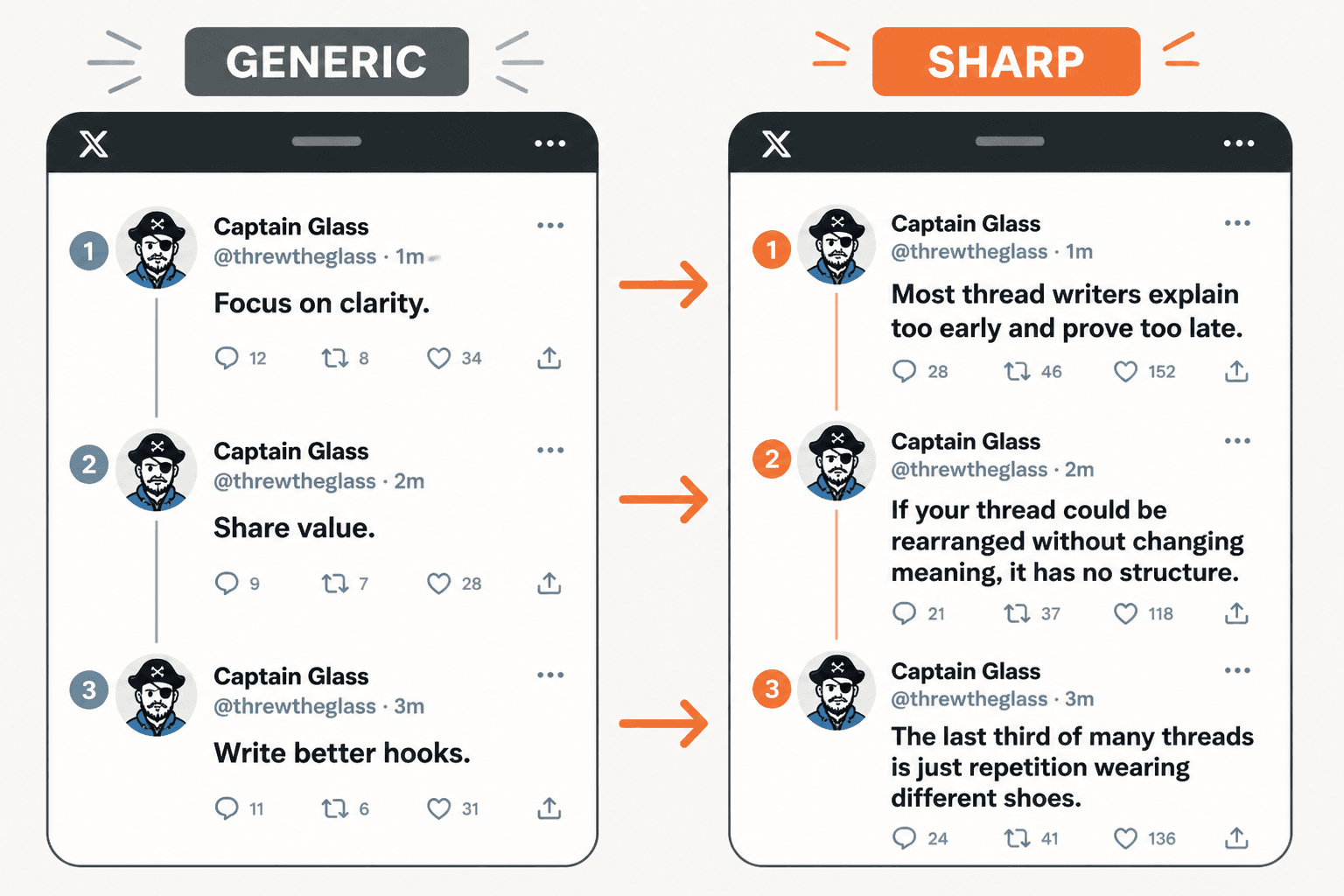
- “Most thread writers explain too early and prove too late.”
- “If your thread could be rearranged without changing meaning, it probably has no real structure.”
- “The last third of many threads is just repetition wearing different shoes.”
That is more memorable than “focus on clarity.”
A simple thread structure template you can actually use
Here is a clean template for educational or authority-building X threads:
- Hook: name the mistake or promise the result
- Problem: explain what usually goes wrong
- Frame: introduce the main principle
- Point 1: first step or core idea
- Point 2: second step that builds on it
- Point 3: proof, example, or contrast
- Point 4: refinement, warning, or nuance
- Payoff: summarize the practical takeaway
- CTA: suggest the next step
That is enough for many threads. You do not need 21 posts unless the idea genuinely needs 21 posts. A thread should feel complete, not inflated.
Filled-in example
1. Most X threads sound generic because they are lists pretending to be arguments. Here’s a better structure.
2. The usual problem: decent hook, then a pile of repeated points with no momentum.
3. A strong thread should move through an idea, not circle it politely.
4. Start with a hook that makes a specific promise.
5. Use the next 1–2 posts to frame the problem and lock attention.
6. Give each post one job: explain, prove, contrast, or transition.
7. Add proof before the end. Otherwise the thread sounds clean but unconvincing.
8. End with a takeaway people can use immediately.
9. CTA: If your threads get polite likes but no real traction, fix the structure before you write more.
Notice what this example does not do. It does not pad. It does not repeat itself for applause. It moves.
Before and after: fixing a weak thread structure
Before
1. How to write better X threads:
2. Be clear.
3. Be concise.
4. Add value.
5. Use a hook.
6. Tell stories.
7. Stay consistent.
8. Have a CTA.
Technically not wrong. Also technically sleep-inducing.
The problem here is not only that the advice is generic. It is that there is no sequence. Nothing builds. Nothing sharpens. It reads like notes from a free webinar that forgot to become a thought.
After
1. Most X threads do not fail in the hook. They fail because the middle collapses into repeated advice.
2. If every post sounds like “also this matters,” the reader has no reason to keep going.
3. Better structure starts by giving each post a job.
4. Post 1: make a promise or name a mistake.
5. Posts 2–3: explain the problem so the reader is locked in.
6. Middle posts: move in order. Teach, then prove, then refine.
7. Final posts: land the takeaway before the CTA.
8. If the CTA arrives before the payoff, it feels needy.
9. Good threads feel guided. Bad ones feel stacked.
Same topic. Much better shape.
What to cut if your thread feels bloated
One reason X threads sound generic is that they are overexplained. You do not need to squeeze every possible nuance into one thread. You need enough clarity to make the idea useful.
Cut these first:
The bigger point is simple: clearer structure and clearer writing make the piece more useful. That is usually what makes the ending land better too.