
Most X threads do not flop because the writer picked the wrong topic. They flop because the first post gives people no reason to care.
A weak hook makes the thread feel longer before it even starts. It sounds vague, recycled, overhyped, or suspiciously like 900 other “valuable” threads posted that same week. People scroll. Fair enough.
X Thread Hook Examples Creators Can Adapt Fast is really about one thing: getting your first post to earn the next click, the next line, and the next bit of attention. Not with fake drama. Not with “you won’t believe.” Not with borrowed guru fumes. Just with clear tension, useful specificity, and a reason to keep reading.
If you write threads to grow an audience, build trust, or point people toward your work, your hook does a lot of heavy lifting. Here’s how to make it do that job properly.
Want the broader roadmap? Start with the parent guide.
What a good X thread hook actually needs to do
A thread hook is not just the first sentence. It is the opening promise of the whole thread. It tells the reader what kind of payoff is coming and why they should spend time on you instead of the next post.
Good thread hooks usually do at least two of these things:
- Make a clear promise
- Create tension or contrast
- Signal a useful outcome
- Show specificity
- Sound like a real person, not a content vending machine
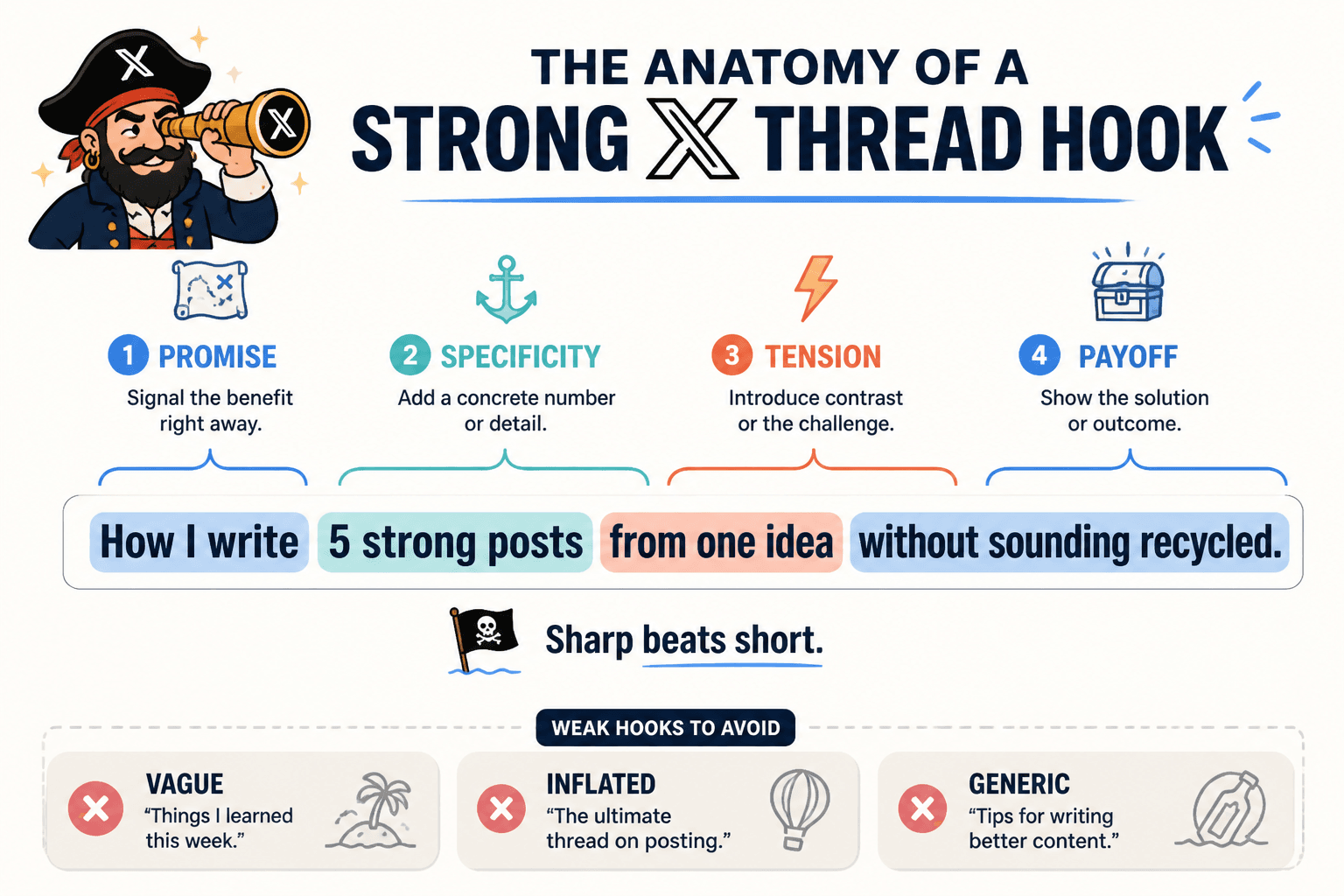
Bad hooks usually fail in one of three ways:
- They are too vague: “A few thoughts on content creation…”
- They are too inflated: “The ultimate thread that will change how you think forever”
- They are too generic: “10 lessons from my journey”
The fix is not always making the hook shorter. It is making it sharper. Short and empty is still empty.
The fastest way to improve your thread hooks
If your hooks are bland, do not start by trying to sound more clever. Start by answering four boring but extremely useful questions:
- What is the actual point of this thread?
- Who is it for?
- What will they get by reading it?
- Why should they believe this is worth their time?
That gives you the raw material. Then you package it.
A strong hook usually combines a topic with a payoff and a bit of tension. For example, “How I write faster” is thin. “How I write 5 strong posts from one idea without sounding recycled” has a point, a promise, and a hint of the problem it solves.
This matters even more on X because the platform rewards compression. You do not have much room to warm up. The hook has to do its job quickly, and yes, that means some of your favorite scene-setting lines need to be taken out back.
7 hook types that work well for creator threads
You do not need 57 formulas. You need a handful of patterns you can adapt without sounding cloned. Here are the ones worth keeping.
1. The clear promise hook
This is the simplest and often the most effective. It works when the payoff is genuinely useful.
I used to overcomplicate my content workflow.
Now I use a 3-step system to turn one idea into a post, thread, and email.
Here’s the process.
Why it works: the benefit is clear, the topic is specific enough, and the structure feels easy to follow.
2. The mistake hook
This works well when your audience keeps doing something badly and needs a better approach.
Most creators do not have a consistency problem.
They have an idea packaging problem.
Here’s how to fix that before you blame discipline again.
Why it works: it challenges an assumption and creates an “oh, that might be me” moment.
3. The contrast hook
Contrast creates tension fast. Old way vs better way. Popular advice vs what actually works. Busy and useful.
You do not need more content ideas.
You need better angles for the ideas you already have.
Here are 9 angle shifts I use constantly.
Why it works: it reframes the problem and promises a more efficient solution.
4. The proof-led hook
If you have results, experience, or repeated observation, lead with that. Just do not make it insufferable.
I have rewritten enough weak hooks to notice the same 5 problems coming up again and again.
Here they are, plus stronger replacements you can steal.
Why it works: it signals credibility without needing a chest-thumping intro.
5. The opinion hook
X still rewards sharp opinions when they are backed by something useful. Empty hot takes are cheap. Informed opinions travel further.
“Just be consistent” is lazy advice for creators.
If your content framing is weak, consistency mostly means repeating something people already ignored.
Here is a better standard.
Why it works: it has energy, but the promise of a better alternative keeps it from becoming rant sludge.
6. The quick-system hook
People love useful process, especially when it sounds practical instead of theatrical.
My best thread writing system is not fancy.
It is 4 checkpoints:
hook, sequence, proof, payoff.
Here is how I use each one.
Why it works: the framework feels immediately usable.
7. The curiosity-with-boundaries hook
Curiosity works. Cheap mystery does not. The trick is to open a loop without hiding the subject.
I changed one thing in my thread structure and people started reading further down the chain.
It was not the topic.
It was the order of the information.
Here is what changed.
Why it works: it raises a question, but still tells the reader what kind of lesson they are getting.
X thread hook examples creators can adapt fast
Below are adaptable hook examples by use case. Do not copy them word for word unless you enjoy sounding weirdly familiar. Use the structure, then swap in your topic, audience, and proof.
For educational threads
- I tested a simpler way to plan weekly content.
It cut the chaos and made posting easier.
Here is the 15-minute system. - If your posts get polite silence, the problem may not be quality.
It is often positioning.
Here are 6 signs that is happening. - Most content advice focuses on volume.
I think that is backward.
Here is the framework I would fix first.
For thread tutorials
- How to write an X thread that does not feel like 14 recycled posts stapled together:
my simple structure. - I use this 5-part thread outline when I want clarity without rambling.
Steal it. - Here is the exact order I use when building a useful thread:
hook, problem, shift, examples, payoff.
For opinion-led threads
- Most “valuable” threads are overloaded and under-edited.
More points do not make a thread better.
Better points do. - I think creators overrate inspiration and underrate framing.
That is why good ideas keep landing flat.
Here is what framing changes. - Not every thread needs 20 posts.
Some of you are writing mini ebooks to explain one decent point.
Here is a better approach.
For authority-building threads
- After rewriting a lot of weak creator content, I have noticed the same hook mistakes on repeat.
Here are the 7 most common and how to fix them. - I spend a lot of time studying what makes short-form writing hold attention.
These 8 patterns show up constantly. - There is a difference between sounding smart and being easy to trust.
Here is how strong creators build both in their threads.
For story-based threads
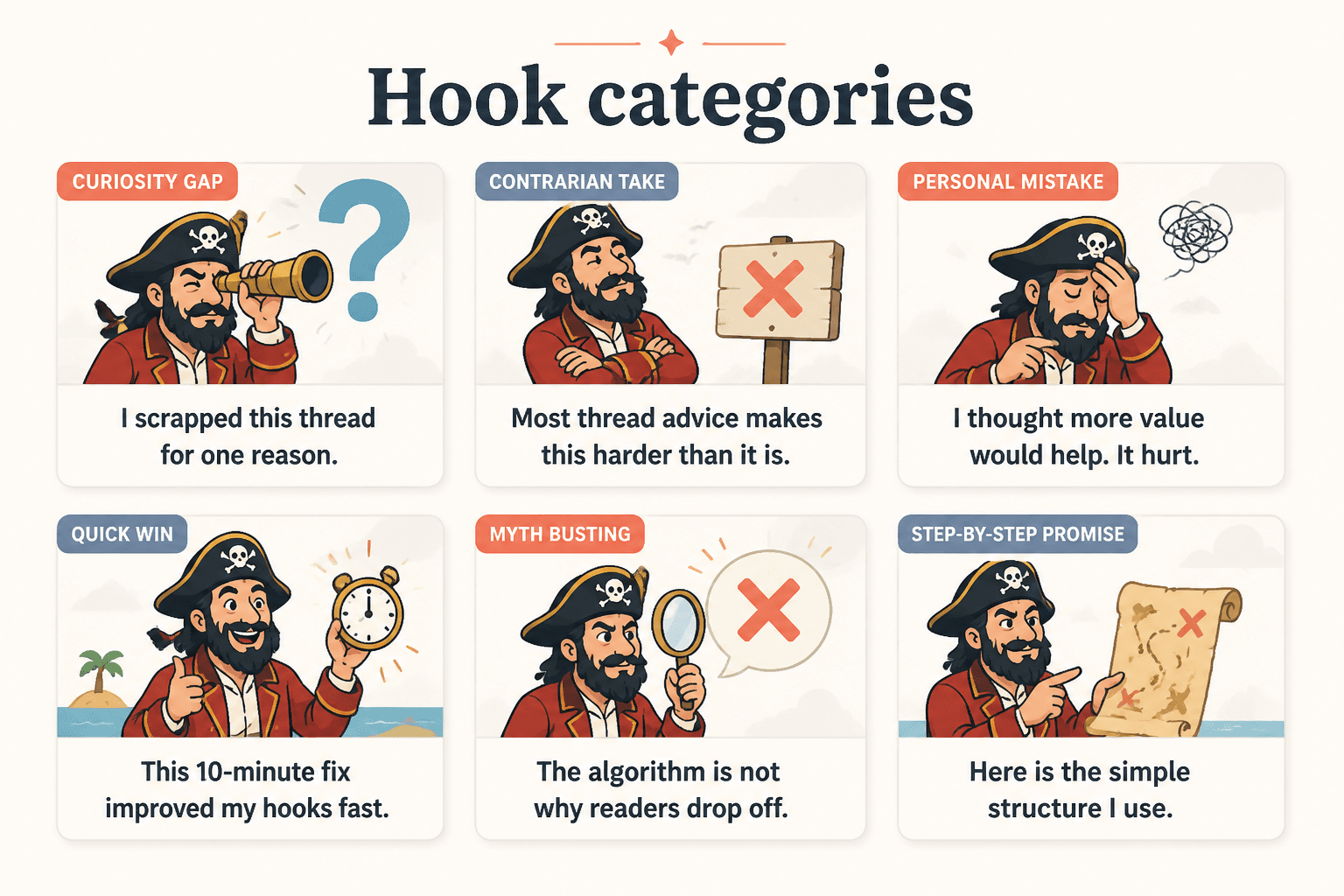
- I scrapped an entire thread draft this morning.
Not because the idea was bad.
Because the opening made the whole thing feel dead.
Here is what I changed. - A creator asked why their threads never got read past post 2.
The answer was not the algorithm.
It was structure.
Here is the fix. - I thought adding more value would make my threads stronger.
It mostly made them swollen.
Here is what trimming taught me.
For more thread angles and concepts, you can also explore best X threads ideas and examples for creators. If your threads lean more narrative, simple X threads story templates for busy creators will help you structure those without turning them into diary soup.
Weak hooks vs stronger rewrites
Sometimes the easiest way to improve your writing is to see exactly where it goes soft. Here are a few before-and-after examples.
Example 1
Weak: Here are some thoughts on writing better threads.
Stronger: Most thread advice makes writing feel more complicated than it needs to be.
Here is the simple structure I use to keep threads clear and readable.
Why it works better: it names the problem and gives the reader a practical reason to continue.
Example 2
Weak: 10 lessons I learned from content creation.
Stronger: I wasted too much time trying to make every post look “smart.”
These 10 content lessons made my writing clearer, faster, and more useful.
Why it works better: there is tension, a mistake, and a clearer payoff.
Example 3
Weak: A thread on how to grow on X.
Stronger: Growth advice on X gets vague very fast.
If you want a smaller account to grow, these 6 habits matter more than posting harder.
Why it works better: “grow on X” is broad and lifeless. This version narrows the audience and sharpens the claim.
A simple formula for writing better thread hooks
If you want one usable formula, use this:
Problem or tension + specific angle + clear payoff
For example:
- Most creators make their threads too broad.
Here is how to tighten one idea into a cleaner, stronger sequence. - Your thread does not need more tips.
It needs a better opening.
Here are 12 hook styles you can adapt fast. - If people stop reading after the first post, this is usually why:
the hook promised nothing concrete.
Here is how to fix that.
That formula is flexible enough to use across educational, opinion, story, or strategy threads. It keeps you focused on utility instead of trying to manufacture charisma in public.
How to adapt hook examples without sounding cloned
This part matters. Templates are useful, but a copied hook with your topic pasted in often sounds stiff. Readers can smell that sort of thing. Not because they are literary bloodhounds, but because generic structure without genuine point tends to feel weirdly hollow.
To adapt examples well, change more than the nouns. Change the angle. Change the tension. Change the promise so it fits what you actually know.
The bigger point is simple: clearer structure and clearer writing make the piece more useful. That is usually what makes the ending land better too.